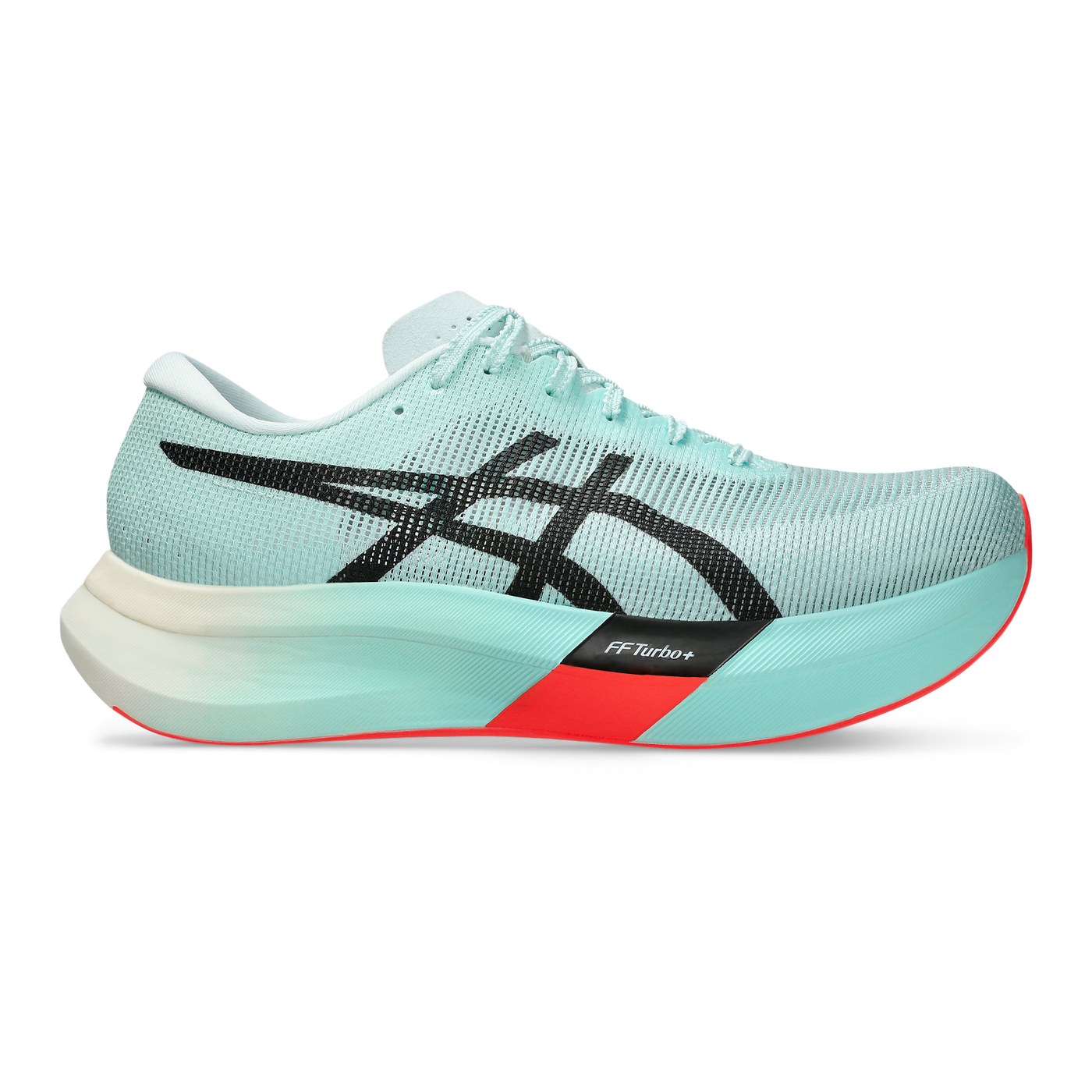
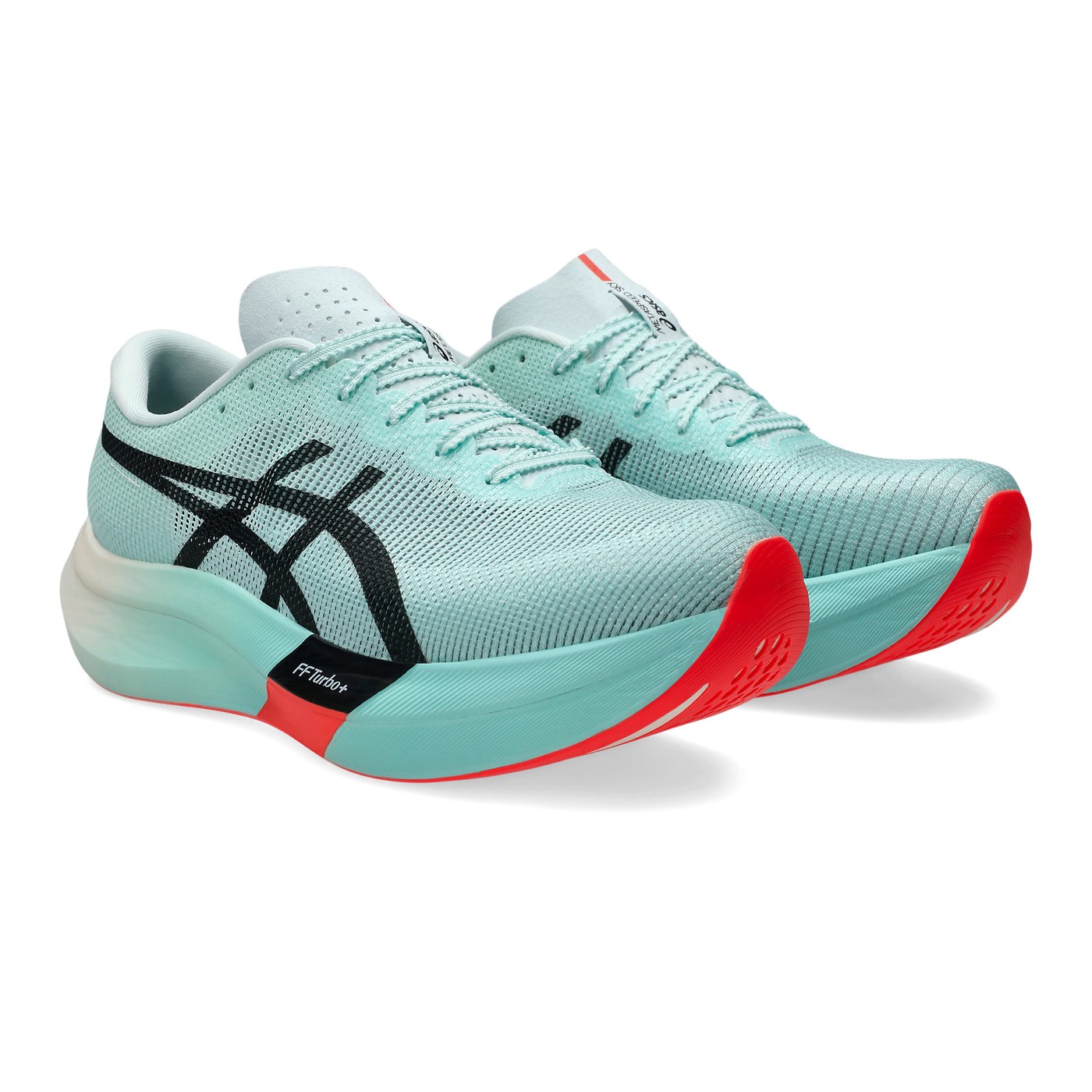
Asics Metaspeed Sky Paris review: 6.5 mm real drop vs 5 mm claimed, the unfiltered test
8.8/10
✓Measured heel energy return of 73.2%, 14.5 points above the market average
✓183 g on the lab scale, among the lightest in its class
✓Generous vertical fit volume (30.4 mm, + 3.3 mm vs average)
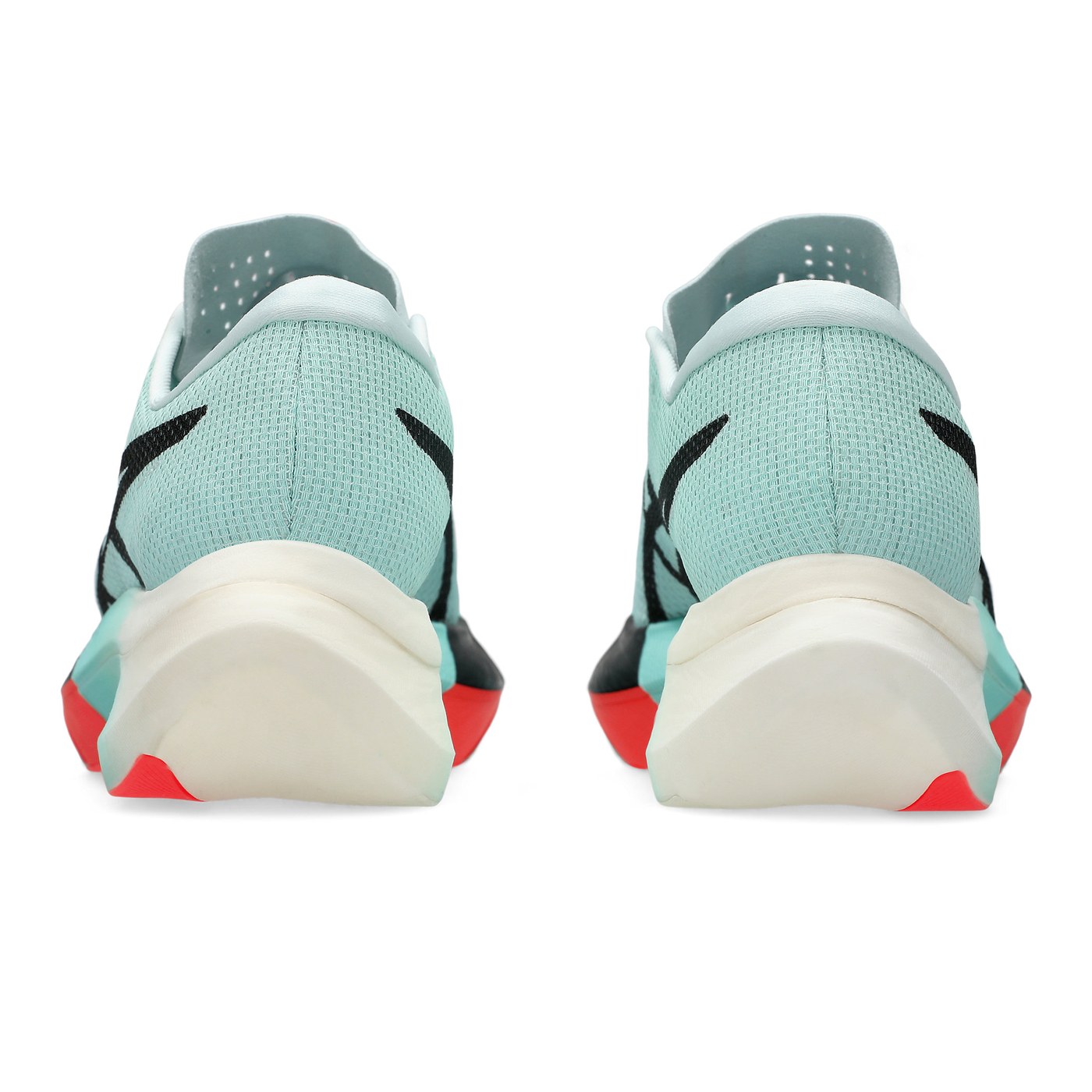
✗Heel 13.3 mm narrower than the market average, not recommended for heel strikers
Asics claims a 5 mm drop on the Metaspeed Sky Paris. Independent lab measurement puts it at 6.5 mm, 30% more than the official figure. Between the marketing sheet and the calipers, RunMorph compared both versions to tell you what has really changed on this 250 euro carbon racer.
The Metaspeed Sky Paris is a carbon-plated racing shoe built for midfoot and forefoot strikers, from 10 km to the marathon. Its measured energy return (73.2% at the heel) and 183 g weight make it one of the best-performing carbon shoes in its class, but its very narrow heel (77.8 mm against a 91.1 mm average) makes it unstable for heel strikers. Asics promises a 5 mm drop, and that claim falls apart under independent measurement, which shows 6.5 mm.
8.8
/ 10 · RunMorph overall score
Responsiveness
9.5 / 10
Cushioning
8.5 / 10
Comfort
7 / 10
Stability
4.5 / 10
Durability
7.5 / 10
Value
7 / 10
Who is it for?Midfoot and forefoot strikers chasing a time over 10 km, the half or the marathon, comfortable with a snug fit and with a 250 euro budget set aside for racing.
Who should skip it?Heel strikers, wide feet, and runners looking for a single pair to train and race in: the Sky Paris does not hold up to daily use.
Sky Paris: a late entrance for an already celebrated line
When Asics presents the Metaspeed Sky Paris as the new flagship of its carbon range, the Japanese brand is banking on the trust already earned by the Metaspeed Sky Tokyo, rated 9.3/10 by RunMorph. The marketing pitch around the Paris promises progress across the board: lighter, bouncier, more refined. The numbers tell a more nuanced story. The Sky Paris weighs 183 g in an independent lab, 13 g more than the 170 g of the Tokyo, and its RunMorph score drops to 8.8/10.
So the real question here is not whether the Sky Paris is a good shoe (it is), but whether it deserves the title of best Asics carbon shoe right now. On paper, Asics lists a 5 mm drop, the same as the previous generation. Independent lab measurement shows 6.5 mm, a 30% gap that changes how your foot rolls through at impact. That kind of gap, between what Asics claims and what the calipers measure, is what this review is built around.
Metaspeed Sky Paris specs
Feature
Value
Brand
Asics
Model
Metaspeed Sky Paris
Type
Road, carbon-plated racer, stride-oriented
Claimed drop
5 mm
Drop measured in an independent lab
6.5 mm
Heel stack claimed / measured
39.5 mm / 39.1 mm
Forefoot stack claimed / measured
34.5 mm / 32.6 mm
Weight claimed / lab-weighed (US M9)
181 g / 183 g
Foam
FF Turbo+, dual-layer supercritical PEBA
Carbon plate
Yes, full-length flat plate
Outsole
ASICSGRIP, partial coverage
Upper
Motion Wrap 2.0, single-layer mesh
Recommended distance
10 km to marathon
Retail price
250 €
RunMorph score
8.8 / 10
Metaspeed Sky Paris: what Asics claims vs what was measured
The table below lists the gaps between Asics' official figures and independent measurements. Two stand out: the drop and the forefoot stack.
Metric
Claimed by Asics
Independently measured
Drop
5 mm
6.5 mm (+ 30%)
Heel stack
39.5 mm
39.1 mm
Forefoot stack
34.5 mm
32.6 mm (- 5.5%)
Weight (US M9)
181 g
183 g
The drop gap comes straight from the two rows above: the foam loses more height under the forefoot than under the heel once it is measured, which mechanically widens the differential. In practice, a runner used to a 5 mm drop will feel a slightly more pronounced heel-to-toe roll than the spec sheet suggests, a detail that matters for runners with sensitive Achilles tendons during the first few runs in the shoe.
FF Turbo+ technology: what does it change underfoot?
The Sky Paris uses two layers of FF Turbo+ foam with the carbon plate sandwiched between them. This supercritical PEBA foam reads 21.0 HA on the durometer, against a 20.1 HA market average: it is slightly firmer than average, even though testers describe it as cushioned. Measured energy return reaches 73.2% at the heel and 70.7% at the forefoot, against a 58.7% market average, which is 14.5 points above average at the heel.
The carbon plate breaks with industry habit. Most super shoes use a spoon-shaped curved plate, tuned to help stride rate. Asics went with a flat plate on the Sky Paris, which is better at compressing the forefoot foam as long as you apply enough force. This geometry rewards runners who lengthen their stride under effort more than those who rely on cadence, a technical choice that fits the Sky positioning in the lineup, as opposed to the more cadence-focused Edge.
The toebox measures 92.3 mm at its widest point, against a 95.2 mm market average: the fit is narrower than the competition. At the big toe, the measured width of 73.4 mm is almost exactly average (73.2 mm). What really matters when choosing your size is vertical volume: toebox height reaches 30.4 mm, against a 27.1 mm market average, so 3.3 mm more. This generous vertical room partly makes up for the narrow width and prevents pressure points on top of the toes late in a race, when your feet swell.
The tongue, on the other hand, is a weak spot: it is only 1.0 mm thick against a 5.8 mm average, so 4.8 mm thinner. On a short easy run you won't notice. On a marathon with tight lacing, several testers report discomfort on the instep after two hours of running.
On the road: from 5 km to the marathon, between 3'10/km and 5'00/km
Independent tests agree on one thing: the Sky Paris stands out from the first meters with its low weight and a clear sense of propulsion as soon as the pace picks up. One tester who ran track sessions close to 2'30/km in the shoe reports that it holds up on very fast efforts without ever feeling like it holds back your stride. The same feedback describes the cushioning as stiffer than on a Hoka Cielo X1, with a clear edge in responsiveness but weaker running economy over the longest distances.
Another test protocol, covering 520 km over three months, backs up the independent drop measurement: those testers also noticed a gap between the claimed 5 mm and a feel closer to the real 6.5 mm, consistent with the lab data. The same test mentions running economy gains of around 4% over the marathon, a figure that remains a field estimate rather than a certified lab measurement, but it points to a shoe built for long distances at a sustained pace.
On grip, everyone agrees. The ASICSGRIP rubber scores a friction coefficient of 0.74 in independent testing, against a 0.52 market average, so 42% better despite a reduced exposed rubber area to save weight. Several testers confirm reliable traction on wet asphalt, reassuring for autumn and winter races.
RunMorph tip: the Sky Paris is not a daily rotation shoe. Save it for quality sessions and race days, and pair it with a more stable shoe like the Asics Gel-Nimbus 28 for your easy aerobic miles.
Where it works and where it falls apart, pace by pace
Easy and aerobic runs: skip it. Slower than 5'30/km, the flat plate doesn't get enough force to compress properly, and the heel counter, rated 2 out of 5 for stiffness (average 3 out of 5), doesn't give the support an easy run needs.
Long run: doable but demanding. The stack, close to the 40 mm World Athletics limit, and heel shock absorption measured at 137 SA protect you well up to 30-32 km, before the 1.0 mm tongue starts creating a pressure point on the instep.
Marathon pace: this shoe's sweet spot. The 73.2% heel energy return and the flat plate, built for sustained and steady force application, make this the pace where the Sky Paris shows its full potential, for a marathon goal between 2h45 and 3h30.
Threshold and half marathon pace: a very good compromise, confirmed by a lab usage sub-score of 87 out of 100 for tempo, far above the sub-score recorded for daily use (39 out of 100).
Short intervals: this is where the flat plate hits its limit. On 200 to 400 m repeats at very high cadence, a curved plate like the one in the Nike Vaporfly 4 transfers energy more efficiently for runners who rely on turnover rather than stride length.
Major flaw: heel stability well below average
The lab Stability sub-score drops to 45 out of 100, far from the 87 and 92 recorded for tempo and racing respectively. The cause is measurable: the heel is only 77.8 mm wide, against a 91.1 mm average across 471 shoes compared, so 13.3 mm narrower. Combined with a heel counter rated 2 out of 5 for stiffness, this design explains why both the brand and independent tests advise against the shoe for heel strikers and for runners who need support late in a race when fatigued, in tight turns or on rough surfaces. For a runner doing a city marathon with sharp surges around the aid stations, this flaw shows up as a floaty feeling right when fatigue erodes the precision of your footstrike.
Major flaw: a tongue too thin for long-distance use
At 1.0 mm measured against a 5.8 mm average, the Sky Paris tongue is one of the thinnest ever tested, a choice consistent with the hunt for low weight but one that costs comfort. With no padding, lacing pressure goes straight onto the instep, a sensitive spot for many runners over a marathon. The practical consequence: you need to loosen the laces slightly for the first third of the race to avoid discomfort, at the cost of slightly less midfoot lockdown, a compromise the previous version didn't demand to the same extent.
The takeaway is straightforward: the Sky Paris does not beat the Sky Tokyo on measured criteria. It is 13 g heavier and loses 0.5 points on the overall score, in exchange for saving 20 euros at checkout. If you own a Metaspeed Sky Tokyo in good shape, there is no objective reason to switch to the Paris. On the other hand, a runner new to the line for whom budget comes first can go for the Paris without second thoughts: the measured performance gap stays modest.
Metaspeed Sky Paris vs 2 direct rivals
Criterion
Metaspeed Sky Paris
Adizero Adios Pro 4
Vaporfly 4
Measured weight
183 g
200 g
169 g
Drop claimed / measured
5 mm / 6.5 mm
6 mm / 8.1 mm
6 mm (claimed)
Measured forefoot / heel stack
32.6 mm / 39.1 mm
28.5 mm / 36.6 mm
29 mm / 35 mm (claimed)
Measured energy return (heel)
73.2%
80.4%
not independently measured
Price
250 €
250 €
259.99 €
RunMorph score
8.8 / 10
see full review
9.2 / 10
The simple read: at the same budget, if raw energy return is your priority, the Adidas Adizero Adios Pro 4 wins with 80.4% measured, the best figure recorded across more than 385 shoes tested, at the cost of 17 g more weight. If pure lightness is your priority for a time goal over 10 km or the half, the Nike Vaporfly 4 is still 14 g lighter. The Sky Paris sits in between: it has neither the record energy return of the Adidas nor the extreme lightness of the Nike, but it offers the best vertical fit volume of the three, which matters for high-volume feet.
Metaspeed Sky Paris pros and cons
Pros
Measured heel energy return of 73.2%, 14.5 points above the market average
183 g on the lab scale, among the lightest in its class
Generous vertical fit volume (30.4 mm, + 3.3 mm vs average)
Measured grip 42% above the market average, including on wet surfaces
Upper and heel padding durability above average (4/5 and 5/5)
Ready to race out of the box, no break-in needed
Cons
Heel 13.3 mm narrower than the market average, not recommended for heel strikers
Real drop of 6.5 mm, 30% above the 5 mm claimed by Asics
1.0 mm tongue, 4.8 mm thinner than average, a source of discomfort over a marathon
183 g against 170 g for the Sky Tokyo, a weight gain that runs against the marketing promise
Narrow fit in width (92.3 mm, below the 95.2 mm average): wide feet should try before buying
Grip and durability: what a kilometer in the Sky Paris costs you
On pure durability, the Sky Paris is a pleasant surprise for a carbon racer. Outsole wear in the abrasion test stops at 0.8 mm of material loss, against a 1.1 mm average: it holds up better than average despite rubber thinned down to 2.1 mm (against a 3.1 mm average) to save weight. The heel padding gets the top score of 5 out of 5 for abrasion resistance, and the toebox scores 4 out of 5. In real-world use, one tester who logged 520 km reports little visible wear by the end of testing, but another reports quick visible wear on the upper, a difference explained by different footstrike styles.
Based on these figures, RunMorph estimates a useful lifespan of 350 to 400 km for use strictly limited to racing and quality sessions, which works out to between 0.63 and 0.71 euro per kilometer for a 250 euro purchase price. For comparison, an Adidas Adizero Adios Pro 4 at the same price, but with more generous rubber coverage, comes closer to 0.56 euro per kilometer over its estimated mileage. The gap is small and doesn't rule out the purchase, but it confirms that the Sky Paris is not built to absorb high training volume.
Our verdict from the road: who is the Metaspeed Sky Paris for?
The Sky Paris is aimed at experienced midfoot or forefoot strikers chasing a specific time over 10 km, the half marathon or the marathon, who are willing to keep the pair for race days and quality sessions. It is especially well suited to runners who owned an older Metaspeed and wanted more cushioning volume without giving up responsiveness. Heel strikers and wide-footed runners should look elsewhere: the geometry is not on their side.
To bring the Metaspeed Sky Paris into your training without getting injured, it has to stay a late-build shoe, not the foundation of your weekly mileage. A RunMorph marathon training plan structured in blocks (base, threshold, race-specific) lets you use this pair only for the sessions that justify it: threshold runs, marathon pace and the race itself, while protecting your tendons on the rest of your mileage with a more stable shoe.
RunMorph verdict: Metaspeed Sky Paris, 8.8 / 10
The overall score is not an arithmetic average of the six bars above. It heavily weights responsiveness and cushioning, the two criteria that define how this shoe is really used (about 55% of the score), moderates comfort and durability (about 30% combined), and only partly penalizes the weak stability and average value (the remaining 15%), because those two points are only decisive for part of the target audience. On its own racing criteria, the Sky Paris delivers: it propels, it protects up to 30 km, it weighs 183 g. On the marketing promise of a generational leap over the Sky Tokyo, though, the numbers don't fully back it up: 13 g heavier, less stable, and a score 0.5 points lower. A good shoe, but not the revolution the Paris name suggests.
Key takeaways for your training
Real drop of 6.5 mm: plan an adaptation phase if you are coming from a lower drop, the gap with the claimed 5 mm is 30%.
183 g on the lab scale: among the lightest in its class, but 13 g more than the Sky Tokyo.
77.8 mm heel width: 13.3 mm below the market average, for midfoot and forefoot strikers only.
Cost of use from 0.63 to 0.71 euro per kilometer: keep the pair for 350-400 km of racing and quality sessions.
30.4 mm vertical fit volume: 3.3 mm above average, a real plus for high-volume feet.
250 euros: 20 euros less than the Sky Tokyo, for a RunMorph score of 8.8/10 against 9.3/10.
Metaspeed Sky Paris FAQ
Is the Metaspeed Sky Paris suitable for heel strikers?
No, the measured heel width is only 77.8 mm against a 91.1 mm market average, 13.3 mm narrower, which reduces stability for runners who land on their heels.
What is the real drop of the Metaspeed Sky Paris?
Independent lab measurement shows 6.5 mm, against the 5 mm claimed by Asics, a 30% gap.
How much does the Metaspeed Sky Paris really weigh?
183 g on an independent lab scale in US M9, against the 181 g claimed by Asics, a 2 g gap.
What is the cost of use of the Metaspeed Sky Paris?
At a price of 250 euros and a recommended mileage of 350 to 400 km reserved for racing, the cost per kilometer is between 0.63 and 0.71 euro.
What is the difference between the Metaspeed Sky Paris and the Sky Tokyo?
The Sky Paris weighs 183 g against 170 g for the Sky Tokyo (13 g more), costs 20 euros less (250 euros against 270 euros), and gets a RunMorph score of 8.8/10 against 9.3/10.