Eleven hundred lumens: that's the number selling the Distance LT 1100. And it lasts ten seconds. After that, the lamp automatically drops back to its previous level to save the battery. The real engine of this Black Diamond headlamp is its 600-lumen mode, more modest on paper but far more telling about what it's actually worth on technical singletrack.
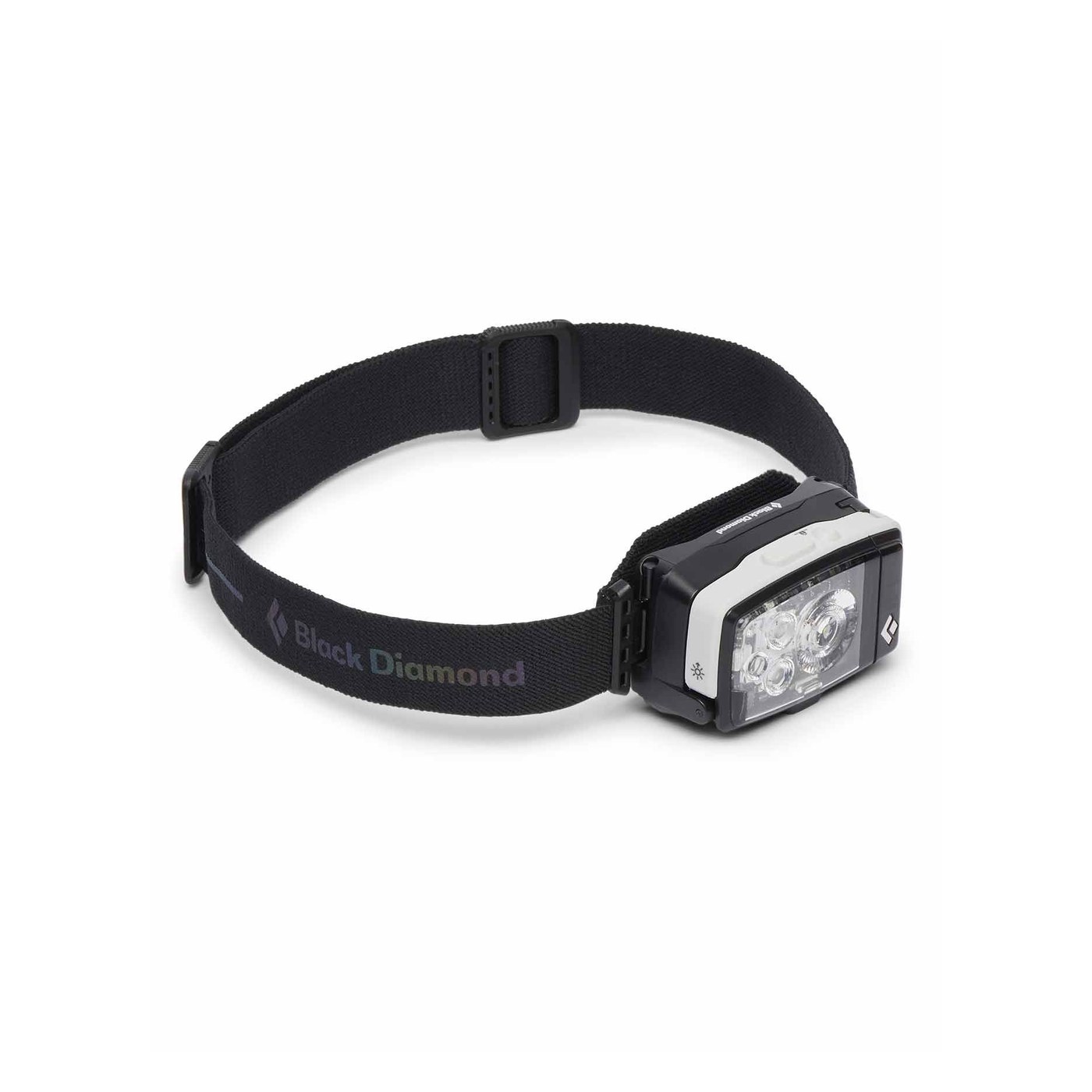
© Black Diamond, official photo used for editorial purposes
Black Diamond takes on performance trail
For trail runners, Black Diamond mostly means poles, gaiters and packs. Yet the American brand has been selling running headlamps for several years, while staying in the shadow of the category specialists. The Distance LT 1100 changes that: it goes straight after the market benchmarks, the Silva Trail Speed 5R, the Petzl Swift RL and Ledlenser's HF series, on turf where Black Diamond only had a modest foothold with its Sprinter 500.
The design choice is clear-cut: the entire battery stays up front, as close to your forehead as possible, while only the optical unit pivots to adjust the beam angle. This build cuts down the bounce you feel with heavier lamps, at the price of deliberately giving up the rear-mounted battery offered by Silva and some Petzl models.
RunMorph's tip: if full-power runtime is your number one criterion for multi-night ultras, compare the Distance LT 1100 with the Silva Trail Speed 5R first. Its rear-mounted, swappable battery makes all the difference over the long haul.
PowerTap and front-mounted design: the tech in detail
PowerTap mode is the Distance LT 1100's true signature. A tap on a touch-sensitive zone on the side instantly fires up the full 1100 lumens for about ten seconds, before automatically dropping back to the previous level. In practice, this feature is mainly for spotting distant course markings or sizing up a technical section, not for running continuously at full power: it's a quick spotlight burst, not a permanent lighting mode.
The multi-LED optics (three white LEDs paired with a multifaceted lens) favor a wide, even beam over a simple long-range spot. At RunMorph, that translates into good perception of the terrain on the sides, handy for anticipating roots and rocks without constantly turning your head. The downside: on the highest levels, the light stays slightly brighter in the center than at the edges. A minor flaw, but a real one next to the most polished optics on the market.
The interface, on the other hand, takes some getting used to. Two buttons on the optical unit handle power, the secondary modes (red, flashing) and locking by pressing both at once. Swapping the battery, in particular, is a hassle on the trail: you have to unclip the optical unit, then detach the battery from the headband via two clips. Not exactly practical in the middle of the night.
Field test: real-world power and runtime
Three independent French sources were compared for this section. Alpine Mag praises a compact headlamp that stays stable on the run, even on technical descents, and highlights the ergonomics of the PowerTap system. Le Comparatif du Trail delivers a far more nuanced test: the interface is judged complicated to get to grips with, the battery indicator (three blue LEDs in 25% steps) is hard to check mid-effort, and above all the 600-lumen mode's runtime fell short of the claimed 4h15 on real outings. CORFF Magazine's multi-brand comparison confirms the overall positioning (the cheapest in the high-end segment, very good runtime in eco mode) while explicitly flagging the lack of a rear-mounted battery as a weak point against the competition.
The disagreement between the three sources is clear, and RunMorph reports it without smoothing it over: the overall experience wins you over (stability, comfort, wide beam), but the gap between claimed and real-world runtime in 600-lumen mode shows up with the tester who focused most on extended use. For runs under three hours, that gap changes nothing. For an ultra where your headlamp has to last a whole night on high, it becomes a genuine concern.
Distance LT 1100 vs Silva Trail Speed 5R vs Petzl Swift RL
| Distance LT 1100 | Trail Speed 5R | Swift RL |
|---|
| Price | €110 | €179.90 | €90 |
| Weight | 108 g | 178 g (with battery) | 100 g |
| Max output | 1100 lm (10 s) | 1200 lm | 1100 lm |
| Battery | Removable, front-mounted | Rear-mounted, swappable | Built-in |
| Auto mode | No | No (adaptive Flow Light) | Yes (Reactive Lighting) |
The short version: the Distance LT 1100 is the cheapest and one of the lightest of the trio, but it offers neither the Trail Speed 5R's rear-mounted battery nor the Swift RL's automatic reactive mode. On a tight budget and for races up to 100-mile ultras, it's more than enough. For longer ultras or mountain races, the Trail Speed 5R keeps the edge thanks to a battery you can swap on the fly.
Our field verdict: who is it really for?
If you string together everyday training runs, fast hikes and races up to the 100-mile format, the Distance LT 1100 gives you an excellent balance of weight, price and power. If you're on a tight budget and want a first high-performing headlamp without paying premium prices, you also have good reasons to pick it.
On the other hand, if you're an ultra runner racing several nights in a row on very long formats, you're better off looking at a headlamp with a rear-mounted, swappable battery like the Trail Speed 5R. It costs more, but it's better equipped for the long haul.
RunMorph Coach's verdict
The Black Diamond Distance LT 1100 makes a convincing entry into the performance trail headlamp segment. The 8/10 score rewards value for money that's rare at this level (110 euros for a wide beam, a moderate weight and real stability on the run), tempered by a high-mode runtime that doesn't fully live up to its promises in real use and an interface that takes time to learn. For races up to 100-mile ultras, it's currently one of the best entry points on the market.