180 euros on the product page, 106.90 euros at a French retailer when this was published: a 40% gap nobody mentions in the comparison guides. The scale tells a shifting story too, depending on who you ask. Does the Dynafit Ultra 100 V3 deserve its reputation as the ultra shoe that finally opens up to everyone?
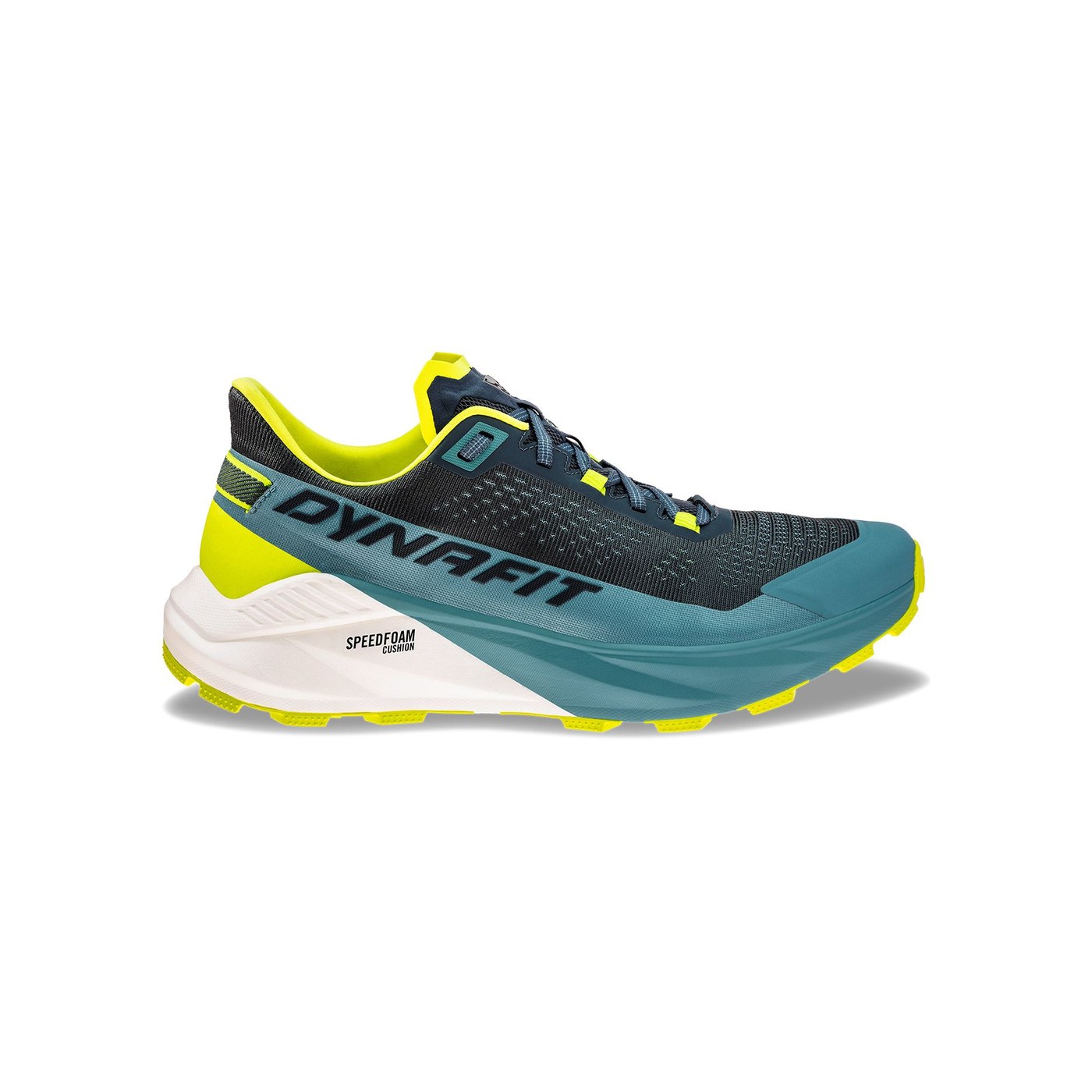
© Dynafit, official photo used for editorial purposes
Dynafit Ultra 100 V3: a ski touring brand reshuffling the trail deck
Dynafit is still a rare sight on French trails compared with Salomon, Hoka or La Sportiva, even though it has kitted out ski mountaineering racers for decades. For a long time its trail range was known for a very snug, skimo-boot style fit, inherited from that alpine DNA. The V3 deliberately goes the other way: more volume in the forefoot, a new foam and Vibram outsoles across the board, to reach a wider audience than the snow leopard brand's usual loyalists.
The list price is 180 euros, but actual prices at French retailers at the time of writing drop to 106.90 euros, a gap of almost 40% that few comparison guides point out. On a model this recent, it is hard to tell whether that is a sliding launch price or a one-off promotion: check before you buy.
Ultra 100 V3: what Dynafit claims vs what was measured
On one specific point, the numbers do not all tell the same story. The product page and independent French tests disagree on the shoe's real weight, a discrepancy rarely flagged in the comparisons covering this model.
| Data | Claimed / measured | Source |
|---|
| Men's weight (EU 42) | 279 g | Spec sheet quoted by an independent French comparison |
| Men's weight (EU 42), catalogue | 293 g | Product page quoted by a second French comparison |
| Men's weight, on a personal scale | 284 g | Independent field tester, shoe in hand |
| Men's weight, general database | 299 g | Spec database, to be confirmed for the exact V3 |
The gap between the catalogue figure (293 g) and the independent weigh-in (284 g) stays within normal manufacturing tolerance, around 3%. What is less common is two serious French comparisons quoting weights 14 g apart for the same model in the same size: a sign that you are better off comparing one tester's measurements from shoe to shoe than catalogue figures gathered from several sources.
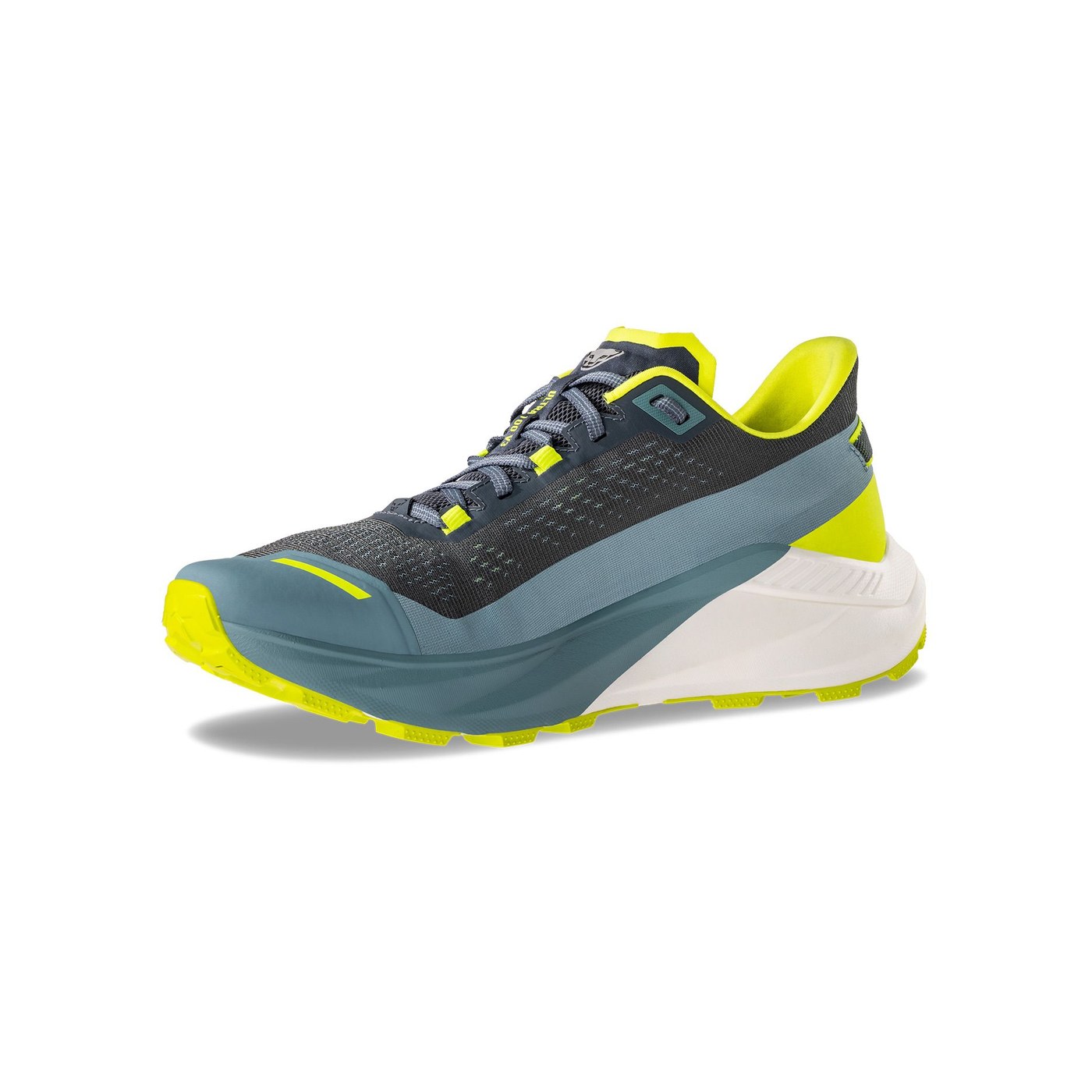
© Dynafit, official photo used for editorial purposes
Speedfoam: Dynafit's first supercritical foam in trail
Historically, Dynafit only fitted its trail shoes with conventional EVA foams. The V3 brings in Speedfoam, a supercritical TPU foam of the same family as the ones used in carbon-plated racing shoes. Both independent testers we consulted agree on a snappier feel than previous generations, with a noticeable rebound on steep descents, though it falls short of the energy return of a carbon-plated race shoe like Dynafit's own Ultra DNA 2, which sits higher in the brand's lineup.
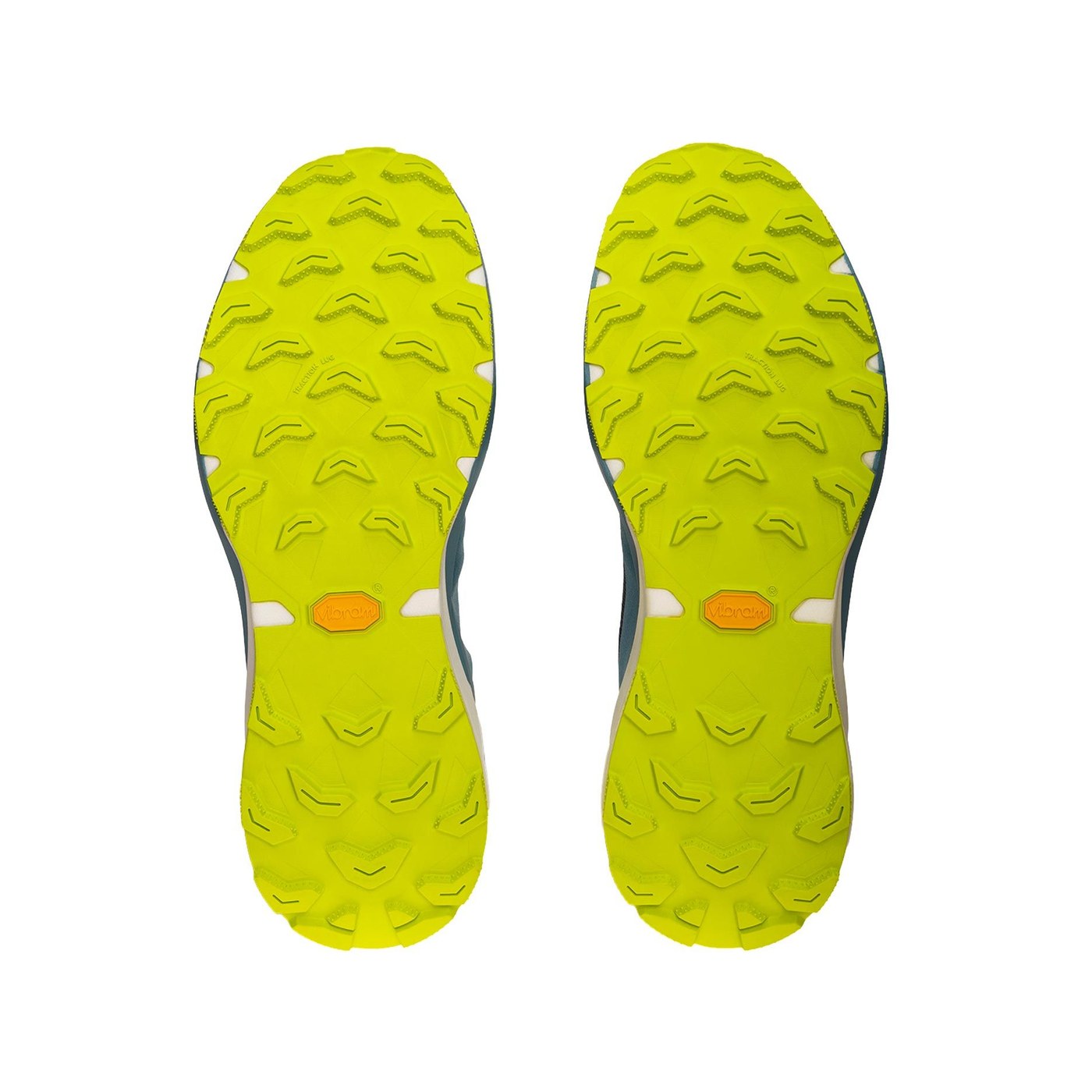
The outsole sticks with Vibram Megagrip rubber, paired with 4 mm deep Traction Lug studs, versus 5 mm on a direct rival like the Hoka Speedgoat 6. On the trail, the shallower lugs do not seem to hurt grip: both testers report reliable traction on dry ground, mud, rock and snow, wet conditions included.
The fit: the core argument of this V3
This is where the two independent field tests agree most clearly: the Ultra 100 V2 suffered from a narrow forefoot that shut out wide feet, a flaw inherited from the brand's skimo DNA. The V3 noticeably widens the forefoot volume and adopts a broader platform under the midfoot.
Precise lab data on toe box width and height in millimetres has not been published yet for this very recent model: at this stage there is no exact figure to compare with the market average. Until an independent measurement comes out, the most concrete signal is the testers' unanimous advice: the shoe runs large, so plan on going half a size to a full size down from your usual. That is a radical shift from the brand's historical reputation, which was known for running small and tight.
Another point raised by one tester: the laces are too long, with no loop or dedicated storage for the excess, a detail that forces some runners to double-knot them or cut them.
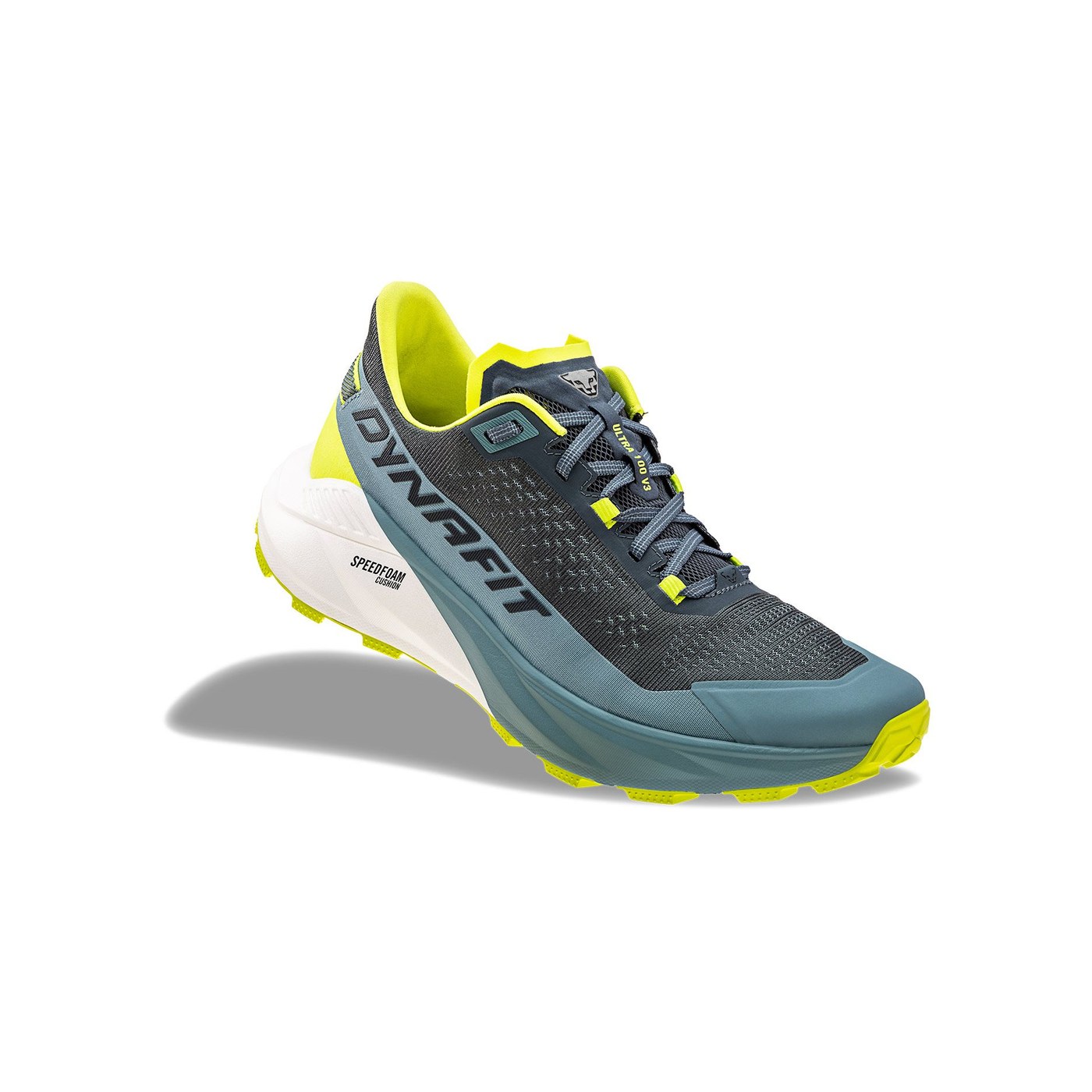
© Dynafit, official photo used for editorial purposes
The field test: what independent runners report
A first full field test, run on Pyrenean trails by an ultra-trail runner and mountain guide, describes a shoe that is "lighter, more dynamic and clearly more comfortable" than previous versions, with grip rated flawless on dry ground, mud, rock, snow and rain. She recommends going at least half a size down from your usual size, and her only reservation is cushioning she finds limited for runners used to the thickest midsoles on the market.
A second field test, by a writer specialising in mountain trail running, confirms the change in fit and the comfort gain, with the shoe weighed at 284 g on his own scale. This tester flags something the first does not explicitly mention: there is no rigid protective plate (rock plate) under the forefoot, and you feel it in the most aggressive scree despite an already absorbent foam. The two verdicts do line up on ride dynamics, described as surprisingly good for a shoe with mountain DNA, and on the Vibram grip, rated reliable in every condition by both testers.
One disagreement deserves to be stated plainly rather than smoothed over: the first tester sees the moderate stack as a successful compromise between ground feel and shock absorption, while the second misses extra protection on technical scree. Both views hold up, and it mostly comes down to the terrain you run most.
At what pace it works, at what pace it falls off
Easy runs and base endurance: a solid compromise. The Speedfoam filters vibrations evenly on a moderate 30 mm stack, with no unwanted instability reported by either tester.
Long run: very good, this is the model's sweet spot. The wider fit limits the risk of foot swelling over several hours, and the Vibram outsole holds its grip with no notable wear reported over the long runs tested.
Marathon pace: fine, nothing more. The 30/24 mm stack stays below the 2026 trend for the most cushioned ultra shoes, and without a propulsion plate, efficiency at sustained pace over time is limited.
Threshold and half marathon pace: borderline. Speedfoam's energy return is real but clearly below that of a carbon-plated shoe like the same brand's Ultra DNA 2, which is built specifically for this job.
Short intervals: not recommended. The roomy fit and a stack tuned for long-distance comfort do not give you the ground connection needed for sharp changes of pace.
The flaw you cannot see in the photos: no rock plate
On aggressive mid-mountain scree, one independent tester explicitly points out the lack of a rigid protective plate under the forefoot. In practice, landing on a sharp rock edge hits harder than on an ultra shoe with a rock plate built into the foam, even if the Speedfoam soaks up part of the impact. If you are preparing an ultra-trail on very rocky terrain like the Diagonale des Fous or UTMB, test this detail in store on a hard surface before buying.
The second structural flaw: laces too long, nowhere to stow them
Second point reported in black and white by one tester: the Ultra 100 V3's laces are too long and the shoe has no loop or pocket to tuck the excess away. On technical ground, a dangling lace can snag on vegetation or rocks. The simplest fix is a double reef knot or trimming the excess after purchase, especially in smaller sizes where the extra length is proportionally bigger.
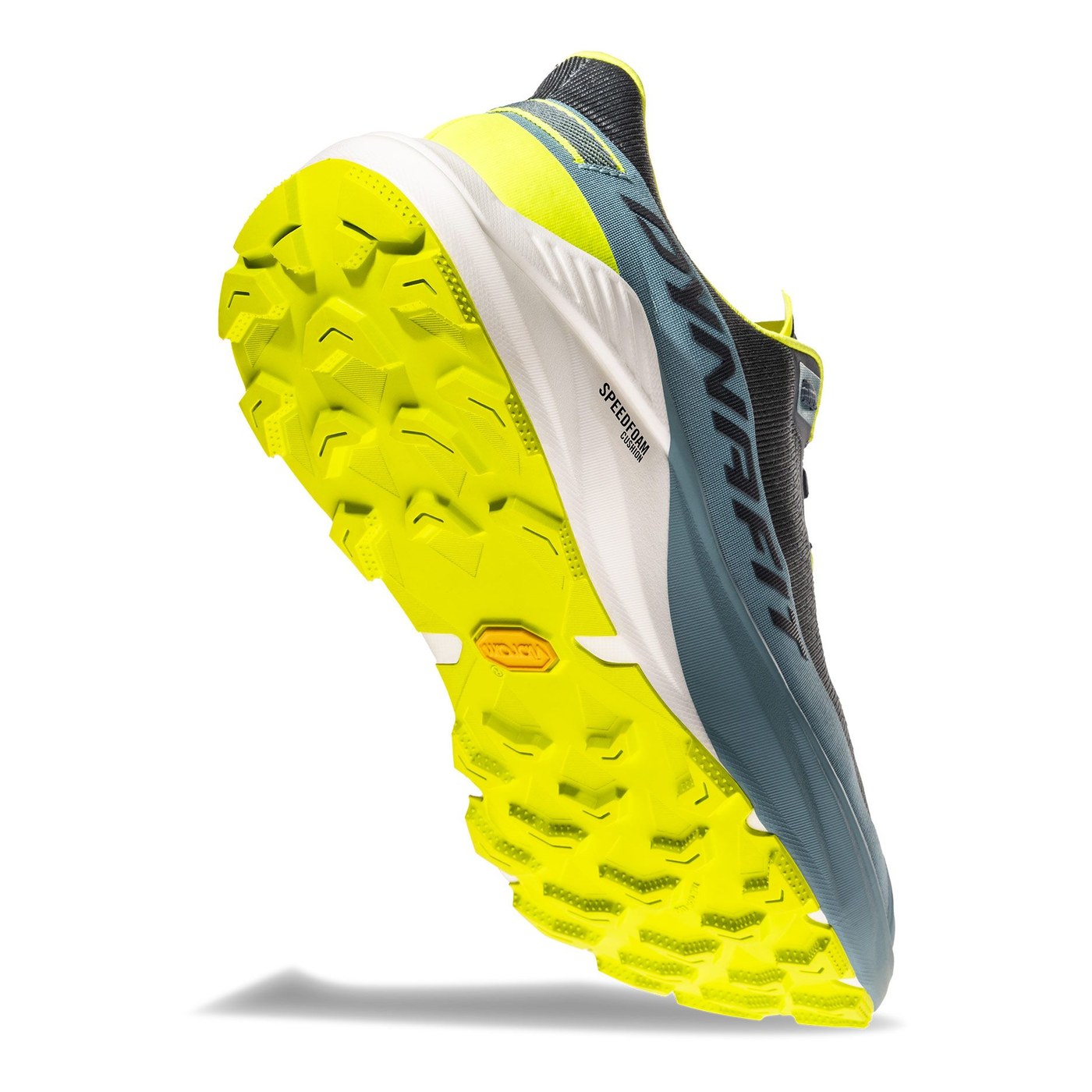
© Dynafit, official photo used for editorial purposes
Dynafit Ultra 100 V3 vs Ultra 100 V2: should you upgrade?
| Ultra 100 V3 | Ultra 100 V2 |
|---|
| Midsole | Speedfoam (supercritical TPU) | Conventional EVA |
| Forefoot fit | Wider, more volume | Narrow, for slim feet only |
| Outsole | Vibram Megagrip across the board | Pomoca outsole on some versions |
| Reported responsiveness | Noticeable rebound on descents | Stiffer, less lively |
The short version: if the V2 pinched your toes, the V3 fixes that and deserves another try. If you already ran comfortably in the V2 and mainly want a very locked-down, skimo-style fit, there is no rush to upgrade, and the change of philosophy may even throw off fans of the old fit.
Dynafit Ultra 100 V3 vs La Sportiva Prodigio Pro and Hoka Mafate 5
| Ultra 100 V3 | Prodigio Pro | Mafate 5 |
|---|
| Weight (men's) | 279 to 293 g | Comparable, premium ultra segment | Higher, maximalist segment |
| Drop | 6 mm | Varies across the La Sportiva range | 4 to 5 mm depending on generation |
| Midsole | Speedfoam supercritical TPU | Next-generation supercritical foam | Dual-density maximalist foam |
| List price | 180 € | Comparable premium segment | Comparable premium segment |
The short version: in 2026 all three models sit in the segment of supercritical foams applied to ultra-trail, a recent tech shift for brands that have historically played it safe here. The Dynafit stands out with its now generous fit, while the Hoka Mafate 5 stays focused on more maximalist cushioning and smoother, more runnable terrain.
Grip and durability: what does it really cost per kilometre?
The lateral overlays, the wider platform that better protects toes and heel, and the Vibram outsole, known for its abrasion resistance, point to a lifespan in the upper half of the ultra segment, around 600 to 700 km depending on use, a figure put forward by a tester who will track wear over time. On that basis and at the 180 euro list price, the theoretical cost per kilometre comes to about 0.26 to 0.30 euro/km. But at the 106.90 euro street price at a French retailer, that cost drops to about 0.15 to 0.18 euro/km, lower than a direct rival like the Hoka Mafate 5 over a comparable lifespan. That calculation, more than the list price, is what should drive your buying decision.
Our field verdict: who is it for?
The Dynafit Ultra 100 V3 is first and foremost for wide-footed runners who had ruled out the brand because of the tight fit of earlier generations. The change of philosophy is clear-cut and confirmed by two independent testers. The trade-off shows up in the most aggressive scree, where the missing rock plate makes itself felt, and at sustained paces, where the shoe cannot match a carbon-plated racer.
© Dynafit, official photo used for editorial purposes
RunMorph Coach verdict
The 7.8/10 overall score gives heavy weight to the wider fit and the Vibram grip, the two points where independent testers agree without reservation, against responsiveness that is real but capped by the lack of a propulsion plate, and protection that falls short in the most aggressive scree. Value for money tips clearly in the shoe's favour as soon as you find it at the actual street price at French retailers rather than at list price.
7.8/10: an ultra shoe that finally fixes the brand's historical flaw, as long as you accept forefoot protection that falls short on the harshest terrain and you buy at the right price.
FAQ: Dynafit Ultra 100 V3
Should you size down in the Dynafit Ultra 100 V3?
Yes: both independent testers recommend going half a size to a full size below your usual size, as the shoe runs large despite its now wider fit.
What is the real weight of the Dynafit Ultra 100 V3?
Sources range from 279 g to 293 g claimed for a men's EU 42, with an independent weigh-in at 284 g, a 3% gap from the highest catalogue figure.
Is the Dynafit Ultra 100 V3 a good choice for a first 100 km ultra-trail?
Yes, with a 30 mm heel stack and a wider fit that limits foot swelling over time, but stay cautious on sections of aggressive scree where the missing rock plate makes itself felt.
How many kilometres does a pair of Dynafit Ultra 100 V3 last?
One tester estimates 600 to 700 km depending on use, for a theoretical cost per kilometre of 0.15 to 0.18 euro at the actual street price of 106.90 euros.
Is the Dynafit Ultra 100 V3 suited to short intervals?
No: the roomy fit and the 30/24 mm stack tuned for long-distance comfort do not support the sharp changes of pace short intervals demand.
