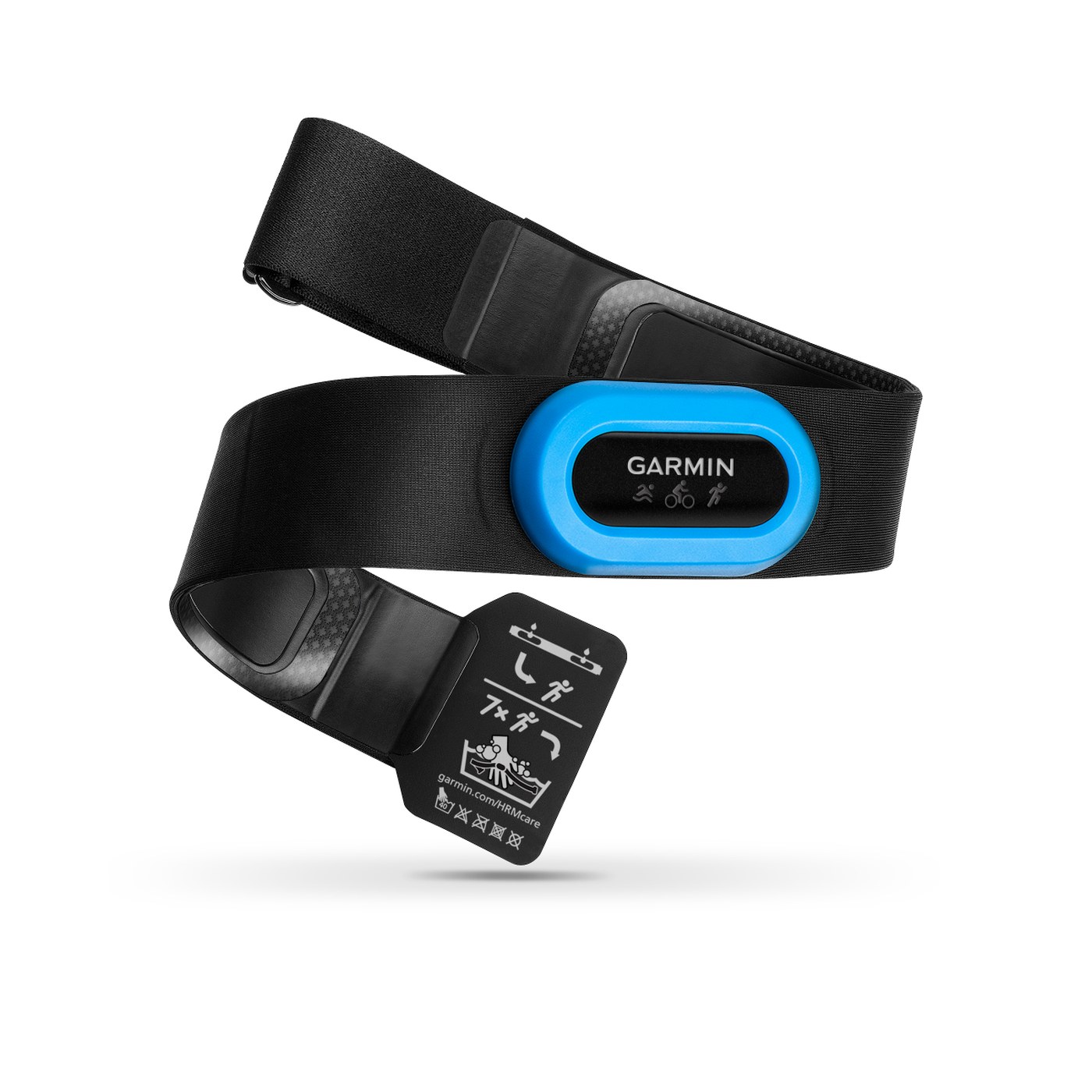
Since 2015, the Garmin HRM-Tri has been the benchmark triathletes pass along at the club and in specialty stores: a strap that records heart rate underwater, in open water or under a wetsuit, then transfers the data the moment you climb out of the pool or the sea. Eleven years later, RunMorph's sensor reviews already covered four Garmin chest straps and armbands (HRM 600, HRM-Dual, HRM-Pro Plus, HRM-Fit), but never the one that launched this very specific segment. This full review fixes that oversight, with cross-checked feedback to back it up.
Garmin HRM-Tri Review: The Triathlon Strap That Logs Underwater
7.6/10
- Heart rate accuracy praised by every independent test we consulted, including at varying intensities
- Works just as well in open water as on the bike and on the run, with no strap swap between the three disciplines
- Real long-term comfort, including on long sessions lasting several hours
- ANT+ only connectivity, incompatible with most apps and smart trainers that require Bluetooth
The essentials in 3 sentences
The Garmin HRM-Tri is an ANT+ chest strap built for triathlon: it stores your heart rate underwater, then transfers it once the swim is over. Independent testers still agree on its accuracy, but ANT+ only connectivity (no Bluetooth) and a module fused to the strap make it look clearly dated next to newer chest straps. It delivers on its triathlon promise in the field; on modernity, much less so.
7.6
/ 10 · RunMorph overall score
Who is it for?Triathletes who want one strap for open-water swimming, cycling and running, and who already own an older-generation Garmin watch with ANT+.
Who should skip it?Runners who use a smartphone app, a smart trainer or a watch that requires Bluetooth, and swimmers who train in the pool with frequent turns.
The HRM-Tri, veteran of a segment Garmin never truly refreshed
In 2015, Garmin launched two twin straps at once, the HRM-Swim and the HRM-Tri, to solve a very real triathlete problem: no chest strap survived an open-water session. The HRM-Swim targets the pool, with a non-slip finish that holds through turns. The HRM-Tri bets on all-day comfort, out of the water too, and adds running dynamics (cadence, vertical oscillation, ground contact time) through a built-in accelerometer. Eleven years on, Garmin has released the HRM-Pro and then the HRM-Pro Plus, both more versatile and Bluetooth-enabled. The HRM-Tri never got a direct successor within its own triathlon line. It's still on sale, but increasingly hard to find new at some French retailers (i-Run and Orbitica list it as out of stock at the time of this review), while others, such as GPS Nation in the United States, are still selling their last units. Take that signal seriously before investing in a product whose restocking is no longer guaranteed.
HRM-Tri specs: what Garmin claims, what the field confirms
| Feature | Value |
|---|---|
| Brand / model | Garmin HRM-Tri (ref. 010-10997-09) |
| Category | ANT+ chest strap dedicated to triathlon |
| Total weight / module only | 59 g / 49 g |
| Connectivity | ANT+ only (no Bluetooth) |
| Water resistance | 5 ATM, underwater recording, delayed transfer after the swim |
| Onboard storage | Up to 20 hours of swim data, internal memory with its own clock |
| Running dynamics | Cadence, vertical oscillation, ground contact time (built-in accelerometer) |
| Claimed battery life | 10 months (based on 1 h of triathlon per day, about 300 hours) |
| Measured battery life (independent field test) | About 245 hours over 6 months of real use, 18% below the manufacturer's claim |
| Battery | Replaceable CR2032, but the module is fused to the strap (strap not replaceable separately) |
| Chest size | 60 to 142 cm, semi-folded adjustment |
| Official price | €129 |
The gap between claimed and measured battery life is no footnote. Over an Ironman build lasting several months, an 18% shortfall can catch out an athlete who expected one battery to last the whole season. At RunMorph, we'd rather say so clearly than repeat the marketing promise as is.
ANT+ and underwater storage: what does it really change?
Technically, the HRM-Tri works like a tiny USB stick worn on your chest. Neither ANT+ nor Bluetooth signals travel through water, so there's no live heart rate on your watch during the swim. Instead, the strap timestamps and records every beat internally, then transfers everything as soon as the watch finds it again when you exit the water (at transition or at the end of the session). This delayed-storage approach works well, but it comes with two practical constraints: the watch must have been paired at least once before the swim, and the activity must be started and stopped properly so the two files merge. One key technical detail separates the HRM-Tri from the rest of Garmin's current lineup: it communicates exclusively over ANT+, with no Bluetooth Low Energy. In 2015, that wasn't a problem, since most watches and trainers of the era already ran ANT+. In 2026, many smartphone apps, recent smart trainers and platforms like Zwift favor Bluetooth. In practice, that limits the HRM-Tri to Garmin devices (and a few ANT+ bike computers) rather than the broad ecosystem newer straps offer.
The field test: from pool to open water, what independent tests confirm
For this specific model, we read three independent sources in full for this review, and a fourth (a discussion thread among French-speaking triathletes) rounded out the picture with feedback from several years of use.
Opentri.fr, which wore the strap for six months during its own training block (about 5,000 km on the bike, 900 km of running, several open-water swims), reports a very solid hold day to day, with no chafing or discomfort even on long sessions. The catch is real-world battery life: over those six months, the strap lasted 245 hours before needing a new battery, versus the 300 hours (10 months at 1 h/day) Garmin claims, and re-pairing after the battery swap proved finicky, taking several attempts. With moisture, the strap tends to slip slightly under extreme sweating or heavy rain, a flaw that doesn't show up in dry conditions.
Independent measurements in a controlled environment (repeated comparisons against other ANT+ straps over several months of multisport use) agree on one point: the recorded data is reliable, with no unusual spikes or dropouts, including heart rate variability when you use it. A summary score built on five criteria (price, accuracy, build, features, openness and compatibility) ranks this product very high on accuracy and build, and much lower on price. That matches the general feeling: a solid product that has aged badly on pricing against a younger field of rivals.
On lifespan, user reports converge with one key caveat: the electronic module doesn't detach from the fabric strap (unlike the older HRM-Run, where the sensor clips on and off). So once the strap wears out, you have to buy the whole unit again rather than a simple €15-20 band. Several users report a lifespan of around a year with regular use, with measurement reliability rated close to 99% over that period, apart from one isolated glitch in full sun on an athletics track.
RunMorph's advice: rinse the strap in clean water after every use (sweat and salt damage the sensors), store it flat rather than rolled up, and budget from day one for a full replacement in 12 to 18 months rather than just a spare strap.
On the specific question of the pool, every source agrees: the HRM-Tri isn't built for it. The strap's finish lacks the non-slip grip of the HRM-Swim, and it tends to slide on the first hard push-off turns. For pool-only use, the HRM-Swim (same electronics, different finish) is the logical choice. In open water, however, whether under a wetsuit or just a trisuit, no source reported any hold issues.
Garmin HRM-Tri vs Garmin HRM-Pro Plus: head to head
| Criterion | Garmin HRM-Tri | Garmin HRM-Pro Plus |
|---|---|---|
| Connectivity | ANT+ only | Simultaneous ANT+ and Bluetooth |
| Running dynamics | 3 basic metrics (cadence, oscillation, contact time) | Advanced dynamics, including left/right balance |
| In the water | Storage and delayed transfer, not recommended for the pool | Storage and delayed transfer, better multisport hold |
| Strap replacement | Impossible, module fused to the strap | Detachable strap, replaceable separately |
| Official price | €129 | About €150 to €175 depending on the retailer |
| 2026 availability | Remaining stock, out of stock at several French retailers | New and widely available |
It's not an even fight: the HRM-Pro Plus fixes almost every weak point of the HRM-Tri for €20 to €45 more, depending on the retailer. The only rational reason to still pick the HRM-Tri in 2026 is a tight budget combined with a Garmin ANT+ ecosystem you already own, or a bargain from a retailer clearing out its last units.
Pros and cons
Pros
- Heart rate accuracy praised by every independent test we consulted, including at varying intensities
- Works just as well in open water as on the bike and on the run, with no strap swap between the three disciplines
- Real long-term comfort, including on long sessions lasting several hours
- Reliable internal storage of up to 20 hours of swim data, with automatic transfer when you exit the water
Cons
- ANT+ only connectivity, incompatible with most apps and smart trainers that require Bluetooth
- Electronic module fused to the strap: you can't replace just the worn fabric, you have to buy the whole unit again
- Measured real-world battery life about 18% below the manufacturer's claim over several months of use
- Not recommended for the pool (slips on turns), and increasingly hard to find new at some French retailers
Our field take: who is it for?
The HRM-Tri still has a real strength: it's a simple, accurate and comfortable strap, cut out for the swim-bike-run sequence without ever switching sensors. For a triathlete who already owns an older-generation Garmin watch and doesn't need to connect a third-party Bluetooth app, it remains a defensible buy, especially at a discount. For everyone else, the math quickly favors a newer model: the closed connectivity and non-replaceable module end up costing more over time than a slightly higher upfront investment.
Whether you're preparing your first sprint-distance triathlon or a full season building toward an Ironman, consistent heart rate zone training makes all the difference at the finish line. RunMorph training plans help you structure your aerobic base weeks and threshold sessions, whatever heart rate strap you wear.
RunMorph Coach's verdict
The Garmin HRM-Tri earns 7.6/10. On accuracy alone, it brushes excellence and holds its own against much newer straps. But a 2015 product is still a 2015 product: no Bluetooth at all, plus a module you can never separate from a strap bound to wear out within a year or two, put it well behind the HRM-Pro Plus over time. At RunMorph, we only recommend it if the price is heavily slashed or if a pure ANT+ ecosystem already suits your use perfectly. Otherwise, the extra cost of a newer, Bluetooth-connected strap is well worth it.
Key takeaways for your training
- Reliable accuracy in every situation: none of the independent sources we consulted found significant drift or dropouts, including at varying intensities.
- Budget for a full replacement, not just the battery: the fabric strap usually wears out in 12 to 18 months, and the module doesn't detach so you can't replace the strap separately.
- Check your ANT+ compatibility before buying: without Bluetooth, the HRM-Tri won't talk to most smartphone apps or recent smart trainers.
- Keep it for open water, not the pool: for laps with frequent turns, go for the HRM-Swim or a newer model with a non-slip finish.
- Rinse it after every use: it's the simplest way to delay the premature wear several users have reported over the long term.