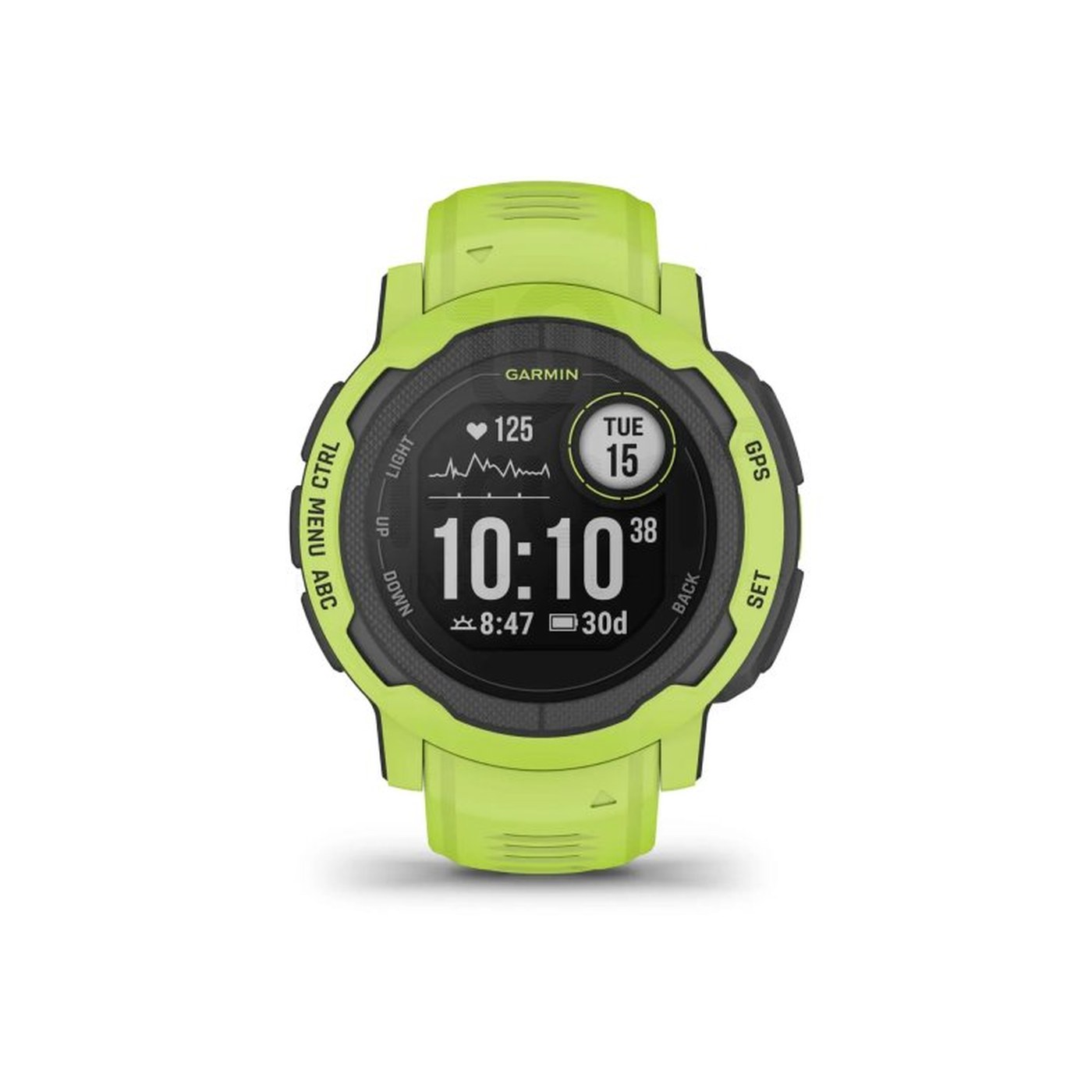
Since January 2022, the Garmin Instinct 2 has sat on the shelves without ever really dropping out of the best-seller lists. No AMOLED, no maps, a screen that would fit on a postage stamp: on paper, everything marks it as outdated next to the AMOLED models released since. Yet in 2026 it keeps selling and keeps getting recommended, carried by an argument few rivals truly deliver on: several weeks without charging. RunMorph put this indestructible watch, in the Electric Lime colorway, under the microscope to check whether that argument still holds up.
© Garmin, official photo used for editorial purposes
Garmin Instinct 2: the watch that refuses to follow the AMOLED trend
Since 2022, Garmin has flooded its lineup with AMOLED screens: Venu, Forerunner 570, epix, fenix 8. Against that wave, the Instinct 2 is a deliberate anachronism. Its always-on monochrome transflective MIP screen uses almost no power. That is a design choice, not a technical limitation: Garmin knows perfectly well how to build AMOLED watches, the brand simply bet that a segment of athletes prefers battery life to a pretty screen.
That bet has paid off rather well. Four years after launch, the Instinct 2 is still a reference in almost every French outdoor watch comparison, alongside the COROS Apex 2 Pro and the Instinct 3 AMOLED, which has since joined Garmin's lineup without replacing it. The model is still actively sold, carried by a simple argument: at around 250 to 300 euros today, it is the most direct way into Garmin's truly indestructible outdoor watches.
RunMorph's advice: if you are torn between the Instinct 2 and a newer watch like the Instinct 3 AMOLED, ask yourself one question: have you ever used maps on a GPS watch? If the answer is no, the price gap is not worth it.
Monochrome screen and Expedition mode: what it really changes
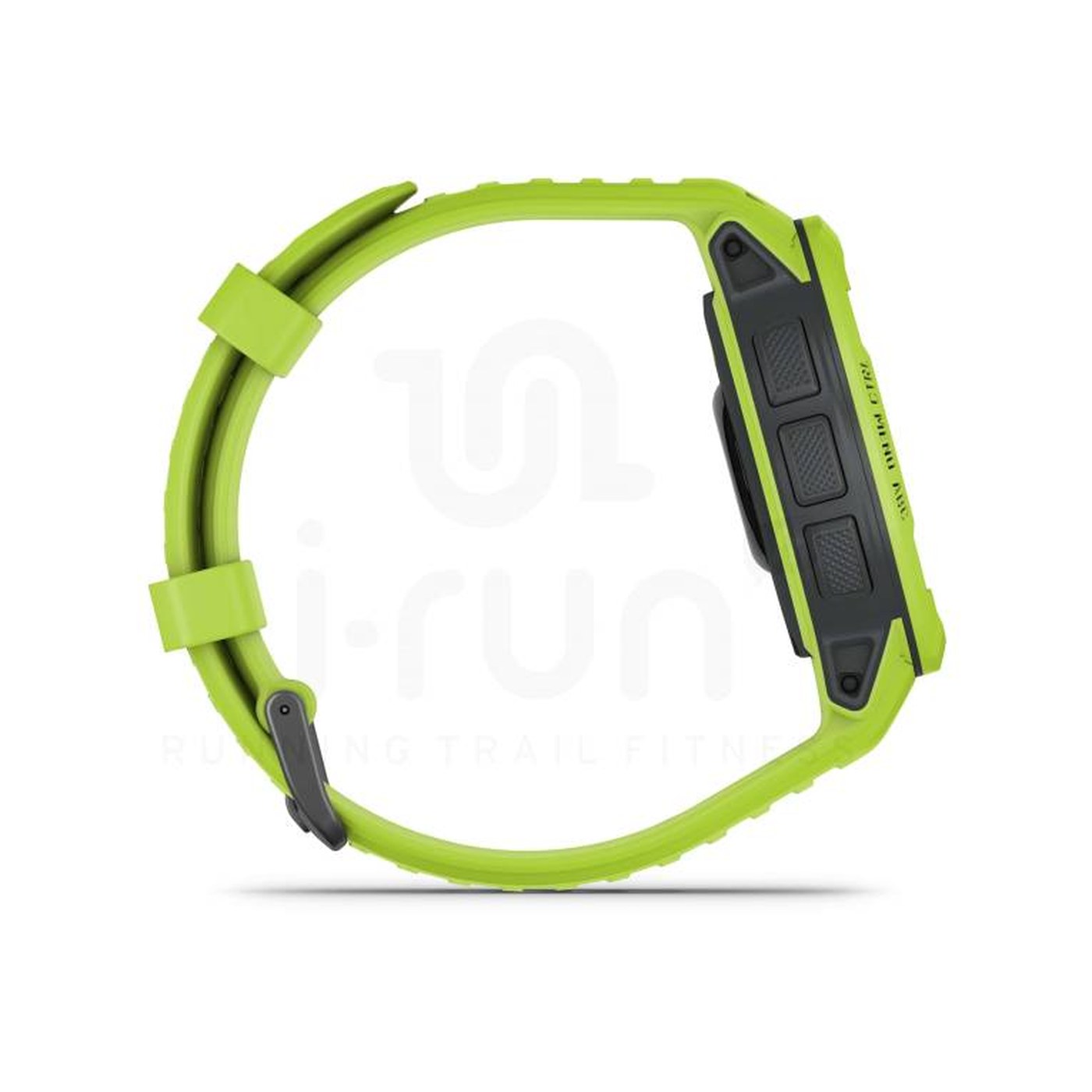
Choosing a transflective MIP screen is not cosmetic: it is what explains the battery gap against an AMOLED watch. An AMOLED screen draws power for every lit pixel; a transflective MIP barely draws any, even when permanently on. The result: the Instinct 2 lasts 28 days in smartwatch mode versus 11 to 16 days for most recent AMOLED Garmins, and up to 32 days in Expedition mode (one GPS fix per hour, sensors and Bluetooth off). On a multi-day long-distance trail, that is the difference between charging once a week and never charging at all.
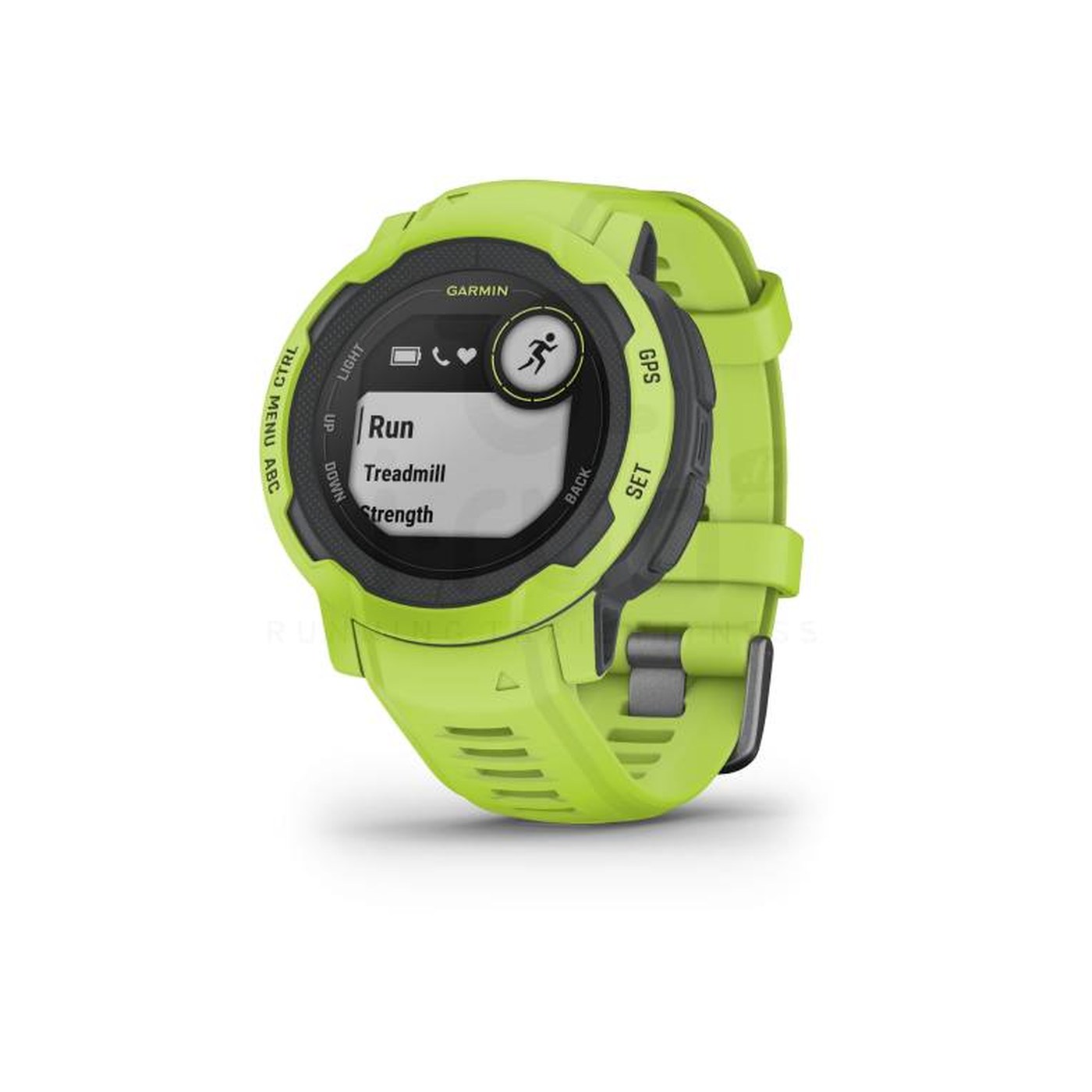
The trade-off is well known: 176 x 176 pixel resolution, no color, no maps you can display even if you download a basemap. The watch only shows a breadcrumb trail (a line showing the path you have covered, with no terrain or topography around it). For a waymarked trail or a loop you already know, that is enough. For an exploratory outing on unfamiliar ground, you will need to pull out your phone.
© Garmin, official photo used for editorial purposes
The field test: GPS accuracy and optical heart rate in the woods
On the road and in open areas, the Instinct 2's multi-GNSS chip (GPS, GLONASS, Galileo) locks on quickly and tracks accurately: feedback converges on decent accuracy for a single-frequency watch, comparable to a standard GPS watch of the same generation. The problem shows up under tree cover or in dense urban areas. Independent measurements gathered by several French testers agree: the lack of dual frequency (L1+L5) costs you in the woods, with track drift that can throw the displayed pace off by nearly 2 minutes per kilometer while the signal settles, a gap you won't see on newer multi-band watches like the Instinct 3 AMOLED.
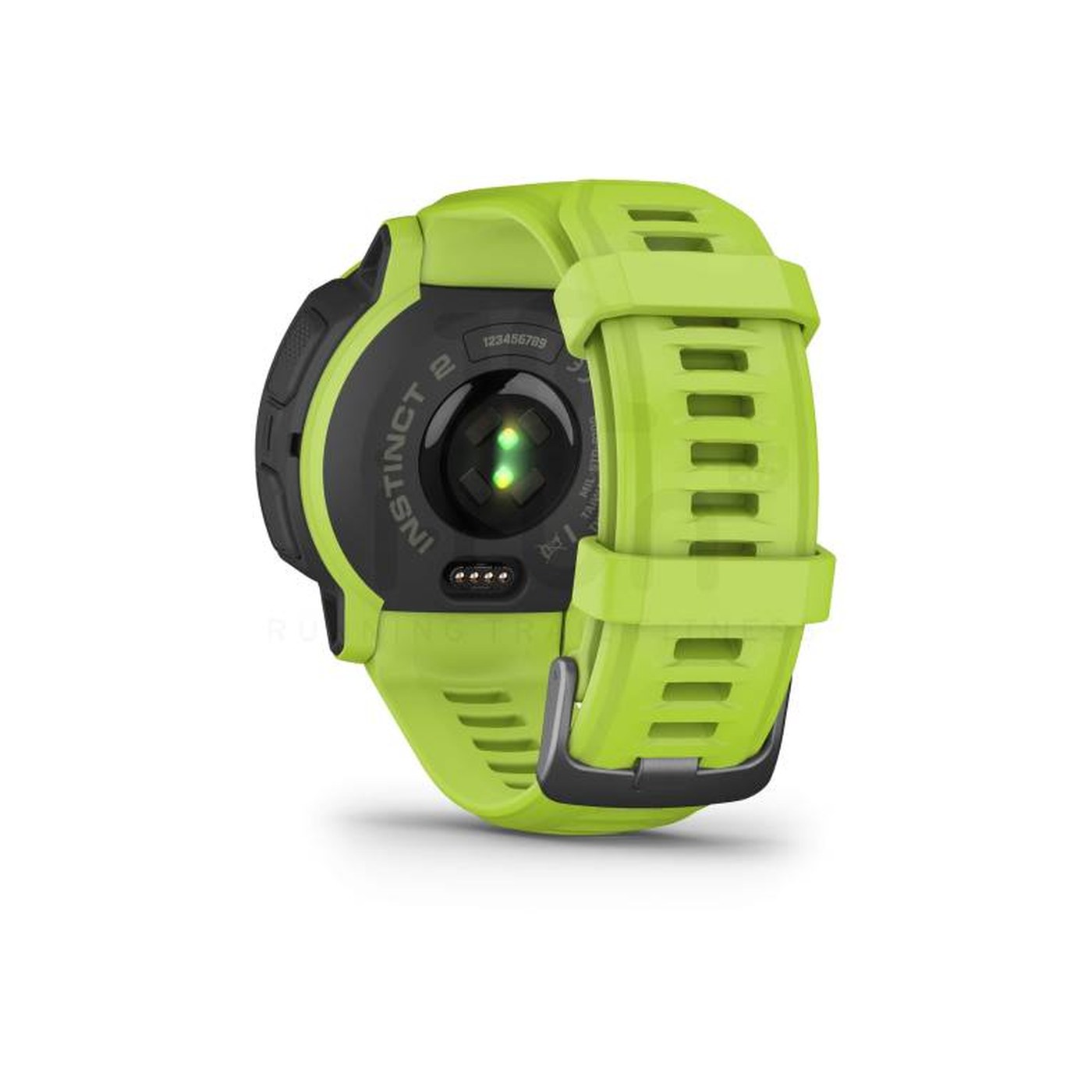
On the heart rate side, the Elevate Gen 4 optical sensor does what you expect from a wrist sensor: Sport-Passion, which covered the Instinct 2 range from its 2022 launch, reports satisfying accuracy on steady-pace runs, while pointing to the lack of maps and onboard MP3 player as the two most common complaints against the model compared with newer rivals. On intervals or very intense efforts, several independent reports flag occasional gaps compared with a chest strap, a classic flaw of any optical sensor and not specific to this model.
The full review published by Gymstreet (editorial score 18/20, March 2026) confirms the picture: battery life described as exceptional and unanimously praised by users, toughness and wrist comfort highlighted despite a 45 mm case that remains bulky on a small wrist, GPS judged accurate with fast signal acquisition. The review also notes two concrete limits: no built-in maps, which is frustrating on unfamiliar ground, and Garmin Pay support restricted to certain French banks, a real drawback if you were hoping to pay without taking out your phone.
Over time, several French testers who have followed the Instinct range since launch agree on one point: the battery promise holds up in the long run, with no noticeable battery degradation after several years of daily use, an argument rarely highlighted but one that matters for a product whose whole appeal rests on longevity.
RunMorph's advice: for a marathon build or a long trail block, the Instinct 2's battery life takes away the fear of a dead battery during a 4 or 5 hour long run. Pair it with a structured training plan on
RunMorph to turn that reliability into measurable progress, week after week.
Garmin Instinct 2 vs COROS Apex 2 Pro: the comparison
In the rugged outdoor segment, the most natural comparison is not with another Garmin but with the COROS Apex 2 Pro, which targets exactly the same kind of athlete at a similar price when bought used or on sale.
| Garmin Instinct 2 | COROS Apex 2 Pro |
|---|
| Screen | Monochrome MIP 176x176 px | Color MIP (64 colors) 260x260 px, sapphire glass |
| Maps | None | Worldwide offline, free |
| GPS battery life | 30 h (single frequency) | 75 h single frequency / 26 h dual frequency |
| Smartwatch battery life | 28 days | 30 days |
| Case material | Reinforced polymer | Grade 5 titanium + PVD, sapphire glass |
| Weight | 52 g | 53 g |
| Typical 2026 price | 250 to 300 euros | 449 to 499 euros |
The price gap tells a good part of the story: the COROS Apex 2 Pro packs full maps, a titanium case and sapphire glass, while the Garmin Instinct 2 skips all three to stay much cheaper. If your budget is tight and maps are not a criterion, the Instinct 2 is more than enough. If navigating unfamiliar terrain is part of your plans, the price gap with the Apex 2 Pro is justified.
© Garmin, official photo used for editorial purposes
Our field verdict: who is the Garmin Instinct 2 for in 2026?
Three profiles clearly stand out from the aggregated feedback. The regular runner who wants reliable GPS and full health tracking without paying for maps they will never open will find excellent value for money in the Instinct 2. The hiker or trail runner who loops familiar trails will get the full benefit of the record battery life, even if it means carrying a phone as backup on exploratory outings. On the other hand, the trail runner who regularly navigates unfamiliar ground or runs ultras should look elsewhere: the complete lack of maps is a real gap, not a detail.
Whether your goal is a first trail race or a half marathon build, the Instinct 2's GPS reliability and battery life fit nicely into a structured training plan. Check out the
RunMorph training plans matched to your level and discipline to turn every recorded run into real progress.
© Garmin, official photo used for editorial purposes
The RunMorph Coach's verdict
Four years after launch, the Garmin Instinct 2 hasn't aged a day on its core argument: battery life. It is an honest watch that owns its trade-offs (no maps, no AMOLED, no music) to keep a simple promise, and it truly keeps it. The single-frequency GPS and the complete lack of map navigation rule it out for exploratory ultra-trail, but for the everyday use of a runner or hiker who wants an indestructible watch and weeks of peace of mind, it remains a solid choice, all the more so since its price has dropped sharply since 2022. 7.2/10: a very good product in its category, with one trade-off (maps) that must be a conscious choice, not something you discover after buying.