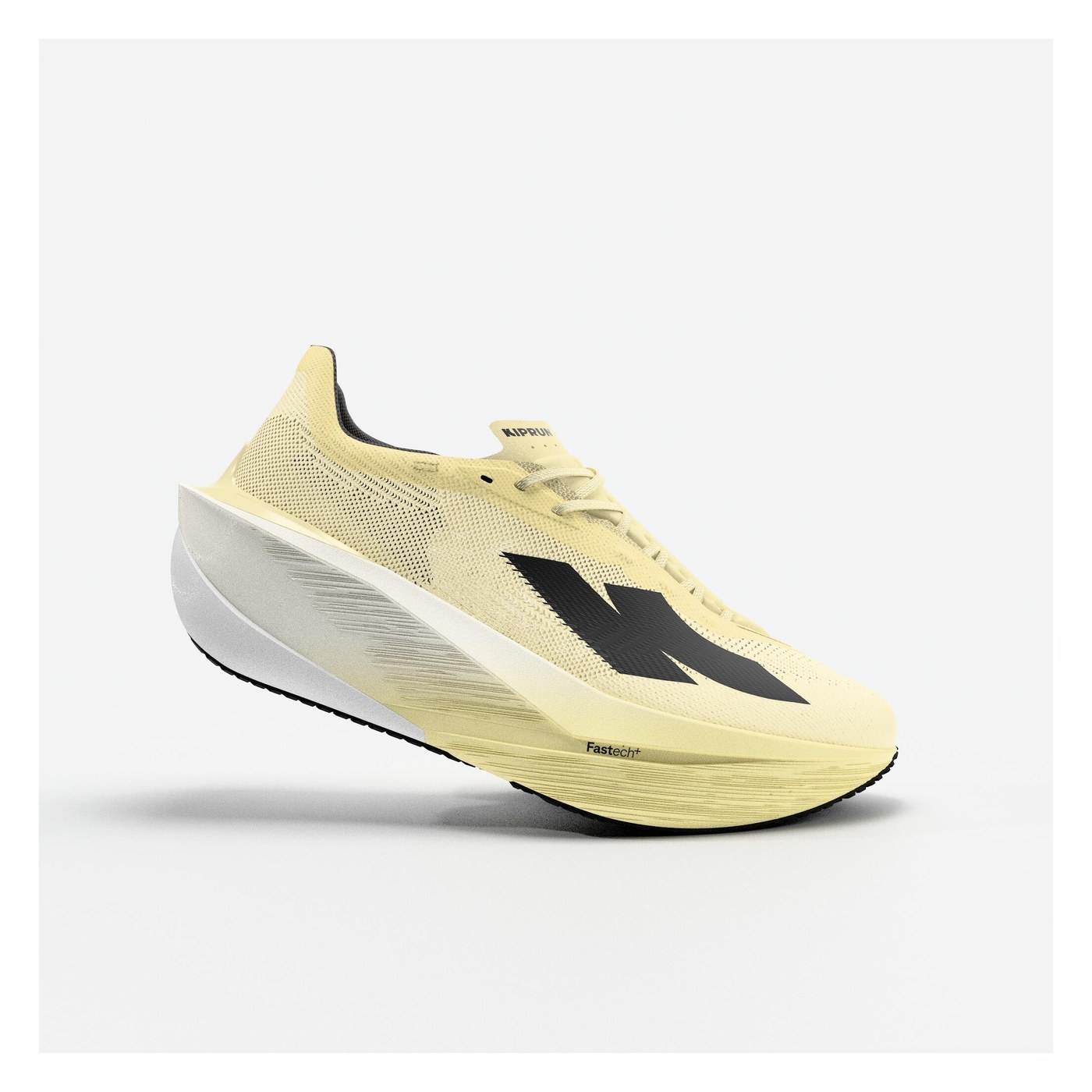
With the carbon-plated Kipstorm Elite, Kiprun had already proved that a mass-market brand could go toe to toe with premium racers on the tech side. The Kipstorm Tempo makes the opposite bet: deliver the feel of a fast shoe without a carbon plate, for 139.99 euros, in a segment Decathlon had left to the heritage brands. The bet mostly pays off, but the shoe's sweet spot is narrower than its entry-level price suggests.
© Kiprun, official photo used for editorial purposes
Kiprun fills the gap between daily trainer and carbon racer
Ever since the launch of the Kipstorm Elite, its 219.99-euro carbon-plated super shoe, Kiprun has had a deliberate blind spot in its road lineup: nothing between the max-cushioned comfort of the Kipride Max and pure racing. Yet plenty of regular runners don't need a carbon shoe for every fast session: they want a pair for threshold, intervals and race-pace reps without wearing out their race shoes. That is exactly the slot the Kipstorm Tempo targets, launched in early 2026 at 139.99 euros.
The technical choice says a lot: no carbon plate, but Fastech+ foam paired with an ultralight CMEVA layer that acts as a pseudo propulsion plate. On paper, the pitch sounds like many plateless tempo trainers on the market, from the Adidas Adizero Boston 13 to the Saucony Kinvara 16. So the real question isn't whether the Kipstorm Tempo is lively (all three French reviews we consulted agree on that) but how far its comfort zone actually stretches. The answer, precise and backed by numbers, is a far cry from the "works at any pace" image its price might suggest.
Kipstorm Tempo spec sheet
| Spec | Value |
|---|
| Brand | Kiprun (Decathlon) |
| Model | Kipstorm Tempo |
| Release | Early 2026 |
| Type | Road, plateless tempo trainer |
| Drop | 8 mm |
| Stack forefoot / heel | 37 mm / 45 mm |
| Weight (size 42) | 225 g |
| Carbon plate | No (CMEVA pseudo plate) |
| Foam | Fastech+ |
| Upper | Knit Sockfit, no traditional tongue |
| Width | Standard only |
| Recommended use | Fast sessions, 10 km to half marathon |
| Official price | €139.99 |
Two details set this spec sheet apart from the segment average. First, the 45 mm heel stack, generous for a plateless shoe, which partly explains why the ride stays comfortable despite the shoe's fast-paced mission. Second, the complete absence of a rigid plate in favour of a simple, denser CMEVA layer under the forefoot: a cheaper solution to produce than a carbon plate or even a nylon fibre plate, which directly explains the price gap with the Kipstorm Elite (€219.99, 80 euros more) and with the Adidas Adizero Boston 13 (€160, fitted with Energyrods 2.0).
Fastech+ and a CMEVA pseudo plate: what does the tech change underfoot?
Fastech+ foam fills the Kipstorm Tempo's entire stack, from heel to toe. At Kiprun, this foam already features on several models in the range, including the Kipride Max, which uses a more comfort-oriented Softech+ variant. On the Kipstorm Tempo, the formula has been reworked to favour responsiveness over pure shock absorption: that explains the 9.0/10 responsiveness score recorded by Runnea, the model's best mark across all the criteria it tested.
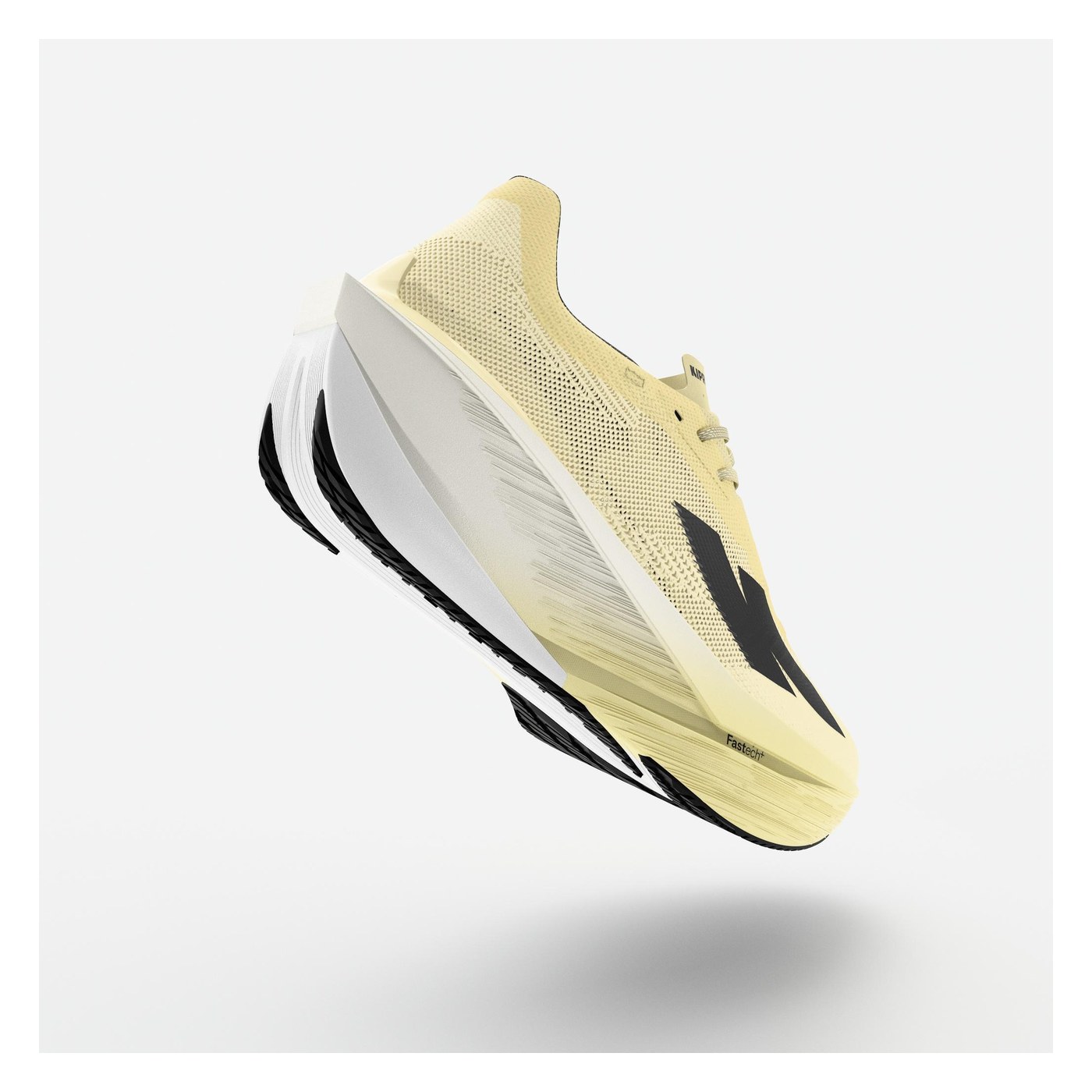
The CMEVA "pseudo plate", a denser, stiffer layer of foam inserted under the forefoot, replaces the carbon or nylon plate found in racing shoes. It partly guides the foot's roll-through without the leverage or energy return of a real plate. In practice, it adds pop at a sustained pace but doesn't create the crisp propulsive feel a carbon plate would at the same price, a gap the testers at fflose.com describe by noting that beyond 3'00 to 3'15 per kilometre, "you feel the difference" against a genuine plated shoe.
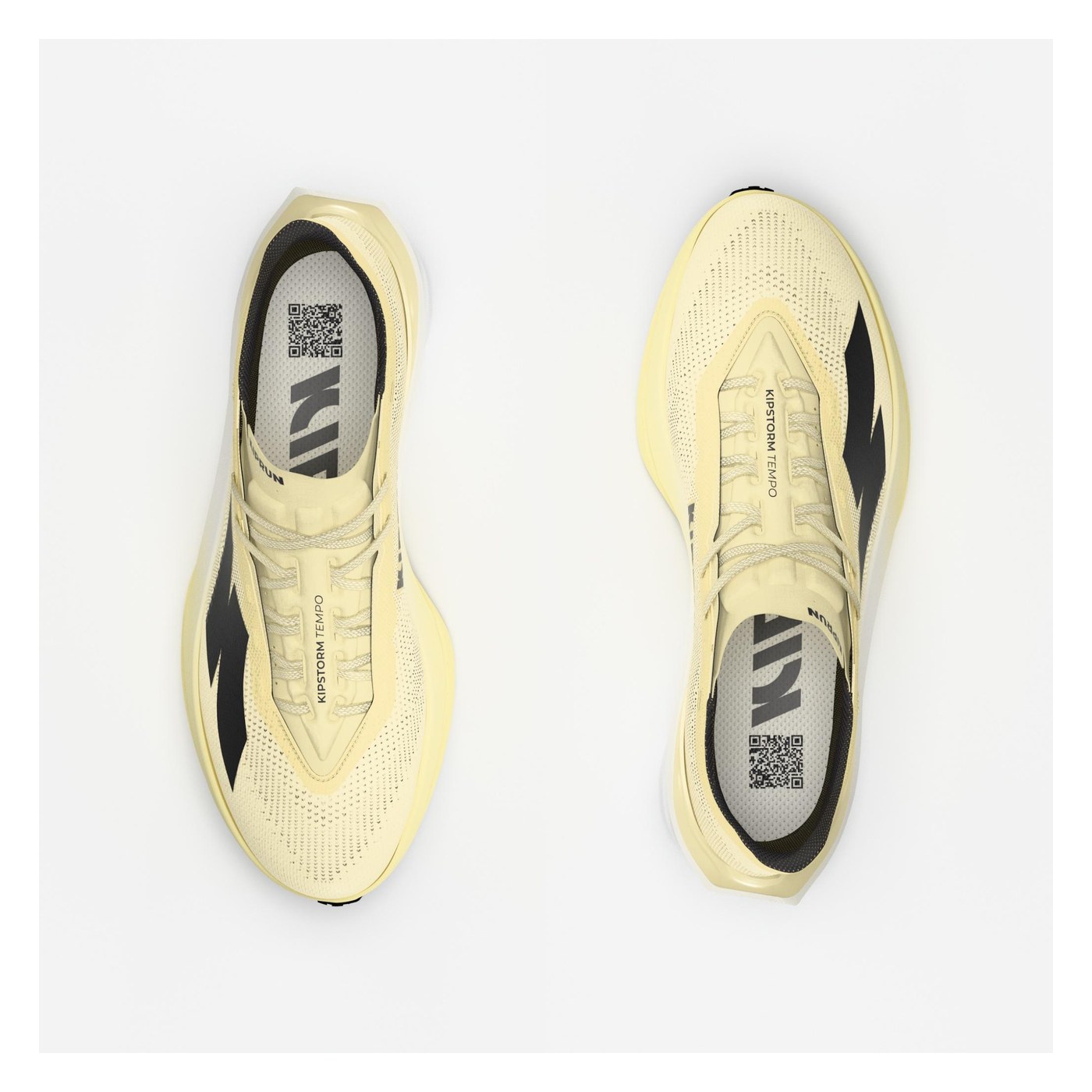
The Sockfit upper, knitted in a single piece with no traditional tongue, completes the package: it locks the foot in with even pressure rather than lace tension, which limits pressure points and makes pace changes easy without retightening your laces mid-session, a point raised independently by both fflose.com and DC Running Club.
© Kiprun, official photo used for editorial purposes
Fit: snug, and built for one type of foot
Kiprun only offers the Kipstorm Tempo in a standard width, with no wide option like some models in the brand's more affordable running range. None of the three French sources we consulted reports an independent measurement of toe box height in millimetres for this exact model: with no published lab data, RunMorph won't make one up and relies on the testers' qualitative feedback instead. The consensus is a snug, wrapping fit, in line with the shoe's fast-paced purpose: DC Running Club describes a "thin, breathable" upper that gives "the feel of a real racing shoe", while fflose.com confirms good foot lockdown "during surges, with no need to retighten the laces".
This kind of build favours narrow to normal feet. If you have wide feet, try the pair on before buying rather than relying on your usual size alone, since the brand offers no alternative width on this model.
Field test: what do runners who actually wore it say?
RunMorph's advice: if your goal is to keep your carbon-plated race shoe fresh for the big day, the Kipstorm Tempo is the natural pick to soak up your threshold and interval sessions all season long, as long as you keep another pair for your easy runs.
Three independent French reviews of this exact model were read in full for this section: fflose.com (over 100 km logged between June and July 2026, with detailed sessions), DC Running Club (track test, feel at pace), and the numerical sub-scores published by Runnea (lightness, cushioning, flexibility, responsiveness, stability, grip, each rated out of 10). A fourth, longer independent test covering 318 km by Running Pirates was identified but could not be read in full at the time of writing (access blocked), which we flag here for transparency rather than sweep under the rug.
The three sources we read agree on the essentials: the Kipstorm Tempo comes alive as soon as the pace picks up. The fflose.com tester, who usually runs 70 to 80 km a week, reports that "the faster I went, the more it seemed to get into the session", during sets like 5 x 500 metres fast followed by 2 km at threshold, or 4 x 800 metres at 5K pace. DC Running Club, which focused on track testing, notes a "quick heel-to-forefoot transition" and "reliable stability in tight bends, with no loss of snap after hard reps". Runnea gives the shoe its best score for responsiveness, 9.0 out of 10, ahead of every other criterion tested.
Where they diverge is the lower end of the usable range. fflose.com is the most precise: slower than 4'40 per kilometre, "the shoe feels unnatural", and the tester explicitly prefers the Kipride Max for easy runs. DC Running Club doesn't test that slow pace in its protocol (track and sustained paces only), so it can neither confirm nor contradict this finding, which is a limit of its test rather than a disagreement. At RunMorph, our take is that the Kipstorm Tempo was never designed for slow running, and the problem isn't the shoe but the expectation some buyers might have of a "140-euro Decathlon shoe" that does everything.
None of the three sources reports noticeable wear after more than 100 km combined, nor any manufacturing defect. That's a short-term positive, even if there's still too little hindsight to judge full lifespan on such a recent shoe.
At what pace it works, and where it falls apart
Easy runs and base endurance (slower than 4'40/km): negative verdict. The CMEVA pseudo plate, designed to transfer energy at a sustained pace, stays stiff when your stride slows down, which hurts comfort on slow runs. fflose.com puts it bluntly, preferring the Kipride Max for this use.
Long run (endurance at moderate pace): guarded verdict, as a logical extension of the previous finding. None of the three sources specifically tested a long run over an hour and a half, but the same stiffness that penalises slow running points to growing discomfort as the kilometres pile up at moderate pace, with no field data to confirm it precisely on this pair.
Marathon pace to half marathon pace (around 4'10 to 4'30/km): positive verdict. This is the zone fflose.com tested during a 14 km run alternating between 4'30 and 4'10/km, described as smooth with no sticking point.
Threshold pace (roughly 3'30 to 4'00/km): very positive verdict, this is the model's core target. The 3 x 10 minutes at threshold sessions followed by short strides, tested by fflose.com, confirm consistent responsiveness over time.
Short intervals (3'00/km and faster): positive but capped verdict. Reps of 500 m and 800 m at 5K pace go well, but beyond 3'00 to 3'15/km, the limit of the CMEVA pseudo plate against a real carbon plate starts to show, as fflose.com notes.
© Kiprun, official photo used for editorial purposes
Major flaw: slower than 4'40/km, the shoe becomes a handicap
This isn't a minor caveat buried in an overview paragraph: it's the limitation most often cited by real-world tests of the model. The CMEVA pseudo plate and the rocker geometry are designed to transfer energy at a sustained stride rate. Slower than 4'40 per kilometre, the same stiffness that makes the shoe so lively at speed becomes a brake: your foot no longer "rolls" naturally, and the ride turns harsh rather than comfortable. If most of your weekly volume is easy running, this flaw changes the buying decision in concrete terms: the Kipstorm Tempo can't be the only pair in a classic training plan, it has to be paired with a daily trainer like the Kipride Max.
Major flaw: a performance ceiling against real carbon plates
The second structural flaw, separate from the first: beyond 3'00 to 3'15 per kilometre, the Kipstorm Tempo hits its limit. Without a rigid carbon or nylon fibre plate, the CMEVA pseudo plate can't reproduce the leverage that springs your foot forward in a true racing shoe. In practice, if you're chasing a 10K time or doing very short intervals at 5K pace and faster, the gap with a carbon-plated Kipstorm Elite (80 euros more) or a lighter Saucony Kinvara 16 shows up in the final stretch. The Kipstorm Tempo remains an excellent fast training shoe, but it isn't a PB shoe.
Kipstorm Tempo vs Kipstorm Elite: which one to pick in the Kiprun lineup?
| Criterion | Kipstorm Tempo | Kipstorm Elite |
|---|
| Price | €139.99 | €219.99 |
| Weight (size 42) | 225 g | 215 g |
| Drop | 8 mm | 5 mm |
| Plate | No (CMEVA pseudo plate) | J-shaped carbon plate |
| Foam | Fastech+ | PEBA |
| Recommended use | Threshold, intervals, fast training | Racing, 10 km to marathon |
The short version: the Kipstorm Elite is the pair to save for race day, for the energy return of its PEBA foam and its J-shaped carbon plate. The Kipstorm Tempo takes over in training, so you don't burn through a 220-euro pair on weekly threshold and interval sessions. If you run one key race a year and train hard three to four times a week, you're better off investing in both complementary pairs than piling fast runs onto your only carbon shoe.
Kipstorm Tempo vs Adidas Adizero Boston 13 and Saucony Kinvara 16: head to head
| Criterion | Kipstorm Tempo | Adizero Boston 13 | Kinvara 16 |
|---|
| Price | €139.99 | €160 | €130 |
| Weight (size 42) | 225 g | 253 g | 206 g |
| Drop | 8 mm | n/a | 4 mm |
| Plate / reinforcement | CMEVA pseudo plate | Energyrods 2.0 | None |
| RunMorph score | 7.8/10 | n/a | 8.5/10 |
The short version: the Adidas Adizero Boston 13 goes further technically with its Energyrods 2.0 borrowed from the Adios Pro, but costs 20 euros more and weighs almost 30 grams more than the Kipstorm Tempo, which makes it less snappy on short intervals. The Saucony Kinvara 16, 19 grams lighter and 10 euros cheaper, remains the benchmark of the plateless segment with its RunMorph score of 8.5/10, but its narrow fit, already flagged in our review, limits it to feet even slimmer than those the Kipstorm Tempo targets. If you have normal feet and a tight 140-euro budget, the Kipstorm Tempo is an honest compromise between the two, without being the best of the three on any single criterion.
Grip and durability: what's the cost per kilometre?
The three testers we consulted agree there's no noticeable wear on the rubber or the foam after 100 to over 300 km combined (Running Pirates test identified but not read in full, see above). With no Dremel lab wear measurement for this exact model, RunMorph uses a reasoned estimate, consistent with the usual lifespan of a Fastech+ type EVA foam used for mixed road tempo work: between 500 and 600 km before a noticeable loss of bounce, a range to treat as indicative, not measured.
On that basis, the Kipstorm Tempo's cost per kilometre comes out between 0.23 and 0.28 euro per kilometre (€139.99 divided by 500 to 600 km). For comparison, the Saucony Kinvara 16, sold at 130 euros with a typical lightweight daily trainer lifespan of around 500 km, works out to about 0.26 euro per kilometre: a very similar cost, which confirms the Kipstorm Tempo's pricing is in line with the market rather than exceptionally good value once lifespan is factored in.
How do you fit the Kipstorm Tempo into your RunMorph training plan?
This shoe slots naturally into a 10K, half marathon or marathon build that includes weekly threshold and short interval sessions. The smart move: save it for the quality sessions in your plan (threshold, race pace, intervals), and keep a softer pair, like the Kipride Max, for your easy runs and long runs.
👉 Pair the Kipstorm Tempo with a RunMorph training plan built around your goal to know exactly which sessions to give it.
Our field take: who is the Kipstorm Tempo for?
If you're a regular runner already doing two or three quality sessions a week, between 3'00 and 4'15 per kilometre, and you want to preserve your race shoe, the Kipstorm Tempo is a smart buy at 139.99 euros. If you're after a single pair that does it all, from the Sunday easy run to the Tuesday intervals, it will disappoint: that's simply not what it's built for, and no bargain price will change that technical limit.
RunMorph Coach verdict
The Kipstorm Tempo keeps a precise promise rather than a broad one, and that's exactly what makes it a good shoe once you know its limits. The pop is real between 3'00 and 4'15 per kilometre, driven by well-tuned Fastech+ foam and a Sockfit upper that holds your foot without squeezing it. The price, 139.99 euros, is 20 to 80 euros lower than equally serious direct rivals. The score is weighted in favour of responsiveness and value, but penalised by genuinely limited pace versatility: that last point is what keeps it from breaking into the tier of truly great all-rounders. 7.8/10.
Kiprun Kipstorm Tempo FAQ
Is the Kiprun Kipstorm Tempo good for beginners?
No, it's not recommended slower than 4'40 per kilometre: real-world tests report an awkward stiffness below that pace, a stride profile most beginner runners haven't reached yet.
How much does the Kiprun Kipstorm Tempo cost?
139.99 euros, versus 160 euros for the Adidas Adizero Boston 13 and 219.99 euros for the carbon-plated Kiprun Kipstorm Elite.
Can the Kipstorm Tempo replace a carbon-plated racing shoe?
Not beyond 3'00 to 3'15 per kilometre: without a rigid plate, it hits a ceiling against models like the Kipstorm Elite at the fastest paces.
How many kilometres does the Kiprun Kipstorm Tempo last?
No noticeable wear is reported by the three French reviews consulted after more than 100 km. With no lab measurement, RunMorph uses a reasoned estimate of 500 to 600 km before a noticeable loss of bounce.
Does the Kiprun Kipstorm Tempo come in multiple widths?
No, standard width only, from size 40 to 47 for the men's version.