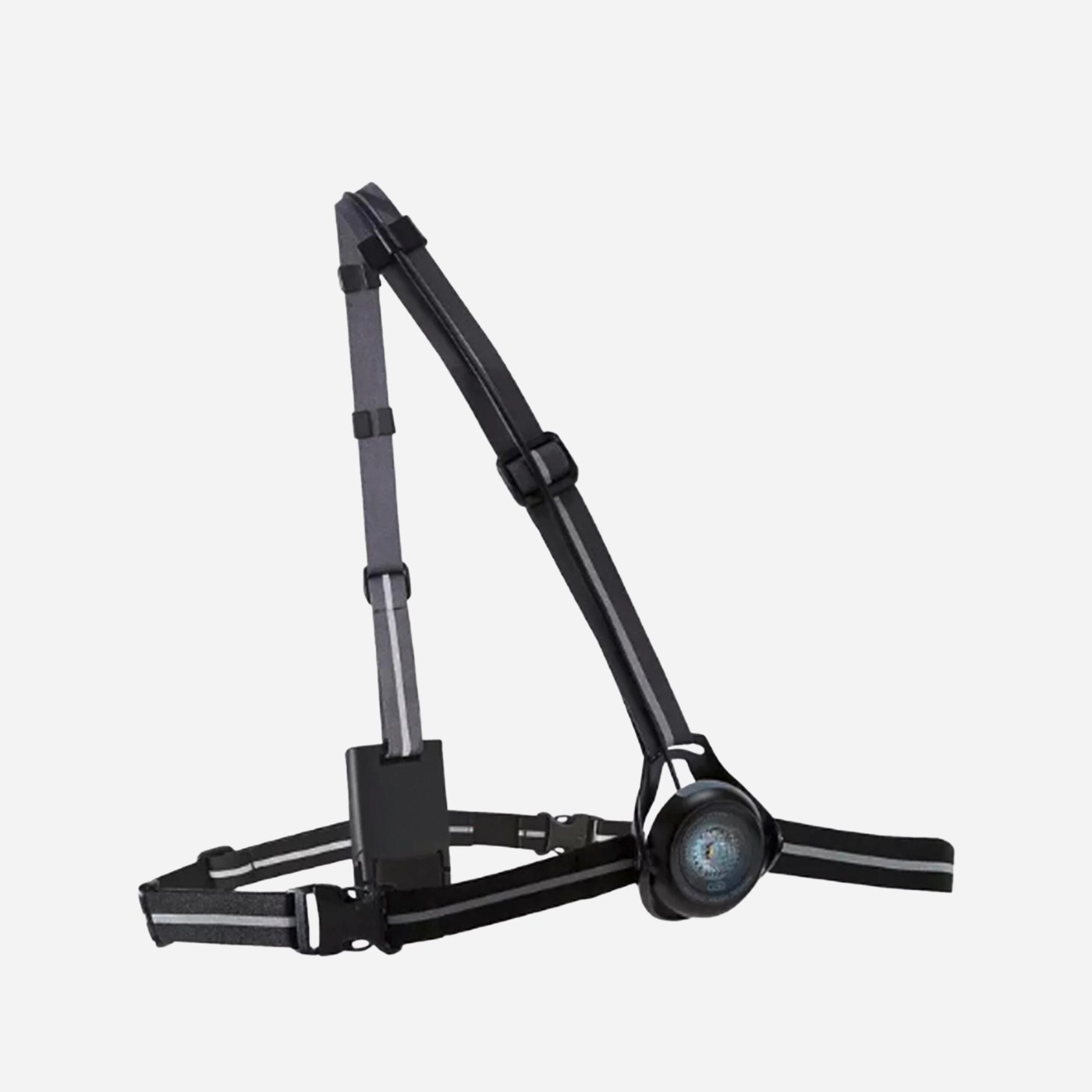
At €34.99, the Kiprun Run Light 250 goes completely against a night-lighting market dominated by the headlamp: a chest harness puts the light source at torso height instead of on your forehead. The idea came from Kalenji (now Kiprun), and no specialist brand has ever picked it up. It deserves a hard look rather than a quick dismissal: is it a genuine technical choice, or a gimmick that failed to win over the competition?
Kiprun Run Light 250 Review: The €35 Chest-Mounted Light
6.8/10
Specs
| Feature | Value |
|---|---|
| Price | €34.99 |
| Weight | 162 g |
| Power | 250 lm (max) / 125 lm (min) / 70 lm (automatic eco) |
| Range | 10 to 20 m |
| Battery life | 2.5 h at 250 lm, 5 h at 125 lm, then switches automatically to eco mode |
| Battery | 2,500 mAh, micro-USB rechargeable, 500 charge/discharge cycles |
| Water resistance | IPX4 (splashes from all directions) |
| Beam | Vertically adjustable (uphill/downhill) |
| Rear visibility | 3 flashing red LEDs on the battery pack |
| Compatible chest size | 75 to 120 cm |
| Official Decathlon rating | 4.7/5 from 1,584 reviews |
Chest light vs. headlamp: what really changes
Vincent, writing for Journal du Trail, tested the light on night runs in the forest and found two real advantages to the chest format: zero discomfort on your head, and a better read of the ground. Because the light sits off your line of sight, stones and roots cast sharper shadows. He says the effect holds up in practice, whereas a classic headlamp, aligned with your eyes, flattens those shadows and hides irregularities.
But that same offset becomes a problem as soon as the terrain gets tricky. Vincent is clear on this: "you can't aim the light the way you naturally do with a headlamp, just by turning your head." On technical trails, where you need to anticipate turns and changes of direction, that's a real issue. Benjamin, from Peche et Sac à Dos, tested the light on a 20 km night trail run and lands on exactly the same limitation in his conclusion: "I'd have preferred the same lens, the same power, but on my forehead." Two reviews, several years apart, reach the same point without comparing notes.
A product update that partly answers the criticism
One spec discrepancy deserves to be flagged, not smoothed over. Benjamin's older review mentions three power modes (250, 180 and 90 lm) and 2 h of battery life at full power. Decathlon's current official product page lists different figures: 250 and 125 lm in manual modes, 70 lm in automatic eco mode, and 2.5 h of battery life at full power. This isn't a measurement error but a real product change. Decathlon's page states explicitly that the current version (FW19) got a new battery "to meet stricter safety requirements" and dropped the backpack mount, which saw too little use. Claimed power and battery life remain unchanged from the older generation Benjamin tested.
More notable: the current product page claims a beam that is "vertically adjustable at the front to suit the runner's needs uphill and downhill." That feature directly addresses the criticism Vincent and Benjamin each raised independently: you can't aim the light. Neither review mentions it, which suggests it was added or highlighted after they tested the light. We're treating it as current official information, to be verified in use until a recent review confirms it on the trail.
A backup light, not a replacement
Both reviewers agree on the positioning: this is a supplementary light, not a headlamp replacement for demanding trail running. Vincent sums it up as "primarily designed for urban use, for anyone who wants to be seen on public roads," backed by the flashing red rear light, which stands out in town. Benjamin, in a comment added after his initial review, says he has since used it "alongside" a headlamp rather than on its own, and that he prefers it that way. The 2.5 h of battery life at full power confirms this role: not enough for a long overnight ultra trail, plenty for an easy run or a short weekday trail run.
Pros
- Very affordable (€34.99) for 250 lm of power.
- No discomfort on your head, unlike a classic headlamp.
- Better read of ground irregularities thanks to the offset light axis.
- Highly visible red rear flasher, a real safety plus for urban running.
- Beam now vertically adjustable, according to the current official product page.
Cons
- The light doesn't follow your eyes: a real, documented drawback on technical trails with turns.
- Limited battery life (2.5 h at full power), not enough for overnight ultra trails.
- Only IPX4, behind premium trail headlamps.
- Torso placement can interfere with a chest strap or a backpack, according to one of the two reviews.
The essentials in 3 sentences
The Kiprun Run Light 250 delivers on a genuine technical promise: its chest position takes the load off your head and lights up ground irregularities better. But that advantage has a downside, documented by two independent reviews several years apart: the light doesn't follow your eyes, a real problem on technical trails. At €34.99, it's an excellent backup or urban safety light, not a credible headlamp replacement for demanding night trail running.
Overall score
6.8/10
6.8/10
Who is it for?
- Urban runners who mainly want to be seen in town, with no technical terrain to deal with
- Anyone who hates the weight or feel of a classic headlamp on their head
- Tight budgets looking for a first safety light
- Use alongside a headlamp rather than on its own
Who should skip it?
- Trail runners who regularly run technical trails with tight turns
- Ultra trail runners who need several hours of continuous battery life
- Anyone already wearing a chest strap or a loaded pack on their torso
- Running in heavy rain (IPX4 only)
RunMorph verdict
The Kiprun Run Light 250 is an interesting experiment. It proves that a chest light has real advantages (comfort, a better read of the terrain), but also a structural limitation that's hard to get around: the light doesn't follow your eyes, as two reviewers documented independently several years apart. The current spec sheet claims a now-adjustable beam that could fix this flaw, still to be confirmed by a recent field test. At under €35, it remains an excellent urban safety and backup light, not a headlamp replacement if you regularly run technical trails at night.