For years, the Duro 6 was the trail pack nobody loved: respected for its build quality, written off as too heavy next to the stretch vests from pure running brands. With the S26 version, released this spring 2026, Osprey starts over. The back panel goes 360-degree stretch, the main fabric switches to bluesign® 100% recycled and PFC-free, and the weight drops to 220 g in size SM (empty). Two Hydraulics 500 mL soft flasks still come in the box, along with a stowable whistle, a key clip, 1.5 L reservoir compatibility and a price that finally lines up with the European competition. The American outdoor brand enters 2026 with the most polished version yet of its mid-distance trail vest. Here's our full review.
Osprey Duro 6 S26 Review: A 100% Recycled Vest for €145
8.5/10
Osprey Duro 6 S26: the first real overhaul of Osprey's trail vest
Osprey's Duro / Dyna line has been around for almost ten years. For most of that time, it carried a stubborn reputation: solid gear with a lifetime guarantee, but too bulky next to the vest-style packs from Salomon, Nathan or Ultimate Direction. The S26 version stops playing it safe. Osprey redesigned the harness, the back panel and the flask pockets around the codes of the minimalist race vest, while keeping what made the Duro a Duro: smart internal organization, a stitched finish and the All Mighty Guarantee.
The Duro 6 S26 targets a precise niche: runs of 2 to 6 hours, from the long Sunday easy run on singletrack to mid-distance trail races between 30 and 80 km. Light enough not to weigh you down on a climb, roomy enough to carry a jacket, gels, a beanie, gloves and a phone, it's built for the runner who wants neither the bare minimum of a 5 L race vest nor the overkill of a 12 L ultra pack.
RunMorph's advice: if you're torn between a 5 L race vest and a 10 L ultra pack, the Osprey 6 L lands right in the sweet spot. It's more practical day to day than the NNormal Race Vest 5L, which gives up the back pocket, and less bulky than the Compressport UltRun S Pack Evo 10 on short runs. Think of it as the do-it-all vest for anyone who races neither 5 km nor 100 km.
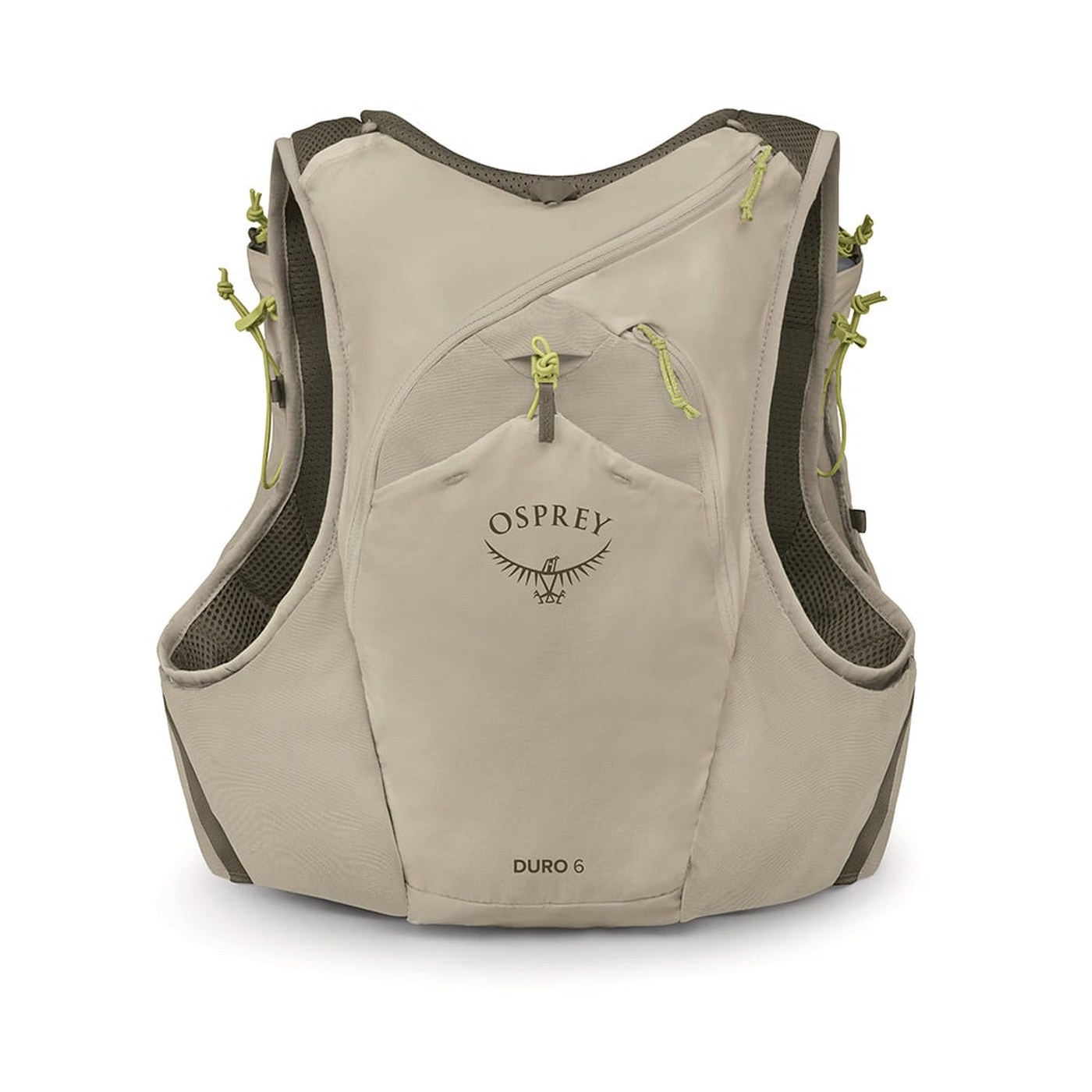
© Osprey, official photo used for editorial purposes
Objective technical specs
| Brand | Osprey |
| Model | Duro 6 (S26 collection) |
| Official release | Spring-summer 2026 (S26) |
| Colorway tested | Sandy Grey |
| Product code | DURO6FLASKS26 |
| Volume | 6 L |
| Empty weight | 220 g (SM) / 230 g (MD) / 240 g (LG) |
| Dimensions | 40 to 44 cm (H) x 35 to 41 cm (W) x 4 cm (D) depending on size |
| Available sizes | SM, MD, LG (chest 88-118 cm) |
| Women's equivalent | Dyna 6 (WS, WM, WL) |
| Front pockets | 2 flask pockets with WingStay stabilizers + elastic safety cords, 1 vertical zip pocket with stowable whistle, 6 stretch fuel pockets |
| Rear pockets | 2 low-profile zippered compartments for storage or a reservoir |
| Flasks included | 2 Hydraulics 500 mL with removable WingStay stabilizers (40 g each) |
| Reservoir compatibility | Hydraulics 1.5 L (not included) with magnetic valve attachment |
| Main fabric | 85% 70D nylon (100% recycled) + 15% elastane, bluesign® APPROVED, PFC- and PFAS-free |
| Back mesh | 100% recycled 75D polyester airmesh |
| Back panel | 360-degree structured stretch mesh |
| Side compression | Two lightweight, adjustable elastic cords |
| Pole holder | Front-mounted, lower elastic strap and stowable upper cords (compatible with the Duro Dyna Pro Quiver, sold separately) |
| Reflective details | Front and rear |
| Safety | Built-in stowable whistle, key clip |
| UTMB mandatory gear compatible | Yes, provided you add the 1.5 L reservoir for total capacity |
| Warranty | All Mighty Guarantee, lifetime |
| Official price | €145 (osprey.com/fr) |
Who is the Osprey Duro 6 S26 for?
The runner heading out for 2 to 4 hours who wants everything neatly stowed
The Duro 6's natural playground is the long run. Think a 25 km Sunday morning run with a windbreaker in the back pocket, two flasks of sports drink, a phone and three gels. Six liters is exactly what you need to never hunt for space, without hauling dead weight. Osprey's organizational rigor, inherited from its hiking packs, shines here: everything has its place, nothing rattles around.
The mid-distance trail runner targeting 30 to 80 km
On a semi-self-supported 50 km trail race, the Duro 6 holds up perfectly. The 2 Hydraulics flasks cover 8 to 12 km between aid stations, the front pole holder works one-handed on the move, and the 6 stretch pockets swallow a big handful of gels without turning your chest into a Christmas tree. The 1.5 L reservoir compatibility opens the door to short ultras (up to 80 km) if you'd rather not refill every hour.
The runner who cares about the environment and durability
A small detail that changes everything in 2026: Osprey switched every fabric on the Duro 6 to bluesign® APPROVED, with a 100% recycled 70D nylon and a 75D polyester mesh that's also 100% recycled. No PFC or PFAS treatment, certified materials and a traceable production chain. Add the lifetime All Mighty Guarantee and you've got a pack that can last ten years with zero buyer's guilt. In this segment, few competitors genuinely deliver on both fronts.
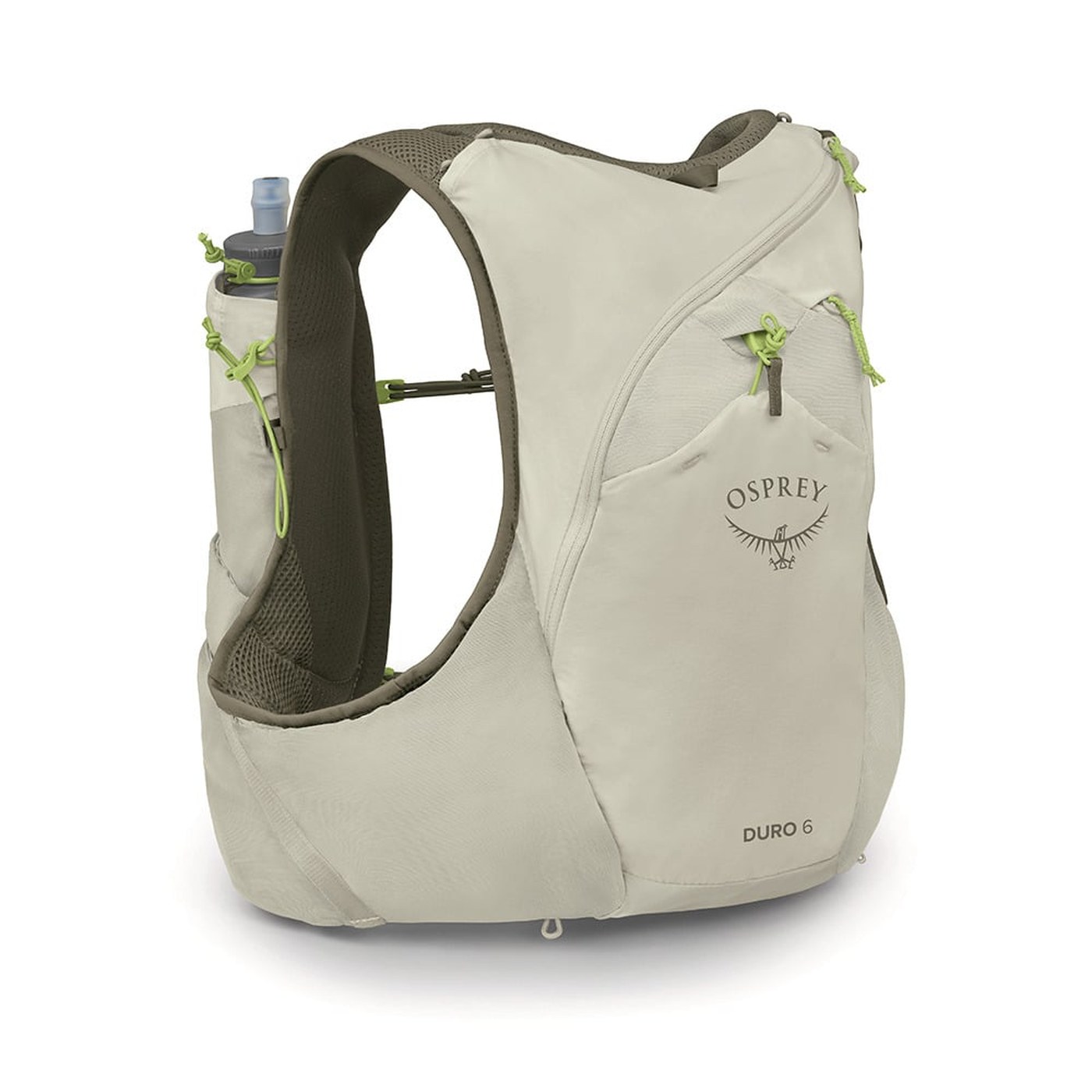
© Osprey, official photo used for editorial purposes
Comfort, bounce and secure fit
This is what changed most between the old generation and the S26. The previous Duro 6 had a segmented back panel that vented well but could pinch under effort. Osprey started from scratch: the new back is a 360-degree structured stretch mesh that spreads the load across the whole surface, with no pressure concentrated on the sternum or armpits.
The front flask pockets finally adopt the running-brand system: dual anchoring with an elastic safety cord and removable WingStay stabilizers. The result: at 220 g empty, the fit is locked down, full 500 mL flasks don't bounce, and the spring effect is gone even on technical descents. In our cadence tests on a 400 m track, the vest loaded with 2 kg didn't budge. That's a real step up from the old Duro, which swayed the moment you picked up the pace.
One thing to watch: with 3 men's sizes based on chest circumference, the fit is less precise than the micro-adjustable systems Salomon and Compressport are known for. Runners between sizes (SM/MD crossover at 94 cm, MD/LG at 108 cm) should try it on in store before buying. For women, Osprey offers the Dyna 6 with redesigned shoulder straps and harness.
Compartments and accessibility
The Duro 6 totals 11 storage spaces, well above average for 6 L race vests. Here's how it breaks down on the run:
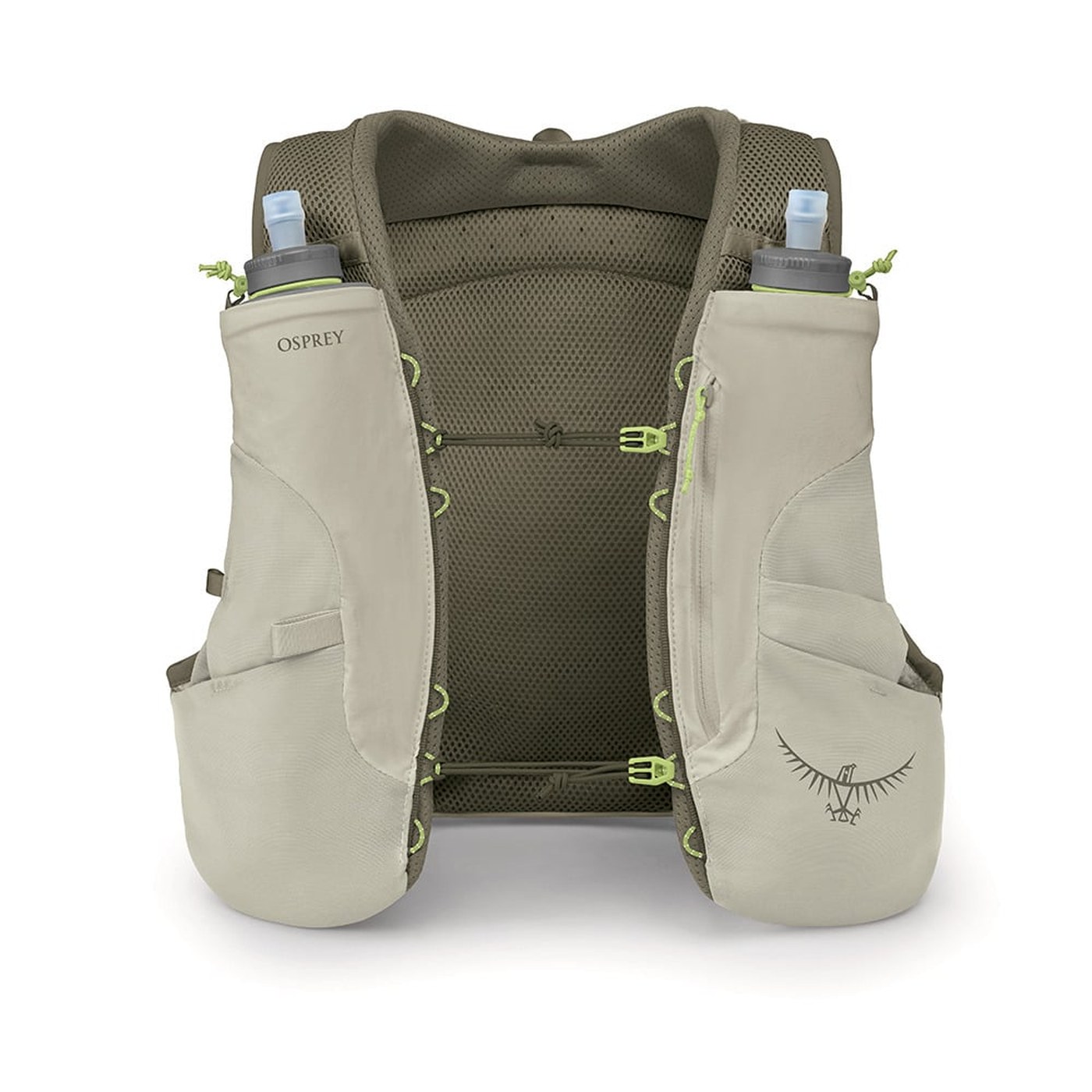
Up front, two flask pockets with elastic safety cords. Above them, six stretch mesh pockets for gels, bars and small extras, three per side. A vertical zip front pocket holds the stowable whistle and fits a smartphone up to 14 cm. An internal key clip saves you from losing your keys on a descent.
On the back, two low-profile zippered compartments: one for the UTMB-mandatory waterproof jacket (the stretch mesh swallows a 130 g Gore-Tex without distorting the silhouette), the other for the Hydraulics 1.5 L reservoir (not included). On the side sits a quick-mount front pole holder with a lower elastic strap and stowable upper cords. It's compatible with the Duro Dyna Pro Quiver, sold separately, if you want to switch to back carry on flat sections.
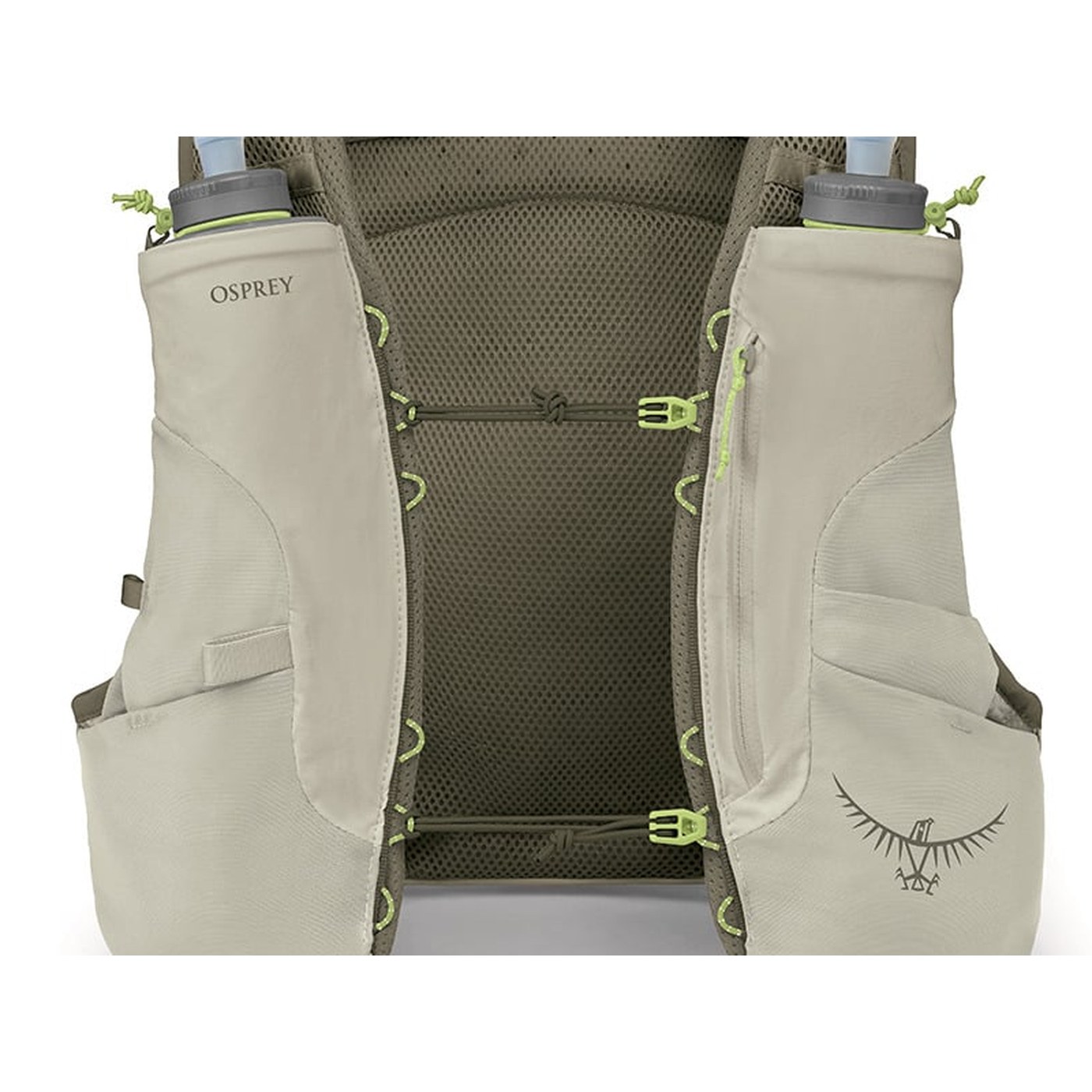
© Osprey, official photo used for editorial purposes
Hydration: the flasks + magnetic reservoir combo
Osprey ships the vest with two Hydraulics 500 mL flasks (40 g each) fitted with removable WingStay stabilizers. Soft bite valve, strong flow, reliable seal. That's 1 L within reach, enough for 8 to 12 km depending on the heat. To go further, the back compartment takes a Hydraulics 1.5 L reservoir (not included, about €35), with a detail that makes all the difference: a magnetic attachment point that holds the hose against the shoulder strap. No dangling tube, no clip to fiddle with.
Bottom line: you can switch between three setups depending on the run. Flasks only (1 L for 2 h), reservoir only (1.5 L for 3 h), or flasks + reservoir (2.5 L for 4 to 5 h self-supported). That versatility puts the Duro 6 in the same hydration class as the Salomon Adv Skin 12 or the Raidlight Ultralight 12L, without stepping up in cargo volume.
How it stacks up against the competition
In the 6 L category, the Duro 6 faces three well-known rivals.
Against the Ultimate Direction Race Vest 6L (175 g, 9 pockets, €155), the Osprey carries 45 g more but gains a far more structured 360-degree back panel, a stowable whistle and 1.5 L reservoir compatibility that the UD doesn't offer in the same format. The Duro 6 is less "skyrace", more "long easy run". Pick by profile: if you run 50 km at 12 km/h on fast, flowing trails, take the UD. If you head out for 4 h in the mountains with a jacket and poles, go with the Duro.
Against the NNormal Race Vest 5L (174 g, 6 pockets, €135), the Osprey adds 1 L of cargo and back reservoir compatibility, but loses the absolute simplicity of Kilian's ultra-minimalist vest. The NNormal remains unbeatable for short skyraces. The Duro takes over as soon as you need to carry a waterproof jacket.
Against the Salomon Active Skin 8 (270 g, about €100), the Duro 6 is more structured, more responsible in its materials, more durable, and costs €45 more. The Salomon Active Skin is still the best price-to-volume pick for short runs. The Duro bets on build quality and a lifetime guarantee.
If your focus shifts to ultra (beyond 80 km), move up to the Salomon Adv Skin 12 (244 g, 12 L, €165) or the Raidlight Ultralight 12L (200 g, Made in France, €159), which double the cargo volume for barely 20 g more.
How to fit it into your RunMorph training plan
The Duro 6 earns its place in three key phases of a road or trail training cycle. Phase one: long runs while preparing for a marathon or a mid-distance trail race, 25 to 35 km at easy pace, carrying full safety gear (jacket, whistle, emergency gel) without discomfort. Phase two: trail blocks at race-specific pace, 2 to 3 h runs with long climbs, where the front pole holder lets you switch fast between poles in hand and poles stowed. Phase three: goal races between 30 and 80 km, where 1.5 L reservoir compatibility gives you refueling flexibility.
To build these runs around the vest, the RunMorph training plans offer progressive long sessions (half marathon, marathon, short trail) that fit this vest format perfectly. Test the loaded vest on long runs from the build phase onward, not on race day, so you can dial in the size and pocket layout before the big day.
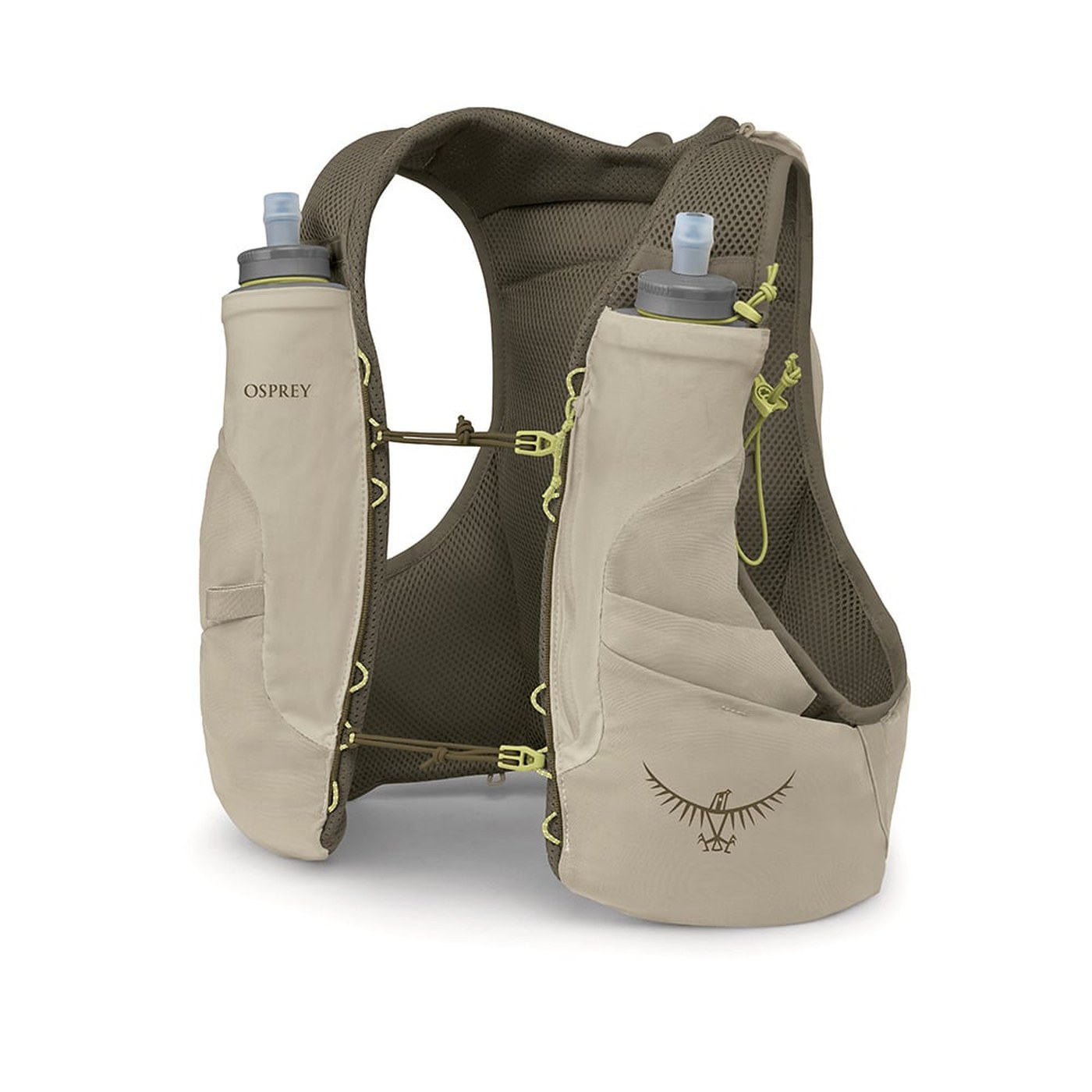
© Osprey, official photo used for editorial purposes
RunMorph verdict
With the Duro 6 S26, Osprey delivers the most polished version of its mid-distance trail vest. The generational leap is real: the 360-degree back panel finally keeps its anti-bounce promise, the bluesign® 100% recycled, PFC-free fabric puts the brand among the leaders on responsible materials, and 220 g empty brings the Duro close to the stretch vests from pure running brands. The stowable whistle, the magnetic anchor for the reservoir valve and Hydraulics 1.5 L compatibility add a level of finish you won't find anywhere else at €145.
Two reservations remain. First: only three sizes and no micro-adjust system, which penalizes runners between sizes. Second: if you're chasing the absolute lowest weight, lighter stretch vests (NNormal Race Vest 5L, UD Race Vest 6L) are still the better call for truly short formats. On the flip side, as soon as you need to carry a waterproof jacket and a reservoir, the Duro 6 takes the lead again.
Value for money holds up: €145 for a bluesign® vest with the lifetime All Mighty Guarantee, two Hydraulics flasks included and flawless finish. It costs more than an entry-level Salomon Active Skin 8, but stays consistent against the UD Race Vest 6L at €155 or the Raidlight Ultralight 12L at €159.90.
RunMorph score: 8.5/10. The Duro 6 S26 becomes a real benchmark in the 6 L segment for runners who value durability, a lifetime guarantee and cargo versatility. Skip it if you only chase featherweight gear or if you exclusively run formats under 2 h.
© Osprey, official photo used for editorial purposes
Key takeaways for your training
- Load it up on long runs during training: test the fit with 1 L of water and a jacket before the race, not on race day. Adjust it with the elastic cord, not the sternum strap.
- Pick your size by chest circumference: SM for 88-94 cm, MD for 94-108 cm, LG for 108-118 cm. If in doubt, size down: the stretch back panel makes up the difference.
- Switch to reservoir mode beyond 3 h: adding the Hydraulics 1.5 L reservoir (sold separately for €35) doubles your range without adding a pocket. Ideal for semi-self-supported 50-80 km trail races.
- Keep one back pocket for the mandatory jacket: the stretch back mesh takes a 130 g Gore-Tex without distorting the silhouette. It's the logical spot for your emergency jacket on any serious trail race.
- Use the front pole holder on long climbs: the dual system (lower elastic strap + stowable upper cords) lets you switch between poles in hand and poles stowed in under 10 seconds, mid-race.