All reviews
September 4, 2026

Suunto 9 Peak Pro: the full RunMorph review

7.6/10
Suunto 9 Peak Pro: the full RunMorph review

Suunto built its own in-house rival. When the Finnish brand launched the Race in 2023 with its big Amoled screen and color maps, the 9 Peak Pro, released a year earlier, could have quietly vanished from the shelves. It's still here, still being tested by the French press in 2026, and its price has been cut in half since launch. RunMorph hadn't published a review of this model yet, even though almost the entire rest of the Suunto lineup (Race, Race 2, Race S, Run, Vertical, Vertical 2) is already in our catalog. Time to fix that, with a watch that raises one simple question: are a slim case and long battery life still enough against newer, better-equipped rivals?

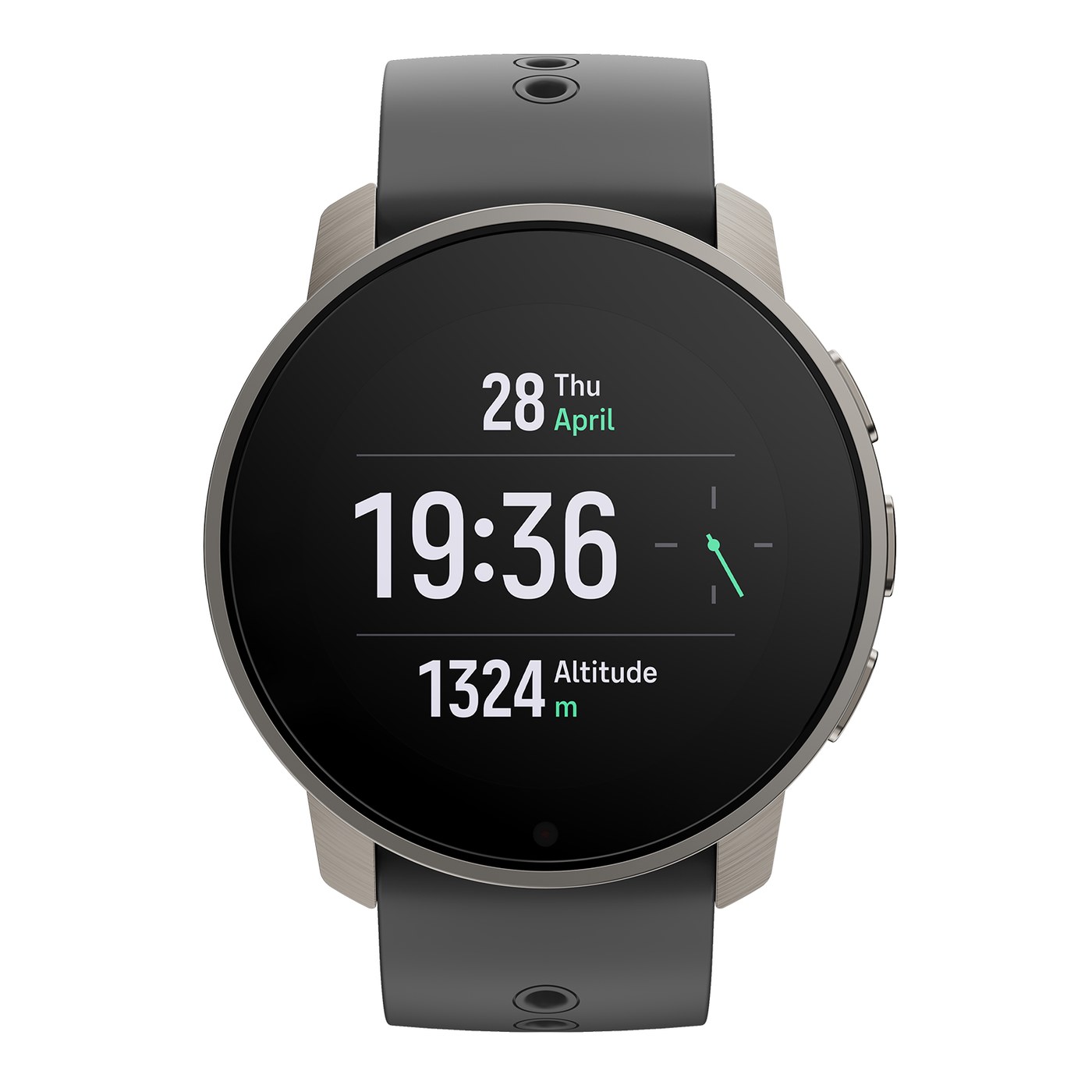
Suunto 9 Peak Pro, main watch face showing altitude

© Suunto, official photo used for editorial purposes

The essentials in 3 sentences

The Suunto 9 Peak Pro is a multisport watch in titanium or steel, ultra-thin (10.8 mm) and built to last (up to 70 hours of GPS tracking in Endurance mode), designed for trail running, triathlon and outdoor hiking. It targets the runner who wants accurate GPS and a watch that survives a multi-day ultra without charging, not the one looking for a big color screen or onboard maps. Independent tests confirm the battery and toughness claims, but the 1.2-inch screen and the lack of maps now put it behind its own replacement, the Suunto Race.

7.6
/ 10 · RunMorph overall score
GPS accuracy
8.0 / 10
Battery life
9.0 / 10
Maps
1.5 / 10
Metrics and recovery
6.5 / 10
Toughness and finish
9.0 / 10
Value for money
8.0 / 10
Who is it for?The trail runner or triathlete who wants a thin, light watch on the wrist for a multi-day ultra, without ever worrying about the battery.
Who should skip it?The runner who wants to read a topo map right on the wrist or enjoy a big, bright Amoled screen: the Suunto Race does that job better.

Suunto 9 Peak Pro: the watch Suunto is easing out, but the French press keeps recommending

Since 2023, the Suunto lineup has been reorganized around three families built for trail and outdoor multisport: Race, Vertical and 9 Peak Pro. The first two got recent successors (Race 2, Vertical 2), while the 9 Peak Pro, launched on October 25, 2022, was never directly replaced: it was simply nudged toward the exit by the arrival of the Race, cheaper at launch (€449) and packing an Amoled screen and color maps it never had.

The Mangeurdecailloux blog, which tested the watch in real-world conditions, sums up the situation bluntly in the 2026 update of its review.

"Since this review was written, the Suunto Race has joined Suunto's GPS watch lineup, and I choose to recommend the newcomer. The Suunto 9 Peak Pro sold for €500 (and €630 in titanium) at launch. But watch out for the big 30% discounts that now bring its price down to around €299."

A discount of nearly half the launch price, on a watch that three independent French testers still describe as reliable and accurate in 2026. That gap between a second-choice commercial status and technical qualities still validated in the field is exactly why this review exists.

Suunto 9 Peak Pro specs

BrandSuunto
Model9 Peak Pro (Titanium Slate colorway)
Official releaseOctober 25, 2022
Case43 x 43 x 10.8 mm
Weight55 g (titanium) / 64 g (steel)
ScreenColor transflective MIP touchscreen, 1.2 inch, 240 x 240 px, sapphire glass
GPS battery life40 h (Performance mode) / 70 h (Endurance mode) / 300 h (Tour mode)
Watch battery life21 days (HR on) / 30 days (HR off)
GNSSMulti-GNSS, 4 systems simultaneously (GPS, Glonass, Galileo, QZSS), up to 32 satellites, no dual-frequency
SensorsLifeQ optical HR, SpO2, barometric altimeter, compass, thermometer, depth gauge
MapsNone (breadcrumb trail and heatmaps via the app)
Sport profilesAbout 115
Onboard musicNo (smartphone control only)
Contactless paymentNo
Water resistance100 m, MIL-STD-810H military standard
Launch price€499 (steel) / €629 (titanium)
Street price in 2026From €299

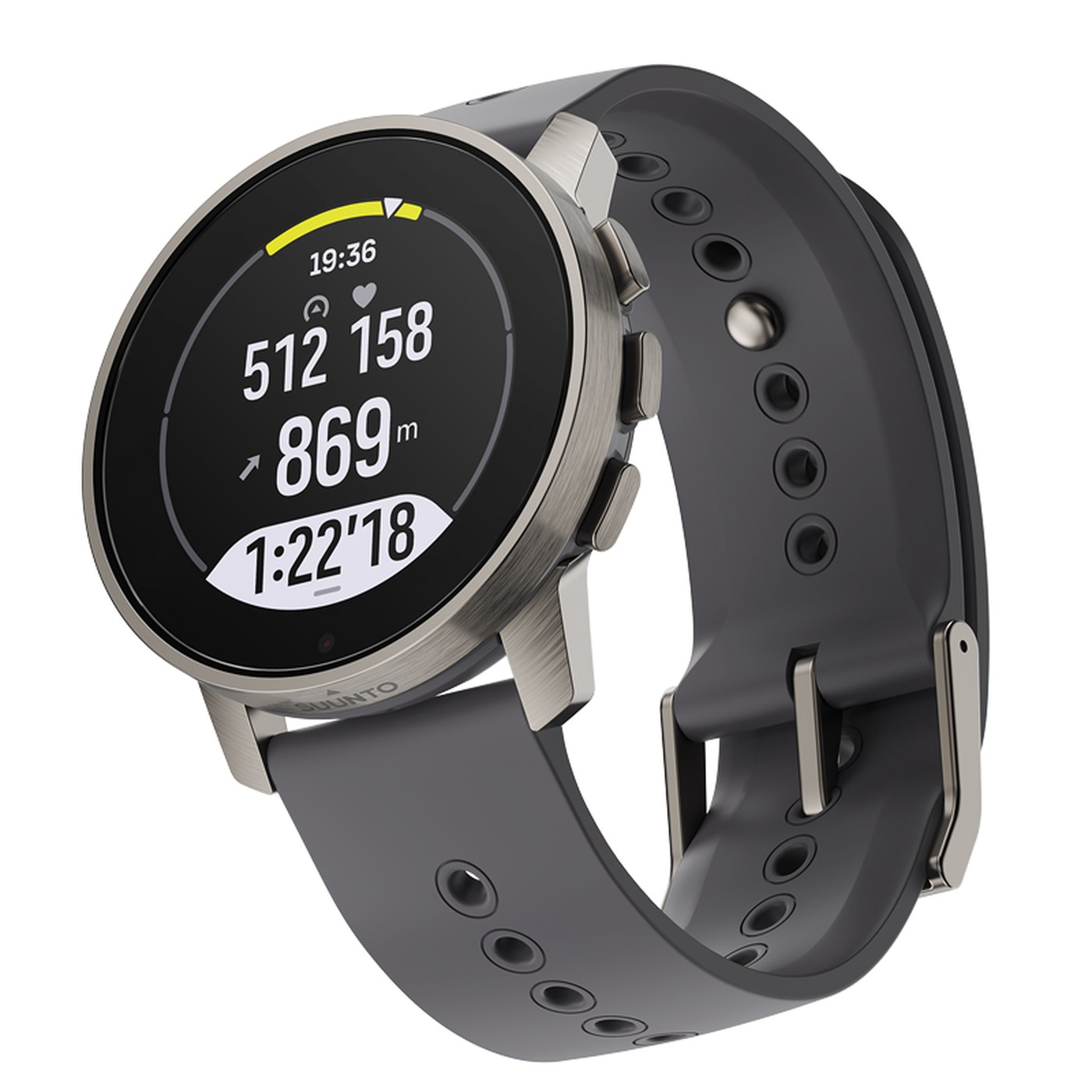
Suunto 9 Peak Pro, side view showing the buttons and strap

© Suunto, official photo used for editorial purposes

Multi-GNSS without multiband: what it really changes in the field

The 9 Peak Pro's GPS chip connects to four satellite systems at once (GPS, Glonass, Galileo, QZSS) and up to 32 satellites, versus 12 on the original Suunto 9 Peak. It stays single-frequency though: unlike the Suunto Race 2 or the latest Garmin and Coros watches, it doesn't pick up the L5 signal on top of L1, which in theory limits its ability to correct signal bounce in cities or under dense cover.

In practice, the measured gap is small. Sport-Passion compared the 9 Peak Pro's GPS track with that of a Garmin Forerunner 255 (multiband reference) on several routes in town and in the forest: cumulative distance gaps stay under 1% in the forest and under 0.5% in open terrain, roughly 200 m over a marathon. On elevation, the same test shows gaps of 1 to 8 m depending on the route, on climbs ranging from 45 to 179 m. Journal du Trail, after five months of use, points the same way: the track stays clean and instant pace stable, even in Endurance mode (sampling reduced to one fix every half-second to push battery life to 70 hours).

RunMorph's tip: on a technical course with lots of tree cover or urban canyon sections, go for Performance mode (40 h) rather than Endurance mode to keep the finest GPS sampling. The battery difference really only matters on outings longer than 20 hours, like an ultra similar to the one we tested with the Coros Vertix 2S.

Field test: from a 10 km run to a multi-day trail

The three French reviews read for this article cover very different uses, from urban easy runs to ultras, and they agree on the essentials despite different protocols.

Sport-Passion ran the most instrumented test, with a head-to-head comparison against a Forerunner 255 over several runs in town and in the forest. The LifeQ optical HR sensor, compared with a Garmin HRM-Dual chest strap, delivers results rated as decent for walking and running, with a few occasional dropouts flagged by the tester. The verdict praises the elegance and thinness of the case, the accuracy of the GPS and altimeter, and regrets the lack of maps and multiband GPS.

Journal du Trail used the watch for five months before publishing its full review, with a score of 4.25 out of 5. The standout is day-to-day reliability: battery life in line with the claims, a smoother interface than on the Suunto 9 Peak thanks to the new processor, and a running power feature judged consistent with the effort. The unanimous weak point: a 1.2-inch screen already lagging behind the competition at the time of the test, and even more so since Suunto itself switched to Amoled.

The Mangeurdecailloux blog, after two months on the wrist, is more nuanced: the tester, 47 at the time of writing, reports personal difficulty reading the 240 x 240 px screen mid-activity, while confirming GPS accuracy "noticeably better" than on his old Suunto Spartan Ultra and a battery that lasts a full week of training between two quick charges of a few minutes.

Opinions mainly split on screen readability: excellent in sunlight for Sport-Passion, decent for Journal du Trail, which calls it "noticeably outdated", more of a struggle for Mangeurdecailloux over long sessions. At RunMorph, we think this split has less to do with the watch than with the tester's age and eyesight: on a screen this size, a 3 or 4 data field layout is the most comfortable, and beyond 5 fields reading on the move gets harder whatever your age.
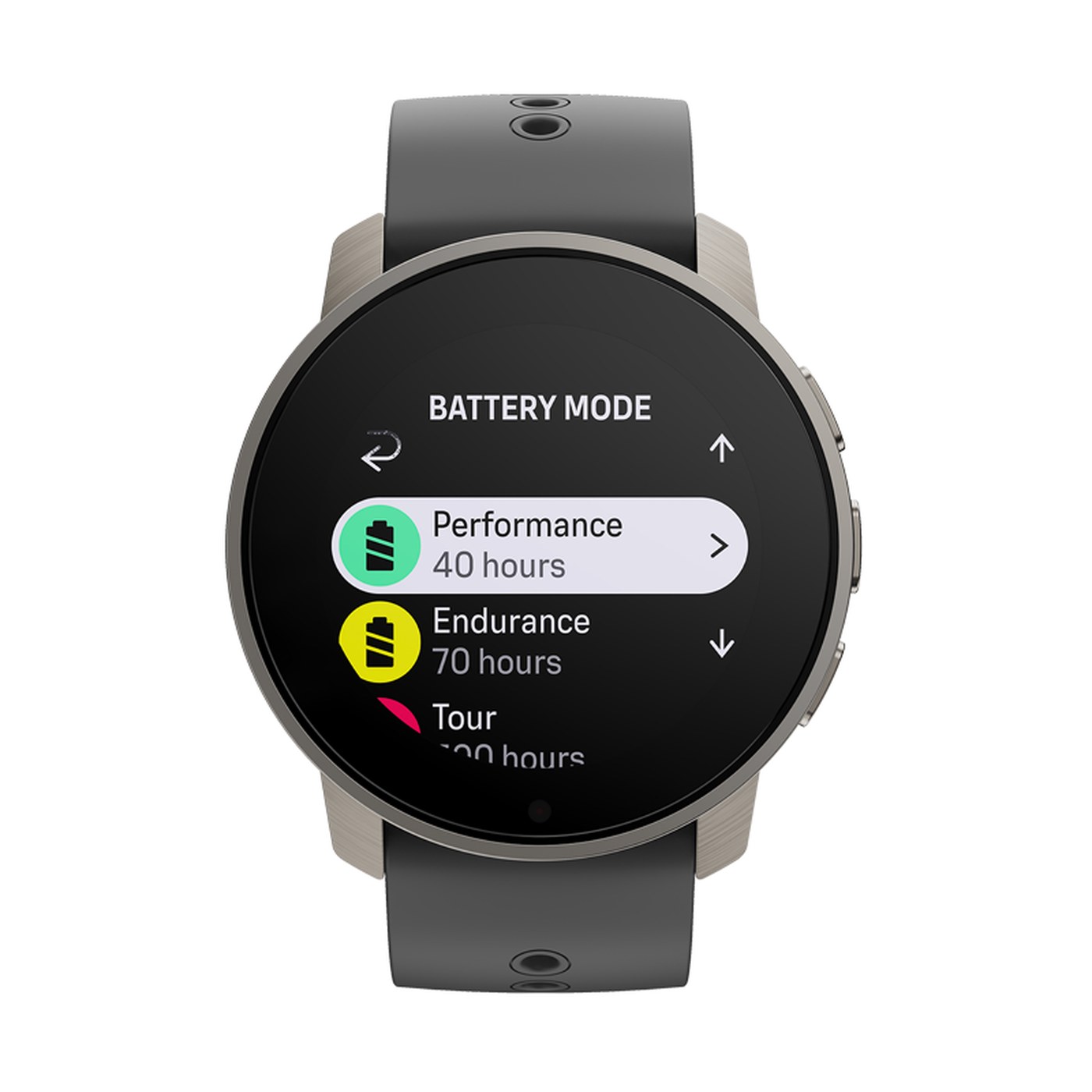
Suunto 9 Peak Pro, battery mode screen showing Performance, Endurance and Tour

© Suunto, official photo used for editorial purposes
No maps: what's the impact for trail running and hiking?

The 9 Peak Pro has never had onboard topo maps, unlike the Suunto Vertical or the Suunto Race 2. Navigation relies on a breadcrumb trail: a dotted line showing the path covered, combined with pre-loaded route following with turn-by-turn guidance and off-route alerts beyond 100 m. Sport-Passion notes that the watch handles complex routes well, including unexpected changes of direction, but that the full-screen guidance prompts temporarily hide the track, forcing you to close the screen to get it back.

For a trail runner used to checking a color topo map on the wrist, like on a Garmin fenix or a recent Suunto Race, this takes some getting used to. For a run on an already marked route or one planned ahead in the Suunto app, on the other hand, the breadcrumb trail does the job in the vast majority of cases and spares the battery compared with rendering color maps.

Suunto 9 Peak Pro vs Suunto Race: the comparison

The Suunto Race took over as the lineup's affordable flagship in 2023, with more aggressive launch pricing (€449 versus €629 for the titanium 9 Peak Pro).

Suunto 9 Peak ProSuunto Race
ScreenMIP 1.2", 240x240 pxAmoled 1.43", brighter
MapsNoneColor, onboard
Max GPS battery life70 h (Endurance)50 h (standard GPS)
Thickness10.8 mmThicker
Launch price€499-629€449
Street price 2026From €299Around €400

The simple takeaway: if you want to read a color map on the wrist or enjoy a brighter screen, upgrade to the Race. If you value a slim watch and longer battery life in Endurance mode, and you find a used or discounted 9 Peak Pro under €350, you can keep or pick this model with no major technical regret, just a smaller screen.

Suunto 9 Peak Pro vs Coros Apex 2 Pro and Garmin Instinct 3 Solar: the comparison

Suunto 9 Peak ProCoros Apex 2 ProGarmin Instinct 3 Solar
ScreenMIP 1.2"Amoled touchscreenSolar MIP
Titanium caseYes (option)YesNo
MapsNoNoNo
Solar chargingNoNoYes
Military standardMIL-STD-810HNot disclosedMIL-STD-810

Against these two direct rivals in the rugged outdoor segment, the 9 Peak Pro remains the thinnest of the three (10.8 mm), a real plus if you find outdoor watches bulky for everyday wear. The Coros Apex 2 Pro wins on readability thanks to its Amoled touchscreen. The Garmin Instinct 3 Solar wins on theoretical battery life thanks to solar charging, but in a polymer case that feels less refined than the Suunto's titanium or steel.

Suunto 9 Peak Pro pros and cons

Pros
  • Ultra-thin 10.8 mm case and light weight (55 g in titanium), rated comfortable by all three French testers we read
  • Up to 70 hours of battery life in Endurance mode, more than the 50 hours of the Suunto Race that replaced it
  • GPS accuracy confirmed close to a multiband reference, with under 1% distance gap in the forest according to Sport-Passion
  • MIL-STD-810H certified toughness and premium materials (sapphire, titanium)
  • Street price halved since launch (from €299)
Cons
  • 1.2-inch screen called "noticeably outdated" by Journal du Trail, hard to read on the move for some users according to Mangeurdecailloux
  • No onboard maps, just a breadcrumb trail
  • Single-frequency GPS, without the dual L1+L5 signal of the latest multiband watches
  • Bare-bones smart features: no onboard music or contactless payment
  • Now a secondary model in Suunto's commercial strategy, behind the Race

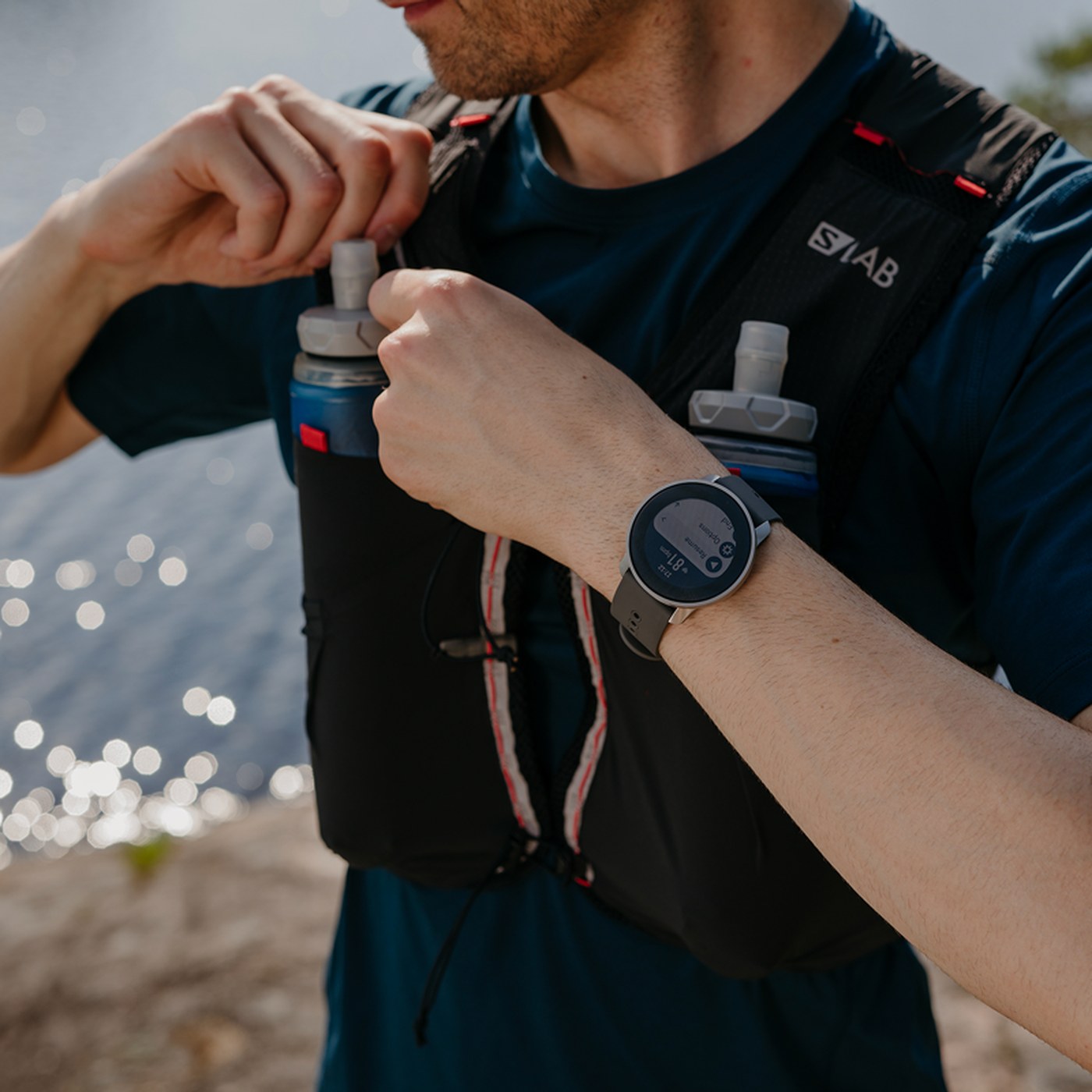
Suunto 9 Peak Pro worn on the wrist during a trail run with a hydration vest

© Suunto, official photo used for editorial purposes
Our field take: who is the Suunto 9 Peak Pro still right for in 2026?

The 9 Peak Pro is first and foremost for the runner or trail runner who puts a slim wrist profile and battery life ahead of screen readability. For an ultra-trail or a multi-day trek, its 70 hours of battery in Endurance mode cover you comfortably without charging, where an Amoled watch requires more careful display settings to go the distance. For a road marathon or half marathon, where battery life is never the limiting factor, the lack of maps and the modest screen weigh more heavily against newer rivals.

RunMorph verdict

The Suunto 9 Peak Pro delivers on its promises: GPS accuracy close to multiband despite a single-frequency chip, battery life better than its own replacement, and a titanium and sapphire finish rarely matched in such a slim format. But it also carries the limits of a model Suunto has stopped pushing since 2023: a 1.2-inch screen that two of the three testers we read call outdated, and a total lack of maps that rules it out for trail runners used to navigating on a color map.

At the €629 titanium launch price, the score would be harsher against a €449 Suunto Race that does better on screen and maps. At the 2026 street price of €299 to €349, the equation changes: it's one of the thinnest and longest-lasting outdoor watches on the market at this price. 7.6/10, a score that rewards toughness and battery life rather than feature richness.

Key takeaways for your training

  • 70 hours of GPS battery life in Endurance mode: enough to cover a multi-day ultra without charging, versus 50 hours on the Suunto Race that replaced it in the lineup.
  • Under 1% measured distance gap against a multiband GPS reference in forest tests, accurate enough to dial in your training paces.
  • No onboard maps: plan your routes ahead in the Suunto app before heading into unfamiliar terrain.
  • Fast charging: ten minutes on the charger gets you back about 10 hours of battery, handy at an ultra life base.
  • Price halved since 2022: from €299 in 2026, versus €629 at launch in titanium.

FAQ

Is the Suunto 9 Peak Pro a good fit for beginner runners?

It offers around 115 sport profiles and full tracking (VO2max, training load), but without guided coaching as accessible as on some Garmin watches. A beginner can use it, as long as you accept an interface that's a bit less beginner-friendly than elsewhere.

What real battery life can you expect for trail running?

All three reviews we read confirm the claimed figures: 40 hours in Performance mode and up to 70 hours in Endurance mode, with a slight loss of GPS accuracy in the latter that Journal du Trail found negligible on its usual routes.

Should you pick the Suunto 9 Peak Pro or the Suunto Race in 2026?

The Race wins on the Amoled screen and color maps for €449 at launch. The 9 Peak Pro wins on thickness (10.8 mm) and maximum battery life (70 hours versus 50), at a price now under €350.

Is the Suunto 9 Peak Pro waterproof for swimming?

Yes, down to 100 m, with a swim profile among its hundred-plus sport profiles. The built-in depth gauge is mainly aimed at freediving and snorkeling, down to 10 m.

How much does the Suunto 9 Peak Pro cost today?

Between €299 and €349 depending on promotions in 2026, versus €499 (steel) and €629 (titanium) at launch in 2022, a drop of 44 to 52%.

← Back to reviews