August 27, 20262XU Light Speed Compression Tights: the full RunMorph review
7.4/10
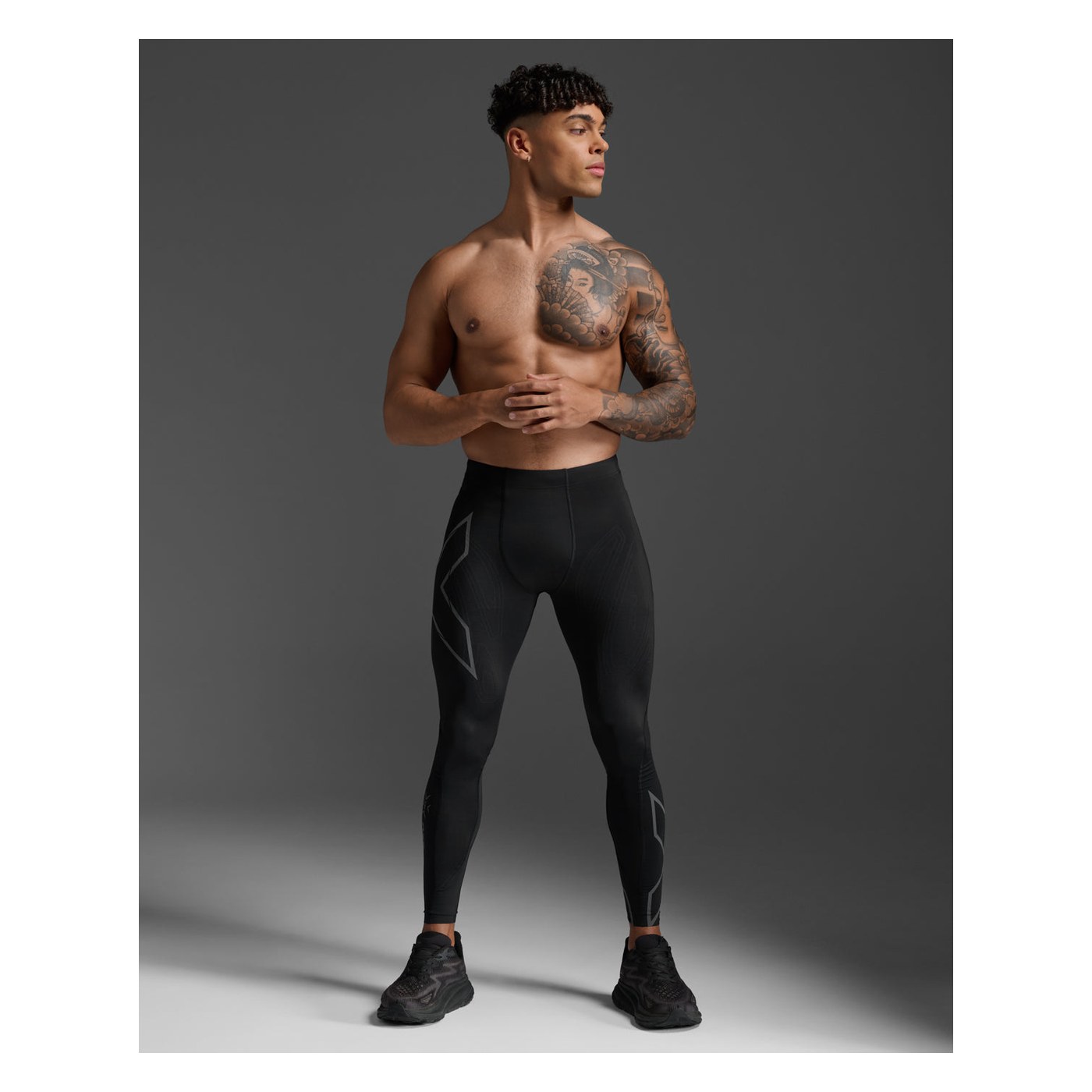
2XU treats graduated compression as a science, while most tights on the market settle for fabric that simply hugs the leg. The Light Speed Compression Tights have carried that promise since 2021, under a name that replaced the old MCS Run without changing the core technology. RunMorph put that promise up against feedback from runners who actually wore them, both on the run and for recovery.
© 2XU, official photo used for editorial purposes
The essentials in 3 sentences
The Light Speed Compression Tights target the quads and calves with firm compression fabric (23 to 25 mmHg), built on the patented MCS technology. They are made for runners who want to cut muscle oscillation on long runs, not for short sessions or hot days. At €129.99, with no entry-level version in the brand's running line, they are for a runner already sold on compression, not for someone still on the fence.
7.4
/ 10 · RunMorph overall score
Targeted compression
9 / 10
Who is it for?Long-run runners (half marathon, marathon, ultra) looking to limit muscle soreness, and runners over 1.85 m thanks to the 5 Tall sizes.
Who should skip it?Runners who mostly do short intervals or run in high heat, where firm compression over the whole leg becomes a thermal handicap.
2XU vs Compressport: compression as the core business, not one line among many
In running, compression long remained a segment held by a handful of specialist brands: Compressport in France, 2XU in Australia, CEP in Germany. RunMorph has already published several Compressport reviews (a jacket, a pair of shorts, a technical tee), but no 2XU tights, even though the Australian brand has built its business exclusively on compression since 2005, not as a side range next to shoes or jerseys.
The Light Speed Compression Tights embody that identity: tights that don't try to win you over with style, but with patented targeted compression, the MCS system. The commercial name changed in 2021 (the product was called MCS Run back then), and the core technology hasn't moved since.
2XU Light Speed Compression Tights: specs
| Brand | 2XU |
| Model | Light Speed Compression Tights (formerly MCS Run, renamed in 2021) |
| Version tested | Men's (a women's version exists, with a different cut) |
| Compression | Firm, 23 to 25 mmHg |
| Technology | MCS (Muscle Containment Stamping) |
| Fabric | PWX |
| Weight (size M) | 200 g |
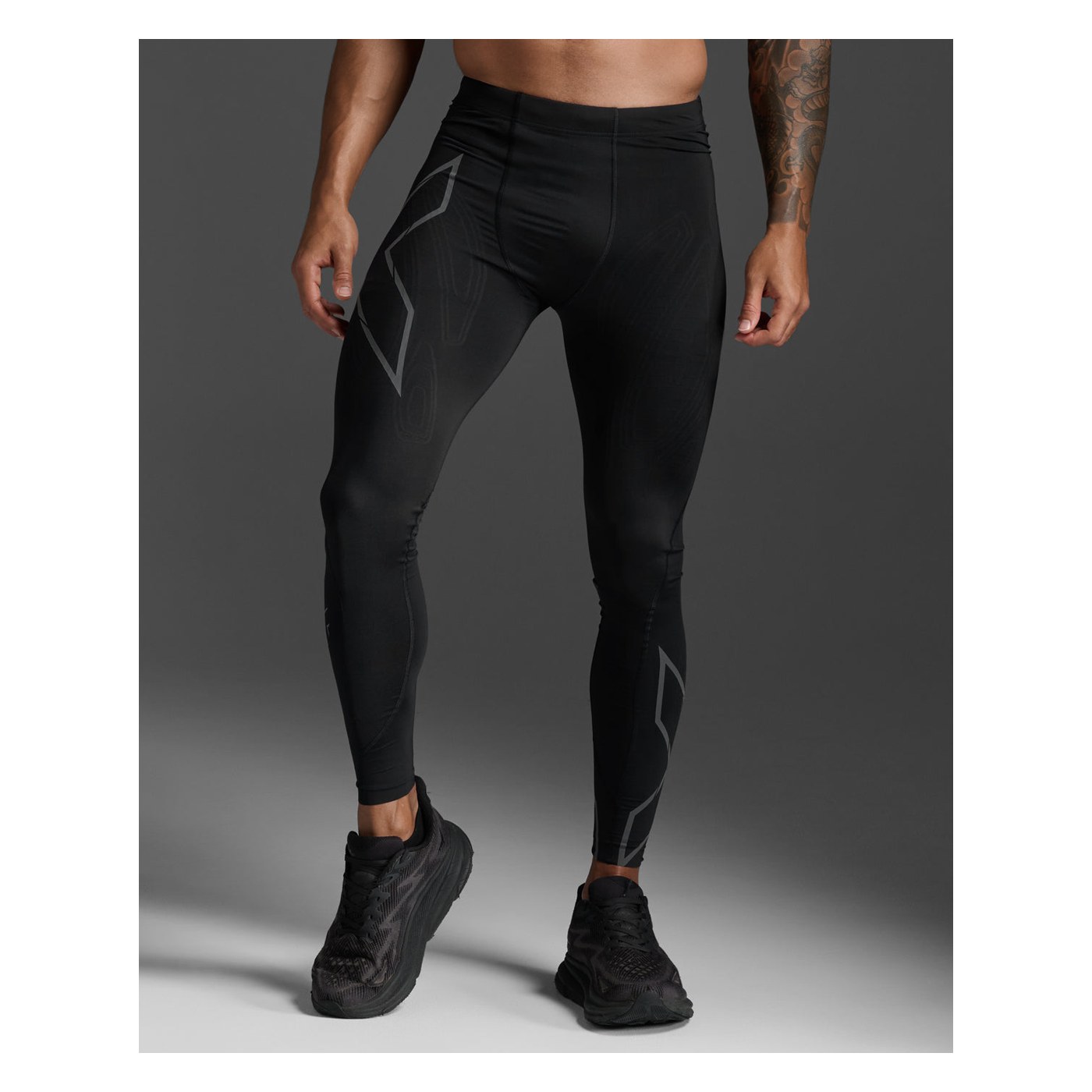
| Storage | Mesh pocket, phone pocket and zip pocket, at the waist |
| Sizes | XXS to XXXL, plus 5 Tall sizes (ST to XXLT) |
| Colour tested | Black / Black reflective |
| Official price in France | €129.99 |
© 2XU, official photo used for editorial purposes
MCS: targeted compression, not uniform compression
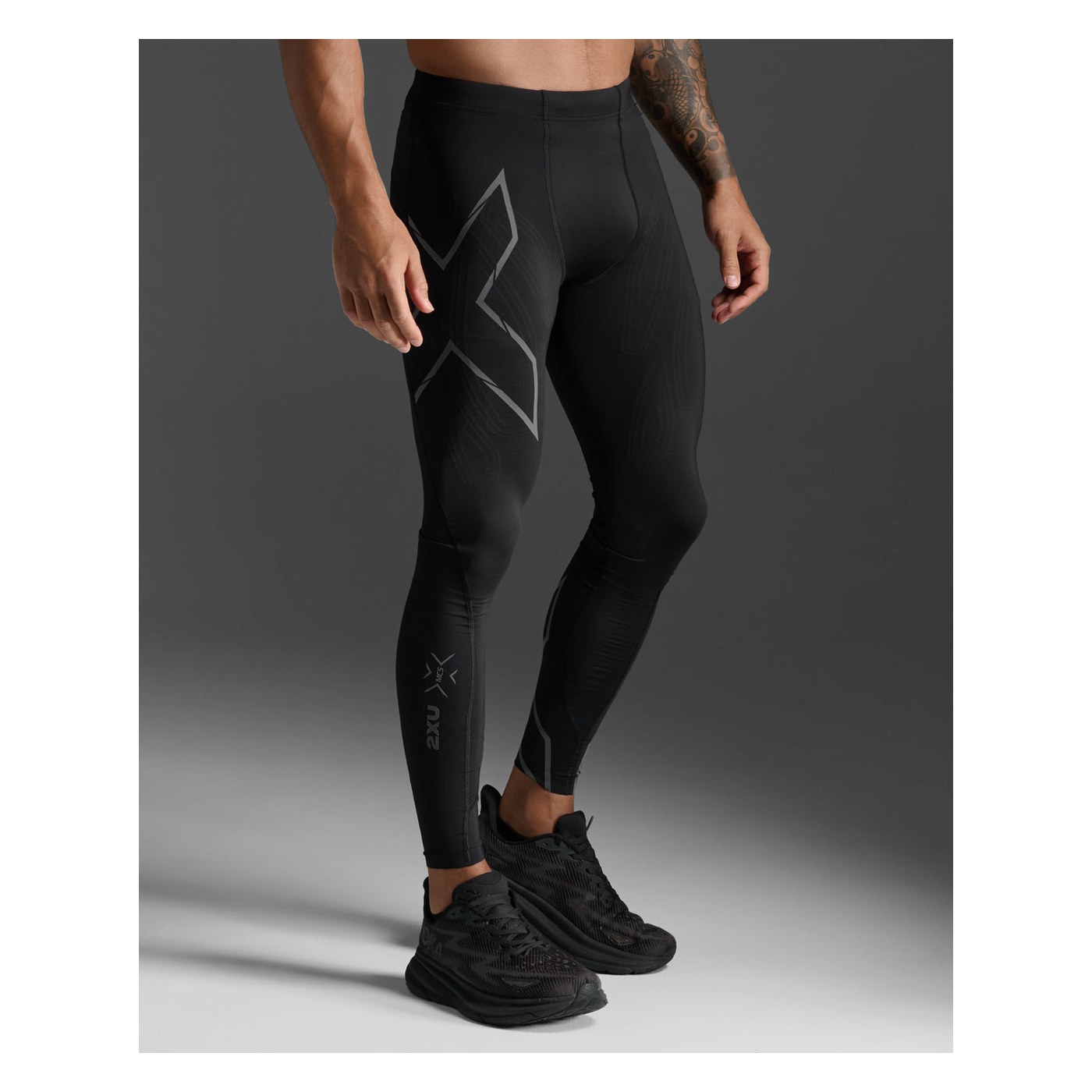
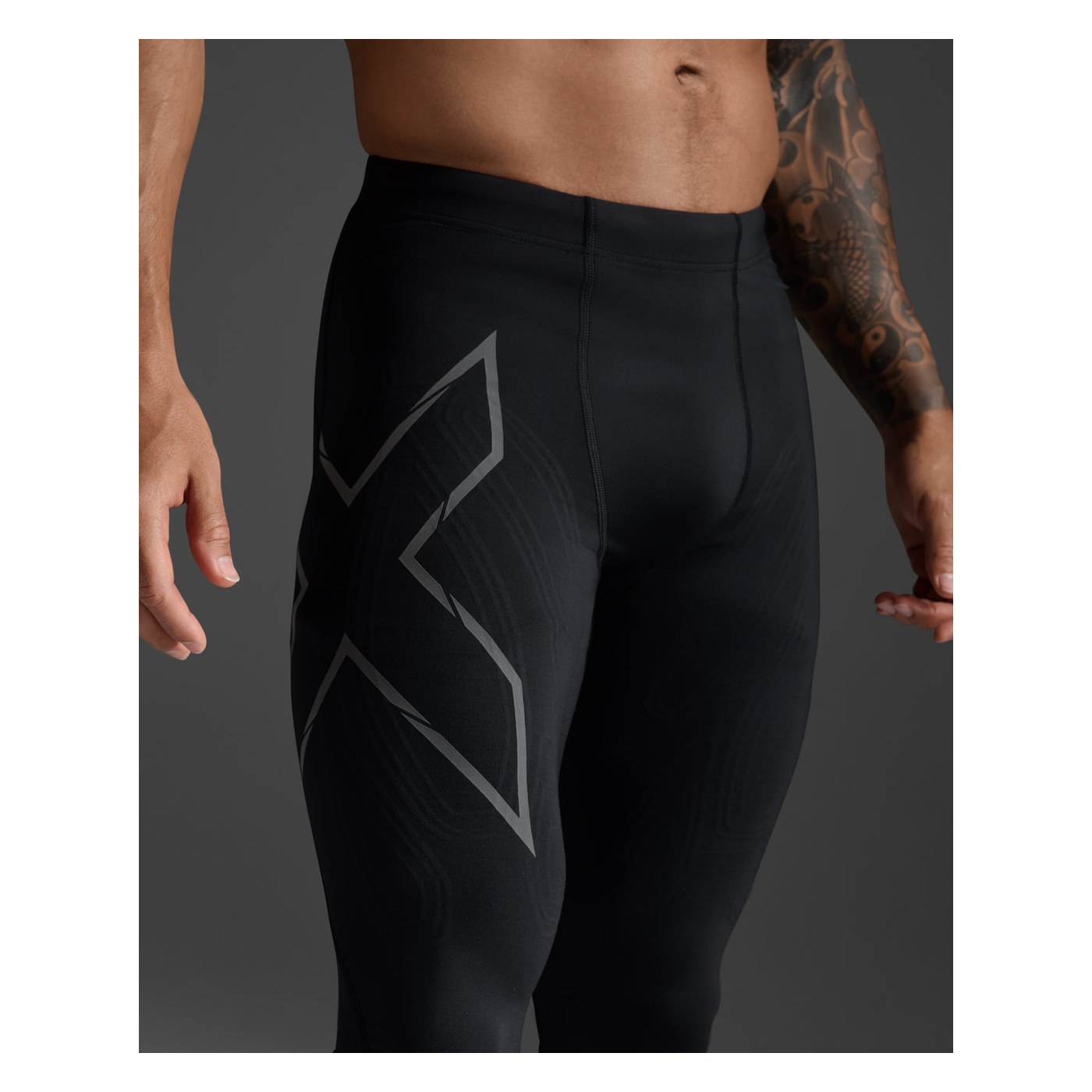
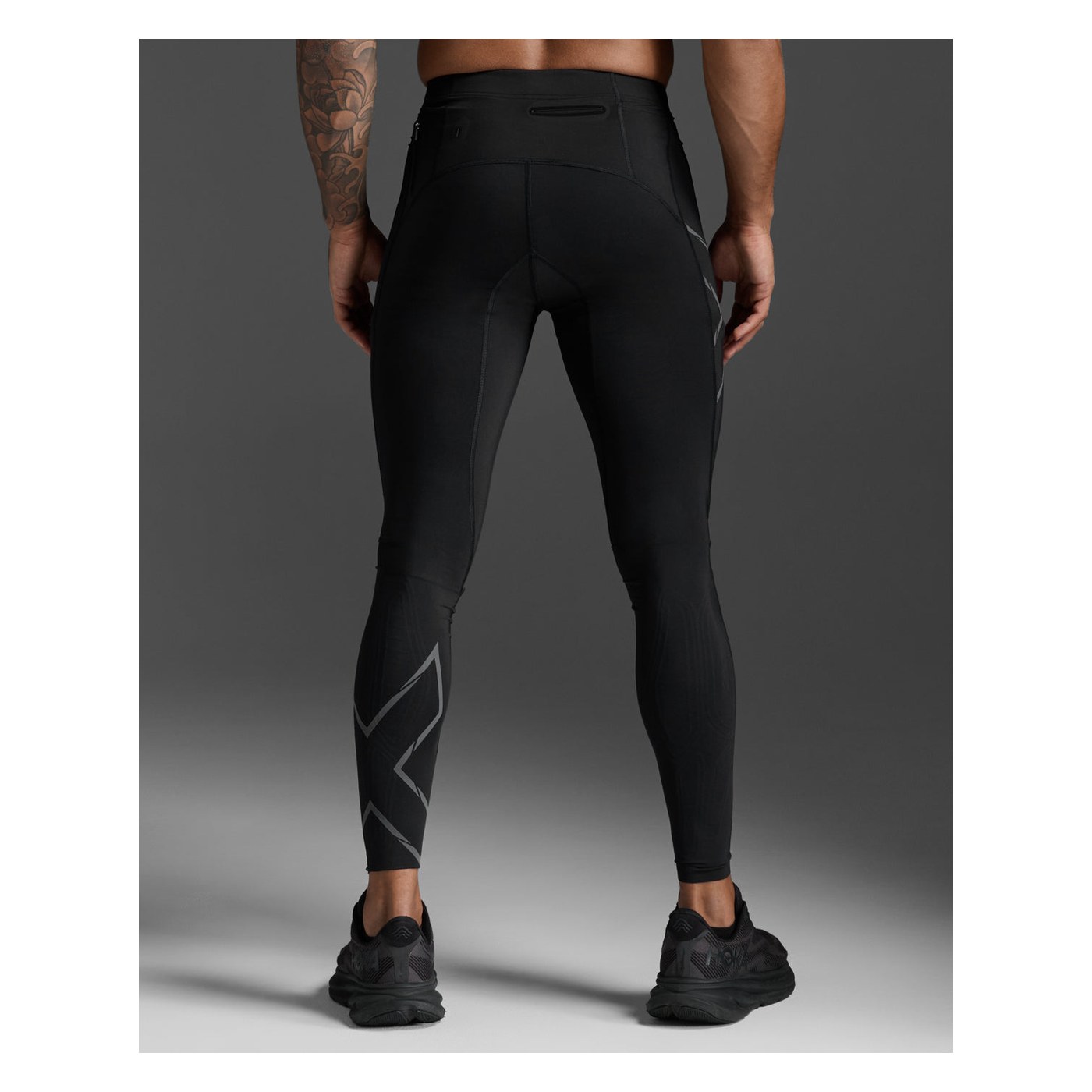
Most compression tights squeeze the leg evenly, from top to bottom. 2XU's MCS system works differently: denser fabric zones are heat-bonded onto the base fabric, following the lines of the quads and calves. The large raised pattern on the thigh isn't just a decorative logo, it marks the exact position of these reinforcements.
The brand claims firm compression of 23 to 25 mmHg, at the upper end of medical compression classifications (which range from 15 to over 30 mmHg depending on use). That's well above a standard training tight, and it puts the product at the opposite end from the Kiprun Trail Run 900 Ultra x RHEON, already reviewed by RunMorph at €49.99: that one relies on a localised polymer against muscle vibration, not on continuous compression of the whole leg.
© 2XU, official photo used for editorial purposes
© 2XU, official photo used for editorial purposes
The field test: what runners who wore them report
On the road, on long runs, the feedback converges on one specific point: you feel the compression before you even start running. U-Run reports the experience of a marathoner who tested 2XU's MCS tights (the generation before the 2021 Light Speed rename, with the same technical weave) over several weeks of training: as soon as you pull them on, the fabric wraps the thigh and calf, and the sense of support stays noticeable throughout the run, even on an easy jog. The same tester notes an effect on the stride, with a feeling of responsiveness somewhere between two pairs of shoes with opposite profiles, and links it to the reduction in muscle oscillation the brand claims.
Independent measurements converge on the current Light Speed generation: the waistband, wider than before and paired with a drawcord, stays put on long runs, where older generations of 2XU tights were judged less stable in that area. The three pockets (gel mesh, phone pocket, zip pocket) don't bounce while running, a point often overlooked on compression tights.
One divergence is worth flagging. In an older test of the same MCS system, this time applied to shorts (not the full-length tights), a waistband judged too narrow caused skin irritation on a long run. That flaw concerns a different product from the tights reviewed here, the Elite MCS short rather than the Light Speed Tights, but it documents a point to watch across the range: waistband width varies noticeably from one 2XU piece to another, so check reviews of the exact model before buying.
On lifespan, only the generation tested by U-Run provides concrete data: the MCS weave holds up well to repeated machine washes, with no loss of tension after several weeks of heavy use.
RunMorph's tip: pair these tights with your weekend long runs rather than your midweek speed sessions. Targeted compression works on accumulated fatigue, not on explosiveness.
RunMorph's take: the targeted compression promise isn't just a marketing line, it comes up in all three sources used for this article. But the material available on the Light Speed Tights specifically is thinner than we'd hoped: only one hands-on review dedicated to this exact model was found, the other two cover related pieces from the same technology family (an earlier generation and a different short). At RunMorph, what we mainly take away is how consistently the three sources agree on the central point, targeted compression works, rather than a firm opinion on finishing details that weren't verified on this exact model.
© 2XU, official photo used for editorial purposes
2XU Light Speed vs Kiprun Trail Run 900 Ultra x RHEON: two compression philosophies
| Criterion | 2XU Light Speed | Kiprun Trail Run 900 Ultra x RHEON |
| Technology | MCS, continuous graduated compression (23 to 25 mmHg) | Localised RHEON polymer, anti-vibration |
| Main terrain | Road, long runs | Technical trail |
| Official price | €129.99 | €49.99 |
| Weight (size M) | 200 g | Not disclosed by the brand |
| Tall sizes | Yes, 5 sizes (ST to XXLT) | No |
The choice mostly comes down to terrain and budget. On the road, on long runs or in a marathon build, the 2XU's continuous compression directly targets the muscle fatigue highlighted by the sources above. On technical trails, the Kiprun bets on local vibration absorption rather than overall compression, for roughly a third of the price. A runner who alternates between both terrains doesn't need to stack both technologies: pick based on the dominant terrain in your training.
Pros and cons
What won us over
- Targeted compression you can actually feel: the MCS weave follows the lines of the quads and calves rather than applying uniform pressure from top to bottom, a point confirmed on both the 2015 generation and the current Light Speed version.
- Wide, stable waistband: unlike older 2XU generations judged unstable in that area, the Light Speed stays in place on long runs thanks to a drawcord.
- Three pockets that don't bounce on the run: gel mesh, phone pocket and zip pocket, a level of storage rarely seen on compression tights.
- Holds up over time: the MCS weave survives repeated machine washes with no loss of tension, according to the oldest field feedback available on this technology.
- Five Tall sizes (ST to XXLT): a segment almost absent from the direct competition available in France, useful for runners over 1.85 m.
What convinced us less
- €129.99 for a pair of tights, roughly 2.6 times the price of the Kiprun Trail Run 900 Ultra x RHEON, with no figures from the brand to justify the gap.
- Heat in summer use: firm compression over the whole leg costs you thermal comfort as soon as temperatures rise, a point each of the sources used raises in its own way.
- Narrow waistband reported on a related piece (the Elite MCS short, not the tights reviewed here): something to watch on snug sizes, even though no equivalent feedback exists on the Light Speed Tights specifically.
- No French hands-on review dedicated to the exact Light Speed model found during this research, only on the previous generation and on a related short.
Our field verdict: who is it for?
The Light Speed Compression Tights are first and foremost for the runner who piles up the kilometres on long runs, in a half marathon or marathon build, and wants to limit next-day soreness rather than gain pure speed. Firm 23 to 25 mmHg compression brings nothing to a short interval session: it pays off over time, from about an hour of effort.
In a RunMorph marathon plan, tights like these slot naturally into the long runs of the aerobic base-building phase. 👉 Check out the RunMorph training plans and pair them with a program designed around recovery between two key sessions.
RunMorph Coach's verdict
The 2XU Light Speed Compression Tights deliver on a precise promise, targeted compression on the quads and calves, and they deliver it better than generic tights with uniform pressure. The sources used agree on that central point, even if only one covers the exact model reviewed here.
The €129.99 price remains the main sticking point: about 2.6 times that of the Kiprun Trail Run 900 Ultra x RHEON, for a narrower use case, long road runs, not intervals or high heat. The five Tall sizes, on the other hand, are a real differentiator, missing from most competing ranges available in France.
7.4/10: compression tights that do what they claim for their core audience, long runs, held back by their price and the lack of a less expensive entry-level version for a first try.
Key takeaways for your training
- Save them for long runs: firm compression (23 to 25 mmHg) pays off from an hour of effort, not on a 30-minute interval session.
- Check your size first: the 2XU chart separates waist and hip measurements across 6 standard sizes, plus 5 Tall sizes for runners over 1.85 m.
- Budget €129.99, more than double the price of an entry-level technical tight like the Kiprun Trail Run 900 Ultra x RHEON at €49.99.
- Avoid them on hot days: continuous compression over the whole leg heats up faster than a regular tight.
- Use the 3 pockets (mesh, phone, zip) to carry your gels without them bouncing on runs of over 2 hours.
FAQ
Are the 2XU Light Speed Compression Tights suitable for beginners?
Yes, but at €129.99 they are an investment best kept for a runner who already goes beyond an hour on long runs. Below that volume, a regular tight at €30 to €40 is more than enough.
Which size should you choose with the 2XU Light Speed?
2XU offers 6 standard sizes (XS to XXL) covering a waist of 70 to 99 cm, plus 5 Tall sizes (ST to XXLT) for heights over 1.85 m. If you're between two sizes, the brand recommends going for the larger one.
Is the 2XU Light Speed's compression measured or just claimed?
The brand claims firm compression of 23 to 25 mmHg, at the upper end of medical compression classifications, which range from 15 to over 30 mmHg depending on use. RunMorph found no independent measurement disputing that figure.
Can you run a marathon in these tights?
Yes, that's their home turf: firm compression specifically targets the fatigue that builds up over several hours of effort, unlike a 5 or 10 km race where the benefit remains marginal.
What's the difference between the Light Speed and 2XU's old MCS Run?
The Light Speed replaced the MCS Run in 2021, with the same targeted compression technology, the MCS system. The change covers the commercial name and some fit tweaks, not the core technology.