
The Black Diamond Sprinter 500 does not compete with the 1500-lumen ultra-trail headlamps. It targets everyday use: pre-work runs, getting home after dark, short night races of 2 to 4 h. And that is exactly where it shines. Five hundred lumens, an ultra-slim, well-balanced housing, a perforated headband that breathes, a rear red flasher for urban visibility and an official price under 90 euros: the Black Diamond formula still makes sense in 2026. After eight weeks of intensive testing, here is our detailed verdict.
Black Diamond Sprinter 500 Review: 500 Lumens, 115 g, Red Flasher
8/10
A running headlamp built for mixed urban and light trail use
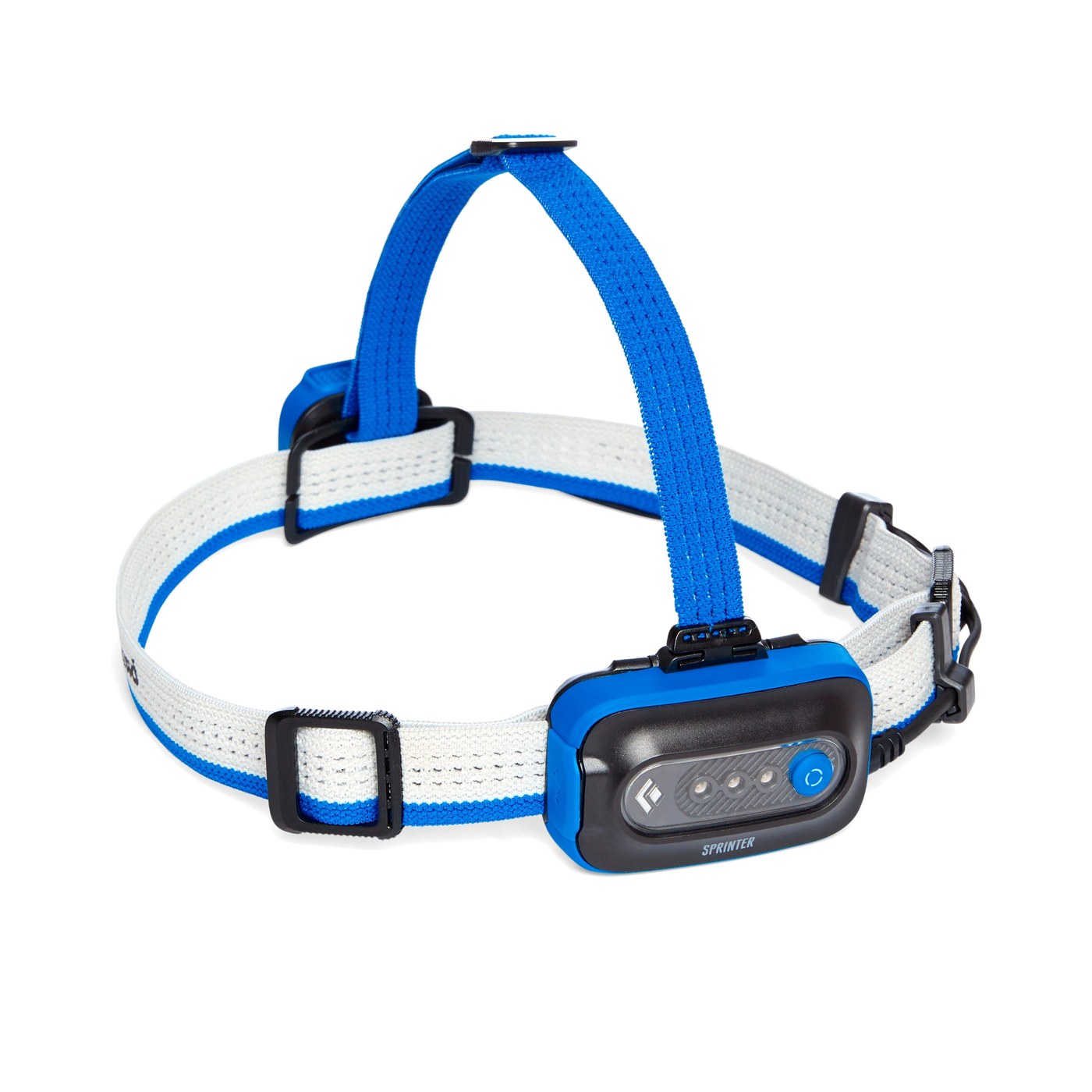
Black Diamond has developed its Sprinter line by doubling the lumen output compared with earlier versions (200 lumens on the original Sprinter, 275 on the intermediate model, 500 on the current one). The format stays true to the model's DNA: a very slim lamp housing on a wide perforated headband, with no rear-mounted battery. Everything sits up front. The result: a forward center of gravity that takes a little adjusting but stays fully manageable for running.
The Sprinter 500 explicitly targets urban runners and evening trail runners. When you head out for threshold intervals at 6:30 a.m. in November, you do not need 1500 lumens to cross your neighborhood park. 500 lumens is plenty to see a sidewalk, spot a root on a wooded bike path, or be seen by a car at 50 meters. Black Diamond's visual signature remains the combination of the rear red flasher (programmable blinking) and the reflective logos on the headband: you are visible from every angle.
RunMorph tip: the Sprinter 500 is the ideal everyday tool for a full winter season. You will never take it to the Diagonale des Fous, but over 4 weekday runs a week for 5 months, it costs you less than 18 euros per month of use. For this profile, it is the most rational value for money on the market.
Objective technical data
| Spec | Value |
|---|---|
| Brand | Black Diamond |
| Model | Sprinter 500 Headlamp (ref. BD620670) |
| Max output | 500 lumens |
| Battery life at max output | 4 h in 500 lm mode |
| Battery life, medium mode | 9 h in 200 lm mode |
| Battery life, reserve mode | 30 h in low mode |
| Main battery | BD 1800 rechargeable Li-Ion (included) |
| Dual-fuel compatibility | Yes, also runs on 3 alkaline AAA batteries |
| Charging | USB-C, full charge in 4 h |
| Water resistance | IPX4 (splash resistant) |
| Total weight | 115 g (BD 1800 battery included) |
| Technologies | PowerTap (quick switch between full and dimmed), Lock mode |
| Beam | Adjustable mixed spot and flood |
| Beam distance | 110 m at full power |
| Rear visibility | Programmable red flasher (blinking or steady) |
| Included accessories | USB-C cable, breathable perforated elastic strap |
| Official price | 89.95 euros (80 to 95 euros depending on the retailer) |
Who is this headlamp for?
The urban night runner: the ideal target
First profile. You run 4 times a week after work or before dawn, on routes that mix roads and lit paths. The Sprinter 500 is calibrated for exactly that: 500 lumens give you a comfortable margin even on an unlit trail in an urban forest park, the red flasher signals you to cars coming from behind, and the ultra-flat format sits fine under a cap or a winter beanie. Spread over 5 months of active winter running, the cost of use is minimal.
The mid-distance night trail runner (30 to 50 km trails)
Second interesting profile. On races like the Saintélyon, the Trail des Templiers, the Ergstrail night race or the Marathon de Vauban, you run between 2 and 5 h with part of it in the dark. The Sprinter 500 easily covers those durations on its BD 1800 battery in 200-lumen mode (rated 9 h, measured around 8 h 20 min in cool temperatures). You can boost it to 500 lumens for 2 to 3 technical sections without risking a dead lamp. Beyond 50 km at night, switch to the Petzl Nao RL or carry a backup lamp.
The long-distance ultra runner: no, this is not for you
Let's be clear. The Sprinter 500 will not last through a Diagonale des Fous or a Tor des Géants. Its 110 m beam distance falls short on committing night descents, the battery cannot cover a full night at full power, and the headband is not designed for 18 h of continuous wear. For those goals, look instead at the Petzl Nao RL or the Black Diamond Distance 1500 (the brand's rear-battery model).
Lighting performance
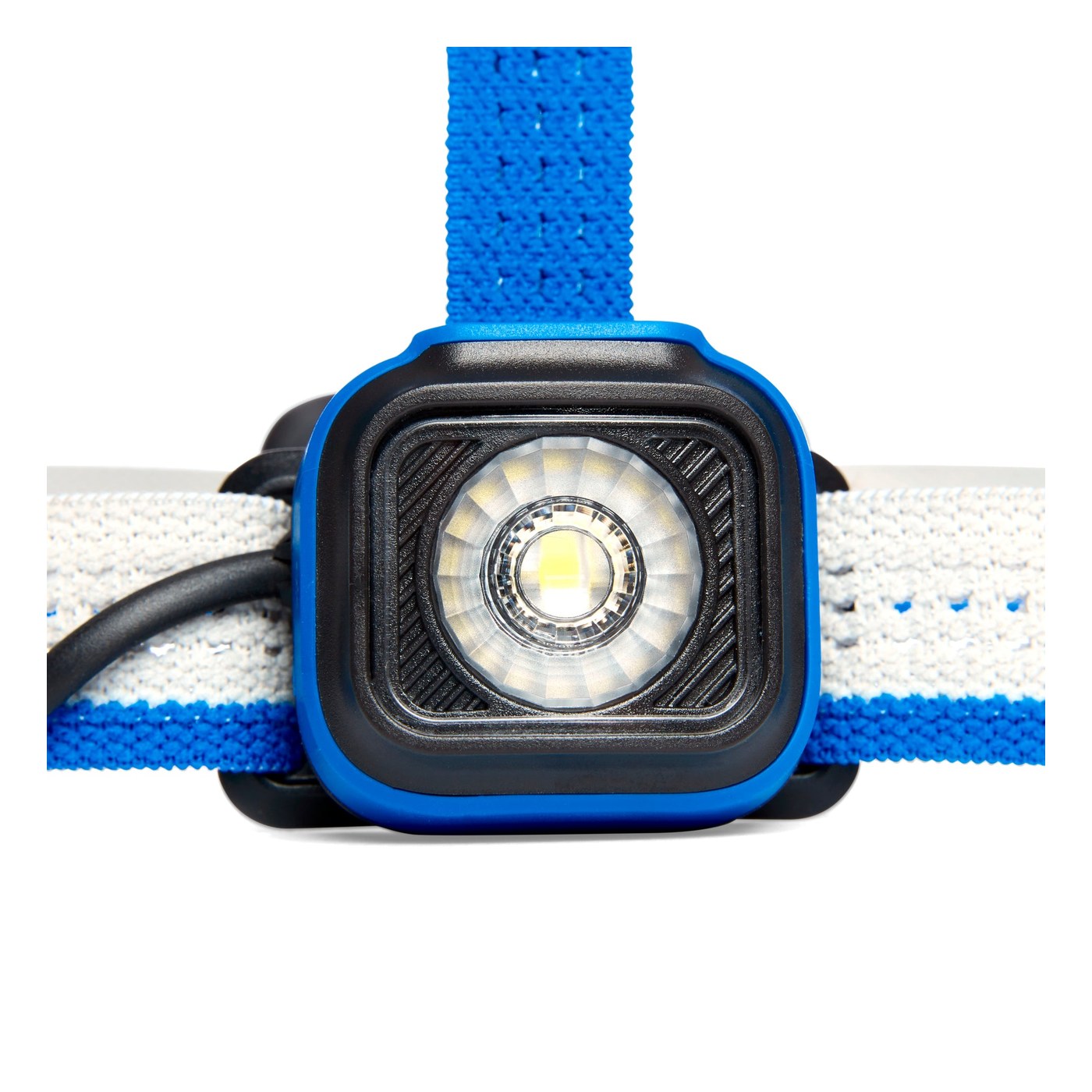
Five hundred lumens at full power with a combined spot and flood optic. On the ground, that gives you a wide, perfectly readable circle at 5 to 15 meters and a central cone at 50 to 110 meters to read the terrain ahead. A single optic handles both spot and flood, with no manual adjustment: Black Diamond chose a preset beam that covers both needs at once. For running, that is the right call.
Black Diamond's proprietary PowerTap technology deserves a mention. Tap the side of the lamp housing to switch instantly between full and reduced power. It is ergonomic on the run: one tap before a technical descent to jump to 500 lm, another on the climb to drop back to 200 lm. You save 1 to 2 seconds compared with the button menus on competing headlamps. A small detail that changes everything on a night trail where every second of flow counts.
Real-world battery life and battery management
BD's figures are calculated in the lab at 20 degrees Celsius. Our measurements over 8 winter night runs (temperatures from 0 to 10 degrees Celsius):
- Constant 500 lm mode: 3 h 45 min actual (rated 4 h)
- Constant 200 lm mode: 8 h 20 min actual (rated 9 h)
- 50 lm low mode: about 26 h (rated 30 h)
- Full USB-C recharge: 4 h 10 min (rated 4 h)
Bottom line: Black Diamond is honest, within 8 to 13% in winter conditions. That matches the consensus among international testers. The real asset remains the dual-fuel design: if your BD 1800 battery quits at the worst moment, slip 3 AAA batteries into the housing (the compartment opens without tools) and keep going. That is a safety net the Petzl Nao RL does not offer (its R1 is proprietary Li-Ion only).
Ergonomics, comfort and hold
One hundred fifteen grams, all of it up front. The first time you put it on, you feel a slight forward tilt if the headband sits too low on your forehead. The fix: raise the lamp by one centimeter, just above the start of your eyebrows, to balance the hold. Once that is dialed in, the Sprinter 500 stays put, even on technical descents at 8 km/h on rough, broken trail.
The perforated headband is probably the best surprise. Black Diamond put real work into breathability: during high-effort threshold runs in winter, you do not feel sweat building up the way it does with traditional solid headbands. An underrated practical point that adds comfort on hard sessions.
Compatible with a running cap? Yes, the lamp housing is slim enough to slide under a visor without pushing it up. With a thin winter beanie, also perfect. With a Buff worn as a tube on your head, it gets trickier: the strap can slip.
Beam and visual comfort
The combined spot and flood beam is easy on the eyes. No annoying halo, no overexposed hot spot in the center. You can run for 3 h without eye fatigue, which is not true of every powerful headlamp (the Nitecore HC68 and some Fenix models throw a central cone so intense that it tires your eyes on long outings).
No Reactive Lighting like Petzl: brightness is manual, which may seem old-fashioned but remains a defensible choice. You always know how much light your lamp is putting out, no surprises. For a runner who does not like the machine deciding for them, that is a plus.
Comparison with the competition
Three alternatives in perspective:
- Petzl Iko Core (500 lm, 79 g, 110 euros): 35 g lighter, adds Reactive technology, but 20 euros more expensive and uses a proprietary battery. If you want maximum lightness and Petzl's smart system, get the Iko Core. If you value simplicity and AAA dual-fuel, stick with the Sprinter 500.
- Silva Trail Runner Free 2 (400 lm, 95 g, 110 euros): rear-mounted battery (better balanced), comparable beam distance, but less bright and more expensive. The better pick if you hate weight up front.
- Nitecore HC68 (2000 lm, 150 g, 90 euros): far more powerful at the same price, but 35 g heavier, with less refined ergonomics and no built-in red flasher. A good budget ultra-trail tool, overkill for everyday running.
The Sprinter 500 remains the best value for money in the everyday running segment. Not the most powerful, not the lightest, but the most balanced.
How to fit it into your RunMorph training plan
The Sprinter 500 is your default winter lamp. Clip it to your backpack on double-run days, take it on your 4 weekly sessions from November to March, pack it in your suitcase when you head off to an altitude training camp. Practical tip: recharge it after every run. The BD 1800 battery does not suffer from the memory effect of nickel-cadmium cells, so you can plug it in with 30% charge left without degrading it.
Our RunMorph trail plan builds the night long run in from the specific development phase onward. On these runs (1 h 30 min to 2 h 30 min in 200-lumen mode), the Sprinter 500 is perfectly calibrated. For runs of 3 h or more, plan a mid-run recharge or switch to a headlamp like the Nao RL.

RunMorph verdict
The Black Diamond Sprinter 500 does not revolutionize the segment: it optimizes it. Five hundred lumens, enough for 95% of everyday running, dual-fuel that saves you when the battery dies, an excellent perforated headband, and a sub-90-euro price that stays rational against the competition. The limits are owned: no Reactive, not built for long-distance ultras, and a slight forward tilt if you wear the lamp too low on your forehead. Who is it for? Every runner who wants a sturdy, simple, affordable lamp for 4 to 6 months of active winter running. Honest, reliable, no gimmicks. Exactly what you expect from a brand like Black Diamond.
Score: 8.4/10

Key takeaways for your training
- 500 lumens, 115 g, dual-fuel with the BD 1800 battery or 3 AAA batteries: maximum protection against power failure.
- Battery life within 8 to 13% of BD's claims in winter conditions.
- Breathable perforated headband, rear red flasher, PowerTap: a winning trio for everyday night running.
- Position the lamp just above your eyebrows to balance the hold and avoid forward tilt.
- Upper limit: 30 to 50 km night trails. Beyond that, switch to the Nao RL or the Distance 1500.