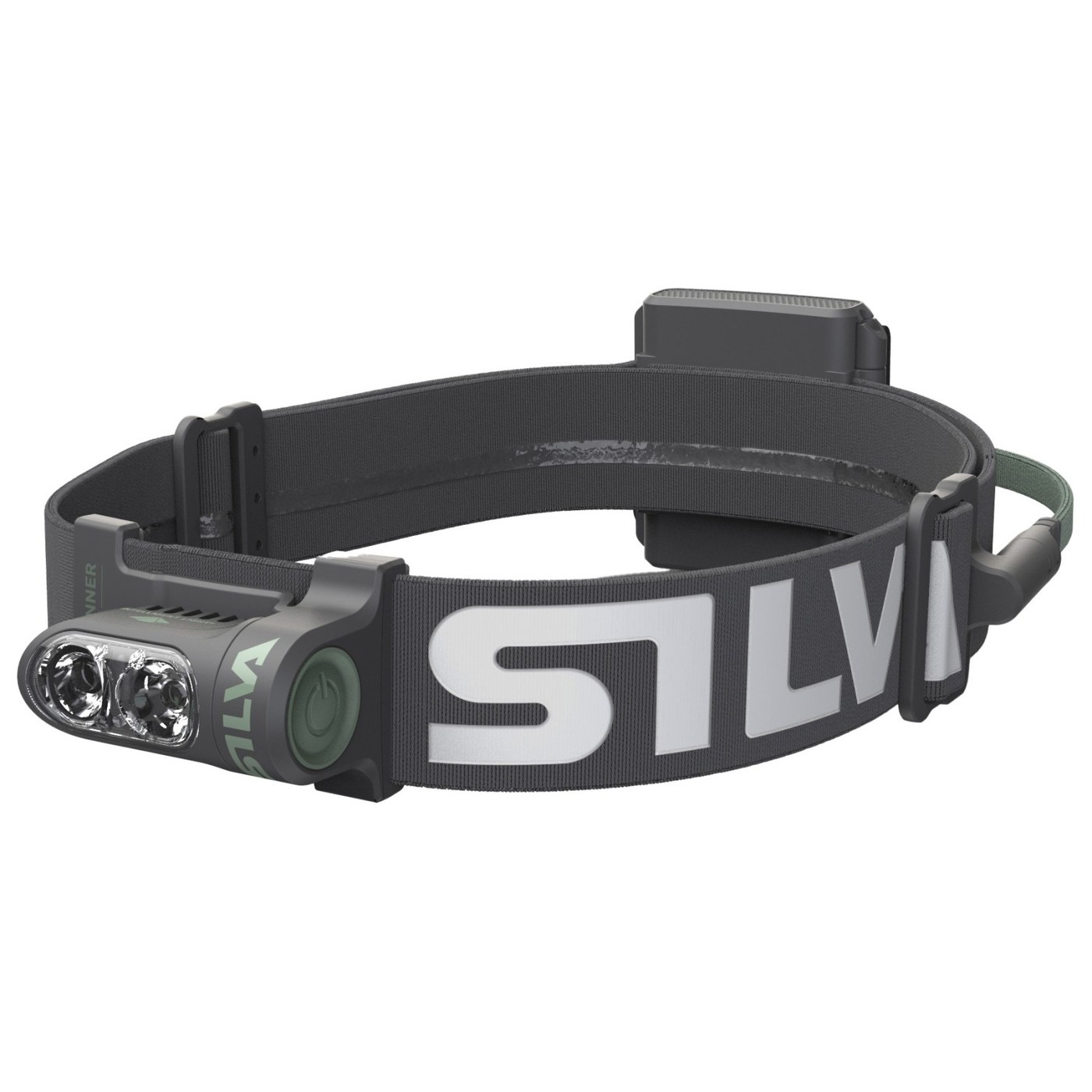
Silva holds a special place in the world of running headlamps. The Swedish brand built its reputation on battery packs mounted at the back of the head, a weight distribution that kills the pendulum effect and the dreaded bounce that ruins so many night runs. The Trail Runner Free 2 carries that architecture over to its entry-level model, the one that makes do with standard AAA batteries instead of a rechargeable pack. That choice comes at a price, in every sense of the word.
Silva Trail Runner Free 2: 84 euros, an AAA battery pack and the rock-solid fit Silva is known for
7.1/10
- Outstanding fit, zero bounce thanks to the rear pack
- Simple operation, a single button that works with gloves
- Dual-beam Intelligent Light technology that avoids tunnel vision
- No rechargeable battery included at this price
Silva Trail Runner Free 2
7.1/10
Specifications
| Reference | 7318860205767 / SV38287 |
| Weight | 60 g (lamp only) / 122 g (pack + 3 AAA batteries) |
| Power | 3 x AAA (not included) or optional rechargeable hybrid battery (not included) |
| Brightness | Min 50 lm / 27 m, Med 200 lm / 50 m, Max 450 lm / 75 m (AAA) or 500 lm / 80 m (hybrid battery) |
| Battery life (AAA) | Min 15 h 30 to 18 h 30, Med 4 to 5 h, Max 1 h 30 to 2 h |
| Water resistance | IPX5 |
| Technology | Silva Intelligent Light, 2 LEDs (long-range beam and close-range beam) |
| Colours | Anthracite grey, white, green |
| Price | 84 euros, 69 euros on sale |
On paper, the spec sheet looks a lot like that of its big sister, the Ultra, which RunMorph has already tested: same two-LED optical head, same Intelligent Light technology combining a long-range spot with a close-range flood to avoid the tunnel vision typical of cheap headlamps. The only difference is the power source. Where the Ultra carries a high-capacity lithium battery, the base Free 2 settles for a pack of three AAA batteries that you have to supply yourself. That is what makes the much friendlier price possible, and it is also where most of the criticism lands.
What the cross-checked reviews say
To judge the base version of the Free 2, RunMorph cross-checked verified customer reviews on the exact product page, along with two editorial tests covering the same lamp architecture, but tested with battery options different from the one reviewed here. That nuance matters, and we flag it every time.
i-Run.fr, verified customer reviews of the base model
Five recent reviews give an average score of 4.2/5, with 80 % of customers satisfied. Timothee C. sums up the general feeling well: "very good, though the brightness is a bit weak for the price of the lamp". Sylvie L. and two other buyers praise a lamp that fits exactly what they need as backup lighting for city runs or easy trails. The most telling signal comes from Séverine A., the only low score (2/5) in the batch: "No rechargeable battery included. Very expensive product." A single comment, but a precise one, and it points straight at the structural limit of the base model: no rechargeable option included at this price.
Outzer, test by Levente Dorogi (8/10)
This editorial test, run by an experienced tester (41 years old, seasoned runner), was carried out as part of a private testing partnership with Silva. To be explicit: the lamp Levente Dorogi tested used the rechargeable Ultra battery (14.8 Wh, 550 lm, 5 to 7 h of runtime), not the AAA pack of the base model reviewed here. That said, the test covers the same lamp head, the same headband and the same dual-beam optics, so its findings hold on those shared points. The strengths he highlights are the stable fit ("doesn't bounce, gives you confidence"), build reliability compared with rivals such as Petzl, Nitecore or Led Lenser, and the quality of the dual beam. The weak points are weight and price, a criticism aimed mainly at the Ultra version and its battery, which costs more than some competing alternatives.
Independent test by Markus Zinkl and Marcel Krebs (Germany)
This editorial test covers the Hybrid version, which ships with a 1.25 Ah battery, different from both the Ultra battery and the AAA pack of the base model. Once again, the lamp head and headband are identical to those of the Free 2 reviewed here. Both testers praise an excellent fit, padding that is clearly better than on the previous generation, simple one-button operation that works with gloves on, and a cool white light that stays visible even through your own breath on cold days. On the other hand, they point to power that falls short on technical trails ("the brightness for technical singletrack is too low in my opinion"), a wide beam that could be better, and a rear red light that is not linked to the main switch, so you end up forgetting it on or off. Both testers actually recommend the lamp more for road and city running than for technical night trails, and suggest more powerful models such as the Petzl Swift RL or the Petzl NAO RL for demanding night ultras.
The three sources line up clearly despite the different battery setups: fit and ergonomics win unanimous praise, power that feels a bit short for technical trails comes up every time, and the value of the base model without an included battery remains the main sticking point.
Who it's for, who it's not for
Who it's for
Road and easy-trail runners looking for a light, stable, easy-to-use headlamp for one to two hour outings, who already own rechargeable AAA batteries or are fine with that constraint.
Who it's not for
Trail runners who string together night runs on technical terrain and want a wide, powerful beam, or anyone who wants a rechargeable setup included from day one without spending more.
The flaw that sparks debate: no rechargeable battery included
At 84 euros (69 euros on sale), the Trail Runner Free 2 sits in a segment where several competitors already include a rechargeable option. The three-AAA pack works well mechanically and lets you swap batteries easily anywhere, ultras included, but it adds a recurring cost that buyers don't always see coming at checkout. That is exactly what Séverine A. flags in her 2/5 review on i-Run.fr, and RunMorph wants to put it front and centre rather than play it down: the Ultra version exists precisely to meet that need, for a higher price.
Head to head with the Silva Trail Runner Free Ultra
The Trail Runner Free Ultra, already tested by RunMorph, shares the same optical head and headband as the Free 2. The difference comes entirely down to power: a high-capacity rechargeable lithium battery included with the Ultra, versus an AAA pack you stock yourself on the Free 2. In practice, the Ultra targets runners who pile up long outings and want comfortable runtime without juggling batteries, while the Free 2 is for those who put a lower entry price first and like the flexibility of standard batteries you can buy anywhere.
Head to head with the Petzl Actik Core
In the segment of versatile, affordable headlamps, the Petzl Actik Core remains a benchmark that RunMorph has already tested. It offers a hybrid battery/AAA system similar in spirit, with comparable peak power. The Silva stands out with its weight distributed at the back of the head, a real comfort advantage over time, whereas the Petzl keeps all its electronics at the front. On the flip side, the Petzl Actik Core comes with its rechargeable Core battery as standard at a similar price, which makes it a serious alternative if you want to skip the battery question from your very first purchase.
Pros
- Outstanding fit, zero bounce thanks to the rear pack
- Simple operation, a single button that works with gloves
- Dual-beam Intelligent Light technology that avoids tunnel vision
- AAA batteries available everywhere, even during long races
- Cool white light that stays visible in the cold, even through your breath
Cons
- No rechargeable battery included at this price
- Power a bit short for technical trails at night
- Wide beam could be better on unmarked sections
- Rear red light not linked to the main switch
A well-chosen headlamp makes your night sessions safer, but it won't replace a structured training plan. Head over to the RunMorph trail training plans, built around pace management on climbs and descents.
RunMorph verdict
The Silva Trail Runner Free 2 confirms what the brand has done well for several generations: a stable fit, optics that avoid the classic tunnel-beam trap, and hassle-free handling. Choosing an AAA pack over an included rechargeable battery makes real commercial sense, since it lowers the entry ticket, but it shifts part of the true cost onto you, something several customer reviews call out bluntly. For occasional road and easy-trail use, it's a sound choice. For regular technical trail running at night, the Ultra version or a rival with an included battery make more sense.
RunMorph overall score: 7.1/10.
FAQ
How long do AAA batteries last in the Silva Trail Runner Free 2?
In minimum mode, expect between 15 h 30 and 18 h 30. In maximum mode at 450 lumens, runtime drops to 1 h 30 to 2 h, so you need to carry spare batteries on long outings.
Is the Trail Runner Free 2 compatible with the Ultra's rechargeable battery?
Yes, the optional rechargeable hybrid battery sold by Silva works with the same lamp head, so you can upgrade the system without buying the whole thing again.
Is this lamp suitable for a technical night ultra-trail?
The cross-checked tests agree that its 450 to 500 lumens are a bit short on technical terrain. For that kind of use, the testers recommend a Petzl Swift RL or a Petzl NAO RL instead, both more powerful.
Is the battery pack uncomfortable on the back of the neck?
No, testers describe it as flat and light, with no noticeable bounce, unlike other lamps where the electronics stay concentrated at the front.
What is the difference between the Free 2, the Free 2 Hybrid and the Free 2 Ultra?
All three share the same optical head and headband. Only the power source changes: AAA batteries for the base Free 2, a mid-capacity hybrid battery included with the Hybrid, and a high-capacity lithium battery included with the Ultra.