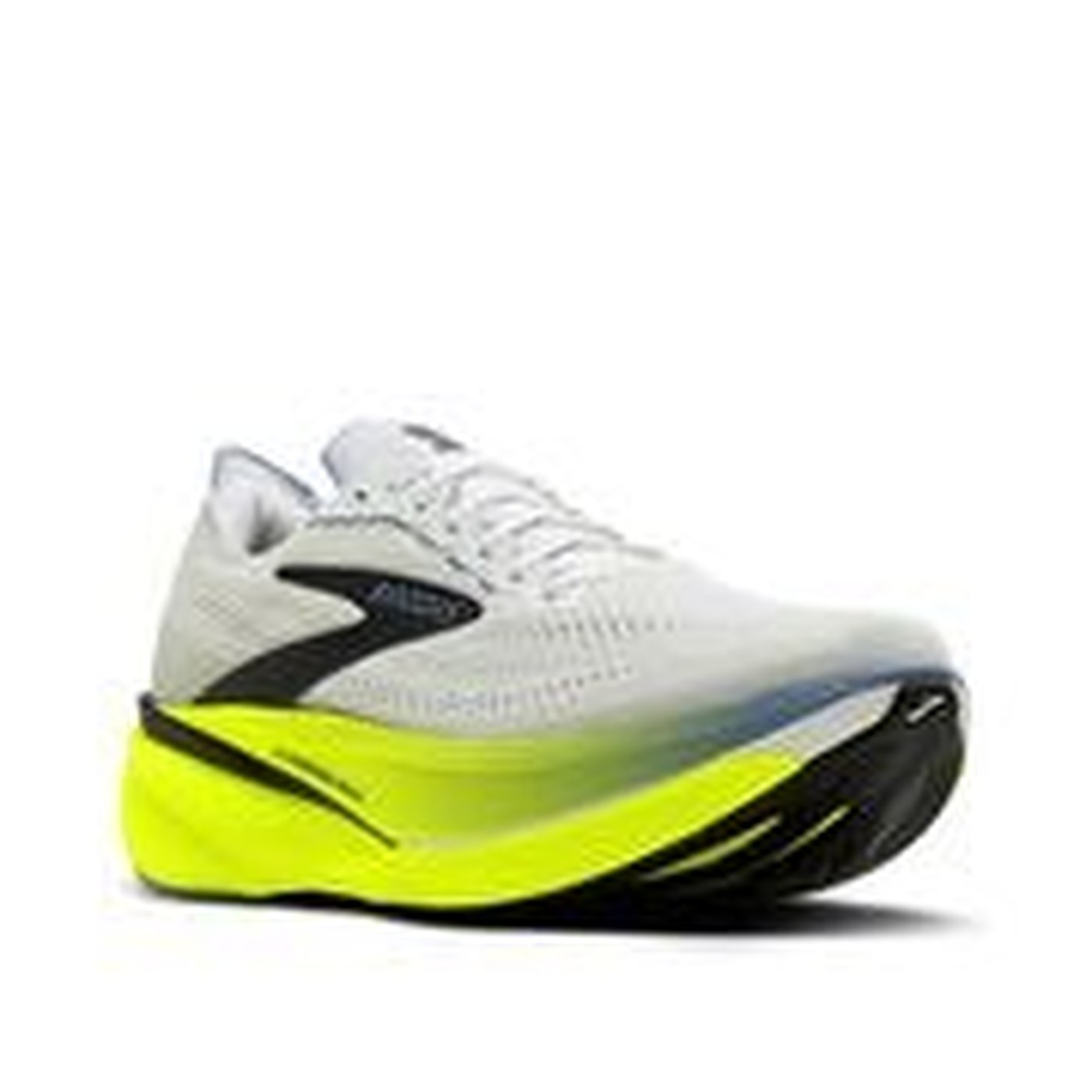
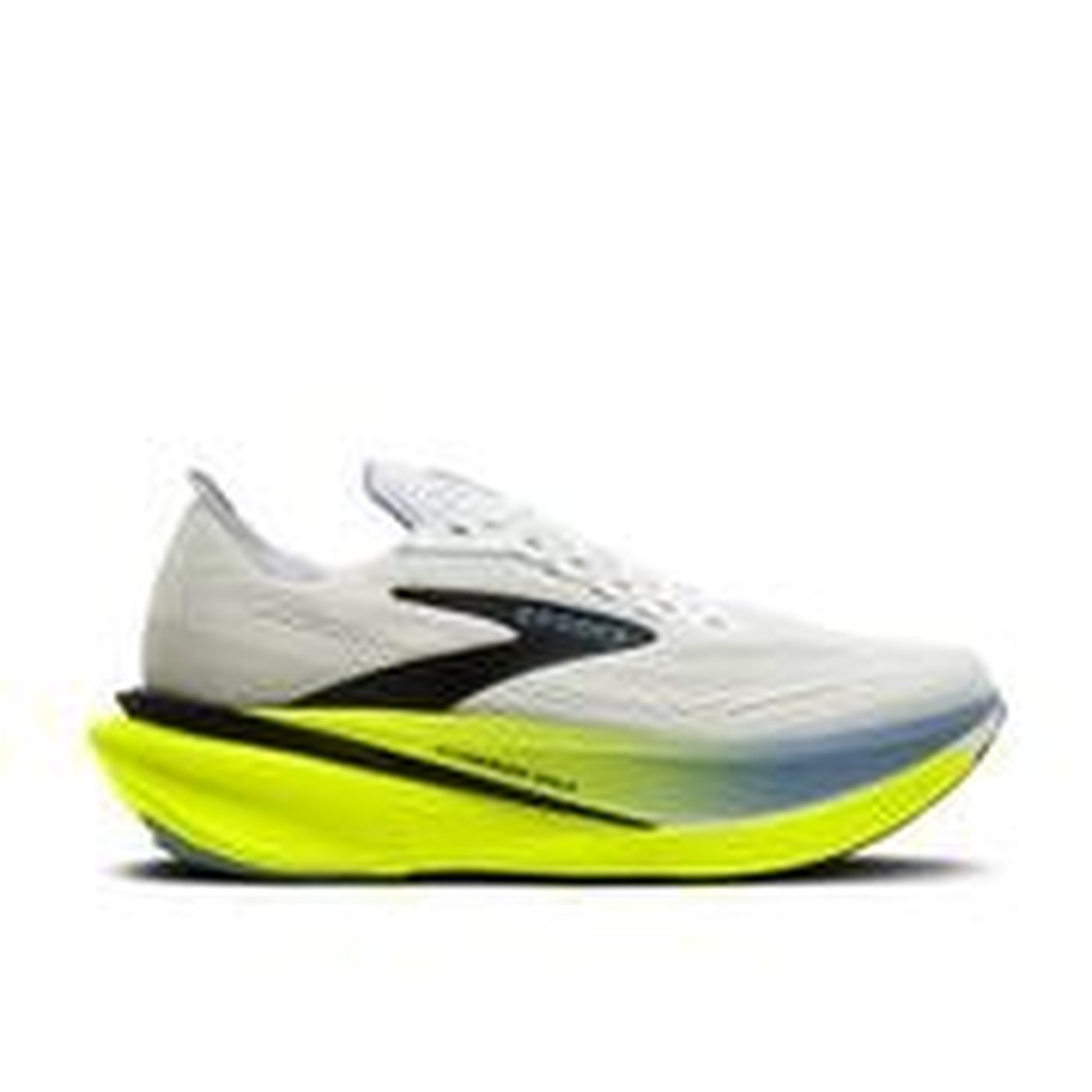
Brooks Hyperion Max 4: 6 mm claimed, 9.6 mm measured, the unfiltered review
8.6/10
Brooks claims a 6 mm drop on the Hyperion Max 4. An independent lab measures 9.6 mm at the shoe, 60% more than the official figure. At RunMorph, we cross-checked that measurement against two other reviews, one European and one American, to understand what this gap really changes on a shoe sold as a super trainer for training.
The Hyperion Max 4 claims a 6 mm drop, but lab testing measures 9.6 mm, a gap of nearly 4 mm that Brooks never mentions. Comfort and lockdown get unanimous praise from all three sources we consulted, with grip and protection above the category average. This is a tempo and long-run trainer, not a race shoe: its lab Race sub-score tops out at 71 out of 100, versus 85 for daily training.
Who is it for?Runners who stack tempo sessions and progressive long runs, want a secure hold for a narrow foot, and are willing to carry above-average weight in exchange for solid protection.
Who should skip it?Runners with wide feet (only one width available), anyone after a pure race shoe (lab Race sub-score of 71 out of 100), or anyone who wants a light pair for short intervals.
Brooks Hyperion Max 4: why review it now?
The Brooks Hyperion Max 4 launched in July 2026, making it one of the most recent shoes in its category to go through independent lab testing, with a verdict published on July 24, 2026. In the Brooks lineup, it sits in a middle slot that the brand itself owns: more protective and more up-tempo than the Glycerin 23, a versatile everyday trainer, and less radical and cheaper than the Hyperion Elite 6, a pure race shoe. RunMorph has already reviewed the Brooks Glycerin Max 2 and the Brooks Hyperion Elite 6: the Hyperion Max 4 fills the gap between the two.
RunMorph's advice: if your training plan includes tempo sessions and progressive long runs, the Hyperion Max 4 is a serious contender. If you're looking for a race-day pair, look instead at the Nike Vomero Plus, which scores higher across the board in lab testing, 91 points versus 86 out of 100.
Specs: what Brooks claims
Brand
Brooks
Model
Hyperion Max 4
Release
July 2026
Type
Super trainer, tempo training and long runs
Claimed drop
6 mm
Claimed weight (men's)
286 g, EU size 42
Claimed stack
45 mm heel and forefoot
Foam
DNA Gold (PEBA) on top, DNA Flash v2 (EVA) underneath
Plate
SpeedVault, nylon, not carbon
Upper
Triple jacquard knit, gusseted tongue
Available widths
Standard only
Recommended use
Daily training and tempo
Official price
190 €
Hyperion Max 4: what Brooks claims versus what was measured
This is the table that justifies this review. In the lab, calipers measured a stack of 44.8 mm at the heel and 35.2 mm at the forefoot on the tested pair. Do the math: that's a 9.6 mm drop, not 6. The Spanish site Runnea and an American running outlet both repeat Brooks' 6 mm figure without checking it against an independent measurement. That is exactly the kind of lazy consensus RunMorph would rather verify than copy.
Data
Claimed (Brooks)
Measured (independent lab)
Drop
6 mm
9.6 mm (44.8 mm heel, 35.2 mm forefoot)
Weight (EU size 42, men's)
286 g
292 g, 6 g more, about 2% above the claim
Heel stack
45 mm claimed
44.8 mm measured, negligible gap
The drop gap is no detail for a runner who picks a shoe based on their foot strike transition. With a real drop close to 9.6 mm rather than 6, the Hyperion Max 4 behaves more like a classic heel-leaning shoe than the midfoot profile the official figure implies. The lab says so explicitly in its verdict: the higher-than-claimed drop makes the shoe better suited to heel strikers than a midfoot-focused marketing launch would suggest.
DNA Gold, DNA Flash v2 and the SpeedVault plate: what it changes underfoot
The Hyperion Max 4 stacks two foams of different densities, separated by a nylon plate rather than a carbon one. On top, DNA Gold, a PEBA that the lab measures at just 24.6 AC on the durometer, versus an average of 35.5 AC across 252 tested shoes, confirming a very soft foam that delivers most of the bounce. Underneath, DNA Flash v2 in EVA plays a support and protection role rather than an energy return one.
The SpeedVault plate, forked at the heel and forefoot, favors a less aggressive feel than a classic carbon plate: the lab describes it as a deliberate choice by Brooks for daily training rather than maximum race propulsion. The measured result is 62.9% energy return at the heel, versus an average of 58.7% across tested shoes, a respectable number but far from the 70% and more posted by the most dynamic super trainers in the category, as the lab itself points out in its own comparison.
The fit: secure and narrow, not for every foot
All three sources RunMorph consulted agree on a snug, secure fit. The lab measures a width of 92.7 mm at the widest point of the upper, versus an average of 95.2 mm across 348 tested pairs, and a forefoot width of 71.7 mm, versus 73.2 mm on average, making the shape noticeably more pointed than the category average. Runnea backs this up by explicitly rating the model as ideal for narrow feet, with a gusseted tongue that improves midfoot hold.
The American outlet adds a useful nuance: the new triple jacquard knit upper, with its gusseted tongue, can create a crease over the instep for narrow-footed runners if the laces are pulled too tight. None of the three sources recommends this pair for wide feet, and Brooks only offers a single width anyway.
The real-world test: what the three sources say
RunMorph read three independent sources in full before making a call: the complete lab review, with its measured data and qualitative verdict, Runnea's detailed review with its six numbered sub-scores, and the American outlet's technical analysis focused on the shoe's place in the Brooks lineup.
The three sources agree on the essentials: firm, protective cushioning, exemplary foot hold, and a shoe designed for training rather than racing. Runnea gives 9 out of 10 to cushioning and responsiveness, and 9 out of 10 to stability as well. The lab confirms this with a Stability sub-score of 74 out of 100, driven by torsional rigidity of 19.1 Nm, well above the 14.5 Nm average measured across 155 shoes.
The most interesting divergence concerns the shoe's very positioning. The American outlet explicitly places it in the middle tier of the Brooks lineup, between the versatile Glycerin 23 and the race-focused Hyperion Elite 5, and stresses that it is not built for race day. The lab points the same way with a Race sub-score of only 71 out of 100, the lowest of the four rated uses: daily training 85, tempo 81, stability 74, racing 71. RunMorph chooses to report this convergence rather than play it down: this pair is structurally not cut out for chasing a time.
At which paces it works, at which paces it falls off
Easy runs and base endurance: fine, though not the shoe's main purpose. The 62.9% energy return measured in the lab is plenty for a relaxed run, even if the firmness of the DNA Flash v2 makes itself felt over the first few kilometers.
Long runs: this is where the Hyperion Max 4 makes the most sense, with a Daily running sub-score of 85 out of 100 in lab testing, the highest of the four rated uses. The 44.8 mm heel stack absorbs repeated impacts over several hours.
Tempo pace: this is literally the use Brooks claims, confirmed by a Tempo sub-score of 81 out of 100. The DNA Gold and SpeedVault plate combo lets you hold a progressive pace without the stiffness of a pure race shoe.
Threshold and marathon pace: doable but not ideal. The measured weight of 292 g, 12% above the 261 g average the lab recorded across 471 shoes, starts to show as the pace picks up.
Short intervals: the admitted weak spot. The Race sub-score of 71 out of 100 and the lack of snap pointed out by the American outlet confirm that this pair is not built for pure speed.
Understated weight and drop: what 4 mm and 6 g really change
Brooks lists 286 g for the Hyperion Max 4 in EU size 42. The lab weighs 292 g on its test pair, a 6 g gap, about 2% more than the official claim. On its own, that number looks trivial. Combined with the 3.6 mm drop gap, with 9.6 mm measured versus 6 mm claimed, it paints a shoe that is noticeably heavier and more heel-oriented than the spec sheet suggests.
In practice, for a runner comparing two pairs based on their spec sheets, the real weight gap with a rival like the Nike Vomero Plus, 289 g measured in the lab versus 285 g claimed by Nike, is almost identical once both numbers are corrected by lab measurement. RunMorph would rather flag this convergence than copy marketing numbers without checking them.
Breathability: relative progress that stays below average
The second red flag identified in lab testing: breathability. The three-hour lab test gives a score of 61 BR, versus an average of 75 BR for shoes tested in this category, a clearly below-average result. The American outlet tempers this by noting that the new triple jacquard knit upper improves breathability and drying compared with version 3, real progress but not enough to bring the shoe up to its category average.
The cause is baked into the design itself: a dense knit and a secure fit, which help lockdown but let less air flow through the shoe. It's a design trade-off rather than a manufacturing flaw, as confirmed by the lab's drying test, which records a result of 53%, in line with the category average despite lower breathability in the static test.
Pros and cons
Pros
Above-average cushioning and protection: 148 SA at the heel versus a 131 SA average in lab testing
Foot hold and lockdown praised unanimously by all three sources consulted
Above-average stability despite a max stack: torsional rigidity of 19.1 Nm versus 14.5 Nm on average
Durable outsole: only 0.9 mm of wear in the abrasion test versus 1.1 mm on average
Reliable grip on asphalt and bike paths, confirmed by the American outlet and Runnea
Cons
Real drop measured at 9.6 mm versus 6 mm claimed, a fact missing from official communication
Measured weight of 292 g, 12% above its category average in lab testing
Below-average breathability: 61 BR versus a 75 BR average
Only one width available, narrow feet only
Race sub-score of only 71 out of 100: not a race shoe
Durability and cost per kilometer: what it really costs
On durability, the lab measures outsole wear of only 0.9 mm after its standardized abrasion test, versus an average of 1.1 mm across 409 tested shoes, a result the lab explicitly calls reliable for marathoners racking up mileage. Since none of the three sources gives an exact mileage figure, RunMorph uses a conservative estimate of 650 km, consistent with the above-average outsole durability and the 2.8 mm rubber thickness recorded in the lab.
At 190 euros and an estimated 650 km, the Hyperion Max 4 works out to about 0.29 euro per km. That's in the upper average for premium super trainers, a positioning the lab sums up in its verdict: the price isn't excessive compared with its direct rivals, but the investment mainly makes sense if a secure hold and maximum cushioning matter more than low weight for how you run.
Hyperion Max 4 versus its predecessor: is the update worth it?
Criterion
Hyperion Max 3
Hyperion Max 4
Measured weight
Lab reference
292 g, 3% more than version 3
Upper
Single-layer mesh
Triple jacquard knit, more structured
Tongue
Standard
Gusseted, attached at the sides, better midfoot hold
Outsole
Original design
Same design, reinforced rubber in high-wear zones
Who should upgrade to version 4: runners with a worn-out Hyperion Max 3 who want better midfoot hold, even if it means accepting 3% more weight according to the lab's own measurement. Who can stick with the old one: anyone who never had an issue with the version 3 fit and values low weight, since version 4 brings no radical overhaul, only incremental tweaks to the upper.
Hyperion Max 4 versus the Nike Vomero Plus and the Glycerin Max 2
Model
Lab score
Measured weight
Measured drop
Price
Brooks Hyperion Max 4
86 / 100
292 g
9.6 mm
190 €
Nike Vomero Plus
91 / 100
289 g
9.6 mm (10 mm claimed)
180 €
Brooks Glycerin Max 2
85 / 100
318 g
8.1 mm (6 mm claimed)
200 €
The short version: the Nike Vomero Plus beats the Hyperion Max 4 on the overall lab score, 91 points versus 86 out of 100, while being slightly cheaper, with a nearly identical measured drop once both figures are corrected in the lab. The Glycerin Max 2, its direct Brooks cousin, goes for even more generous cushioning but weighs 26 g more on the scale and shows an equally large gap between claimed and measured drop. If your priority is the overall score and value for money, the Vomero Plus wins. If you're loyal to the Brooks ecosystem and want the sweet spot between protection and pace, the Hyperion Max 4 remains a coherent choice.
Our real-world take: who is it really for?
The Hyperion Max 4 targets a specific profile: the narrow-footed runner who builds their weeks around tempo sessions and progressive long runs, and who prioritizes protection and hold over low weight or pure responsiveness. If your RunMorph training plan already alternates a light race-day pair with a more protective training pair for volume, this Brooks has a clear place in the second category. If you want a single do-it-all pair, the Race sub-score of 71 out of 100 should give you pause.
The RunMorph Coach's verdict
As a coach, I see the Hyperion Max 4 as an honest shoe on the essentials, cushioning, hold and stability, but one whose spec sheet needs correcting by independent measurement: a real drop of 9.6 mm rather than 6, and 292 g rather than 286. The overall score of 8.6/10, in line with the lab score of 86/100, rewards a very solid product for daily training and tempo work, with sub-scores of 85 and 81 out of 100, without ignoring its admitted limits for pure racing, at 71 out of 100, and breathability, at 61 BR versus a 75 average. It's not a do-it-all shoe, it's a very good shoe at what it does.
Key takeaways for your training
The real drop is 9.6 mm, not 6: adjust your transition if you're coming from a low-drop shoe, heel striking will feel more natural than expected.
Count on 292 g in reality, not 286 g, when comparing weight with another pair in your rotation.
Save it for tempo sessions and long runs: sub-scores of 85 and 81 out of 100 confirm that's where the shoe performs best.
Plan on about 650 km before replacing it, which works out to roughly 0.29 euro per km.
Don't count on it for racing: with a Race sub-score of 71 out of 100, a dedicated carbon-plated pair will do the job better on race day.
FAQ
What is the real drop of the Brooks Hyperion Max 4?
Brooks claims 6 mm, but lab testing measures a stack of 44.8 mm at the heel and 35.2 mm at the forefoot, which gives a real drop of 9.6 mm, 3.6 mm more than the official claim.
How much does the Hyperion Max 4 really weigh?
The official spec sheet lists 286 g in EU size 42. Independent lab measurement records 292 g, a 6 g gap, about 2% more than the published figure.
Is the Hyperion Max 4 good for racing?
No: with a lab Race sub-score of only 71 out of 100, versus 85 for daily training, this pair is built for volume and tempo, not for chasing a time on race day.
How many kilometers can you expect from a pair?
The lab doesn't give an exact figure, but measures outsole wear of only 0.9 mm versus 1.1 mm on average. RunMorph uses a conservative estimate of 650 km, for a cost of about 0.29 euro per kilometer.