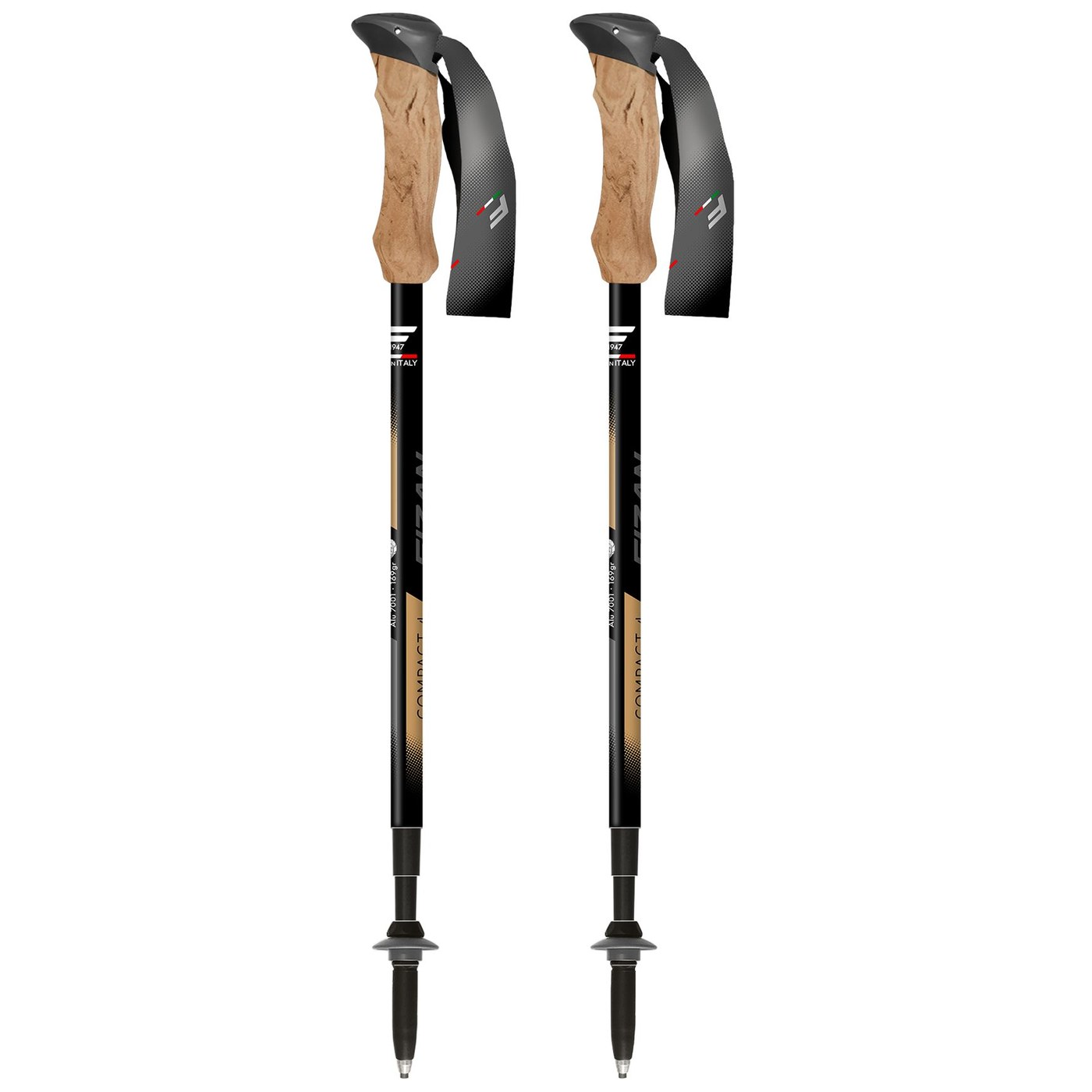
Trail pole catalogues have been filling up with carbon over the past few months. The Fizan Compact 4 takes the exact opposite route: aluminium, twist-lock system, cork grip, and a hiking/trekking focus rather than racing. Yet at 169 g per pole, it ranks among the lightest on the market, carbon included. The real question is whether that weight saving costs you durability, and on that point long-term user feedback is split.
Fizan Compact 4 review: 169 g per pole, cork grip and twist-lock, the lightest on the market against carbon
8/10
Specifications
| Feature | Value |
|---|---|
| Weight | 169 g per pole (338 g per pair) |
| List price | €72.90 (often discounted to around €60-65) |
| Material | 7001 aluminium |
| Number of sections | 4, telescopic |
| Locking system | Twist-lock, FLEXI system |
| Grip | Natural cork |
| Tip | Tungsten |
| Packed length | 51 cm |
| Extended length | 125 cm |
| Section diameters | 17 / 16 / 14 / 12 mm |
| Baskets included | 2 sets: 35 mm (summer) and 50 mm (all-round) |
| Made in | Italy |
| Warranty | 2 years |
The lightest on the market, carbon included
On weight, the figure can be checked directly on the product: "Alu 7001 - 169gr" is printed on the shaft of each pole, which matches the spec sheet from official retailer Snowleader. That number puts the Compact 4 ahead of most carbon poles on the market, including some folding models that cost two to three times more. Tibison, which tested the product and gave it 8.4/10, backs this up without reservation: "the lightest on the market", a verdict in line with the consensus across the comparisons we reviewed.
One discrepancy deserves to be flagged rather than smoothed over: Snowleader's spec table lists a "foam" grip, while the official product photo clearly shows a natural cork grip, texture and colour included, and Tibison explicitly confirms a "natural cork grip". This kind of data-entry error on generic retailer spec sheets is not unusual; we go with the visual evidence and the specialist source rather than the retailer's table.
Durability: what long-term field feedback says
This is the most documented point in the community, through many reports posted on the Randonner Léger forum, some covering the Compact range with the same twist-lock system, across several generations of Fizan poles. Positive feedback clearly dominates: one user reports more than 20 days of hiking, including a full GR20, without a single issue, with a locking system rated "much better" than his old Decathlon poles; another ran a 70 km trail with 3,100 m of elevation gain leaning heavily on them without breakage, noting that the poles "bend but don't break".
But several reports also document real limitations, and they should be treated as such rather than played down. A hiker who completed a 40-day traverse reports a locking system that ended up seizing and then loosening towards the end of the route, requiring a makeshift repair; another, on the HRP (Pyrenean High Route), broke two tips five days apart; a third measured 342 g per pair on his scale against the 320 g claimed at the time for his model, a gap close to the one already noted on the official weight of the Compact 4 tested here. Fizan's after-sales service is mentioned several times as responsive, with free replacement of faulty sections.
Folding and storage: the 4-section trade-off
Going to 4 sections instead of 3 brings the packed length down to 51 cm, noticeably more compact than classic 3-section poles, which sit around 64 cm. Tibison openly acknowledges the downside: extending and collapsing take longer than with a 3-section system, especially when you need to fine-tune the length at camp. The twist-lock system, inherited from the original Compact range, also needs periodic retightening to prevent any slipping under heavy use, a point independently confirmed by Tibison and several reports on the Randonner Léger forum.
Strengths
- 169 g per pole, a verified weight that puts it among the lightest on the market, carbon included.
- Natural cork grip: good hold, and it handles sweat better than a standard EVA foam grip.
- Very compact packed length (51 cm) thanks to the 4 sections, easy to slip into a pack or a suitcase.
- Rare weight-to-price ratio: around €60-65 street price, two to three times cheaper than carbon poles of similar lightness.
- Fizan after-sales service described as responsive by several users across several product generations.
Weaknesses
- Twist-lock system that needs regular retightening and can seize or slip under very heavy, prolonged use.
- Tips reported as breakable by several users under sustained use on rocky terrain.
- Slower to extend and collapse than a classic 3-section system.
- Less stiff than carbon: the weight saving costs a bit of responsiveness, mostly noticeable in sustained sporty use.
- Retailer spec sheet unreliable on the grip material, so double-check before buying if that matters to you.
The essentials in 3 sentences
The Fizan Compact 4 delivers on its lightness promise: 169 g per pole, verified on the product itself, a figure that beats a good share of carbon poles. Long-term field feedback, positive overall, also documents real limitations with the twist-lock system and occasional tip fragility under heavy use. At €60-65 street price, it is a smart choice for lightweight hiking and trekking, less obvious for sustained competitive trail running where carbon stiffness still wins.
Overall score
8.0/10
8.0/10
Who is it for?
- Lightweight and ultralight (UL) hikers chasing every gram
- Long-distance trekkers (GR routes, HRP) looking for a pole that packs small
- Occasional to regular users on non-extreme terrain, on a controlled budget
- Anyone who prefers a cork grip over a standard EVA foam one
Who should skip it?
- Competitive trail runners who want the maximum stiffness of carbon for very intense use
- Anyone who routinely abuses their gear on very rocky terrain (documented risk of tip breakage)
- Users who want a maintenance-free system: the twist-lock needs regular retightening
- Downhill skiing or uses that require more stiffness and bigger baskets than those supplied
RunMorph verdict
The Fizan Compact 4 does its job: it is one of the lightest telescopic poles on the market, at a price that stays reasonable next to carbon. Long-term user feedback, plentiful and spread over several years of real use, confirms decent reliability for standard hiking, provided you accept regular maintenance of the locking system and don't put your full weight on them on unforgiving terrain. For trekking and lightweight hiking, the weight-to-price equation is hard to beat; for demanding competitive trail running, carbon keeps the edge.