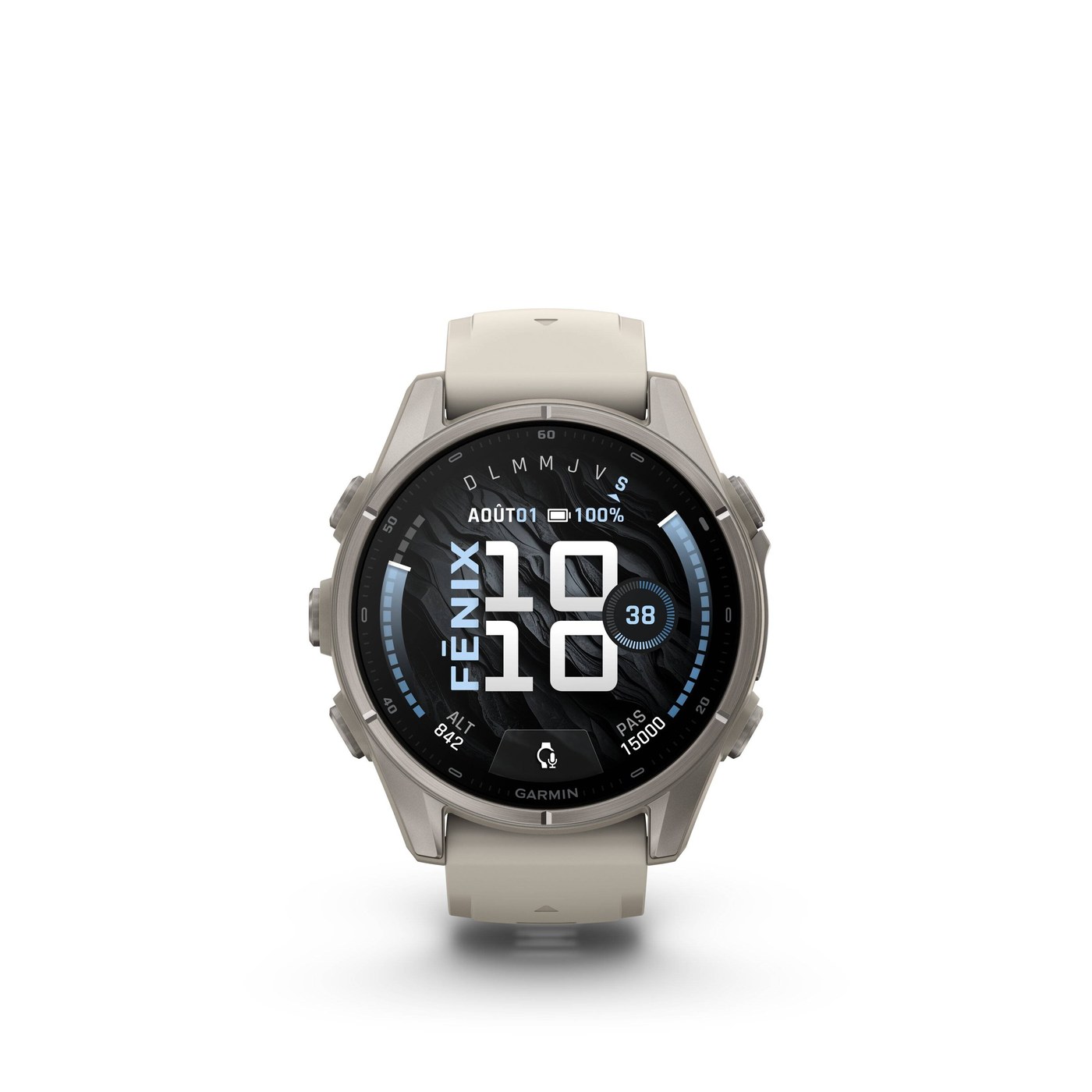
On 25 August 2026, Garmin pulled the rug out from under its own Solar lineup. The fenix 9 arrives with a display twice as bright, 64 GB of storage and a new Epic feature that tells the story of your runs. But the standard model, the one most runners will actually buy, loses the argument that has sold fenix watches to trail runners for years: solar charging. At RunMorph, we went through the fenix 9 AMOLED 47 mm with a fine-tooth comb, the size Garmin itself presents as the best all-round option in the range.
© Garmin, official photo used for editorial purposes
Garmin fenix 9: the outdoor watch that has to replace an entire lineup
Garmin is not refreshing a watch here, it is refreshing an architecture. Since the fenix 7, the formula fit in one sentence: a rugged case, a choice between a spectacular AMOLED and a near-indestructible MIP Solar, and mapping that no direct competitor can match. The fenix 9 changes one variable in that equation, and not a minor one: on the standard fenix 9 models (excluding Pro), there is no Solar version anymore. The choice now comes down to AMOLED, in 43, 47 or 51 mm.
This shift is not a marketing detail. It redraws who buys what in the range. A trail runner who wanted the solar always-on display of a fenix 7 Solar now has to climb all the way to the fenix 9 Pro Solar inReach, a model starting at 1,199.99 euros in 47 mm. The model tested here, the fenix 9 AMOLED 47 mm Carbon Gray DLC Titanium, remains the most sensible entry point in the range: 999.99 euros according to Garmin, even though French retailers tend to list it around 1,049.99 euros once it is in stock.
RunMorph tip: before comparing the fenix 9 with a Garmin fenix 8, first check whether you really need solar. If the answer is yes, your budget jumps by 150 to 350 euros in one go toward the Pro range.
Multi-band GPS and Elevate Gen 5 heart rate: the foundation stays put
The fenix 9 keeps dual-frequency multi-band GNSS (GPS, GLONASS, Galileo, QZSS, BeiDou) with SatIQ technology, which automatically adapts the reception mode to the terrain. Technically, it is the same building block as on the fenix 8 and the Forerunner 970 already tested at RunMorph: nothing new under the GPS hood, which is not bad news, since multi-band accuracy is already the market benchmark in this price range.
On the heart rate side, the Elevate Gen 5 sensor stays in place, backed by ECG (region dependent) and the Pulse Ox oximeter. No independent data is available yet on this sensor's real-world accuracy during exercise on this exact model, as the watch was only three days old when this review was written. The independent measurements available for the Elevate Gen 5 sensor on the fenix 8 serve as a technical baseline, with no guarantee of strictly identical accuracy on the fenix 9.
TopoActive mapping: the engine that runs 30% faster
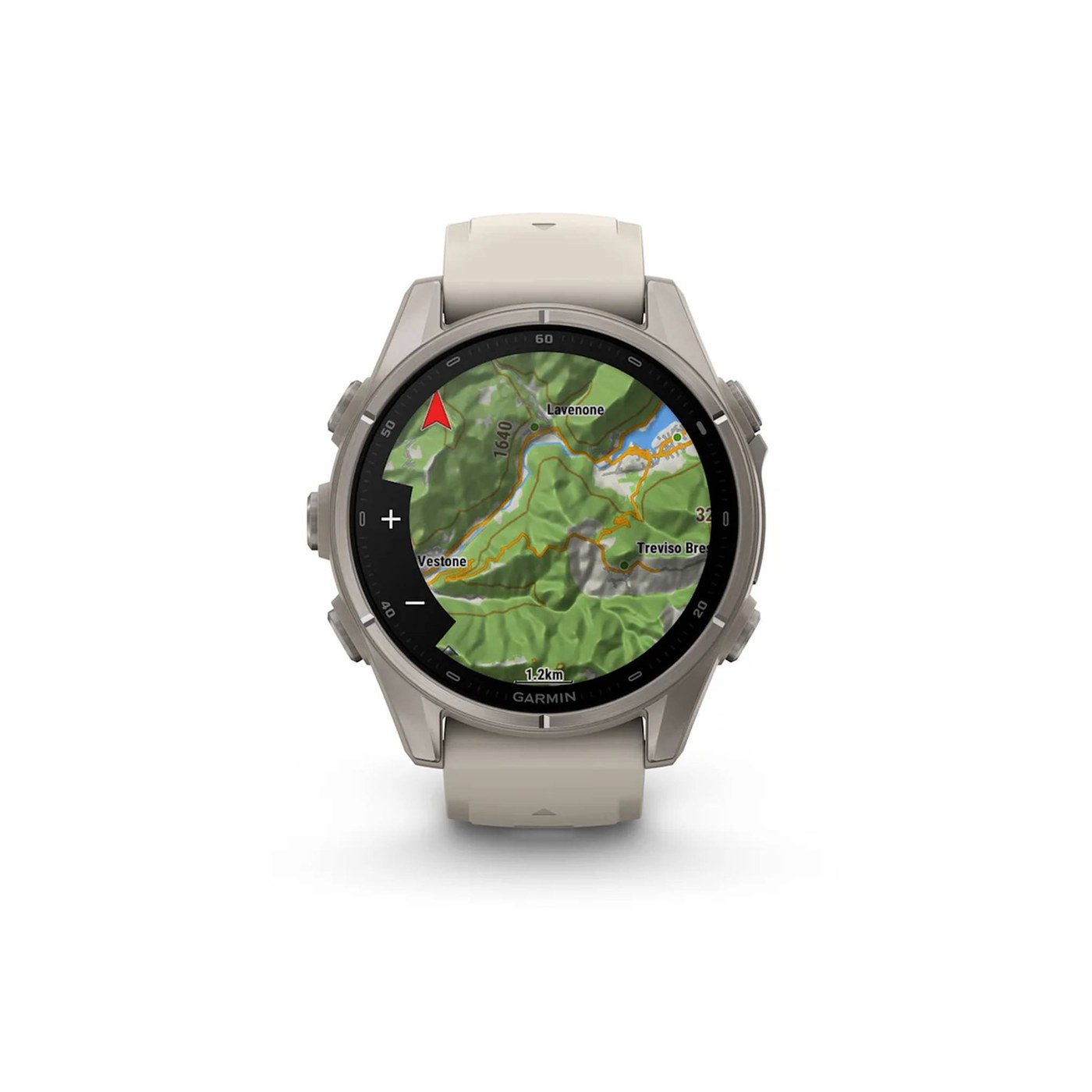
This is where the fenix 9 makes its most concrete progress for a trail runner. Garmin announces a new mapping engine with 50% more RAM than the fenix 8, panning up to 30% faster, and route calculation 40% faster than on the fenix 8 Pro. The new perspective view adds relief to the display so you can anticipate what is coming on the route, both up close and further ahead.
Multi-continent TopoActive maps remain preloaded, with dynamic routing and the NextFork guide at junctions to quickly find the right fork without pulling out your phone. With 64 GB of storage, twice as much as a fenix 8, you can download more map areas without juggling the available space.
© Garmin, official photo used for editorial purposes
Field test: Stamina, Epic and the new sport profiles
Only three days separate the official launch of the fenix 9 from the writing of this review. No independent multi-week field test exists yet for this exact model: the available material comes from Garmin's official specifications, a detailed technical analysis published by a specialist GPS watch site (used internally here, never named), and two French takes published at launch. u-Trail methodically compared the eighteen models in the range and points out that the 43 mm AMOLED version at 999.99 euros is the real commercial surprise of this launch, a compact format finally available in the fenix world without sacrificing power. Quatorze Running, after several weeks following the product leak and then the official launch, stresses the premium feel of the titanium case on the Pro versions compared with the reinforced polymer of the standard fenix 9, and clearly positions the range for the runner who really uses every feature, not the occasional runner.
Both sources agree on one point that shapes this whole review: the standard fenix 9 is no longer the indestructible solar watch some trail runners were looking for. u-Trail puts it bluntly: MIP Solar is now concentrated on the most expensive Pro models, which forces a trail runner seeking solar battery life to pay considerably more than with the previous generation. At RunMorph, this reading matches our analysis of the spec sheet: Garmin has split its range into two distinct logics, premium AMOLED for everyday use and connected sport, Solar inReach for endurance and safety when fully self-sufficient.
On the software side, the Garmin Epic feature now assembles several days of activity, photos and health data directly on the watch into a story you can view without going back to the app. The Stamina metrics also evolve, with an endurance curve and zones that sharpen pace management on a long run. More than a hundred sport profiles are available at launch, with two notable additions for a trail audience: full indoor rowing (VO2 max, FTP, power curve) and rucking as a dedicated session, separate from the simple activity profile already present on the fenix 8.
fenix 9 vs fenix 8: the comparison
| Garmin fenix 9 (47 mm) | Garmin fenix 8 (47 mm) |
| Weight | 75 g | 72 g |
| Display | AMOLED 1.4", around 2,000 nits | AMOLED 1.4", around 1,000 nits |
| Storage | 64 GB | 32 GB |
| Solar (standard) | No, reserved for the Pro | No, already reserved for the Solar variant |
| Epic feature | Directly on the watch | Only in Garmin Connect |
| New profiles | Full rowing, dedicated rucking | Not available |
| Launch price (47 mm AMOLED) | 999.99 € | 899 € |
The short version: the fenix 9 brings a brighter display, twice the storage and a real software gain with on-watch Epic, for 100 euros more at launch. A runner happy with their fenix 8 has no reason to rush an upgrade, since the GPS and heart rate fundamentals remain identical. Someone buying their first fenix, on the other hand, has no reason to target the old generation now that the new one is available in the same price segment.
fenix 9 vs Suunto Vertical 2 and COROS Vertix 2S: the comparison
| Garmin fenix 9 (47 mm) | Suunto Vertical 2 | COROS Vertix 2S |
| Solar | No (Pro only) | Yes, 2000 nits AMOLED display | No |
| Max GPS battery life | 81 h (max battery mode) | 65 h multi-band | 140 h UltraMax |
| Mapping | Full TopoActive | Free worldwide offline | Landscape and Topo offline |
| Price | 999.99 € | Around 750 € | Around 700 € |
On raw battery life alone, the COROS Vertix 2S crushes the fenix 9 AMOLED with its 140 hours in UltraMax mode, for 300 euros less. The fenix 9 only closes that gap with its software ecosystem (Garmin Connect, Training Readiness, the depth of its profiles) and TopoActive mapping, more polished than on either rival. The choice boils down quickly: COROS or Suunto for raw battery life at the best price, Garmin for the ecosystem and mapping, even if it means paying the difference.
Pros
- AMOLED display twice as bright as the fenix 8, readable in full sun
- 64 GB of storage, double the previous generation
- TopoActive mapping and a noticeably faster rendering engine (30 to 40%)
- Epic feature built right into the watch, no need to go through the app
Cons
- Solar dropped from the standard model, reserved for the Pro from 1,199.99 euros
- Launch price up 100 euros compared with the fenix 8 (899 euros)
- Claimed expedition mode battery life clearly down (18 days versus 40 days), even though the naming has changed
- No independent multi-week field feedback at the time of this review, as the watch has only just come out
How to use it the RunMorph way: the fenix 9 AMOLED fits into a trail or multisport build-up where you want complete mapping and reliable recovery metrics without waiting for the Pro version. Pair it with a RunMorph trail or ultra-trail training plan to make the most of the Stamina zones and load tracking on your long runs, instead of leaving that data asleep in the app.
Our field verdict: who does the fenix 9 AMOLED make sense for?
The trail runner preparing an ultra who does not need solar
If you charge your watch between long runs, which is still the case for most runners even over an ultra weekend, the fenix 9 AMOLED covers your needs with room to spare: complete mapping, multi-band GPS, thirty hours of battery life in normal activity mode, up to 81 hours in max battery mode. Solar only really matters if you head out for several days with no power outlet available.
The triathlete or multisport athlete already in the Garmin ecosystem
The Garmin Connect ecosystem, multisport profiles and the depth of the recovery metrics remain a strong argument for anyone who already owns Garmin sensors or other Garmin devices. The fenix 9 slots in without friction, unlike a complete switch to the COROS or Suunto ecosystem.
The tight budget that mainly wants a reliable GPS watch
At 999.99 euros minimum, the fenix 9 AMOLED stays out of reach for a tight budget. A Garmin Forerunner 970 covers most running and triathlon features for considerably less, without the rugged case or the same outdoor depth.
© Garmin, official photo used for editorial purposes
The RunMorph Coach's verdict
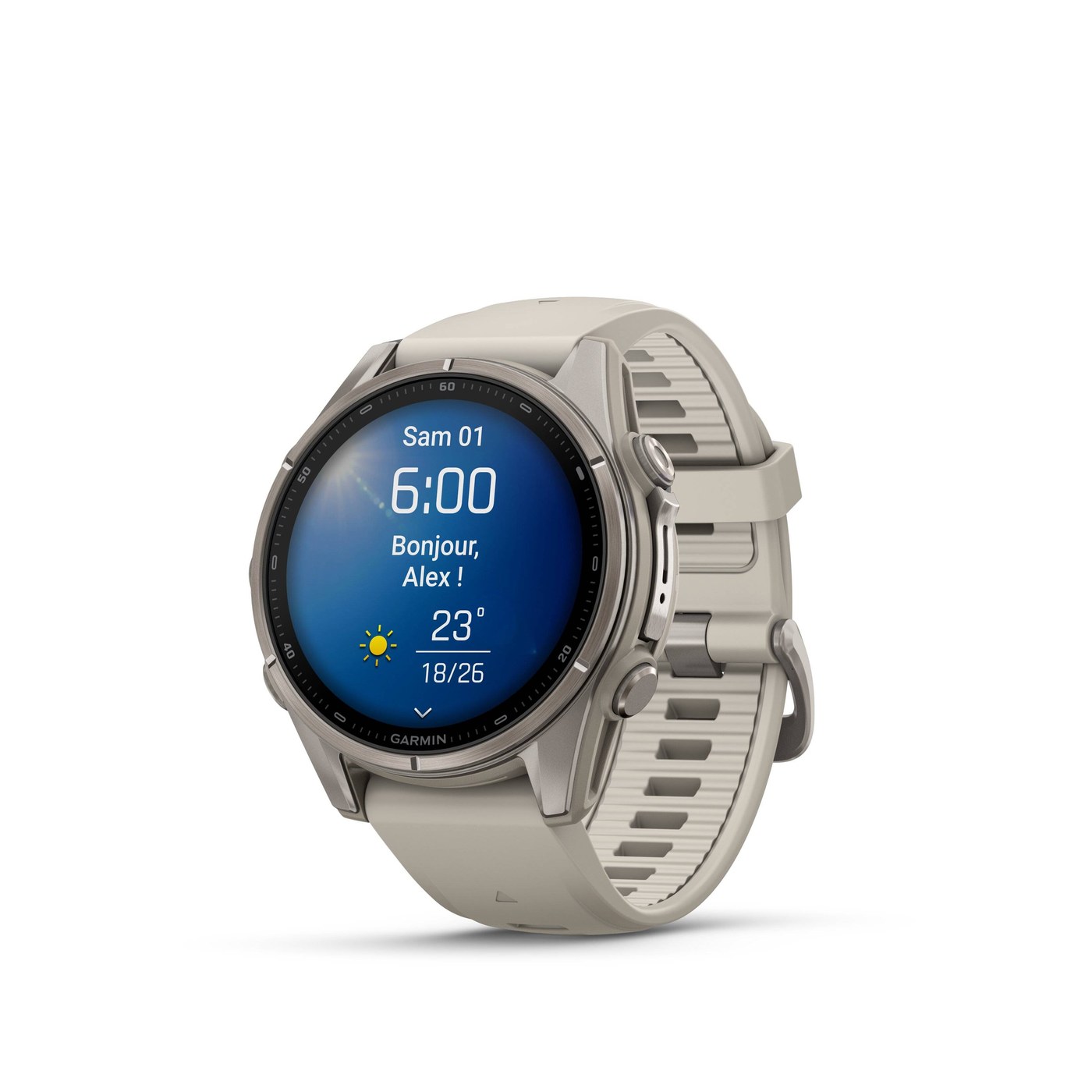
The fenix 9 AMOLED 47 mm improves exactly where Garmin says it does: display, storage, mapping engine, software features. Nothing revolutionary, but solid execution that confirms the fenix as the most complete outdoor watch on the market for anyone who really uses its functional depth. The real shift in this generation is not technical, it is commercial: solar leaves the standard model, and the trail runner who made it a buying criterion now has to budget for a Pro Solar inReach at more than 1,200 euros. At a listed 999.99 euros, often 1,049.99 euros at French retailers, the fenix 9 AMOLED is a very good product, not an obvious buy for everyone.
8.0/10. The score rewards the technical and software execution, but is held back by value for money that deteriorates further in an already very expensive segment, and by the lack of independent field hindsight at this stage.