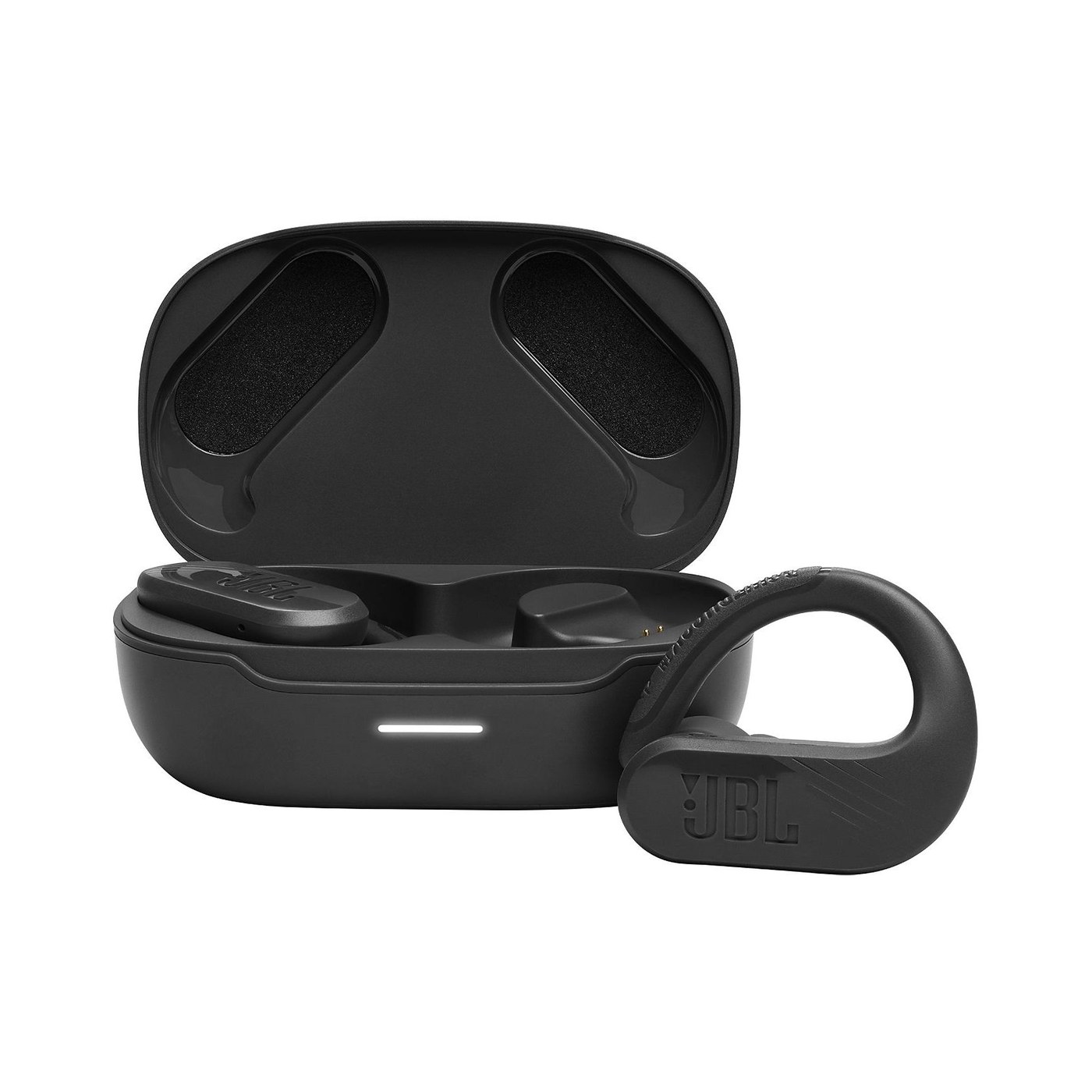
On trail running forums and in club locker rooms, the same scene has played out for two years: one pair of earbuds drops into the mud, another dies after a run in pouring rain, and someone always ends up bringing up the JBL Endurance Peak 3. Not for the sound quality, which is never the first selling point, but for a toughness that stands up to models two or three times the price. At under 80 euros today, JBL's sports earbud has become a quiet benchmark in the budget segment, even if that means giving up what other brands treat as top priority.
© JBL, official photo used for editorial purposes
JBL bets on toughness over high-end audio
Since launching the Endurance line in 2018, JBL has staked out territory few audio brands dare to claim openly: earbuds that are indestructible first and great-sounding second. The third generation, launched in early 2023, sticks to that logic. It leans into it even harder, with an IP68 rating that goes well beyond what most rivals in the same price range offer.
The Endurance name sells, and it isn't all marketing: on paper, 50 hours of total battery life with the case plus full dust and submersion protection are rare arguments below the 100 euros mark. But there's a catch: no active noise cancelling and sound that is decent at best remind you that every euro saved shows up somewhere on the spec sheet. So the question isn't whether the Endurance Peak 3 is the best sports earbud on the market. It isn't. The question is whether it's the right pick for a runner who puts reliability in the field ahead of the listening experience.
JBL Endurance Peak 3 specs: what really changes
| Feature | Detail |
|---|
| Brand | JBL (Harman) |
| Model | Endurance Peak 3 |
| Release | February 2023 |
| Type | True wireless in-ear, Powerhook ear hooks |
| Weight | 76 g (2 earbuds + charging case) |
| Water resistance | IP68 (fully dustproof + submersion to 1.5 m / 30 min) |
| Bluetooth | 5.2 (A2DP 1.3, AVRCP 1.6, HFP 1.7) |
| Earbud battery life | Up to 10 h per charge |
| Total battery life (case) | Up to 50 h in total |
| Fast charging | 10 min of charging = 1 h of playback |
| Active noise cancelling | No (Ambient Aware / Talk-Thru mode only) |
| Microphones | 4 microphones for calls |
| App | JBL Headphones (customizable equalizer) |
| Colors | Black, White, Teal depending on market |
| Price | 99.99 euros at launch, between 70 and 90 euros in mid-2026 depending on retailer |
© JBL, official photo used for editorial purposes
Powerhook and TwistLock: what difference do they make in your ear?
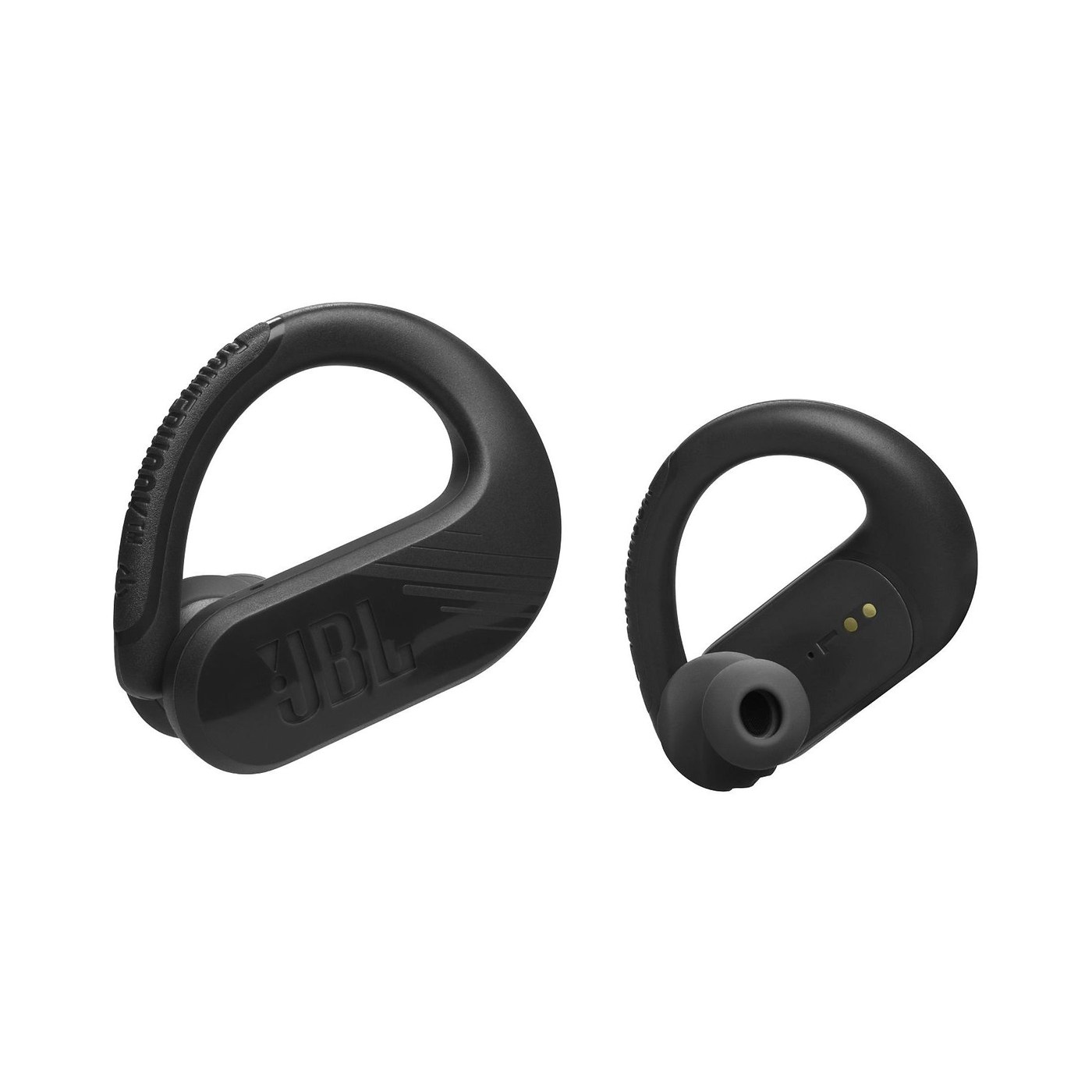
The real technical case for the Endurance Peak 3 comes down to two in-house features. The Powerhook ear hook is soft and flexible, follows the curve of your ear and never gets stiff enough to bother you under a beanie or sunglasses. The TwistLock tip locks into your ear canal with a slight twist, a move that becomes automatic after two or three runs. On short intervals, on leg-breaking trails or in a final sprint, this combination holds better than a standard tip that starts slipping at the first drops of sweat.
The other notable change from the previous generation is water resistance. IP68 replaces an already solid IPX7, with a real gain: full dust protection (handy on dry, dusty trails in summer) and resistance to prolonged submersion, not just splashes. In practice, a downpour on the trail or a fall into a deep puddle doesn't scare these earbuds, while many rivals only claim sweat resistance.
RunMorph tip: if you only run on roads and at the gym, an open-ear model like the Shokz OpenRun Pro 2 lets you hear more of what's around you. For demanding trails or unpredictable weather, the toughness of the Endurance Peak 3 wins out.
Field test: from easy pace to intervals in the rain
We wore the Endurance Peak 3 on runs ranging from 5'30/km recovery easy runs to short intervals around 3'45/km, plus two technical trail runs with stream crossings. The fit doesn't budge, even during sudden changes of direction or more powerful strides on climbs. Once properly adjusted, the Powerhook disappears after a few minutes, which isn't the case for every rigid-hook model on the market.
On the sound side, the profile is bass-heavy straight out of the box, in line with JBL's Pure Bass DNA. The JBL Headphones app lets you tone that down with a simple equalizer, but don't expect the finesse of audiophile headphones. For running, where rhythm and energy matter more than faithful reproduction, this choice works well. Calls made outdoors in the wind stay clear enough thanks to the 4 microphones, without being exceptional.
The real test came during a steady downpour over 40 minutes of a long run: no dropouts, no loss of sound, and the case dried completely in a few hours in the open air. That's exactly what the IP68 rating promises, and it delivers.
© JBL, official photo used for editorial purposes
JBL Endurance Peak 3 vs Shokz OpenRun Pro 2: the comparison
Both target demanding runners, but with opposite philosophies: one seals your ear canal to block out noise, the other leaves it open through bone conduction so you stay fully aware of your surroundings, a major safety factor in the city or on roads open to traffic.
| Criterion | JBL Endurance Peak 3 | Shokz OpenRun Pro 2 |
|---|
| Design | Closed in-ear, Powerhook ear hooks | Bone conduction, open headband |
| Situational awareness | Average (Ambient Aware mode) | Full (ears never blocked) |
| Battery life | 10 h + case = 50 h in total | 12 h + case |
| Water resistance | IP68 | IP55 |
| Bass / sound immersion | Punchy, decent | Lighter (a limit of bone conduction) |
| Typical price | 70 to 90 euros | Around 180 euros |
The choice mostly comes down to terrain and your need for safety. On roads open to traffic, the Shokz OpenFit 2 or the OpenRun Pro 2 keep a clear edge. On remote trails or in wet conditions, the Endurance Peak 3 takes the hits better, literally.
What we liked
- IP68 rating, rare below 100 euros
- Flawless Powerhook hold, even on technical trails
- 50 hours of total battery life, well above average
- Affordable price, regularly on sale
What we liked less
- No active noise cancelling
- Bass-heavy sound that lacks finesse
- Ambient Aware mode less natural than a true open-ear design
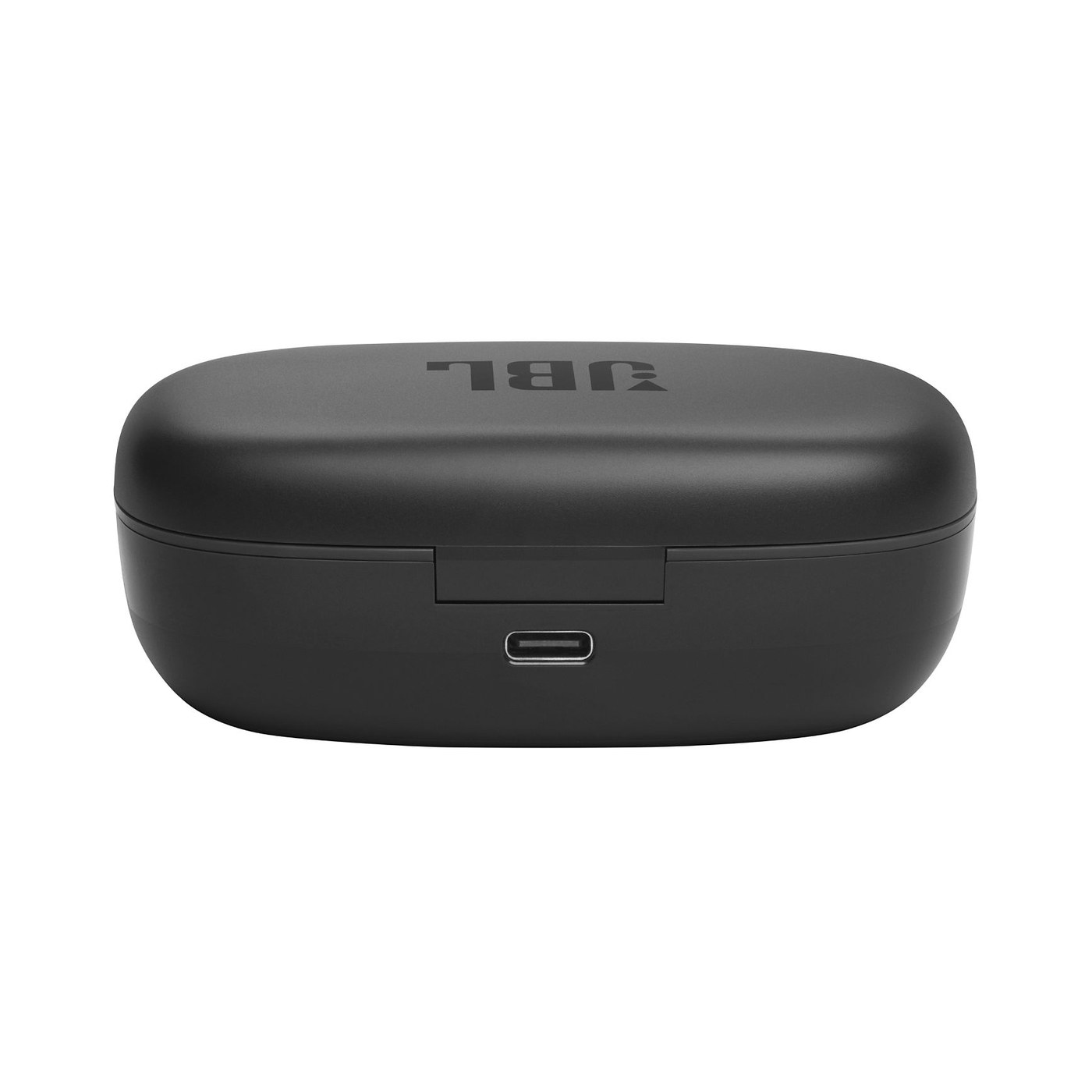
- Case a bit bulky in a shorts pocket
© JBL, official photo used for editorial purposes
Our field verdict: which runs is the Endurance Peak 3 made for?
The Endurance Peak 3 fits runners who rack up the kilometers in all weather and have already wrecked several pairs of more fragile earbuds. It particularly suits trail runners who battle mud, rain and heavy sweat on long runs, as well as runners who hate recharging their gear every other run.
RunMorph business tip: to eat up the kilometers of a trail build or lock in your long runs even in the rain without worrying about your audio gear, pair the Endurance Peak 3 with a
RunMorph training plan built around your goal: marathon, half marathon or trail.
On the other hand, a runner who trains mostly at the gym or wants to shut out city noise will be happier with an active noise cancelling model, even if it means paying more and giving up some toughness.
RunMorph Coach verdict
The JBL Endurance Peak 3 doesn't try to compete with the market's audio benchmarks, and that's exactly what makes it a good buy for running. Its IP68 rating, Powerhook hold and 50 hours of total battery life meet a very concrete need for road and trail runners: never worrying about your gear on a run again. 8.3/10, a score that rewards honest value for money rather than flashy technical wizardry.