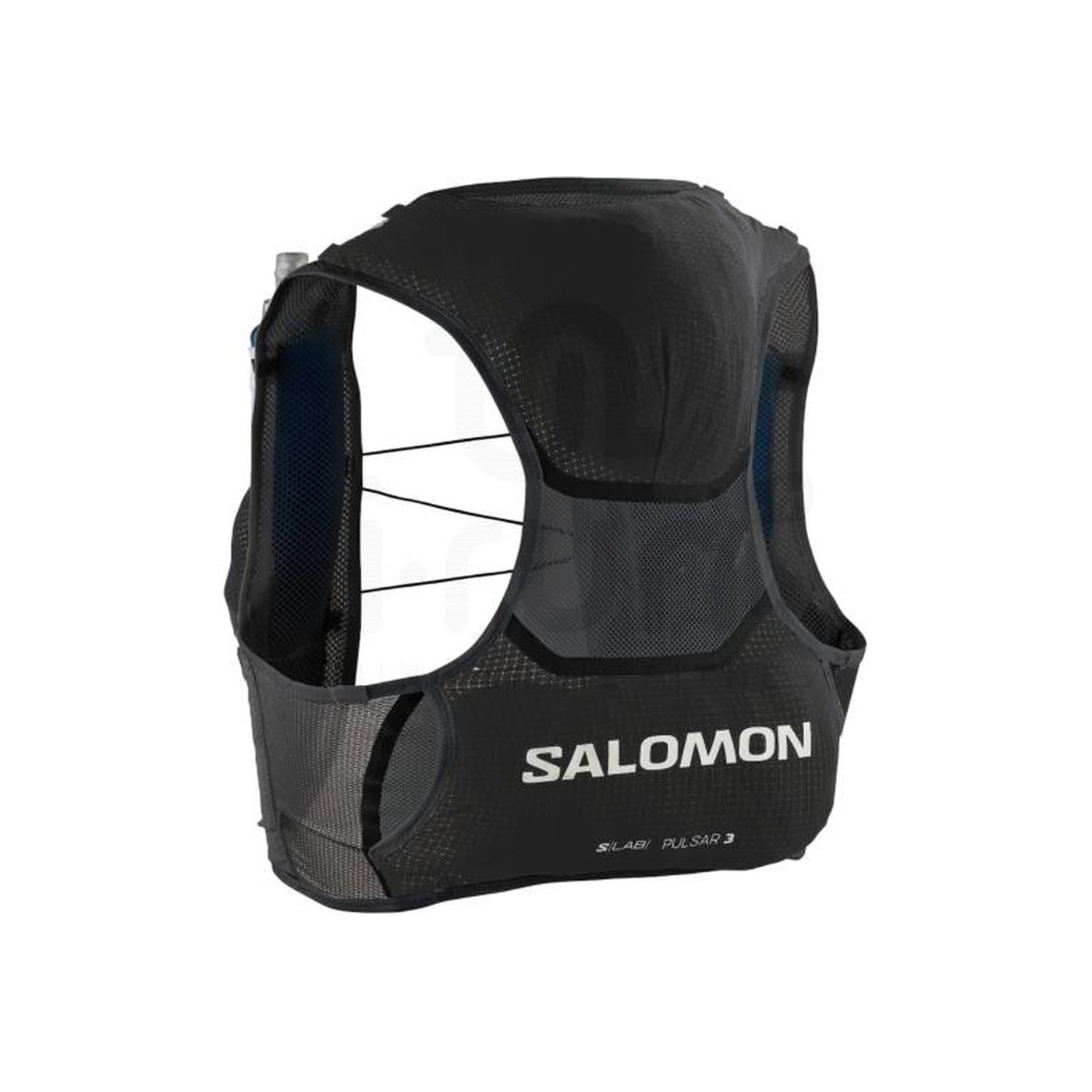
Salomon claims 90 grams for the S-Lab Pulsar 3, flasks not included. With the two 250 ml softflasks fitted, the weight climbs to 140 grams. It's the lightest vest RunMorph has ever tested, built for one job only: short racing, from a 10K up to a vertical kilometer, with nothing extra to carry. Independent testers praise a fit that nearly disappears and zero bounce, but they also flag a poorly placed zip pocket and a rear compartment that lets heavy items slide out.
Salomon S-Lab Pulsar 3: 90g and Two Flasks for Short, Fast Races (Full Test)
8/10
The essentials in 3 sentences
The S-Lab Pulsar 3 is the most minimalist vest in Salomon's lineup, built for races under 80 km where every gram counts. It delivers on fit and zero bounce, with an unexpected bonus: hydration bladder compatibility that its bigger sibling, the Sense Pro 6, doesn't offer. In exchange, its zip pocket sitting on the right and its open rear compartment force you to organize your gear differently than with a do-it-all vest. For a short race or a quality session with two flasks, it's a benchmark. For stashing everything without thinking twice, that's not its job.
8
/ 10 · RunMorph overall score
Who's it for?Runners who want a nearly invisible vest for a short race or a quality session with two flasks.
Who's it not for?Trail runners who need to carry bulky mandatory gear at the back.
Salomon S-Lab Pulsar 3: the vest that owns up to doing just one thing
Salomon positions the S-Lab Pulsar 3 at the very bottom of its S-Lab range, aimed at short race formats and quality sessions. The brand targets distances under 30 km in minimal configuration, and up to 80 km for a runner willing to refuel often. The vest borrows its name from Salomon's racing shoe, the Pulsar, but it's a completely separate product: there's no connection to the running shoe beyond sharing the same mindset of going as light as possible to go fast.
RunMorph's advice: if the S-Lab Pulsar 3 tempts you but you're racing 30 to 80 km formats with mandatory gear to carry, look at the Sense Pro 6 first. Both vests share the same minimalist philosophy, but the Sense Pro 6 doubles the available volume.
© Salomon, official photo used for editorial purposes
Objective technical data
| Feature | Value |
|---|---|
| Brand | Salomon |
| Model | S-Lab Pulsar 3 |
| Capacity | 3 L |
| Claimed weight | 90 g, flasks excluded |
| Weight with accessories | 140 g with the two flasks and included accessories |
| Available sizes | XS to L, unisex |
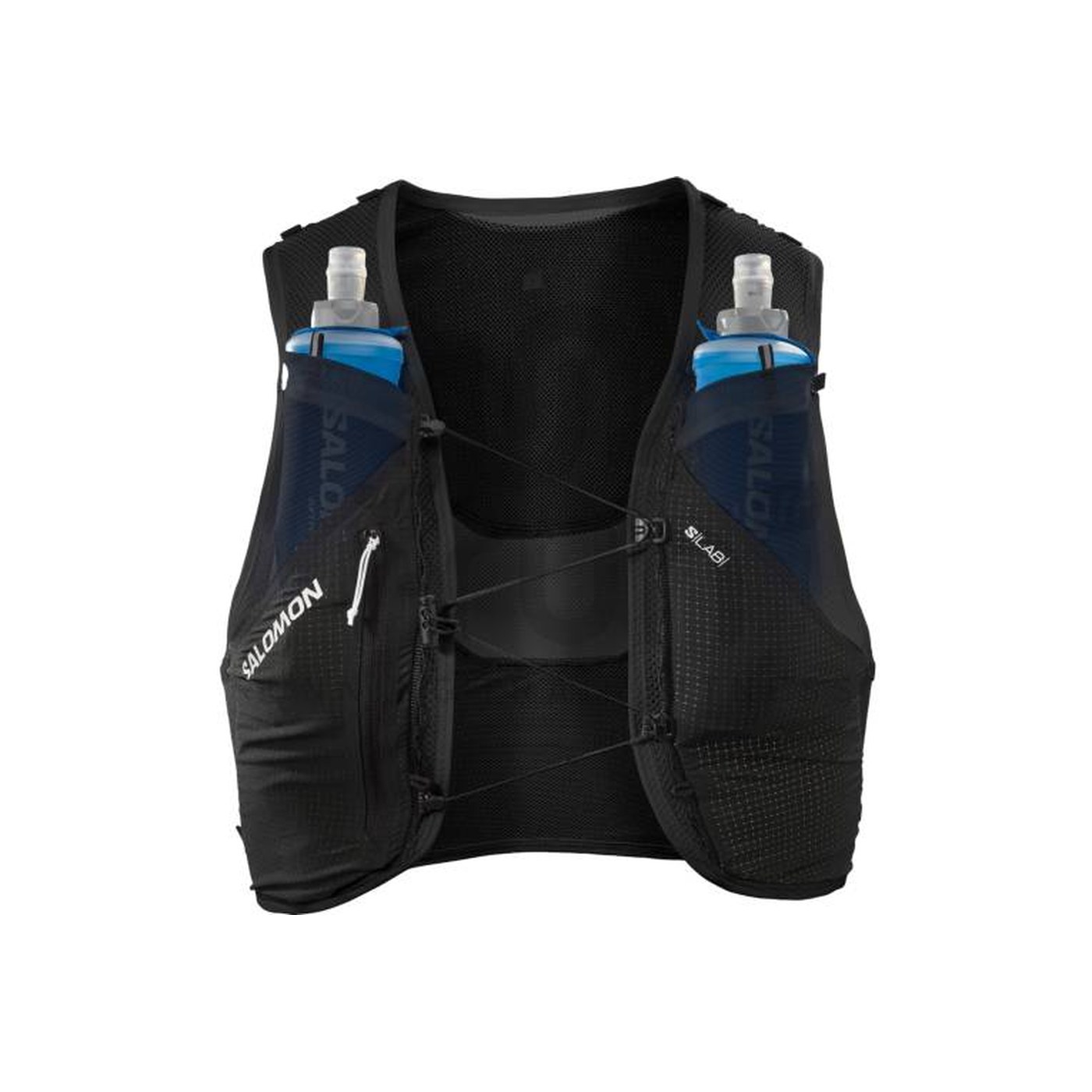
| Front pockets | 1 zip pocket (right side) + 2 stretch side pockets in front of the flasks |
| Hydration bladder compatibility | Yes, reservoir not included |
| Included flasks | 2 softflasks, 250 ml each |
| Fabrics | Body 84% polyester and 16% elastane, Power Mesh technical fabric, PFC-free |
| Side compression | None, support comes from the harness construction itself |
| Pole carry | Fittings compatible with Salomon Pole Quivers, sold separately |
| Reflective elements | Not specified by the brand for this model |
| UTMB mandatory-gear compliant | Partially, check the specific race's rules and the real transportable volume |
| Price | €160 |
A 50-gram gap separates the empty weight from the race-ready weight with both flasks full of water and the whistle attached. On a 90-gram vest, that gap weighs proportionally more than on a 200-gram model: worth keeping in mind before comparing spec sheets across brands.
Who is the S-Lab Pulsar 3 built for?
The racer on a short or vertical format
This is exactly the use case Salomon built this vest for. On a technical 10K, a vertical kilometer, or a 20 to 30 km race, the two flasks and the tunnel pocket are plenty, and the near-total absence of bounce becomes a genuine performance edge.
The trail runner stacking quality sessions
Intervals, hill repeats, threshold runs: the S-Lab Pulsar 3 stays put on your chest without restricting your arm swing, right where a more loaded vest starts to be felt with every fast stride.
The trail runner targeting an ultra with mandatory gear
This runner isn't served by the Pulsar 3's 3 liters. An ultra's mandatory kit (a thick waterproof jacket, a survival blanket, a sizeable food reserve) simply doesn't fit in this volume. A Sense Pro 6 or a larger-capacity vest like the Oxsitis Gravity 10L is a better fit.
© Salomon, official photo used for editorial purposes
The field test: a near-invisible fit, one badly placed pocket
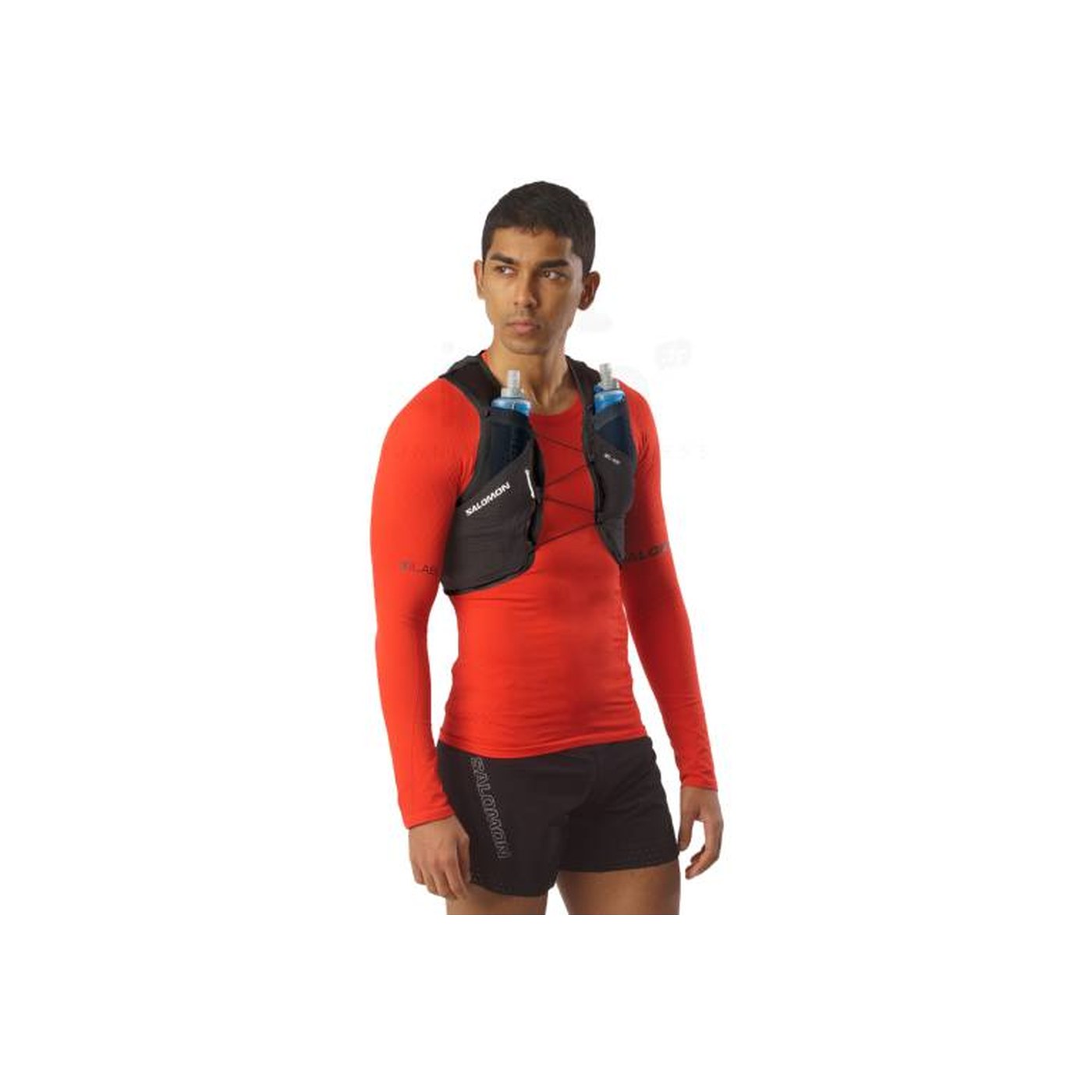
An independent field test run across several outings describes a fit close to that of a racing singlet, with a collar judged noticeably more comfortable than on previous Pulsar generations. The tester highlights the total absence of bounce while running, a wide-open and highly ventilated back, and flasks sitting slightly higher than on earlier generations, making them easier to grab without breaking stride.
The same test flags one specific flaw: the front zip pocket, moved from the left side to the right side on this third generation, becomes less accessible for the vast majority of runners, who are right-handed. A French consumer review posted on Outzer confirms the overall picture (practical pockets, good ergonomics, lightness that makes you forget the vest) while flagging a different issue with the rear compartment: a 250 ml softflask sits loosely in the bottom pocket and can fall out while handling the vest mid-run, a risk that disappears with a properly seated 500 ml flask.
Both sources agree on breathability, rated excellent even under load, and on the absence of hot spots around the shoulders or lower back. Neither reports any chafing issues, even on extended outings for a vest of this size.
Storage and accessibility: the essentials up front, the extras out back
Up front, the S-Lab Pulsar 3 offers a right-side zip pocket for your phone or keys, plus two stretch side pockets in front of the flask slots, large enough for gloves, gels, or a folded cap. The whistle is built directly into the harness.
© Salomon, official photo used for editorial purposes
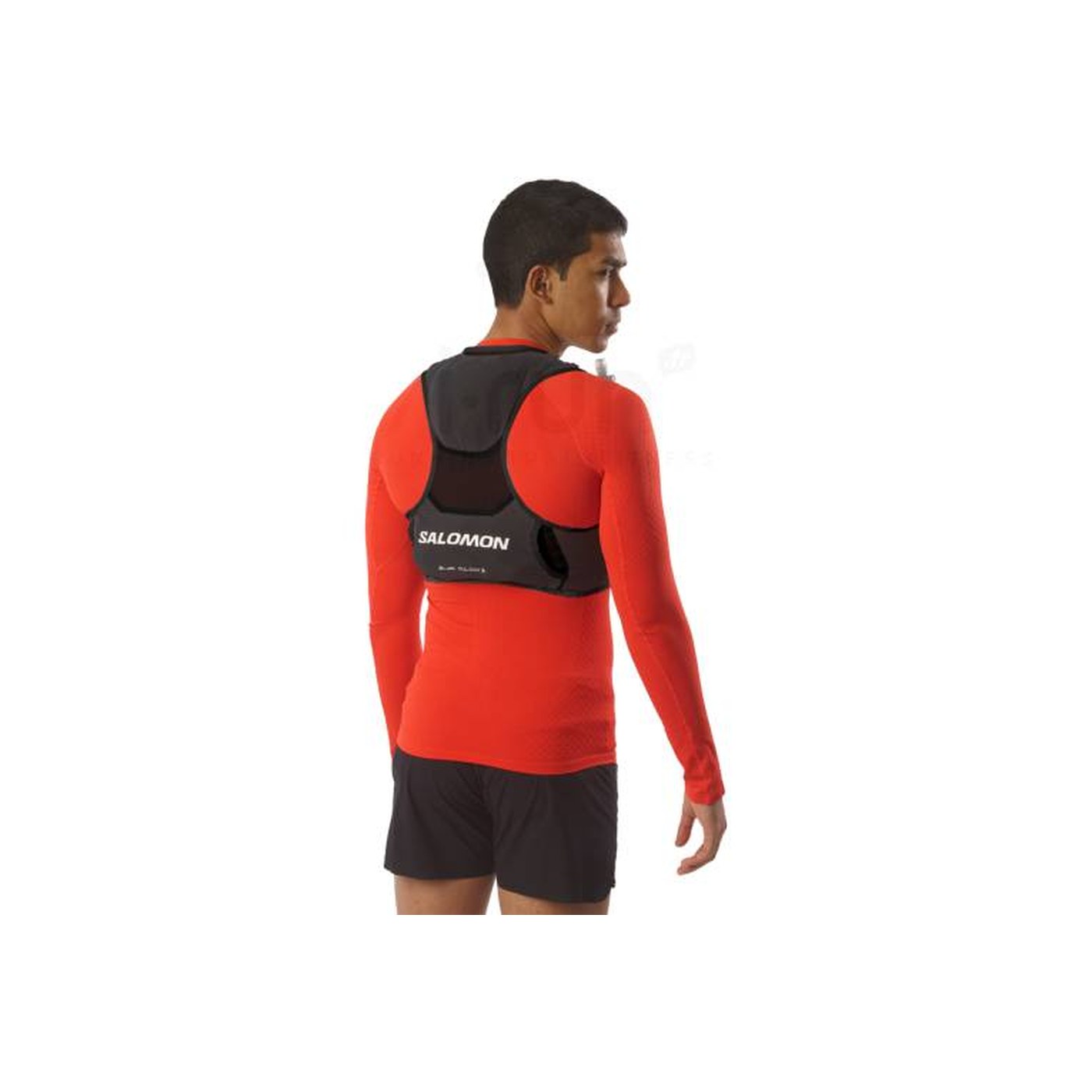
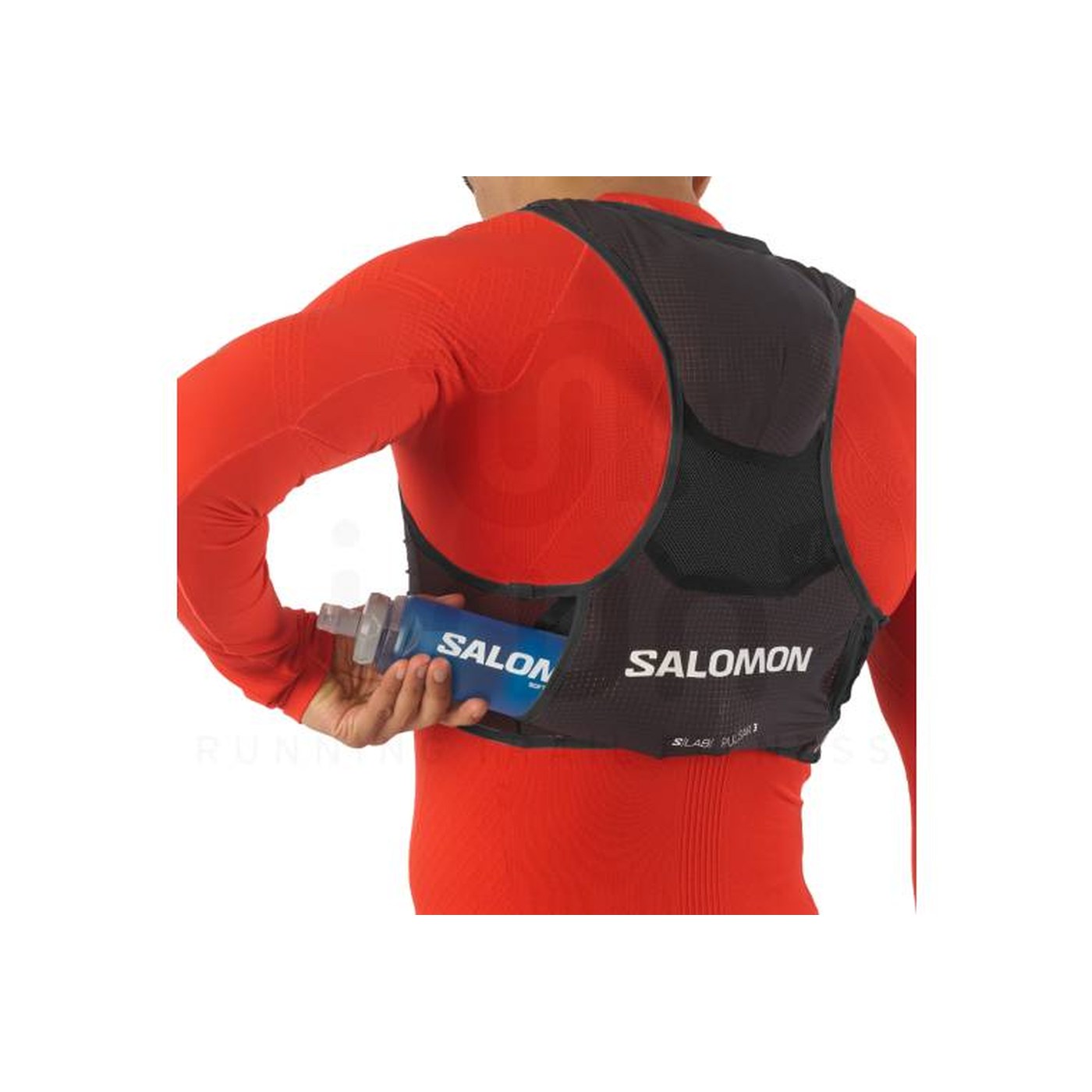
Out back, two compartments share what little space is available. The upper compartment holds a windbreaker or a thin mid-layer, but reaching it demands good shoulder mobility on the run, a motion that gets uncomfortable past a certain pace. The lower compartment, reachable from the side without taking the vest off, holds a spare 500 ml flask: a good idea on paper, less convincing in practice since it lacks a side closure to secure a lighter object.
On the pole-carry side, the fittings compatible with Salomon's quivers let you add poles, but you'll need to buy that accessory separately: no built-in carry system ships with the base vest, a logical call given the product's ultra-minimalist positioning, but one that adds to the bill if you want to run with poles.
Hydration: the pleasant surprise of the minimalist segment
This is where the S-Lab Pulsar 3 truly sets itself apart from its bigger sibling, the Sense Pro 6: despite its 3 liters, it still supports a hydration bladder, the reservoir simply isn't included out of the box. The two included 250 ml softflasks replace the older 500 ml Speed Flasks from the previous generation, a choice that halves the carryable volume in the front pockets but also cuts the weight on board for short formats where every gram counts.
For a 10K or a vertical format, the two 250 ml flasks are plenty, no question. Once the distance climbs toward 50 or 80 km, hydration bladder compatibility becomes a real edge over direct competitors that don't offer that option at this level of lightness: it lets you top up your water supply without waiting for an aid station, provided you invest in a compatible reservoir, which Salomon doesn't include.
© Salomon, official photo used for editorial purposes
Pros and cons
Pros
Among the best-fitting vests RunMorph has ever tested, zero bounce reported while running.
Hydration bladder compatible despite a mere 3-liter capacity, a rare feature on this segment.
Wide-open, highly breathable back, no hot spots reported by the sources consulted.
Flasks sit high, easy to grab without breaking stride.
Weight kept to 90 grams excluding accessories, among the lightest on the market.
Hydration bladder compatible despite a mere 3-liter capacity, a rare feature on this segment.
Wide-open, highly breathable back, no hot spots reported by the sources consulted.
Flasks sit high, easy to grab without breaking stride.
Weight kept to 90 grams excluding accessories, among the lightest on the market.
Cons
Front zip pocket sits on the right, less accessible for the majority of right-handed runners.
Lower rear compartment has no side closure: a 250 ml flask can slip out and fall.
Reaching the upper rear compartment demands good mobility on the run.
No built-in pole-carry system, the quiver is sold separately.
€160 for 3 liters, a steep price per liter even for a premium product.
Lower rear compartment has no side closure: a 250 ml flask can slip out and fall.
Reaching the upper rear compartment demands good mobility on the run.
No built-in pole-carry system, the quiver is sold separately.
€160 for 3 liters, a steep price per liter even for a premium product.
Pulsar 3 vs Sense Pro 6: the Salomon lineup compared
Both vests share the same minimalist logic within Salomon, but they target different race formats. The Sense Pro 6 doubles the volume and suits 20 to 80 km outings, while the Pulsar 3 stays focused on short formats and quality sessions.
| Criterion | S-Lab Pulsar 3 | Sense Pro 6 |
|---|---|---|
| Capacity | 3 L | 6 L |
| Claimed weight | 90 g | 141 g |
| Included flasks | 2 x 250 ml | 2 x 500 ml |
| Hydration bladder | Compatible | Not supported |
| Price | €160 | €180 |
The result is surprising: the smaller of the two vests is also the only one compatible with a hydration bladder. In short, pick the Pulsar 3 for a short format with two flasks, and the Sense Pro 6 as soon as storage capacity matters more than absolute lightness.
Against the competition beyond Salomon: a format with no real direct match
In the racing vest market, most competitors sit at 5 or 6 liters rather than 3. The Ultimate Direction Race Vest 6L and the NNormal Race Vest 5L remain the closest references in terms of philosophy, even though they offer almost double the volume.
| Criterion | S-Lab Pulsar 3 | UD Race Vest 6L | NNormal Race Vest 5L |
|---|---|---|---|
| Capacity | 3 L | 6 L | 5 L |
| Claimed weight | 90 g | 175 g | 174 g |
| Hydration bladder | Compatible | Compatible | Compatible |
| Price | €160 | €155 | cheaper |
On paper, the Pulsar 3 has no direct rival at its own capacity among the major generalist brands: it occupies a niche even narrower than the already-minimalist Race Vest segment. If 3 liters turn out to be too tight in practice, the UD Race Vest 6L and the NNormal Race Vest 5L remain the logical upgrades for more storage without sacrificing lightness.
How to fit the S-Lab Pulsar 3 into your RunMorph training plan
The S-Lab Pulsar 3 earns its place on interval sessions, threshold runs, and short races within a RunMorph trail training plan: exactly the moments when a more loaded vest gets felt on every surge. Keep a larger-capacity vest for the long runs in your buildup where mandatory gear piles up, and save the Pulsar 3 for the days when speed matters more than self-sufficiency.
RunMorph Coach's verdict
The S-Lab Pulsar 3 delivers on its promise of lightness and fit, with a genuinely unexpected bonus: hydration bladder compatibility despite its 3 liters. But Salomon hasn't solved everything, between a zip pocket poorly placed for most runners and a rear compartment that lets small flasks slip out. At €160 for a vest that openly commits to a single use, the Pulsar 3 mainly wins over the runner who knows exactly why they're buying it. 8/10, for one of the most accomplished vests in its niche, a niche that's deliberately very narrow.
Key takeaways for your training
- 90 g excluding flasks, 140 g race-ready: the lightest vest RunMorph has tested to date.
- 2 included 250 ml softflasks: plenty for a short format, limiting beyond 50 km without frequent refueling.
- Hydration bladder compatible: a rare feature at this level of lightness, reservoir sold separately.
- Right-side zip pocket: check how it feels to reach before buying, whether you're left- or strongly right-handed.
- €160: an investment built for one specific use, not a replacement for an all-round vest.