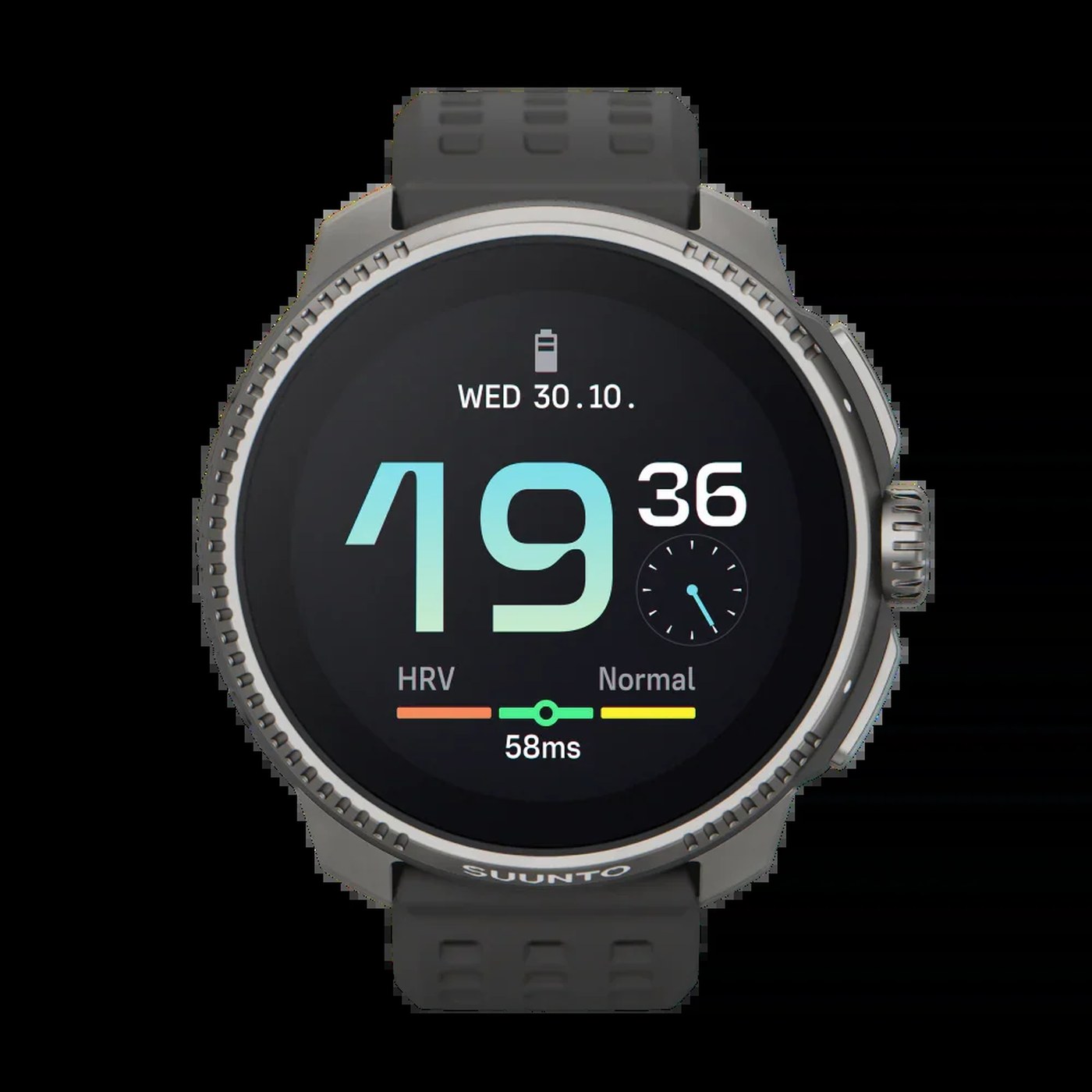
For years, Suunto had a reputation as an austere brand built for hardcore adventurers who'd take an indestructible transflective display over a flashy AMOLED any day. The Race changed that image in 2024: sapphire glass, a digital crown, a high-resolution color screen, free offline maps and a price that takes the fight to Garmin and Polar on their own turf. The question is whether the new look is more than skin deep.
© Suunto, official photo used for editorial purposes
Suunto Race: the premium mid-range play that shakes up Garmin and Polar
For years, Suunto owned a clearly defined niche: long expeditions, indestructible transflective displays and extreme battery life on watches like the Vertical. The Race moves onto new ground. With its AMOLED touchscreen, digital crown and free maps, it hunts directly on the turf of the Garmin Forerunner 965 and the Polar Vantage V3, two watches that list for roughly 200 and 150 euros more respectively.
The name alone, Race, spells out the ambition: this is no longer a watch for the lone adventurer but a performance tool for road running, trail and triathlon. It's a risky bet. Suunto has neither Garmin's software reputation nor Polar's heart rate expertise. So the brand is betting on an aggressive features-to-price ratio, with manufacturing in China that keeps the launch price at 449 euros for the steel version without cutting corners on build: sapphire glass and military-standard testing remain on both versions.
RunMorph's advice: if your budget tops out around 450 euros and you're torn between the Race and a Forerunner 965 at 650 euros, first ask yourself whether you really need routable maps. If the answer is no, the Race covers the essentials for a lot less money.
Suunto Race specs: AMOLED, dual-frequency GPS and free maps
| Brand | Suunto |
| Model | Race (Titanium Charcoal) |
| Release | Late 2023, on sale in France from early 2024 |
| Case size | 49 x 49 x 13.3 mm |
| Weight | 69 g (titanium) / 83 g (steel) |
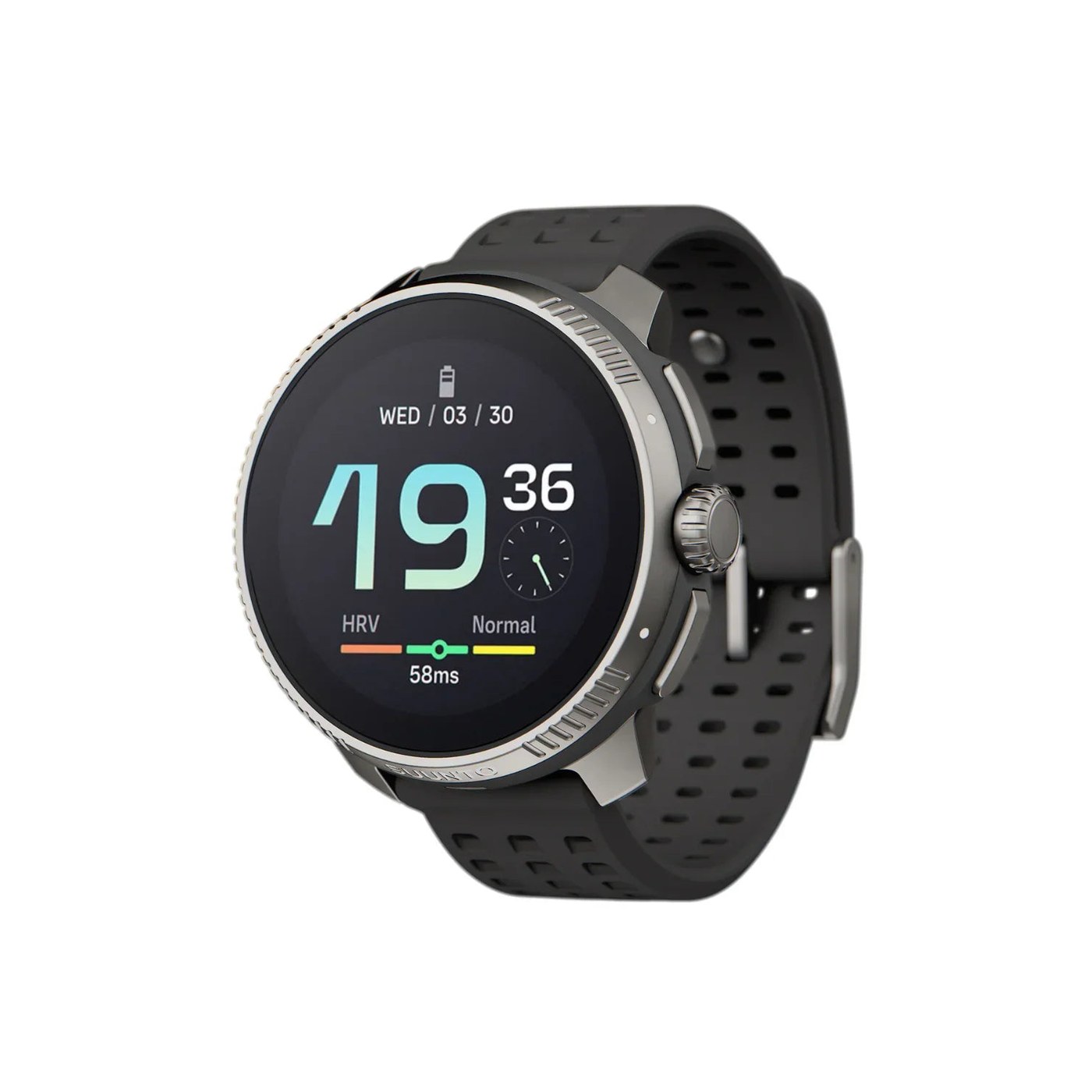
| Display | 1.43" (36 mm) AMOLED touchscreen, 466 x 466 px, sapphire glass, digital crown |
| Battery life | 12 days smartwatch / 40 h GPS Performance (multi-band) / 50 h Endurance / 70 h Ultra / 120 h Tour |
| GNSS | Multi-GNSS (GPS, GLONASS, Galileo, BeiDou, QZSS), dual-frequency L1+L5 |
| Sensors | Optical heart rate sensor + pulse oximeter, barometric altimeter, compass, thermometer, depth gauge (snorkeling mode) |
| Maps | Yes, offline (OpenStreetMap), NOT routable |
| Sport profiles | 95+ |
| Music storage | No (smartphone control only) |
| Contactless payments | No |
| Water resistance | 10 ATM (100 m), snorkeling 10 m |
| Smartphone connection | Bluetooth, iOS and Android, Suunto app |
| Price | €449 (steel, 16 GB) / €549 (titanium, 32 GB), often €349 to €408 on sale in mid-2026 |
The steel and titanium versions share exactly the same chassis and the same software features. Only the weight (69 vs 83 grams), map storage (32 vs 16 GB) and price differ. For typical road and trail running in France, 16 GB is plenty to store maps of several entire regions.
© Suunto, official photo used for editorial purposes
Maps and dual-frequency GPS: what they really change
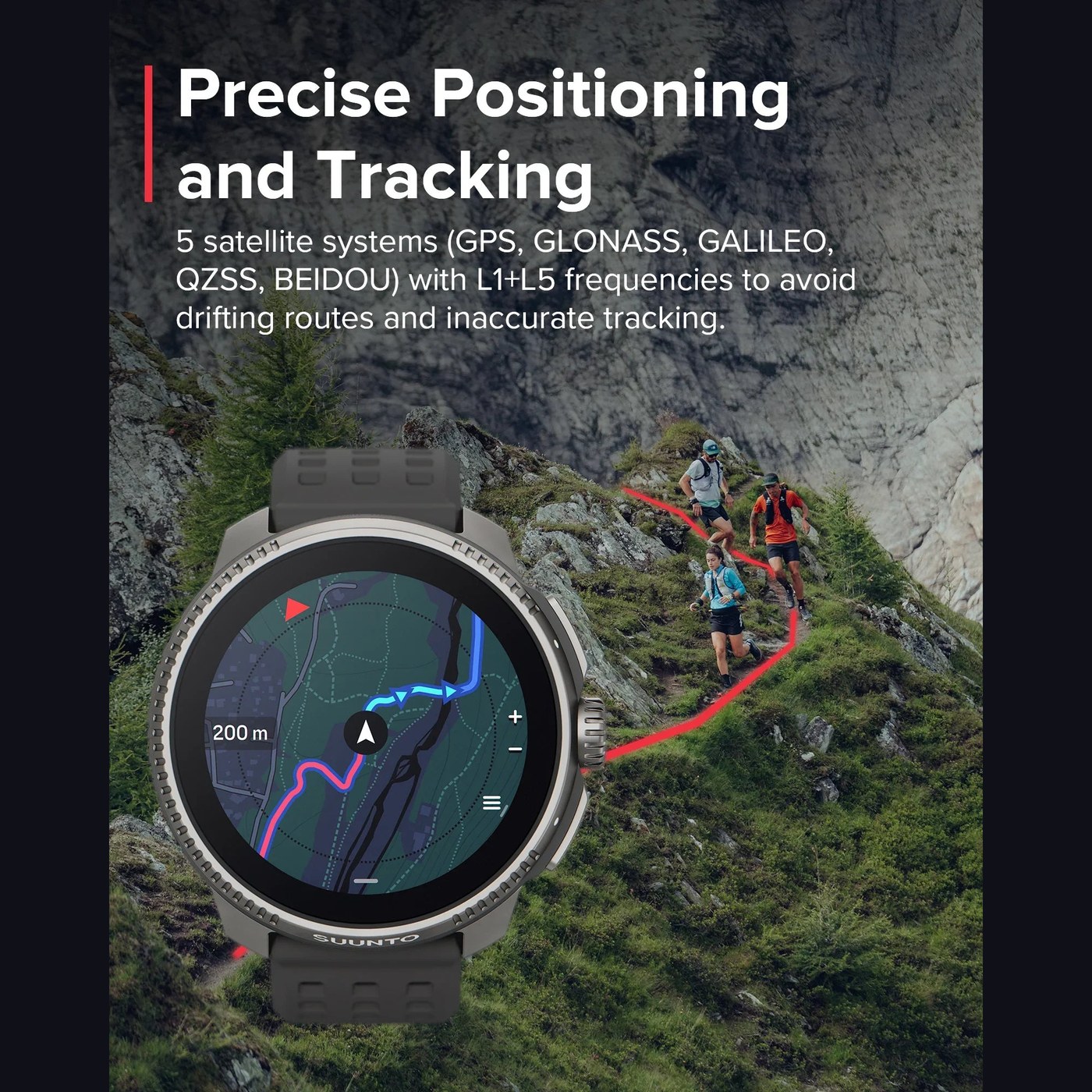
Dual-frequency L1+L5 GPS, paired with five constellations (GPS, GLONASS, Galileo, BeiDou and QZSS), is the Race's main technical selling point. Out on the road and trail, every independent tester acknowledges its accuracy: in the city and in dense forest alike, the track stays clean, even on narrow streets where the signal bounces off building fronts. The Snap to route feature, which locks the GPS track to a planned route, also fixes much of the remaining error when you follow a course.
The maps deserve a more nuanced verdict. They come from OpenStreetMap, are free and downloadable offline by region, and they render sharp and readable on the AMOLED screen, with contour lines, dotted trails and distinct forest areas. But they're not routable: the watch won't recalculate a route automatically if you stray from the planned track. You have to make do with breadcrumb navigation and turn-by-turn guidance on routes planned in advance. It's the limitation independent reviews cite most against rivals like the Forerunner 965, whose TopoActive maps are routable.
Field test: from structured training to ultra-trail
Independent reviews agree on one point: the AMOLED screen genuinely changes the experience compared with older Suunto watches and their transflective displays. Readability in direct sunlight and smooth navigation through maps and widgets draw unanimous praise. On multi-hour mountain outings, the Always-on mode stays readable at a glance, a real plus on climbs or technical trail.
On battery life, there's a clear gap between the claimed figure and independent measurement. Suunto claims 40 hours in Performance mode (multi-band GPS, maximum accuracy). One independent measurement, taken over several weeks of heavy map use with the display always on and brightness high, recorded 28 to 32 hours in that mode instead. Conversely, in daily use with continuous heart rate tracking, the same measurement recorded up to 17 days of battery life against the 12 days claimed. That shows the gap depends mostly on how often you check the map mid-run. If you're targeting an ultra-trail of more than 24 hours, switch to Endurance or Ultra mode and limit map display rather than staying in Performance from start to finish.
On the optical heart rate sensor, opinions differ on the intensity at which it loses track. One independent measurement rates it reliable overall for steady endurance work but notes a response time that's too slow during sudden surges, with gaps of up to 30 beats per minute on short intervals. Another field test found accuracy varying noticeably from one run to the next despite a snug strap, especially during interval efforts. For heart rate variability tracking, a gap of 5 to 10 milliseconds was also measured against a Garmin watch worn at the same time on the other wrist, which is significant for an average HRV of around 30 to 40 milliseconds. At RunMorph, the message is clear: for easy aerobic running, the wrist sensor is more than enough; for demanding intervals, a Bluetooth chest strap is still the better choice.
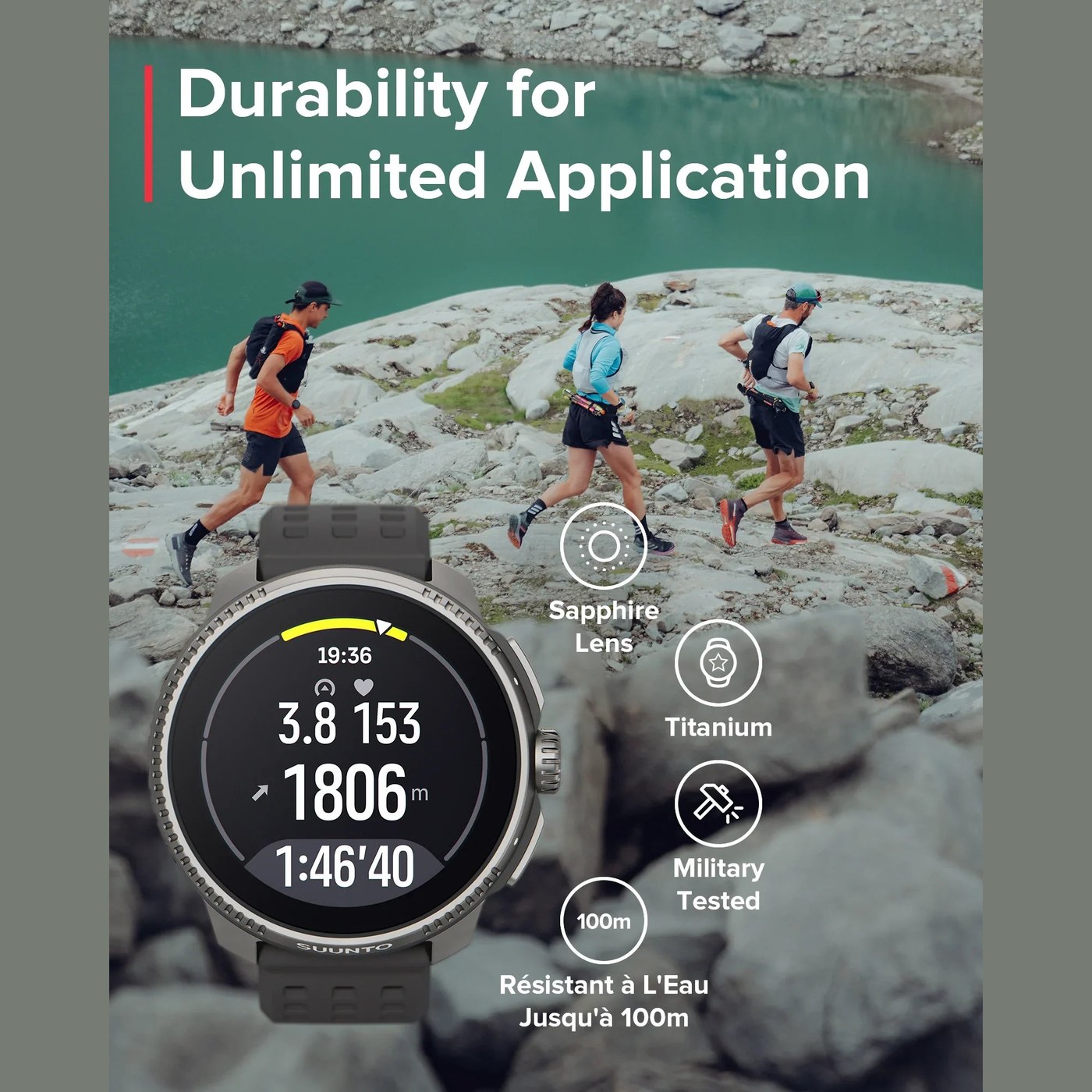
Another sore point surfaced over several weeks of testing: recurring Bluetooth disconnections from the smartphone, forcing you to switch Bluetooth off and on again to resync the watch, a software bug Suunto is expected to fix in an update. The case itself shows no weakness: sapphire glass, military-standard testing and no visible wear on the notched bezel after several weeks of mountain use.
© Suunto, official photo used for editorial purposes
Suunto Race vs Garmin Forerunner 965 vs Polar Vantage V3: the comparison
| Criterion | Suunto Race | Garmin Forerunner 965 | Polar Vantage V3 |
|---|
| Price | €449-549 | ~€650 (€499 on sale in mid-2026) | €599.90 |
| Display | 1.43" AMOLED, sapphire | 1.4" AMOLED | 1.39" AMOLED |
| Maps | Free offline, not routable | TopoActive, routable | Offline, not routable |
| Multi-band GPS battery life | 28-40 h (real-world measurement vs 40 h claimed) | ~21 h claimed | 43 h claimed |
| Heart rate | Optical + pulse oximeter | Optical, no ECG | Optical + wrist ECG |
| Onboard music | No | Yes, 32 GB | No |
Against the Forerunner 965, the Race loses on routable maps and music storage, but it's much cheaper and delivers comparable real-world battery life. Against the Polar Vantage V3, the price gap is narrower, but the Race wins on real-world GPS battery life while Polar keeps the edge in physiological tracking with its wrist ECG. Within Suunto's own lineup, the Race stands apart from the Suunto Vertical, which leans toward pure expedition use with a less modern transflective display, and from the newer Suunto Race 2, which pushes claimed GPS battery life to 55 hours at a higher price.
Our field verdict: who is it for?
The Suunto Race is built first for road and trail runners who want reliable GPS, a great screen and solid battery life without crossing the 500-euro mark. It's a very good fit for marathon, half marathon or trail training, with long runs of up to 28-32 hours in Performance mode, or far more if you switch to Endurance mode once you no longer need the map. Triathletes will also find what they need, thanks to 95 sport profiles and swim tracking.
It's less suited, however, to anyone planning long off-trail navigation without a preloaded route: without routable maps, you need to plan your course before you head out rather than improvise on the ground.
Whether you're training for a marathon, a trail race or simply getting back into running with a specific goal in mind, pairing your Suunto Race with a RunMorph training plan lets you structure your easy runs, intervals and long runs using its HRV and training load tracking, while keeping an external sensor on hand for the hardest sessions.
© Suunto, official photo used for editorial purposes
RunMorph verdict
The Suunto Race keeps its main promise: accurate GPS, a premium AMOLED screen and free offline maps at a price that stays below Garmin and Polar. Value for money is the real selling point, backed by a solid build.
The real limitations are known and documented by several independent reviews: maps that recalculate nothing automatically, an optical heart rate sensor that shows its limits at high intensity, and real-world battery life in Performance mode well below the claim once the map runs continuously. None of these flaws is a deal-breaker for typical road or trail running, but they're why it doesn't rank alongside a Forerunner 965 or a Vantage V3 on paper, despite a much lower price.
8/10: excellent features-to-price value if you don't need routable maps or top-tier heart rate tracking at high intensity.