Suunto Spark review: Suunto's first open-ear earbuds put to the test
7.4/10
With the Spark, Suunto steps away for the first time from the bone conduction that built its audio reputation (Wing, Sonic) and goes for classic air-conduction open-ear earbuds. Launched on 8 April 2026 at 149 euros, they add cadence and head posture tracking right inside your ears. Two independent field tests, one Swiss and one American, confirm genuine comfort but flag the same real-world limits.
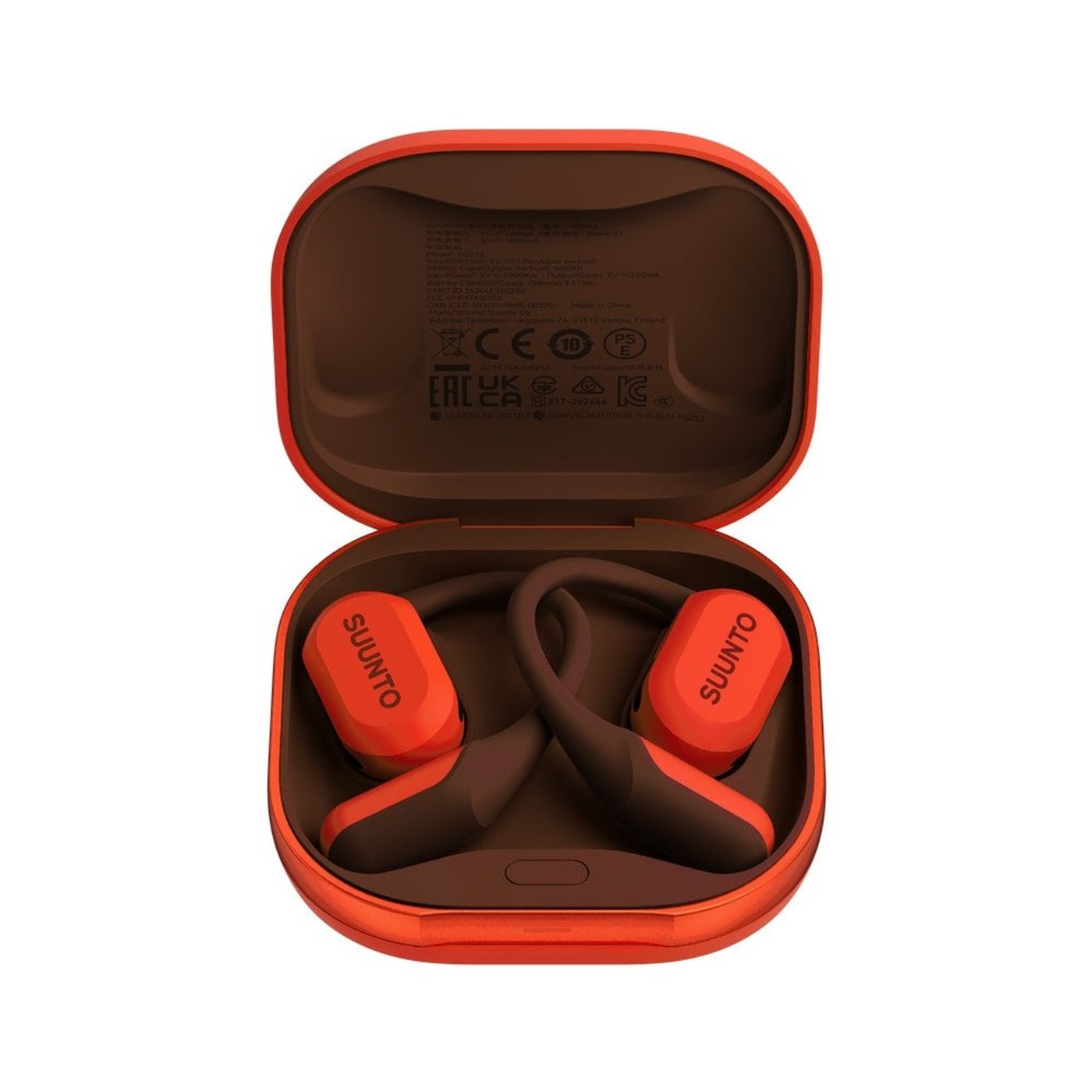
The Suunto Spark and its charging case in Coral Orange (official Suunto photo).
The gist in 3 sentences
The Suunto Spark drops bone conduction for a more conventional open-ear design, with a clear jump in sound quality confirmed by two independent testers in Switzerland and the US. Comfort and battery life are convincing, with up to 36 hours including the case according to Suunto. But overly sensitive touch controls and use in strong wind or under a beanie remain weak spots documented by both tests.
7.4
/ 10 · RunMorph overall score
Comfort
8.5 / 10
Sound quality
7.5 / 10
Battery life
8 / 10
Sport features
7 / 10
Touch controls
5.5 / 10
Who is it for?Runners who want to stay aware of their surroundings while getting better sound than Suunto's bone conduction headphones deliver.
Who should skip it?Winter runners who wear a beanie, and anyone who fiddles with their earbuds a lot (accidental touch triggers).
Suunto pushes its audio range beyond bone conduction
Since launching the Wing nearly 3 years ago, Suunto has stuck exclusively to bone conduction for its sports headphones: Wing, Sonic, the two Aqua variants and now the Wing 2, all neckband designs. The Spark switches both technology and format: two true wireless earbuds using classic air conduction, still open so you hear what is going on around you, but promising better sound than bone conduction can deliver.
At RunMorph, we see this switch as a direct answer to a well-known weakness of bone conduction: it struggles to reproduce deep bass. The Spark also brings sport features Suunto has never put in an earbud before: cadence tracking, running technique analysis based on ground contact time, and head position monitoring while you train.
Suunto Spark specs
Spec
Value
Price
149 € (France), $179 (United States)
Weight
9 g per earbud, 76 g with the case
Technology
Open-ear air conduction, triple hybrid transducers
Audio codec
LHDC 5.0 Hi-Res up to 96 kHz, Bluetooth 5.4
Earbud battery life
7 to 7.5 h per charge depending on the source
Total battery life with case
32 to 36 h depending on the source
Water resistance
IP55 (sweat, rain, dust)
Connectivity
Bluetooth 5.4, pairs with 2 devices at once
Controls
Customizable touch controls (single, double, triple tap, long press) and head gestures
Colors
Black, white, coral orange
Availability
Since 8 April 2026
Claimed vs measured: the numbers vary slightly between sources
Data point
What the sources report
Earbud battery life alone
7 h in the American field test, 7.5 h in the Swiss field test: a minor gap, most likely down to the volume and EQ settings used
Total battery life with case
36 h claimed by Suunto and repeated by the mainstream press; 32 h measured by the Swiss tester, based on "one earbud charge plus three case charges"
"All-day comfort"
Confirmed in daily life and on the run by both testers, but one of them reports clear discomfort under a winter beanie, as the loop gets pressed against the ear
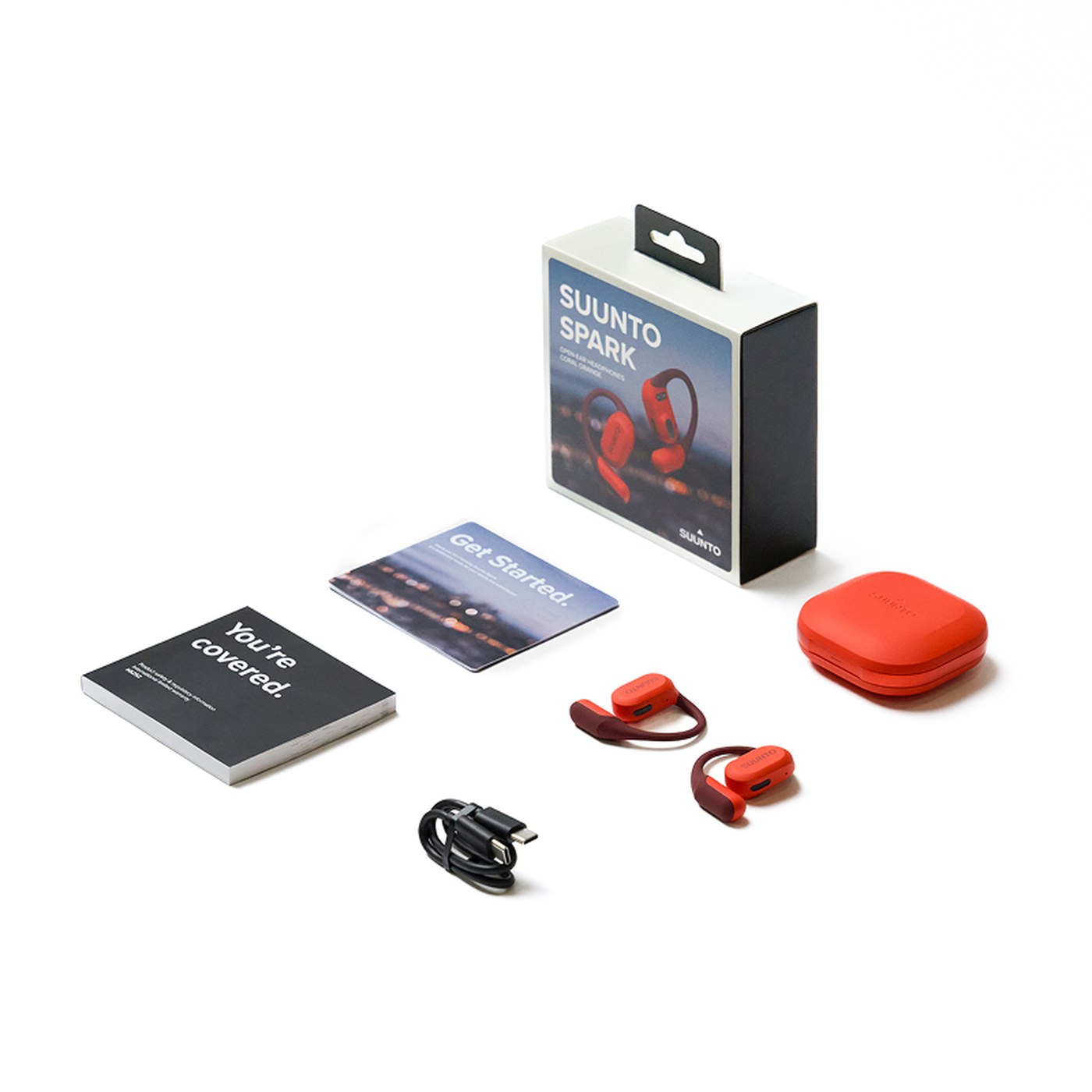
What comes in the Suunto Spark box: earbuds, charging case, USB-C to USB-C cable and documentation (official Suunto photo).
Air conduction, cadence and posture: the tech under the hood
The Spark uses a hybrid system with several transducers per earbud: a balanced armature driver for the highs, a large dynamic driver for the bass, and an anti-leak transducer that limits sound spilling outward to keep your listening private. It all supports LHDC 5.0, a Hi-Res codec rarely found on sports watches, so in practice the quality gain is limited to compatible smartphones and computers rather than the GPS watches themselves.
On the sport side, the Suunto app lets you set a target cadence between 120 and 200 steps per minute with a built-in metronome, turn on a mode that tracks cadence, ground contact time and vertical oscillation in real time, and get voice prompts for pace, heart rate, distance and laps straight from a compatible Suunto watch. There is also a neck mobility test to assess flexibility and range of motion.
The field test: two reviews that agree on the big picture, differ on the details
The Swiss tester from nakan.ch used the Spark for a full week, on every run and in daily life. The verdict: flawless comfort and fit, even with glasses or a cap, sound quality clearly ahead of bone conduction even if the bass stays limited by the open design, and hassle-free compatibility tested with a Garmin Forerunner 970, a Coros Pace 4, an Apple Watch Ultra 3 and a Suunto Run. The only real regrets: no onboard storage for music on its own, and discomfort under a winter beanie.
Meanwhile, the two American testers from a US running review site are just as positive about comfort, describing it as almost unnoticeable on the run, with a fit that shows zero risk of falling out. They agree with the Swiss take on sound quality and praise the dual-device connection. Their main reservation is cycling: the open design lets wind and traffic noise drown out the music in some conditions, a flaw they do not notice when running.
Watch out, flagged by both tests: the touch controls are so sensitive that simply adjusting the earbuds, pulling back a hood or brushing them by accident can trigger an unwanted action (skipping a track, launching a voice call). Both testers recommend a light touch and careful setup in the Suunto app, which itself displays a warning about it.
Documented limitation: the open-ear design leaves your music exposed to ambient noise. On the road or in town at moderate volume, both testers stay aware of traffic, which is exactly the point. But on a bike in the wind, or near noisy equipment (gym, machines), the sound can be partly drowned out. The Spark is also uncomfortable under a beanie, contrary to what the Swiss tester hoped for when switching from the Wing neckband design.
Suunto Spark vs Suunto Wing 2
Criterion
Suunto Spark
Suunto Wing 2
Technology
Air conduction, true wireless earbuds
Bone conduction, neckband
Sound quality (bass)
Better bass reproduction, open design
More limited bass, bone technology
Under a beanie
Uncomfortable, loop pressed against the ear
Also awkward according to feedback, but thinner band
Battery life
32 to 36 h with the case
30 h in total with built-in power bank
Price
149 €
Higher positioning, expedition range
Suunto Spark vs Shokz OpenFit 2
Criterion
Suunto Spark
Shokz OpenFit 2
Design
Open-ear air conduction, titanium loop
Open-ear DualBoost, ear hook
Dedicated sport features
Cadence, running technique, head posture
No built-in coaching features
Price
149 €
189 €
Watch ecosystem
Native integration with recent Suunto watches
Independent of any watch ecosystem
Exploded view of the Suunto Spark: hybrid transducers, circuit board and shape-memory titanium loop (official Suunto photo).
Pros and cons
Pros
Comfort and fit praised by both field tests, even with glasses or a cap
Sound quality clearly ahead of Suunto's bone conduction headphones
Generous battery life (32 to 36 h with the case depending on the source)
Broad compatibility tested with Garmin, Coros, Apple Watch and Suunto
New sport features: cadence, running technique, head posture
Cons
Touch controls far too sensitive, accidental triggers reported by both tests
Wind and ambient noise can drown out the music, especially on the bike
Uncomfortable under a winter beanie
No onboard storage for standalone music
Bass still behind sealed in-ear buds, a built-in limit of the open design
Compatibility: an ecosystem that goes well beyond Suunto watches
The Spark connects to any standard Bluetooth device and is not locked into the Suunto ecosystem. The Swiss tester paired it without any trouble with an iPhone, a MacBook, a Linux computer and Garmin, Coros and Apple watches. The advanced voice coaching features, on the other hand (pace, heart rate and distance read out in your ear), require a recent Suunto watch.
What RunMorph thinks of the Spark
At RunMorph, our take is a convincing first open-ear earbud that fixes the most common complaint about the brand's bone conduction headphones without giving up the comfort that made their name. The cadence and head posture features are a modest bonus rather than a selling point on their own, but they come at no extra cost on a product that is already solid on comfort and battery life. The overly sensitive touch controls are the top thing to fix in a possible version 2.
To structure your cadence sessions and track your progress over time, check out our 10K training plans.
RunMorph verdict: 7.4/10
The Suunto Spark nails its switch to air conduction without losing what made Suunto headphones strong: comfort and safety outdoors. At 149 €, it stacks up well against pricier open-ear rivals like the Shokz OpenFit 2, as long as you can live with touch controls that need work and do not expect to wear it under a beanie in winter.
Key takeaways
9 g per earbud, 76 g with the case, IP55
Suunto's first air conduction earbud, available since 8 April 2026 at 149 €
Comfort and battery life confirmed by two independent field tests (Switzerland and the United States)
Overly sensitive touch controls and cycling in strong wind flagged in both tests
Cadence, running technique and head posture features, with full voice coaching reserved for recent Suunto watches
The Suunto Spark in everyday use, Coral Orange colorway (official Suunto photo).
FAQ
How much does the Suunto Spark weigh? 9 g per earbud and 76 g with the charging case, about 13 g more than a pair of AirPods Pro 2 in their case according to a direct comparison by one tester.
What is the Suunto Spark's battery life? 7 to 7.5 h per charge depending on the source, and 32 to 36 h in total with the case, the gap coming from real-world measurements (32 h) versus Suunto's claimed figure (36 h).
Does the Suunto Spark work with a Garmin or Coros watch? Yes for audio and touch controls, tested and confirmed with a Garmin Forerunner 970 and a Coros Pace 4. Voice prompts for pace and heart rate in your ear, however, require a recent Suunto watch.
How much does the Suunto Spark cost? 149 € in France ($179 in the United States), available in black, white and coral orange since 8 April 2026.