Arc'teryx Norvan 7 Review: RunMorph's Complete Trail Vest Test
7.5/10
Arc'teryx is the brand of alpinists and ski mountaineers. But trail running? That's different terrain, with its own demands: ultralight vests, one-handed flask access, a secure fit when you pick up the pace. With the Norvan 7 Spring 2026, the Canadian brand makes a serious move into the 7 L race vest segment. At RunMorph, we wanted to measure the gap between mountain expertise and what the trail actually demands.
7.5
/ 10 · RunMorph overall score
Comfort/Fit
8 / 10
Capacity
6.5 / 10
Accessibility
8.5 / 10
Hydration
8 / 10
Value for money
7 / 10
Who is it for?
Trail runners covering 20-50 km on soft flasks alone who want a close-to-body fit, maximum accessibility and built-in RECCO® for technical mountain races.
Who should skip it?
Ultrarunners carrying a long mandatory gear list, or runners who need firm side compression on very rough terrain.
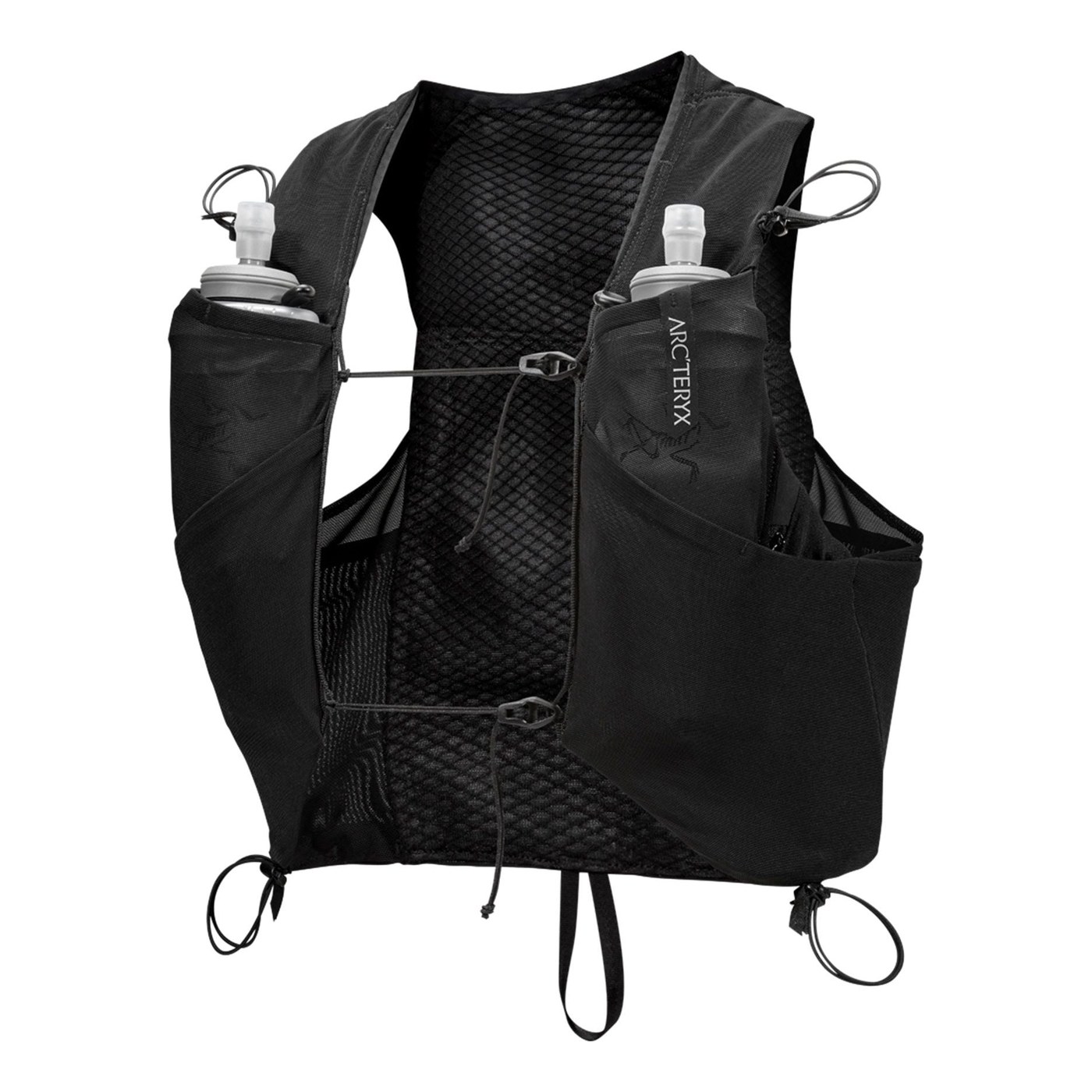
Arc'teryx Norvan 7, front view with the two included 500 mL SoftFlasks. Photo Arc'teryx / Snowleader.
The essentials in 3 sentences
The Norvan 7 is a technical 7 L trail vest in Nylon 66 Cordura and Powernet, weighing 207 g with two 500 mL SoftFlasks included. It targets trail runners covering 20 to 50 km without resupplying along the way who want wearing comfort and maximum accessibility. The dual-access pass-through pocket is a real innovation; the net capacity and the lack of side compression will disappoint the most demanding runners.
Arc'teryx comes to the trail: a late arrival with a proven mountain track record
Arc'teryx didn't invent the trail vest. The North Vancouver brand built its reputation on two pillars: Gore-Tex jackets with obsessive attention to materials, and high-performance climbing harnesses. Trail running came later on its roadmap, with the Norvan line (Norvan LD for ultras, Norvan SL for skyraces) and technical shoes. But no lightweight race hydration vest had come out of its catalog yet.
The Norvan 7 Spring 2026 is that entry: for the first time, Arc'teryx takes on the fiercely competitive segment of 6 to 8 L race vests. The field is held by strong players: Salomon Adv Skin 12, Compressport UltRun S Pack, NNormal Race Vest 5L. To stand out, Arc'teryx bet on two things: material quality (Nylon 66 Cordura, bluesign®) and an original feature, the dual-access pass-through pocket.
The question is simple: does mountain expertise translate into a real advantage on the trail? That's what we tested over several 2 to 5 h runs, in forests and in the mountains.
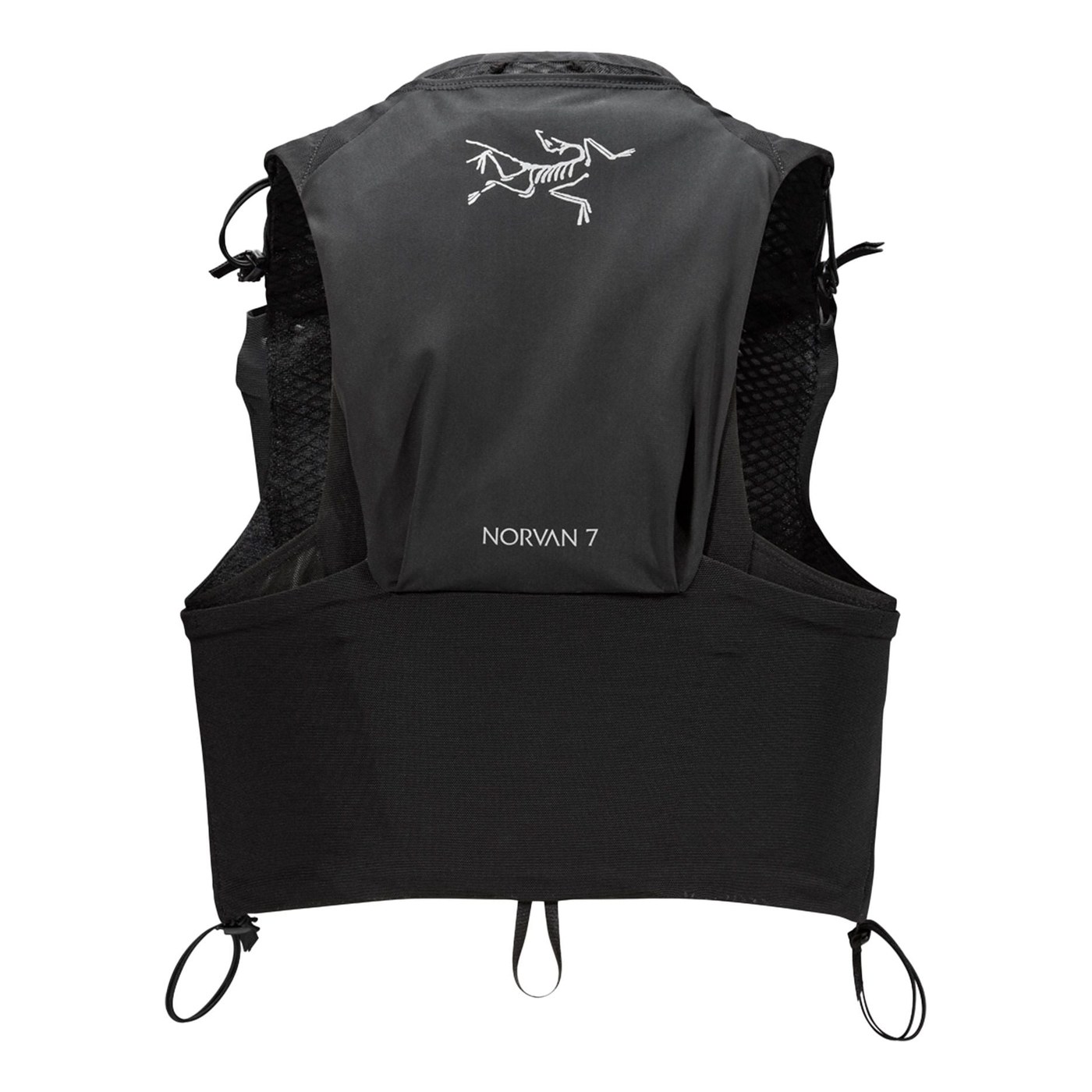
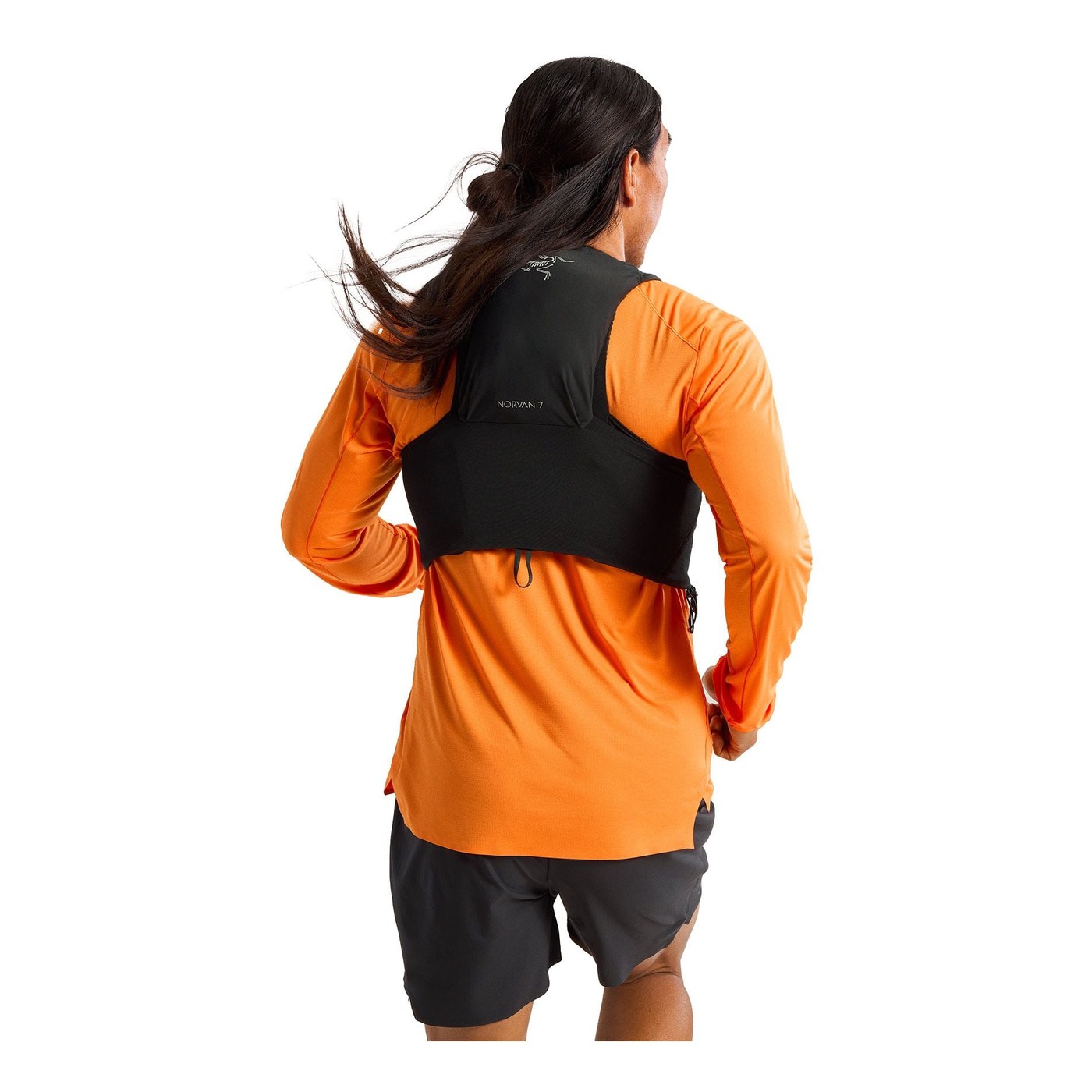
Back view of the Norvan 7: stretch Powernet panels and a breathable back.
Norvan 7 specs: 207 g, 7 L and mountain materials for the trail
Brand
Arc'teryx
Model
Norvan 7 Hydration Vest
Collection
Spring 2026
Volume
7 L
Empty weight
207 g (size M)
Available sizes
S, M, L (runs large: go 1 size down if in doubt)
Body fabric
100% Nylon 66 Cordura + Vectran + PU (PFAS-free DWR)
Panel fabric
72% nylon + 28% elastane (Powernet)
Soft flasks included
2 x Arc'teryx SoftFlask 500 mL included
Bladder
Compatible up to 2 L (main compartment)
Pass-through pocket
Yes, accessible from 2 sides (left or right zip)
Side compression
No
Pole holder
Yes (elastic + bungee)
Certifications
bluesign®, RECCO®, PFAS-free DWR
UTMB compatible
Yes (built-in RECCO®, enough capacity for the basic kit)
Retail price
€159.90
Nylon 66 Cordura, Vectran and a pass-through pocket: what the Norvan 7 really changes
Let's start with materials, because Arc'teryx has its own way of thinking about fabrics. The Norvan 7 body isn't standard nylon: it's Nylon 66 Cordura, with clearly higher abrasion resistance against hard surfaces. On rocky trails in the Alps or the Pyrenees, the pack regularly rubs against rock on scrambling sections: this toughness matters in practice, it's not a spec-sheet detail.
The shoulder straps and strap reinforcements use Vectran, a high-strength fiber made from liquid crystal polyester. Under dynamic loads, Vectran has higher tensile strength than aramid (Kevlar), and it doesn't absorb moisture. For a vest that goes through thousands of flex cycles on every run, it's a logical choice.
The side panels and back are Powernet (72% nylon, 28% elastane): this stretch mesh creates a second-skin effect. The Norvan 7 hugs the rib cage without creating pressure points, and breathability is good in hot weather. On the other hand, Powernet doesn't give as much structure as rigid panels for lateral stability on fast descents.
The most original feature is the central pass-through pocket, accessible from both sides via a left or right side zip. On a standard vest, pulling a rain jacket out of the main compartment means stopping and undoing the straps. On the Norvan 7, you reach the jacket in 5 seconds without stopping, from your dominant-hand side. Over a 6 h race, this detail really changes the experience.
Finally, the built-in RECCO®: this radar reflector is mandatory at several mountain races (UTMB, TDS, CCC). Here it's sewn directly into the pack, which sets it apart from ultralight vests that leave it out and force you to carry a separate reflector.
Norvan 7 front pockets with the two included 500 mL SoftFlasks.
Field test: 2 to 5 h runs, from forest to mountain
We tested the Norvan 7 on several runs lasting 2 to 5 h, on varied terrain: hardpacked forest trails and mountain routes (600 to 1,200 m of elevation gain), in temperatures from 8°C to 22°C. Here's what we found.
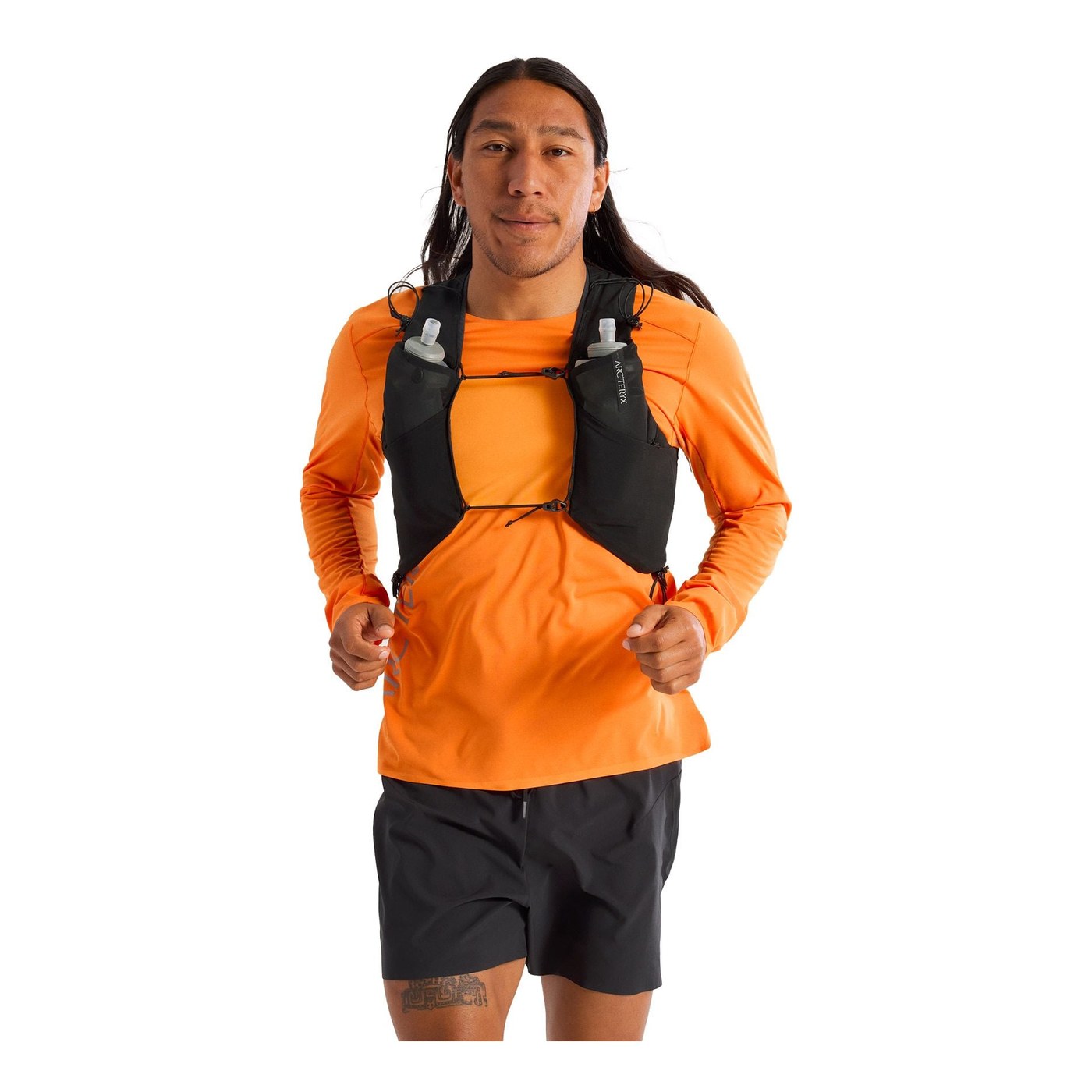
Comfort and setup: Adjustment is quick thanks to the two elastic sternum straps. The Powernet hugs the body remarkably well: at a 4:30/km pace on a fast descent, vertical bounce is almost nonexistent. On the other hand, the sternum straps tend to loosen gradually beyond 2 h, especially on climbs where your chest works harder. On long runs, you need to retighten them every 45-60 min.
Flask access: The front pockets for the SoftFlasks work one-handed, with slight resistance when you pull out full flasks (which keeps them secure). The ergonomics are good, on par with the Osprey Duro 6 or the Ultimate Direction Race Vest 6L.
Pass-through pocket: The real revelation. Over 5 h of testing, we pulled out a light jacket, gels and a phone without ever stopping or undoing the straps. One drawback: the pocket isn't waterproof, so your phone needs its own protection in the rain.
Hydration: The included 500 mL Arc'teryx SoftFlasks have good flow and didn't leak once during the entire test. The 2 L bladder compatibility works well but squeezes the main compartment even further (about 1.5 L of remaining volume).
Real capacity: This is the main weak point. The claimed 7 L covers everything: front pockets, side pockets, the pass-through pocket and the main compartment. Once the two flasks and a phone are stowed, you're left with about 3 to 3.5 L of net volume. For a 3 h run with gels, a light jacket and basic nutrition, that's manageable. For a 50 km race with a full mandatory gear list, it's not enough: you'll need a 10 L vest like the Black Diamond Distance 15.
Side compression: The lack of side compression straps shows on very fast descents and technical sections. The pack holds well overall but loses stability compared with a model that has this adjustment.
RunMorph's advice: if you're between two sizes, take the smaller one. The Norvan 7 runs large, and a fit that's too loose cancels out the whole benefit of the Powernet. For reference: size S up to 82 cm chest circumference, M up to 90 cm, L above that.
Detail of the Norvan 7's Vectran shoulder straps and sternum strap system.
Norvan 7 vs Osprey Duro 6 and Rab Veil 6L: the comparison to help you choose
Arc'teryx Norvan 7
Osprey Duro 6
Rab Veil 6L
Volume
7 L
6 L
6 L
Weight
207 g
~185 g
240 g
Price
€159.90
€145
~€150
Soft flasks included
2 x 500 mL
No
No
Pass-through pocket
Yes (2 sides)
No
No
Side compression
No
Yes
No
RECCO®
Yes
No
No
Certification
bluesign®
bluesign®
bluesign®
RunMorph score
7.5 / 10
Review coming soon
Review coming soon
The Osprey Duro 6 is the most direct competitor: same price range, also bluesign®, slightly lighter and with the side compression the Norvan 7 lacks. It doesn't come with flasks, which puts the real cost on par once you add 2 SoftFlasks. If side compression and minimum weight are your priorities, the Osprey is more versatile. If you want the pass-through pocket and built-in RECCO®, the Norvan 7 takes the edge.
The Rab Veil 6L weighs 240 g (33 g more) with PFAS-free Mono Mesh and a mountain focus: a good option for trail runners who also do light alpinism, but less optimized for pure running with soft flasks.
Norvan 7 pros and cons: the honest verdict
+ Pros
Dual-access pass-through pocket, unique in this segment
Powernet: close-to-body fit, almost zero bounce
Built-in RECCO® for races that require it
2 SoftFlasks (500 mL) included in the price
PFAS-free DWR and bluesign® certification
Vectran shoulder straps with high tensile strength
- Cons
Net capacity ~3 L once the essentials are stowed
No side compression: reduced stability on descents
Sternum straps loosen after 2 h
Pass-through pocket isn't waterproof
Runs large: a common sizing mistake when ordering online
High price (€159.90) for a 7 L vest without side adjustment
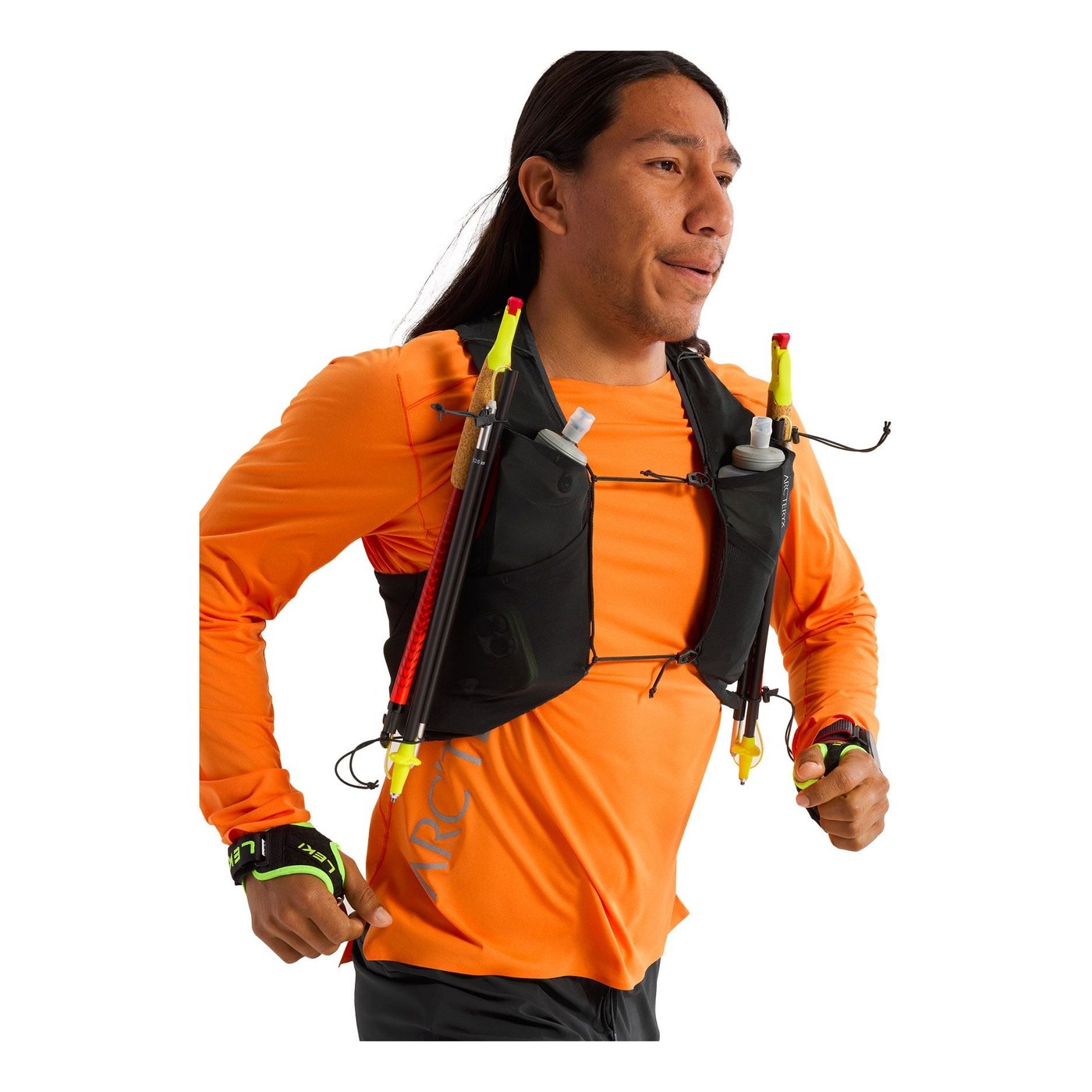
Rear view of the Norvan 7 with its pole attachment system.
Which runner is the Norvan 7 for?
The Norvan 7 fits a specific profile: the trail runner covering 20 to 50 km in a day with two soft flasks as the only hydration, who wants a flawless fit and maximum accessibility, and who enters races that require RECCO®. That's the natural target for this pack.
It's not the pack for someone preparing a first 100 km race with a full mandatory gear list (emergency blanket, Gore-Tex rain jacket, nutrition for 8 h or more): you'll need a 10-12 L vest like the Salomon Adv Skin 12 or the Black Diamond Distance 8. Nor is it the pack for runners chasing the lowest possible weight: the NNormal Race Vest 5L at 174 g is the pick there.
To build your trail preparation and choose gear that matches your distance and elevation goals, check out the RunMorph training plans: runmorph.com/en/training-plans.
RunMorph verdict: is the Norvan 7 worth €159.90?
RunMorph score: 7.5 / 10.
The Norvan 7 is a good product that reflects Arc'teryx's technical expertise. The dual-access pass-through pocket is a genuine functional innovation in this segment: no direct competitor at this price offers it. The Powernet delivers better wearing comfort than its direct rivals, and the built-in RECCO® is a real differentiator for regulated mountain races. The material quality (Nylon 66 Cordura, Vectran) backs up the durability promise.
But €159.90 for a 7 L vest with no side compression and only 3 L of usable net volume is a hard sell against the Osprey Duro 6 at €145 (more versatile, with side compression). Offering only 3 sizes (S, M, L) on a model that runs large also makes sizing harder without trying it on.
For runners who match the target profile exactly (25-50 km, two soft flasks, mountain races with mandatory RECCO®, accessibility first), the Norvan 7 is an excellent choice. For everyone else, there are more versatile alternatives in the same price range.
Key takeaways for your training
Pass-through pocket: the Norvan 7's standout feature, accessible from both sides without stopping or undoing the straps.
Runs large: go down a size if you're unsure. A fit that's too loose cancels out the benefits of the Powernet.
Net capacity ~3 L: the stated 7 L covers everything. For an ultra with mandatory gear, plan on a 10-12 L vest.
Built-in RECCO®: a real plus for regulated mountain races (UTMB, CCC, TDS).
Sternum straps: retighten them every 45-60 min on runs longer than 2 h.