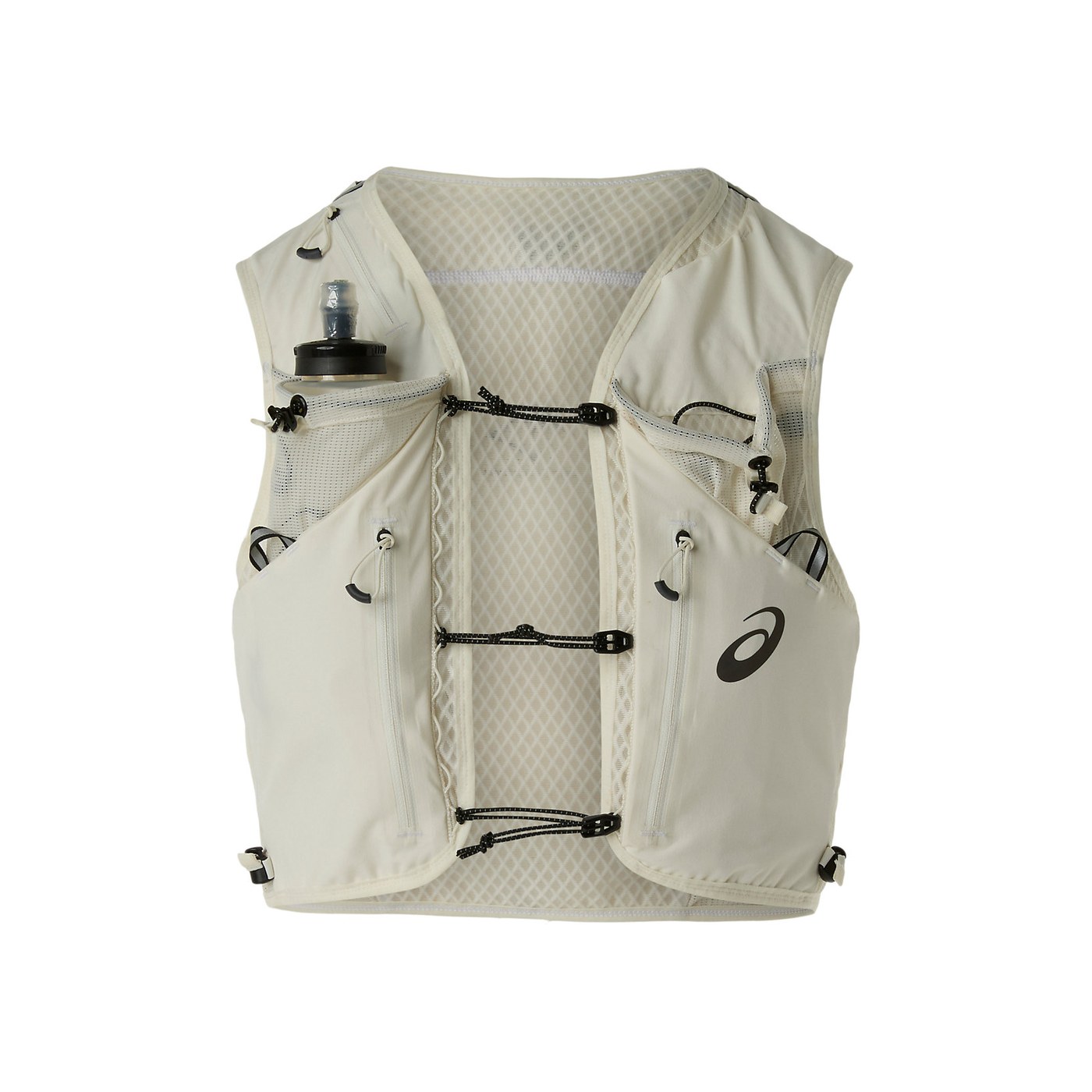
Asics built its trail credibility on shoes, from the Fuji Lite to the MetaFuji Trail. With the Fujitrail Vest 7L, the Japanese brand makes its first serious move into hydration vests, a segment Salomon, Raidlight and Compressport have owned until now. A cream colorway with a sublimated Mount Fuji print, a Tasuki anti-bounce system inspired by the kimono, and a 150 euro price tag: does it deliver on the trail?
© Asics, official photo used for editorial purposes
Asics and the trail vest: a shoe brand finally takes on hydration
Asics took its time before getting serious about trail running. The Fujitrail collection started out as a line of shoes and apparel (jackets, tights) before expanding into accessories. So the Fujitrail Vest 7L is no improvised first attempt. It follows several years of a Fujitrail waterproof jacket that the specialist press has tested and approved, and it reuses a selling point the brand has already refined: the Tasuki system, inspired by the Japanese kimono ties that hold the sleeves back without squeezing the chest.
The bet is simple: convince runners who already own Asics Fuji Lite or Trabuco shoes to stay in the brand's ecosystem instead of buying a vest from Salomon or NNormal. On paper, the pitch fits in one sentence: the stability of a race vest with the accessibility of a training model. The question is whether Asics, a newcomer facing specialists who have been refining their patterns for fifteen years, can really go the distance.
Fujitrail Vest 7L specs: what's really in the vest
| Brand | Asics |
| Model | Fujitrail Vest 7L |
| Product code | 3013B198-101 |
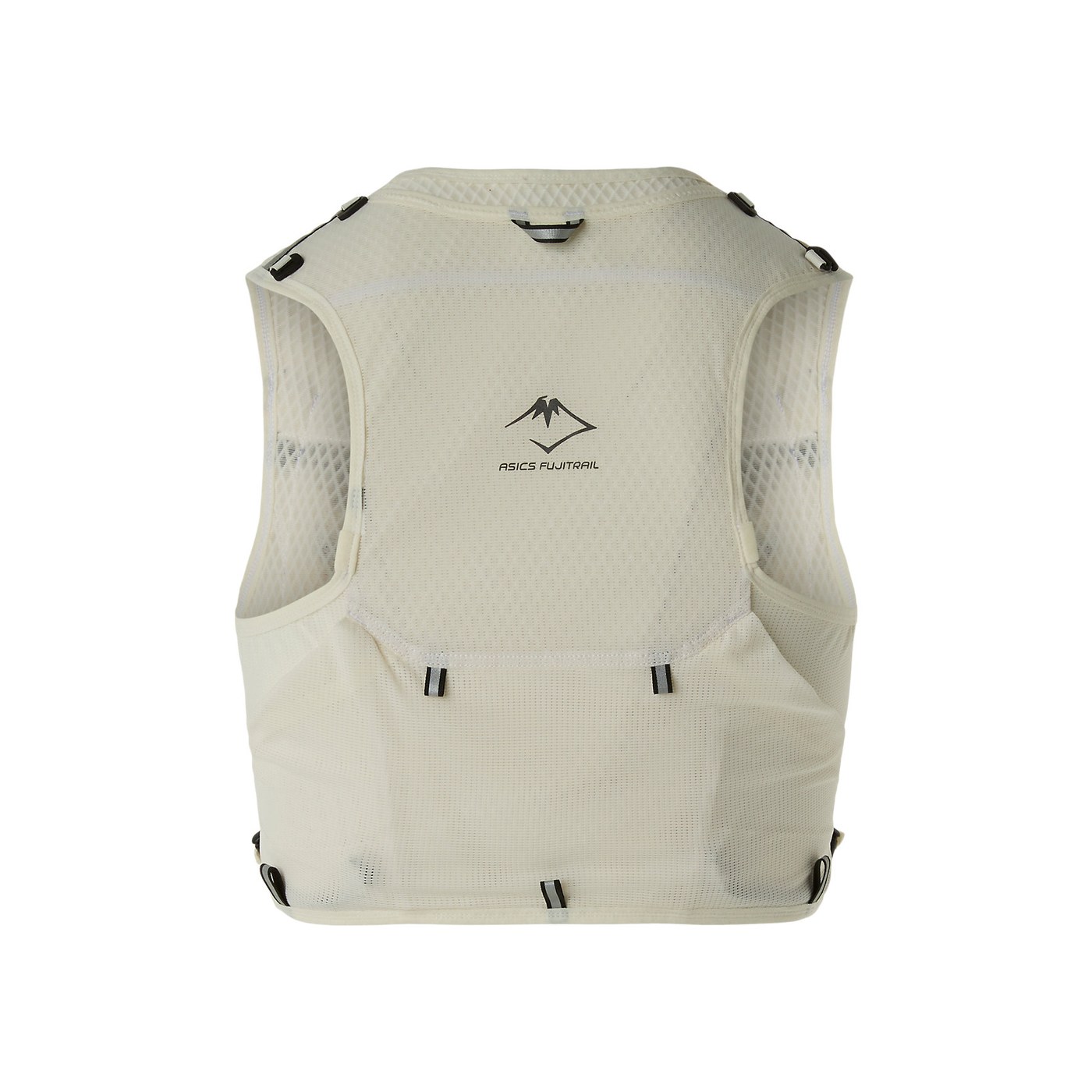
| Colorway tested | Cream, sublimated Mount Fuji print on the back |
| Volume | 7 liters |
| Weight | Not disclosed by Asics |
| Soft flasks included | 2 x 500 ml, front sleeves |
| Front pockets | 2 zippered pockets + 1 zippered chest pocket |
| Back pocket | 1 large pocket (jacket or poles) |
| Pole attachment | 1 attachment point |
| Back bladder | Not compatible |
| Fabric | 78% recycled polyester / 22% elastane, 100% recycled polyester lining |
| Anti-bounce system | Tasuki, one-handed magnetic buckles |
| Sizes | XS to L, unisex |
| Official price | €150 |
Asics publishes no official weight for this vest. That lack of transparency sets it apart from most competitors: Salomon, Compressport and Arc'teryx all list a figure down to the gram. It's a real gap for buyers who compare vests gram by gram.
The Tasuki system: what does it change on your back?
The Tasuki is a traditional Japanese cord used to tie back kimono sleeves during physical work, running under the arms and over the shoulders. Asics borrows the principle for its anti-bounce system. The straps cross at the front and lock with magnetic buckles, spreading tension across the whole torso instead of loading the shoulders or sternum, which is what most classic elastic-cord systems do.
In practice, you can close it with one hand, even on the move: the magnetic buckles snap shut on contact, a real time-saver at an aid station where every second counts. The stretch mesh back panel also lets you wear the vest over a rain jacket without loosening anything, a detail that matters on fall runs in the hills.
© Asics, official photo used for editorial purposes
On the trail: runs of one to four hours
RunMorph tip: slide the flasks into the front sleeves neck-down, then push them back up once they're in place. The Tasuki mesh feels a little tight going in, but it loosens naturally once you're running.
The field reports available on this vest agree on one point: no bounce, even on technical climbs and descents. One test run at the Trail des Anglais (30 km, 1300 m of elevation gain) describes a hold that stayed stable from start to finish, with no need to retighten the straps along the way, and flasks you can grab without dropping your pace. The same report highlights zero chafing or discomfort over the distance, which is far from a given on a brand's first model.
A more recent verified review, written after a 42 km run in Brittany, confirms the light feel and the absence of skin irritation. It also flags a downside of the cream colorway chosen for this review: the light fabric gets visibly dirty faster than a dark one. That's a cosmetic flaw more than a technical one, but worth knowing before you buy if you plan to wear it on several muddy runs without washing it in between.
On range, the vest stays true to its positioning. The two 500 ml flasks cover a 1:30 to 2 hour run in mild weather. Beyond that, you either refill along the way or switch to a bladder-compatible model, which the Fujitrail Vest 7L is not.
Fujitrail Vest 7L vs Arc'teryx Norvan 7: head to head
| Criterion | Asics Fujitrail Vest 7L | Arc'teryx Norvan 7 |
|---|
| Volume | 7 L | 7 L |
| Weight | Not disclosed | 207 g (size M) |
| Price | €150 | €159.90 |
| Soft flasks included | 2 x 500 ml | 2 x 500 ml |
| Bladder compatible | No | Yes, up to 2 L |
| Pole attachment | 1 point | Elastic + bungee |
| Pass-through pocket | No | Yes, dual access |
| Signature feature | Tasuki anti-bounce system | Pass-through pocket, built-in RECCO |
With near-identical volume and price, the Arc'teryx wins on pure versatility (bladder, pass-through access), while the Asics goes all in on stability and ease of use. Your priority decides: hydration freedom with the Arc'teryx, a vest that disappears on your back with the Asics.
Our field verdict: who is it for?
The Fujitrail Vest 7L targets a specific profile: runners doing 1 to 4 hour training runs, on short trails or cross-country, who don't need to carry more than two flasks. In that niche, it seriously rivals benchmarks like the Oxsitis Gravity 10L and the Osprey Duro 6, with one strong argument: stability on the move.
To build up without getting injured, pair a light vest like this with a structured plan rather than improvised runs. Check out the RunMorph training plans for your goal, from 10K to trail, to manage the volume and intensity of your flask-only runs.
RunMorph Coach verdict
For a first vest, Asics turns in a serious, honest effort. The Tasuki system is no empty marketing claim: it really works on the trail, and flask accessibility is a genuine strength. But the brand doesn't yet have the experience of the segment's specialists. A single pole attachment point and zero bladder compatibility rule out anything beyond 2 hours, which is short for 150 euros.
7.5/10. It's a very good training vest for short runs, not a versatile vest that can keep up on an ultra. If that's exactly the niche you're after, it delivers. If you're aiming further, look at the Arc'teryx Norvan 7 or the Salomon Adv Skin 12.