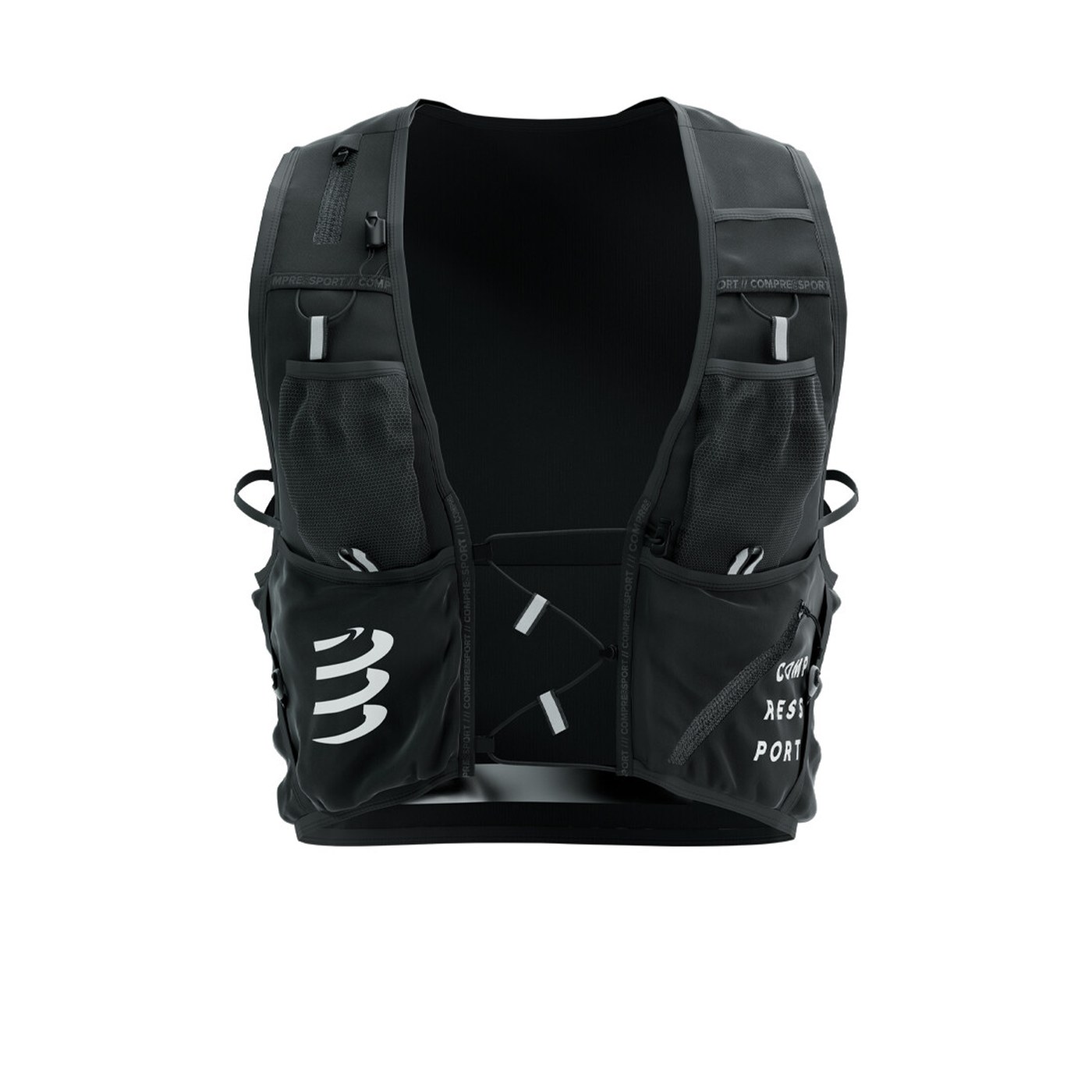
The V2 of the vest Ludovic Pommeret wore at UTMB 2024 is finally hitting French trails. A claimed 114 grams, a redesigned elastic closure, angled flat flasks: Compressport builds on the UltRun S Pack Evo 10 and hunts down the V1's flaws one by one. At €180, it goes straight after the Salomon S/Lab and remains, on the scale, one of the three lightest 10-liter vests on the market. Our verdict, cross-checked against recent French coverage.
Compressport Ultrun Evo 10 V2 Review: Pommeret's 114 g UTMB Vest
8/10
Compressport UltRun Evo 10 V2: the logical follow-up to a French best-seller
Compressport means Lausanne. A Swiss brand with a French calling, now a fixture on trails across the Alps. The V1 we reviewed last May, the UltRun S Pack Evo 10, was already a benchmark in the ultralight 10 L category. Its zigzag elastic closure, the brand's ultimate signature, split opinion: some loved it, others missed precise adjustment under load.
The V2, simply named Ultrun Evo 10 Pack, keeps the minimalist DNA but reworks three things. First, the front closure, simplified to two hooks and a shorter cord. Second, the flask pockets, moved to the sides and angled so they don't squeeze your rib cage. Third, the flasks themselves, redesigned in a "flat" version instead of a cylinder, so they hug your chest better. The goal isn't to tear everything up. It's to answer feedback from the ultra circuit, where the V1 has logged two full seasons.
RunMorph tip. Torn between the V1 and the V2? Settle two questions. Want the most precise closure possible? The V2 is a step up. Prefer a system proven by hundreds of UTMB finishers? The V1 is still €170 and delivers on its promises. If you're discovering Compressport in 2026, the answer is simple: the V2. For weight and stability benchmarks on the larger-volume side, also check out the Naak Ultra Energy Gel review: 27 g carbs + BCAAs for ultras
Salomon Adv Skin 12.
© Compressport, official photo used for editorial purposes
Objective technical data
| Brand | Compressport |
| Model | Ultrun Evo 10 Pack (V2, SKU 2031) |
| Volume | 10 liters |
| Empty weight | 114 g manufacturer claim, 116 g on an independent scale in size M |
| Available sizes | XS, S, M, L, XL (unisex) |
| Front pockets | 2 laterally angled flask sleeves, 2 open low stretch pockets, 1 zippered, 2 small upper pockets (1 zippered + 1 open) |
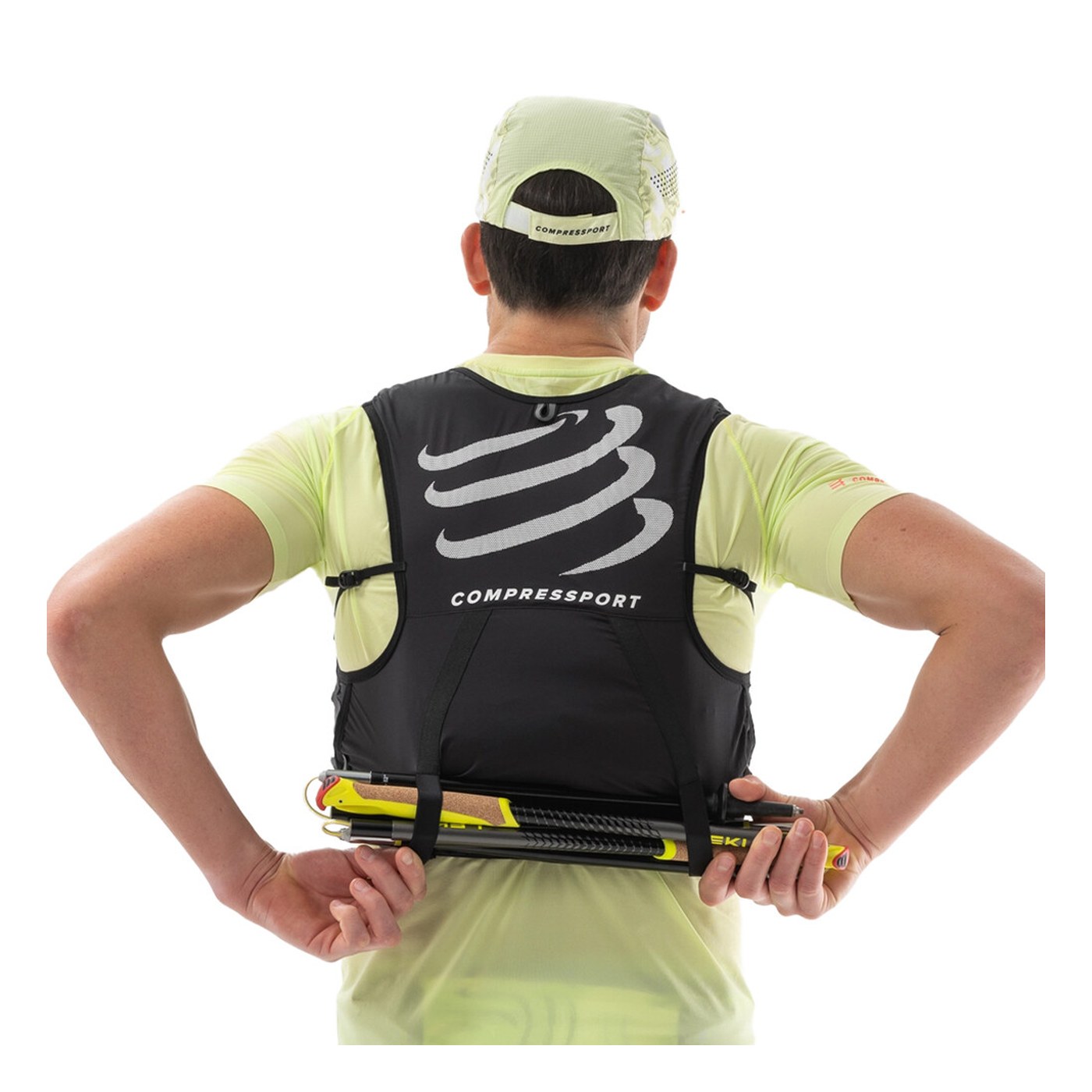
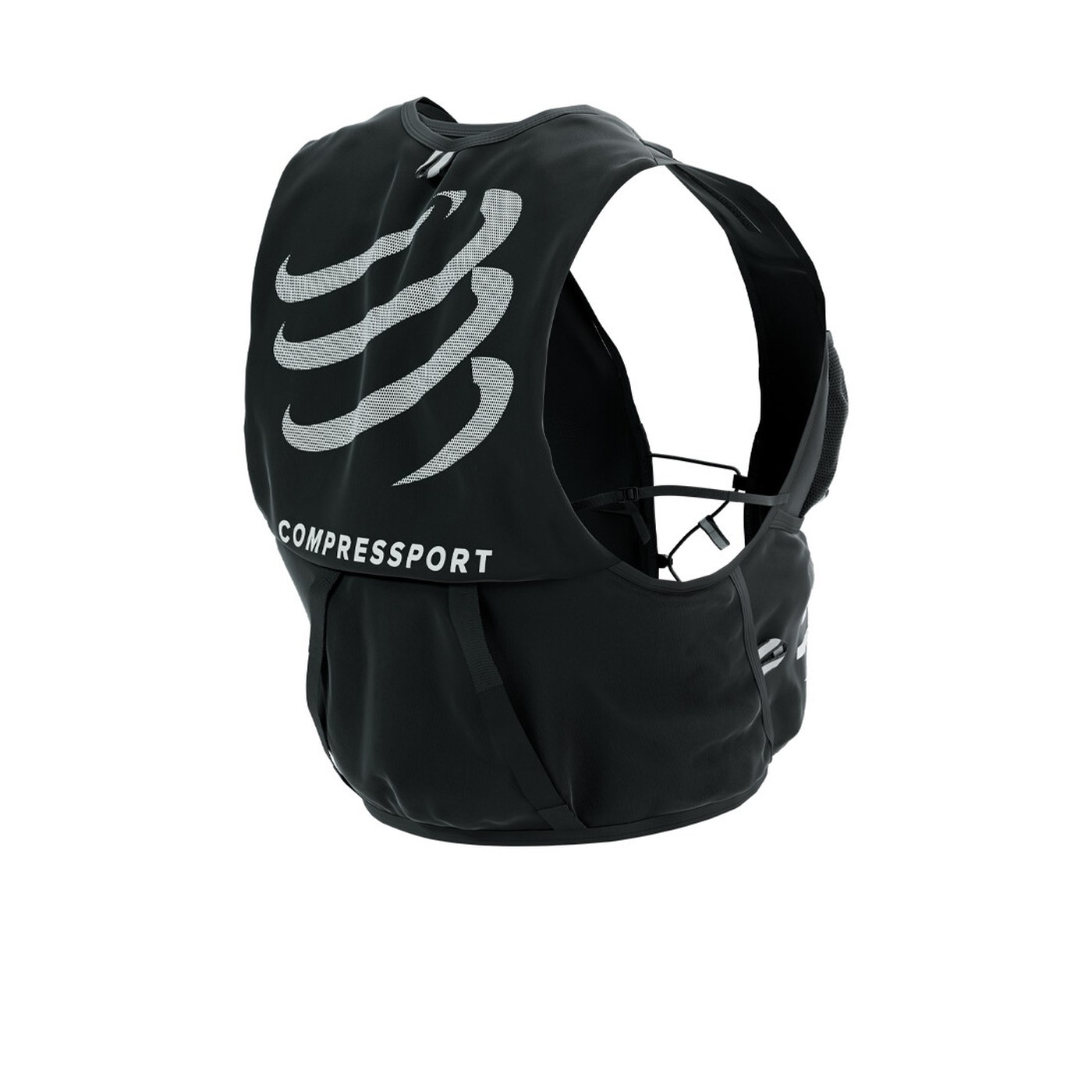
| Rear pockets | 1 large upper stretch pocket (hook-and-loop + pull tab), 1 lower dual-access "tunnel pocket" |
| Hydration bladder compatible | No (attachment point removed, unlike the 15 L version) |
| Flasks included | 2 next-gen flat soft flasks (sit more snugly against the chest than the round V1 flasks) |
| Fabrics | Ultra-thin synthetic blends, partly stretch, no foam inserts |
| Closure system | Simplified zigzag front elastic (2 hooks, short cord) |
| Pole holder | Rear, 2 elastic straps with anti-slip silicone inserts |
| Reflective details | White Compressport branding, partly reflective |
| Fits UTMB mandatory gear | Yes (with no added bladder, volume is tight, so plan your aid station strategy) |
| Official release | Early 2025 (SS25 collection carried over into SS26) |
| Official price | €180 |
Who is the Compressport Ultrun Evo 10 V2 for?
The skyrunner or 30 to 80 km racer
This is the vest's natural hunting ground. In fast races where every gram counts, the V2's 114 g make a difference from the third hour onward. The simplified elastic closure lets you put the vest on or take it off in seconds, handy when you need an extra layer at the top of a pass. The angled flat flasks are a real improvement: less pressure on your rib cage on steep climbs, easier access on descents. For this profile, the V2 goes toe to toe with the NNormal Race Vest 5L in the skyrace segment, with 5 L more capacity for longer races.
The technical ultrarunner (80-170 km)
At UTMB or Lavaredo, the V2 gets the job done, as long as you accept its limits. Pommeret wore it at UTMB 2024, proof of its credibility over the distance. But without the back bladder compatibility found on the 15 L version, you have to manage the two 500 ml flasks and the course's water points strictly. On a course with aid stations more than 90 minutes apart, the Raidlight Ultralight 12L or the Naak Ultra Energy Gel review: 27 g carbs + BCAAs for ultras
The fast trail runner on a long run (2 to 5 h)
Ideal for ultra-specific training or 30 to 50 km exploration runs in the mountains. The 10 liters swallow a jacket, a cap, gels, a safety kit and the mandatory gear for a mid-distance trail race. The vest is so unobtrusive you forget it within the first few hundred meters, which makes it a perfect partner for trail-specific sessions at 75% of your uphill maximal aerobic speed.
Comfort, bounce and secure fit
This is where the V2 truly shines. The simplified front closure spreads tension more evenly across your torso, and the new angled flat flasks remove the pressure point you felt with the V1's round flasks beyond 3 hours of running. On smooth trails and climbs, you forget the vest is there. The two side straps hold it securely, even on technical descents, and nothing bounces around inside.
One small caveat flagged by the independent test from Le Comparatif du Trail: with the front pockets fully loaded (smartphone in the zippered pocket + solid food in the stretch pocket + full flasks), you get some bounce up front. Not a deal-breaker, but plan for it on long, heavily loaded outings. Some testers also pointed to fragile flask straps, so keep an eye on them over time.
Breathability is excellent. The ultra-thin, partly stretch fabrics wick sweat remarkably well. The lack of foam inserts on the back may surprise fans of "comfort" vests, but that's exactly what keeps your back dry after 4 hours of summer racing, while competitors leave a damp patch on your shirt.
Storage and accessibility
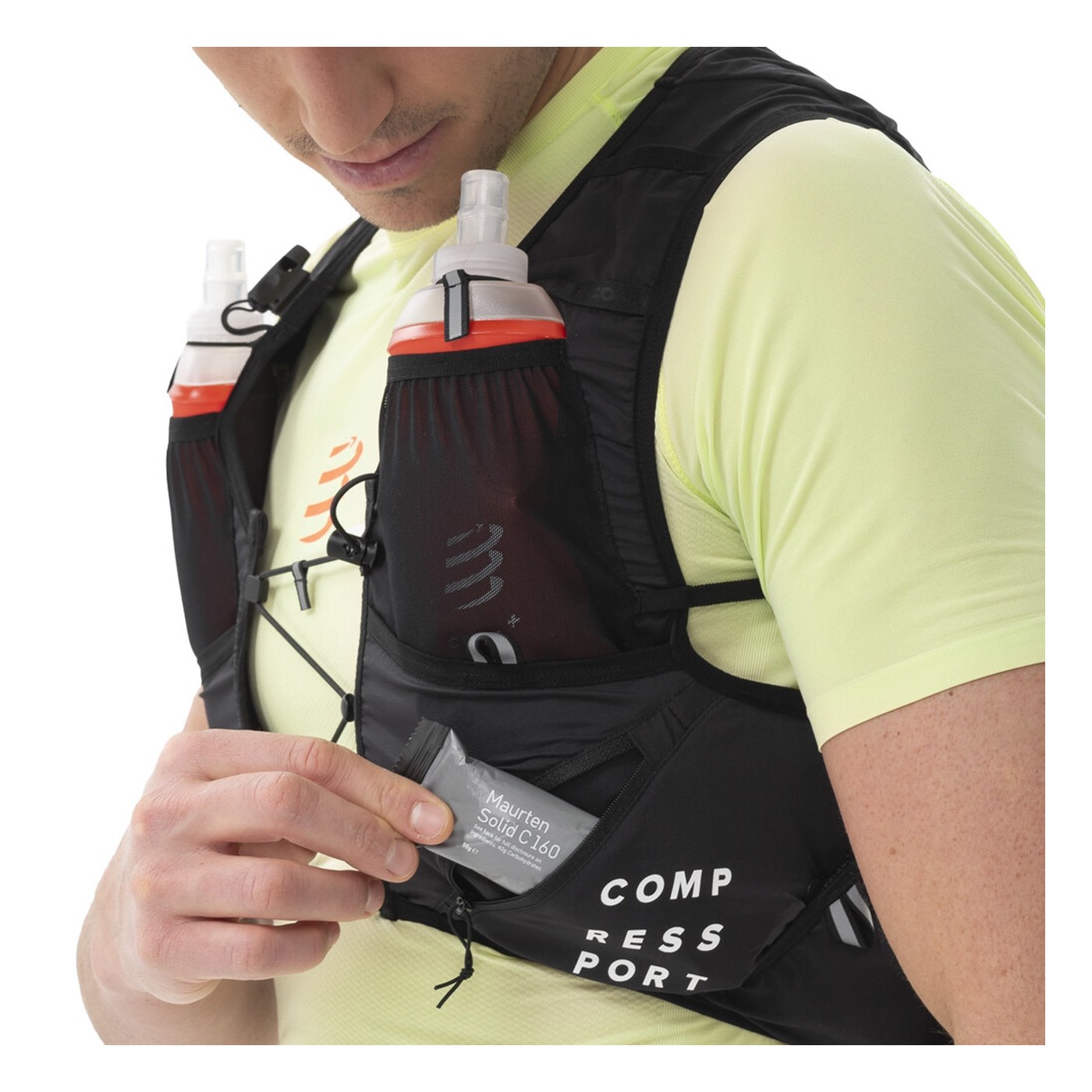
Compressport promises "total accessibility," and it's not empty marketing talk. Up front, you get nine useful storage spots, all within reach without taking the vest off:
- Two angled flask sleeves: set on the sides of the vest rather than mid-chest. If you're coming from a Salomon or Raidlight vest, the motion changes slightly, but you adapt fast.
- Two low stretch pockets: expandable, ideal for stashing two bars and a gel without bulking up your silhouette.
- One front zippered pocket: big enough for a recent smartphone up to 6.7 inches plus your keys.
- Two small upper pockets (1 zippered + 1 open): carried over from the Ultrun Evo 15. Perfect for quick-grab gels at the front of the shoulder straps.
The back has a main stretch compartment open at the top (ideal for a jacket balled up), plus a lower "tunnel pocket" that turns out to be two stacked pockets, each accessible from one side. Smart overall: you can keep your headlamp and clothing (top) apart from the mandatory safety gear (bottom) without mixing everything up.
© Compressport, official photo used for editorial purposes
Hydration
Two 500 ml soft flasks come standard, in the new flat shape. The benefit is mechanical: the flask follows the curve of your chest instead of sticking out like a cylinder. On the run, you breathe more freely and feel less like a foreign object is sloshing around. A solid answer to the V1's most common complaint.
A deliberate limit: no back bladder compatibility. Where the 15 L version in the range has an attachment point and a hose port, the V2 skips both. That fits its race positioning, and it saves the grams that bring the vest under the 120 g mark. In practice: 1 L of total water capacity, roughly 75 minutes of effort in hot conditions. Beyond that, you need to know where the aid stations are.
How it stacks up against the competition
Three direct rivals to know if you want to place the V2:
- Compressport UltRun S Pack Evo 10 (V1, €170): the V1 stays in the catalog at a slightly lower price. If the V2 feels too expensive, the V1 is still an excellent deal with a proven closure system. The V2 beats it on front stability and flask comfort. The V2 wins on finish; it's a tie in real-world use.
- Ultimate Direction Race Vest 6L (€155): 175 g and 9 pockets for 6 L of volume, versus 114 g and 7 pockets for 10 L on the Compressport side. The UD has the micro-adjustable daisy chain and the most precise adjustment on the market. The V2 takes back the lead on volume and absolute weight.
- Naak Ultra Energy Gel review: 27 g carbs + BCAAs for ultras
- Salomon Adv Skin 12 (€165): the ultra-trail benchmark. 244 g, 12 L, 8 front pockets, compatible with a 1.5 L bladder. More versatile over the UTMB distance thanks to its larger water capacity, but 130 g heavier empty. Choose Compressport, and you're choosing fast racing. Choose Salomon, and you're choosing self-sufficiency.
How to fit it into your RunMorph training plan
This vest slots naturally into a trail race build (50 to 100 km) or skyrace prep. In training, it shines on the key sessions of the RunMorph trail plan that call for a race-like load: long runs with specific work at 75% of uphill maximal aerobic speed, hilly fartlek, simulated technical night sections. The 10 L capacity holds your headlamp, a waterproof jacket, two full flasks and nutrition for a 4-hour mountain run.
For sessions of 2 h or less, it's probably oversized; a 5 L option like the NNormal Race Vest makes more sense. For committing 6 h+ outings, step up to a 12-15 L format like the Naak Ultra Energy Gel review: 27 g carbs + BCAAs for ultras
© Compressport, official photo used for editorial purposes
RunMorph verdict
Final score: 8.5/10.
The V2 delivers exactly what we expected: it fixes the V1's flaws without sacrificing any of the ultralight DNA behind its success. 114 g for 10 L is still off the charts. The angled flat flasks and the simplified elastic closure are two tangible improvements, proven on the ultra circuit by Ludovic Pommeret in 2024. The €180 price remains high, and the lack of back bladder compatibility is the only real compromise. But for the skyrunner or fast trail runner who wants a vest that disappears, it's now the French benchmark in the minimalist segment. Compressport has its race vest, and it weighs less than half a liter of water.
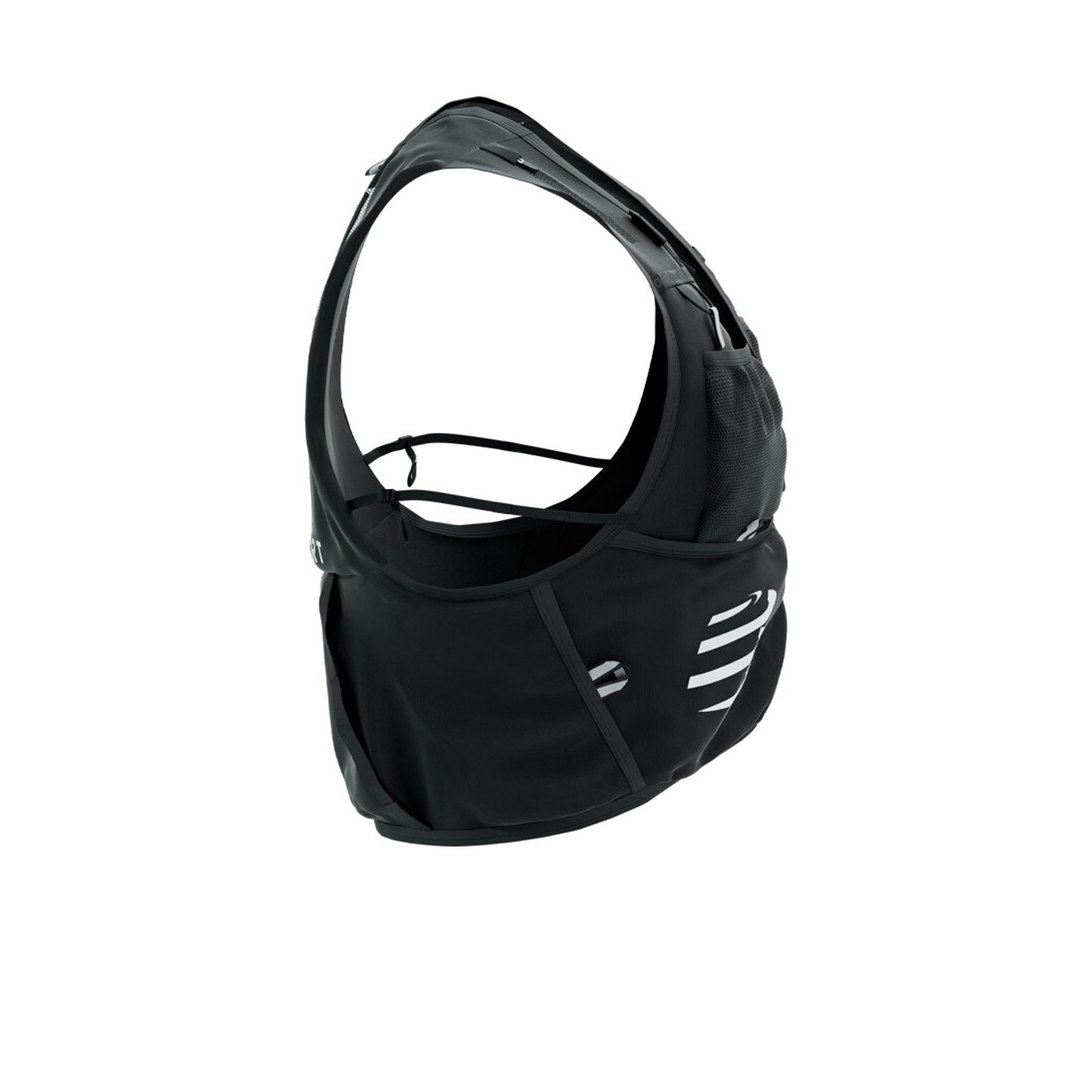
© Compressport, official photo used for editorial purposes
Key takeaways for your training
- Ideal volume for skyraces and short ultras: 10 L covers UTMB mandatory gear and nutrition for a 30 to 80 km race.
- Record weight in its category: 114 g claimed, among the three lightest 10 L vests on the market in 2026.
- Flat flasks, a real step forward: less chest compression on steep climbs, easier access on descents.
- No back bladder: water capacity capped at 1 L, so plan ahead for hot sections without aid stations.
- Signature elastic closure: on and off in seconds, ideal for managing layers in technical races.