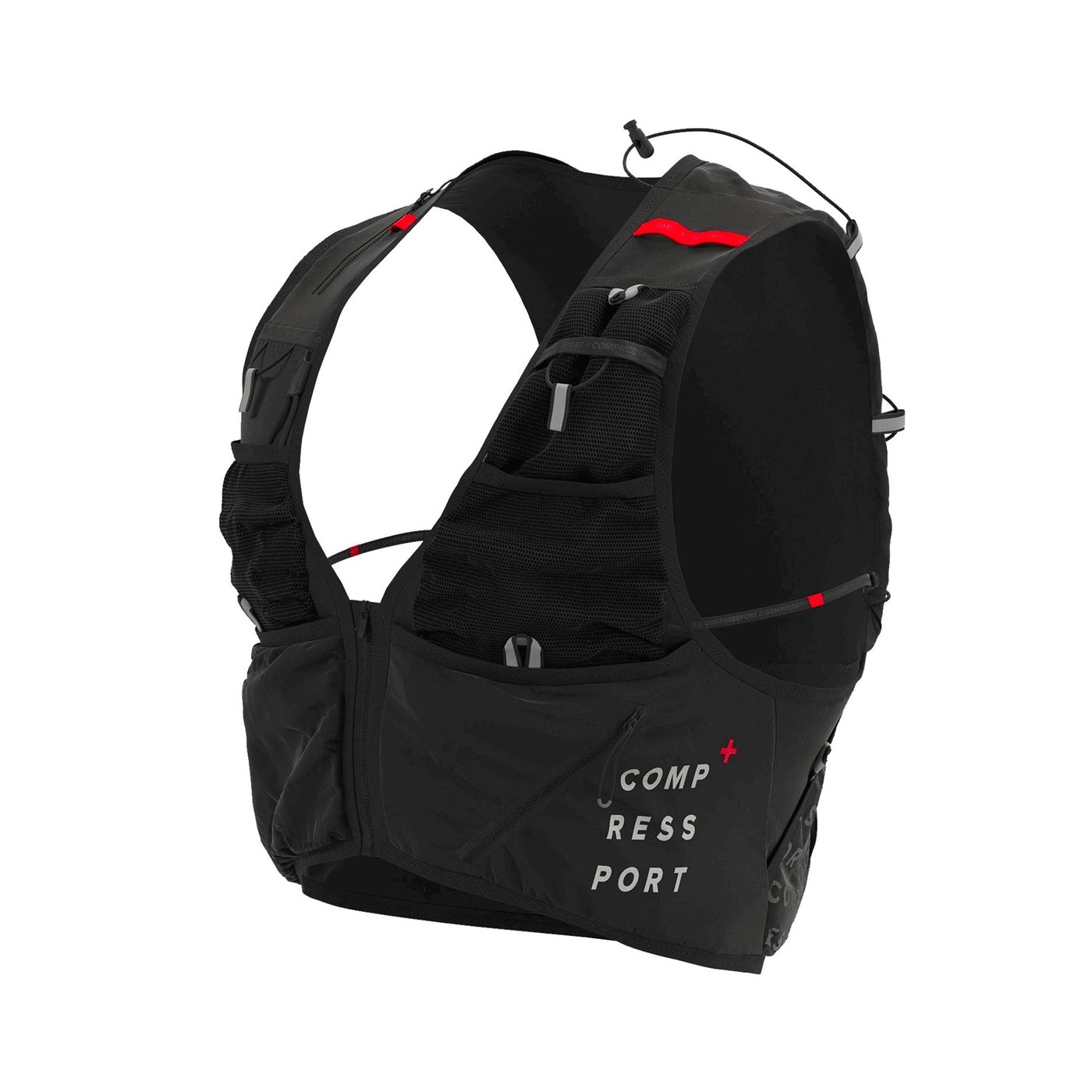
Compressport built its reputation on the UltRun S Pack Evo 10, an ultralight vest adopted by a big share of the French ultra field. The Evo 15 keeps the same architecture and adds five liters, enough to target fully self-supported races of 30 to 35 hours. On paper, the promise fits in one sentence: keep the lightness of the 10 L while gaining the capacity of a real ultra pack. Field testing tells a slightly more nuanced story, especially once you add a hydration bladder.
© Compressport, official photo used for editorial purposes
Compressport UltRun S Pack Evo 15: the answer to the Evo 10's lack of volume
Compressport holds a special place in the French trail scene. The brand built its name on ultralight vests worn by elite runners, led by Ludovic Pommeret, who wore the UltRun Evo 10 V2 at his UTMB races. The problem with that 10 L pack, documented by several testers, is the lack of headroom on long races: beyond 15 to 20 hours of effort, mandatory gear and nutrition end up spilling over.
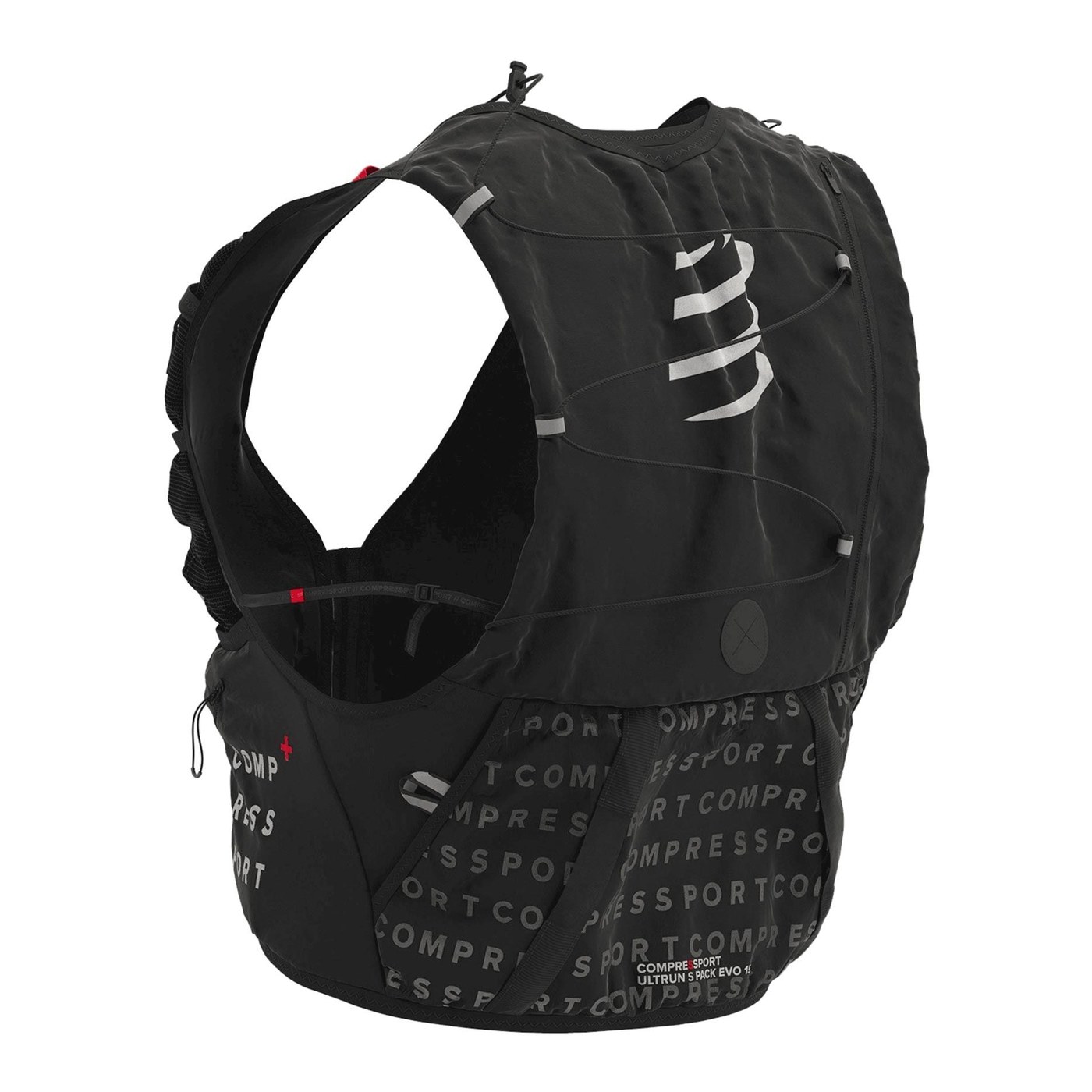
The Evo 15 tackles that shortfall head-on. At RunMorph, we see that Compressport didn't try to reinvent its architecture: the pack keeps the harness, fabrics and philosophy of the Evo 10, and adds a 3 L zippered back pocket closed by a Z-strap, on top of the 12 L spread across the fixed pockets. The result: 15 L for just 130 g, or 40 g more than the Evo 10 V2 for five extra liters. RunActu explicitly positions the product as the evolution designed for races of 30 to 35 hours, where the 90 g UltRun Pack S was limited to shorter formats.
Who is the UltRun S Pack Evo 15 for?
The self-supported ultrarunner (50 to 120 km)
This is the profile Compressport explicitly targets. For an ultra with full mandatory gear, the 15 L lets you stow a rain jacket, power bank, long-race nutrition and headlamp without touching the strap extension. Trail-Session and Journal du Trail both confirm loads above 4 kg with no noticeable loss of stability on technical descents.
The Evo 10 finisher who keeps running out of room
If you already run with an Evo 10 or Evo 10 V2 and keep hitting the volume ceiling on long races, the Evo 15 is the logical next step at almost the same weight. The switch doesn't change your adjustment habits, since the harness stays the same.
The runner who relies on a hydration bladder
This is the profile it serves worst. Courir Mieux documents the pack sagging as soon as a bladder goes into its dedicated sleeve, with incomplete hose routing. If your race format calls for a bladder rather than flasks (heat waves, widely spaced aid stations), another pack in the Compressport lineup or a more bladder-oriented competitor will be more comfortable.
© Compressport, official photo used for editorial purposes
Comfort, bounce and secure fit
On stability at full load, the sources agree. Journal du Trail, testing the pack loaded, reports excellent stability even at a fast pace and on technical descents, with no perceptible bounce despite a load above 4 kg. Courir Mieux confirms this under the same load conditions and adds a caveat the other sources don't mention: the shoulder straps, kept thin to save weight, become uncomfortable on fast descents once the pack carries more than 4 kg, where a wider harness would absorb the pressure better.
The other point of disagreement is how the pack behaves when nearly empty. Courir Mieux notes that the Evo 15 is less stable than the Evo 10 when lightly loaded, a logical effect of the extra back pocket volume shifting around when it isn't full. Le Comparatif du Trail focuses mainly on the Z-strap extension, which sometimes opens unintentionally mid-race: a closure flaw rather than a general stability problem. At RunMorph, our takeaway is that the pack delivers on its stability promise once loaded for a real ultra outing, but it isn't designed to be worn half-empty, unlike more compressible vests such as the Salomon Adv Skin 12.
Compartments and accessibility
The pocket count varies slightly between sources (10 to 11, depending on what counts as a separate compartment), but the layout is consistent: two flask pockets on the shoulder straps, two mesh pockets for snacks, a zippered phone pocket, a small zippered key pocket, and at the back a large zippered pocket for mandatory gear, a dedicated bladder sleeve, two nested stretch back pockets and the 3 L Z-strap extension. RunActu and Courir Mieux both confirm that nine of the eleven pockets stay reachable without taking the pack off, a real strength for fueling on the move.
The catch is which flasks fit. The pack is designed for narrow Compressport or Salomon flasks: Le Comparatif du Trail reports that wider 750 mL Hydrapak flasks barely fit into the front pockets. If you already use a different flask system, check compatibility before you buy rather than finding out mid-race. According to Le Comparatif du Trail, the bottom pocket, closed with hook-and-loop instead of a zipper, also limits practical use for heavy or small items, a design choice that puts lightness ahead of closure security.
Hydration
This is the lowest-rated criterion on our scorecard, and it deserves a straight answer. Two readings clash head-on here. Journal du Trail and RunActu describe a dedicated back bladder sleeve, with loops to manage the hose valve, presented as functional. Courir Mieux, by contrast, reports that as soon as a bladder goes in, the pack loses its shape and sags, and the hose routing lacks a properly placed loop to hold the tube in place.
Opinions split sharply on a point that is far from minor for a pack built for long self-supported efforts. Our reading at RunMorph: the Evo 15 is designed first and foremost for flask hydration, true to Compressport's DNA, and the advertised bladder compatibility works in theory without being the product's strength in practice. If most of your hydration strategy relies on a 1.5 to 2 L bladder rather than flasks refilled at aid stations, this isn't the right vest for you.
Compressport UltRun S Pack Evo 15 vs UltRun S Pack Evo 10 V2: which one should you choose?
| UltRun S Pack Evo 15 | UltRun Evo 10 V2 |
|---|
| Volume | 15 L (12 L + 3 L extension) | 10 L |
| Weight | 126 to 130 g | 114 g |
| Weight difference | 16 g for 5 L of extra volume |
| Price | 190 euros | 180 euros |
| Recommended use | Ultras of 30 hours and up, full mandatory gear | Races up to 15 to 20 hours, on flasks |
The weight gap between the two vests is minimal: just 16 g for five liters of extra capacity. The decision comes down to race format more than carried weight. For a short trail race or an ultra of up to 15 hours on flasks, the Evo 10 V2 remains the more logical choice: it costs 10 euros less and has a better reputation for stability when lightly loaded. Once the race goes past 20 hours and the mandatory gear list grows, the Evo 15 takes the lead thanks to its extra back pocket and modular extension.
Compressport UltRun S Pack Evo 15 vs Black Diamond Distance 15: head to head
| UltRun S Pack Evo 15 | Black Diamond Distance 15 |
|---|
| Volume | 15 L | 15 L |
| Weight | 126 to 130 g | 330 g |
| Weight difference | 200 g apart for the same claimed volume |
| Price | 190 euros | not stated in our review |
| Philosophy | Maximum lightness, minimalist construction | Reinforced vest harness for vertical ultras |
At equal volume, the choice between these two packs comes down to the terrain you're targeting rather than the claimed capacity. The 200 g gap reflects opposite priorities. Compressport sacrifices padding and rigidity to hit 130 g, while Black Diamond builds a more structured harness for technical vertical ultras, with more support at the cost of nearly triple the weight. For a runnable or semi-technical race of 50 to 100 km, the Evo 15 keeps the weight advantage. On very rugged terrain with frequent carrying sections, the extra structure of the Distance 15 can justify the additional 200 g.
Pros and cons
Pros
- 130 g for 15 L, just 16 g more than the Evo 10 V2 for five extra liters
- Stability confirmed by two independent sources at full load (4 kg and up), including on technical descents
- Nine of the eleven pockets reachable without taking the pack off
- Two 500 mL soft flasks included, worth an estimated 40 euros
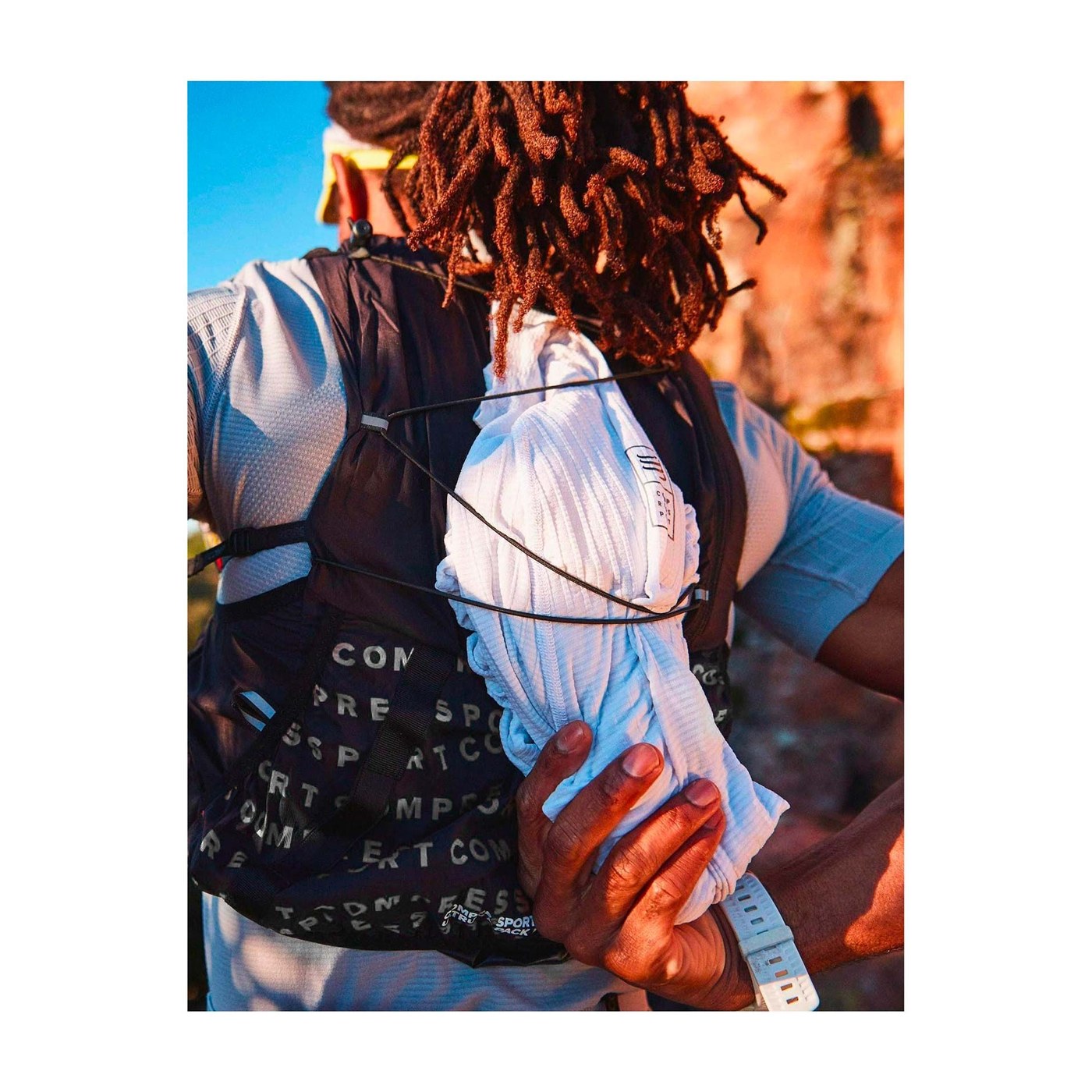
- Modular Z-strap extension for an extra layer without a dedicated pocket
Cons
- Bladder integration judged faulty by an independent tester (pack sags, hose poorly secured)
- Thin shoulder straps judged uncomfortable on fast descents with more than 4 kg of load
- Less stable than the Evo 10 when lightly loaded
- Front pockets sized for Compressport or Salomon flasks, incompatible with wider flasks such as the Hydrapak 750 mL
- Z-strap extension sometimes opens unintentionally during a race
© Compressport, official photo used for editorial purposes
Our field verdict: who is it really for?
The UltRun S Pack Evo 15 nails the core of its mission: adding volume to the Compressport architecture without sacrificing the lightness that made the brand's name. In a race where you handle hydration with flasks and the mandatory gear stays within reasonable limits, it's a credible vest for 50 to 120 km. The serious reservation is the bladder: if your race strategy depends on one, take the conflicting field reports on this point seriously before you buy.
Whether you're preparing a self-supported ultra or your first long mountain outing, your gear choices matter as much as your physical preparation.
The RunMorph trail training plan structures your weeks of volume and elevation gain so you show up ready on race day, with flasks or a bladder depending on your strategy.
RunMorph Coach verdict
7.6/10. The UltRun S Pack Evo 15 delivers on its promise of volume without excess weight and proves its stability once loaded for a real ultra outing, two points backed by several independent tests that reach the same conclusion. The score is held back by two real, documented reservations: bladder integration judged faulty by at least one serious source, and shoulder straps that show their limits on fast descents at full load. This isn't a do-it-all vest for every hydration setup. It's a flask vest built for long ultras, and you should buy it knowing exactly that.