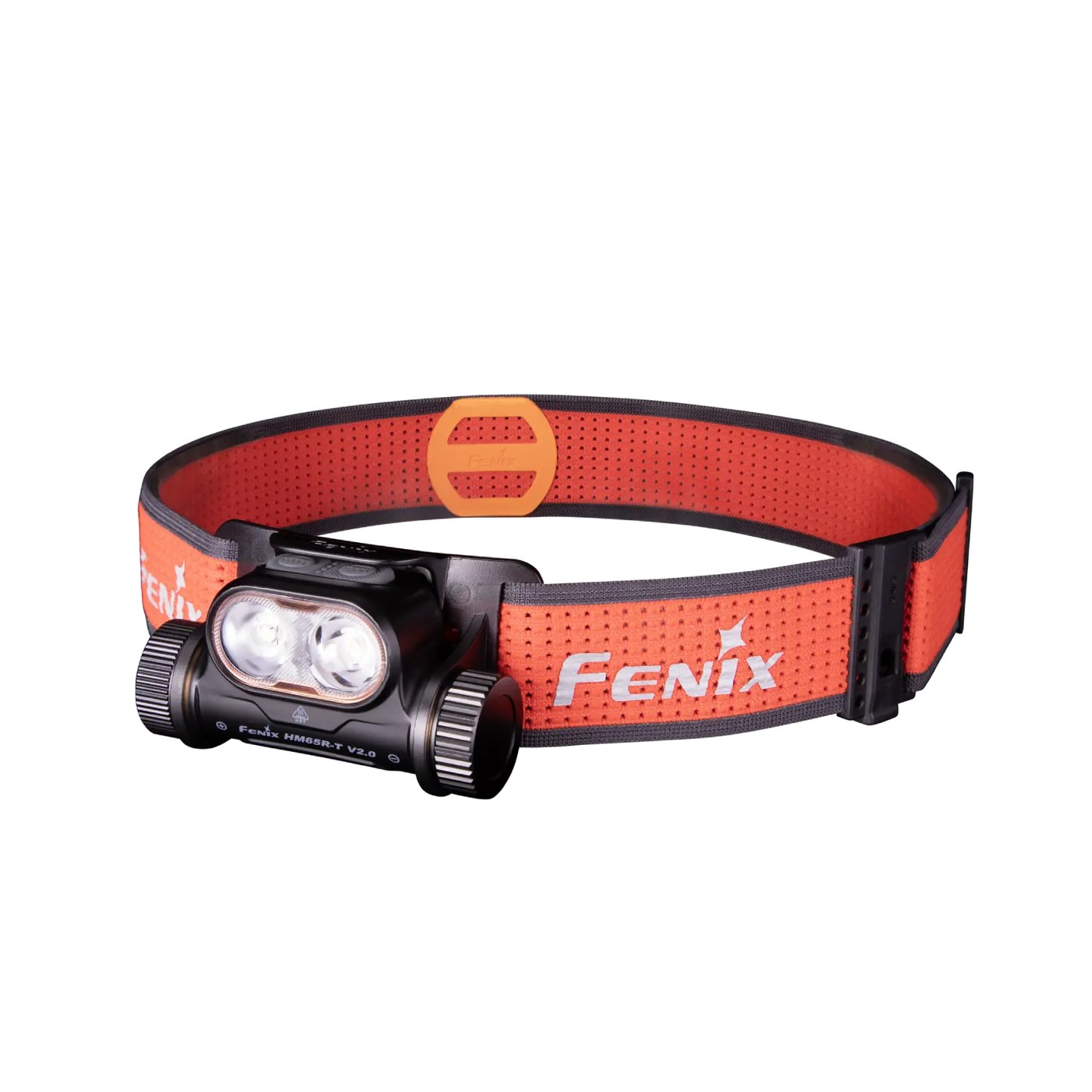
Fenix is a global benchmark in technical headlamps, yet the brand had never appeared in the RunMorph catalog. The HM65R-T V2.0 fills that gap with a headlamp built for ultra-trail: 1600 lumens, a dual cool white and warm white beam, a magnesium alloy housing and a dial-adjust headband system borrowed from the cycling world. At RunMorph, we cross-checked a detailed English-language field review of this exact model against a French review of the previous generation to get a clear picture of what this premium headlamp is really worth.
© Fenix, official photo used for editorial purposes
Fenix HM65R-T V2.0: the Korean brand takes on premium night trail running
Fenix built its reputation on tactical and outdoor flashlights before moving more decisively into trail running with its HM range. The HM65R-T V2.0, which replaces the original HM65R-T, shows that move upmarket. You get a magnesium alloy housing (30% lighter than an equivalent aluminum housing, according to the brand) and two light sources: a Luminus SST40 white LED and a Luminus SST20 warm white LED. Add a two-way dial headband system that breaks with classic elastic straps. All of this for a listed price of around 105 US dollars, well below high-end Petzl benchmarks like the Nao RL.
HM65R-T V2.0 specs
| Feature | Value |
|---|
| Brand | Fenix |
| Model | HM65R-T V2.0 |
| Max output | 1600 lumens (white LED) + 800 lumens (warm white LED, separate beam) |
| Max beam distance | 170 m |
| Battery life | 300 h in eco mode (5 lm) / about 3 h claimed in high mode, over 4 h measured in real-world testing |
| Battery | Rechargeable 18650 3400 mAh included, compatible with CR123A batteries |
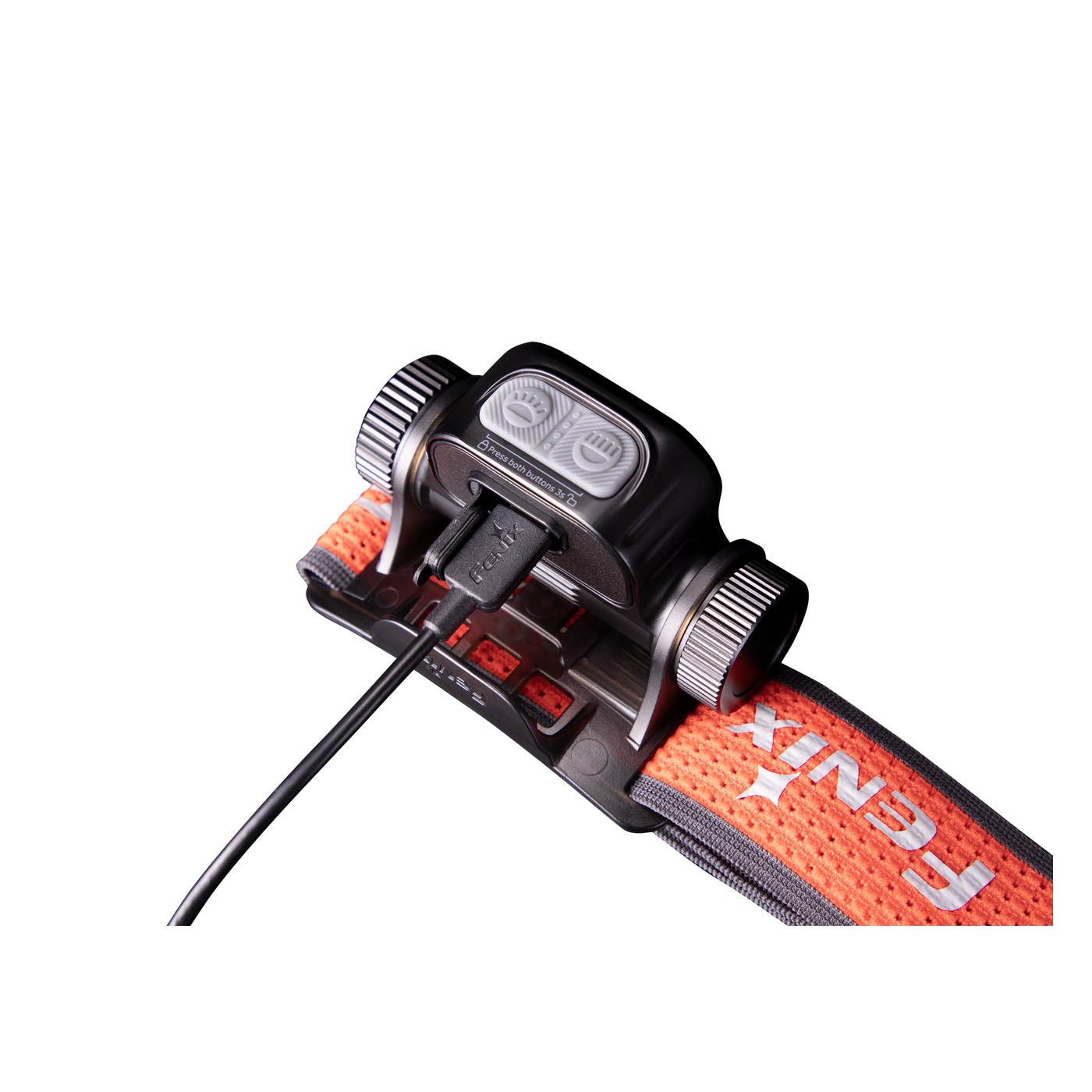
| Charging | USB-C, about 2 h 30 to 3 h for a full charge |
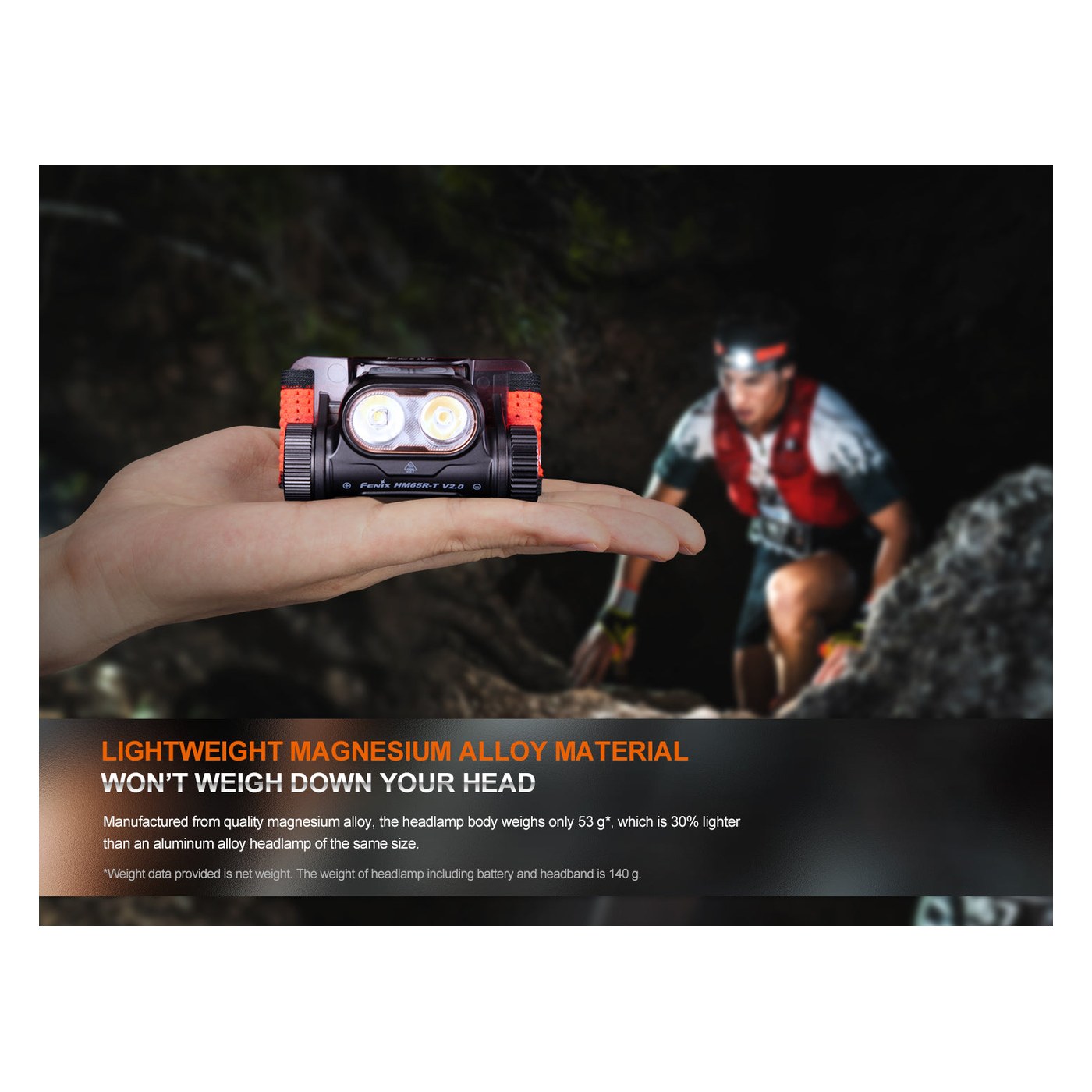
| Weight | 140 g (headband and battery included), housing alone 53 g |
| Water resistance | IP68 (2 m submersion), impact resistance 2 m |
| Headband | Two-way dial system, built-in emergency whistle, reflective strips |
| Colors | Black, dark purple, Nebula |
| Official price | About 105 US dollars (roughly €100 to €130 depending on the French retailer) |
One point deserves attention before you buy: the 300 hours of battery life splashed across the box only apply to the 5-lumen eco mode, which is practically useless on technical trails. In max mode, the brand claims about 3 hours, and an independent field review measured more than 4 hours in comparable conditions. That's a pleasant surprise, but it doesn't change the order of magnitude. For a full night of ultra running, plan on either an intermediate mode or a backup battery.
Magnesium housing and dual beam: what difference does it make on the trail?
The big technical promise of the HM65R-T V2.0 is its independent dual beam: a cool white LED for raw power and a warm white LED designed for fog, where cool light tends to bounce off suspended particles and create a distracting halo. An independent field review confirms that the cool white LED is far more powerful than anything the tester had used before, to the point of making darkness almost irrelevant on runnable sections. The warm LED is judged less essential day to day, but useful in the damp, misty conditions it was designed for.
The magnesium alloy housing delivers on its lightness promise. At 53 grams without headband and battery, it's clearly lighter than a comparable aluminum housing, without sacrificing IP68 certification or 2-meter impact resistance (lab-tested by the brand itself on all 6 faces of the housing). That's a real differentiator against rivals like the Petzl Nao RL, which is only IPX4 rated.
© Fenix, official photo used for editorial purposes
RunMorph tip: if you string together long night runs, pair the HM65R-T V2.0 with an intermediate mode rather than running max mode continuously. Your real-world battery life will benefit noticeably. For lighter, occasional use, the Petzl Swift RL remains a more compact alternative.
The field test: headband comfort and real-world battery limits
On this headlamp's biggest differentiator, the dial headband, the feedback clearly converges. A very detailed independent field review describes a system that literally changed how the tester adjusts a headlamp mid-run. No more pulling the headlamp off in the middle of the night to tighten the strap: the side dial lets you fine-tune the fit without breaking stride. The headband, wider than average and perforated for breathability, also earns praise. The only recurring drawback is a slight pressure point at the front of the head after several hours, which the tester partly puts down to the shape of their own head rather than a design flaw, and a weight of 140 grams judged a bit high compared with the lightest headlamps on the market.
On battery life, the reviews also converge, but toward a caveat on the marketing claims. The most powerful mode, rated for 3 hours on the spec sheet, lasted more than 4 hours in an independent field review. That's a positive gap, and a rare one in a sector where real-world battery life often falls short of the claimed figure. A French review of the previous generation in the same product family (the Fenix HM65R, without the -T suffix, a close but distinct model tested ahead of the Ultra Trail du Mont-Blanc and its CCC race) confirms the brand's long-term reliability and resistance to varied weather. It also highlights a comfortable beam distance of up to 150 meters in wide-beam configuration.
Charging wins unanimous approval: USB-C, about 2 hours 30 to 3 hours for a full charge, much faster than most direct rivals. A low-battery indicator that automatically dims the output before full shutdown is also flagged as a welcome safety feature rather than a mere gimmick.
© Fenix, official photo used for editorial purposes
Fenix HM65R-T V2.0 vs Petzl Nao RL vs Ledlenser NEO9R: the comparison
| Model | Max output | Weight | Water resistance | Max battery life | Price |
|---|
| Fenix HM65R-T V2.0 | 1600 lm | 140 g | IP68 | 300 h (eco) | ~105 dollars |
| Petzl Nao RL | 1500 lm | 145 g | IPX4 | 80 h (10 lm) | Premium |
| Ledlenser NEO9R | 1200 lm | 199 g | IP54 | 120 h (30 lm) | €115 |
Against the Nao RL, the Fenix stands out with far better water resistance (IP68 vs IPX4) and a lighter housing, but it has no equivalent to Reactive Lighting, which automatically adjusts output to ambient light. Against the NEO9R, the weight gap is the most striking: 140 g vs 199 g, a real advantage on very long runs. Fenix's true differentiator remains its cool/warm dual beam, a feature neither rival offers in this form.
Pros
- 1600 lumens, among the highest outputs in the segment
- Dial headband that's especially comfortable and quick to adjust
- IP68 water resistance and impact resistance ahead of direct rivals
- Fast USB-C charging, about 2 h 30 to 3 h
- Real-world battery life in high mode beats the claimed figure
Cons
- Headline 300 h battery life only applies to an eco mode of little use on trails
- 140 g is a bit heavy next to the lightest headlamps
- No automatic light-sensor mode (Reactive Lighting)
- Slight forehead pressure point reported after several hours of wear
Our field verdict: who is the HM65R-T V2.0 for?
The trail runner training for an ultra with long night sections
This is the target profile. The 1600 lumens and cool/warm dual LED make reading the terrain safer over hours of night racing, as long as you manage the power modes smartly to preserve battery life.
The casual runner who heads out once or twice a week after dark
Less relevant. The price and power of this headlamp far exceed the needs of occasional use. A more compact headlamp like the Petzl Swift RL will be more than enough.
The runner who puts lightness on the head first
It depends. At 140 g, the HM65R-T V2.0 is reasonable but not the lightest in its power class. In practice, the well-designed headband more than makes up for it.
For your training: a headlamp this powerful makes the most sense in a build with regular night runs, especially ultra-trail training blocks where safety and seeing far enough matter as much as your race plan. Structure your weeks with the right plan: explore RunMorph training plans.
RunMorph verdict
The Fenix HM65R-T V2.0 marks a successful debut for the brand in the RunMorph catalog. Powerful, waterproof and fitted with one of the most comfortable headbands we've tested, it mainly suffers from confusing battery life marketing: the advertised 300 hours only apply to a mode that's practically useless, and the mode that actually matters on technical trails lasts between 3 and 4 hours. Once you factor that in, it's a reliable, well-built headlamp, best kept for runners who truly need its power. 8/10.