August 27, 2026Hoka Rocket X Trail: 248 g measured vs 268 g claimed, the unfiltered review
7.8/10
- ✓Measured weight of 248 g, 20 g under the manufacturer's claim
- ✓Propulsion and efficiency rated better than a classic PEBA by all three sources we read
- ✓Widened heel base that offsets a high stack (36/42 mm)
- ✗3 mm lugs with no Vibram, documented slip on greasy off-camber ground
Two back-to-back Hardrock 100 wins (2024 and 2025) on Ludovic Pommeret's feet, a Western States podium for Fuzhao Xiang: the Rocket X Trail didn't need a marketing campaign to make a name for itself. It proved itself in races before Hoka even put it on sale. The real question is what it's worth outside the elite bubble, on the legs of a runner paying 225 euros out of their own pocket.
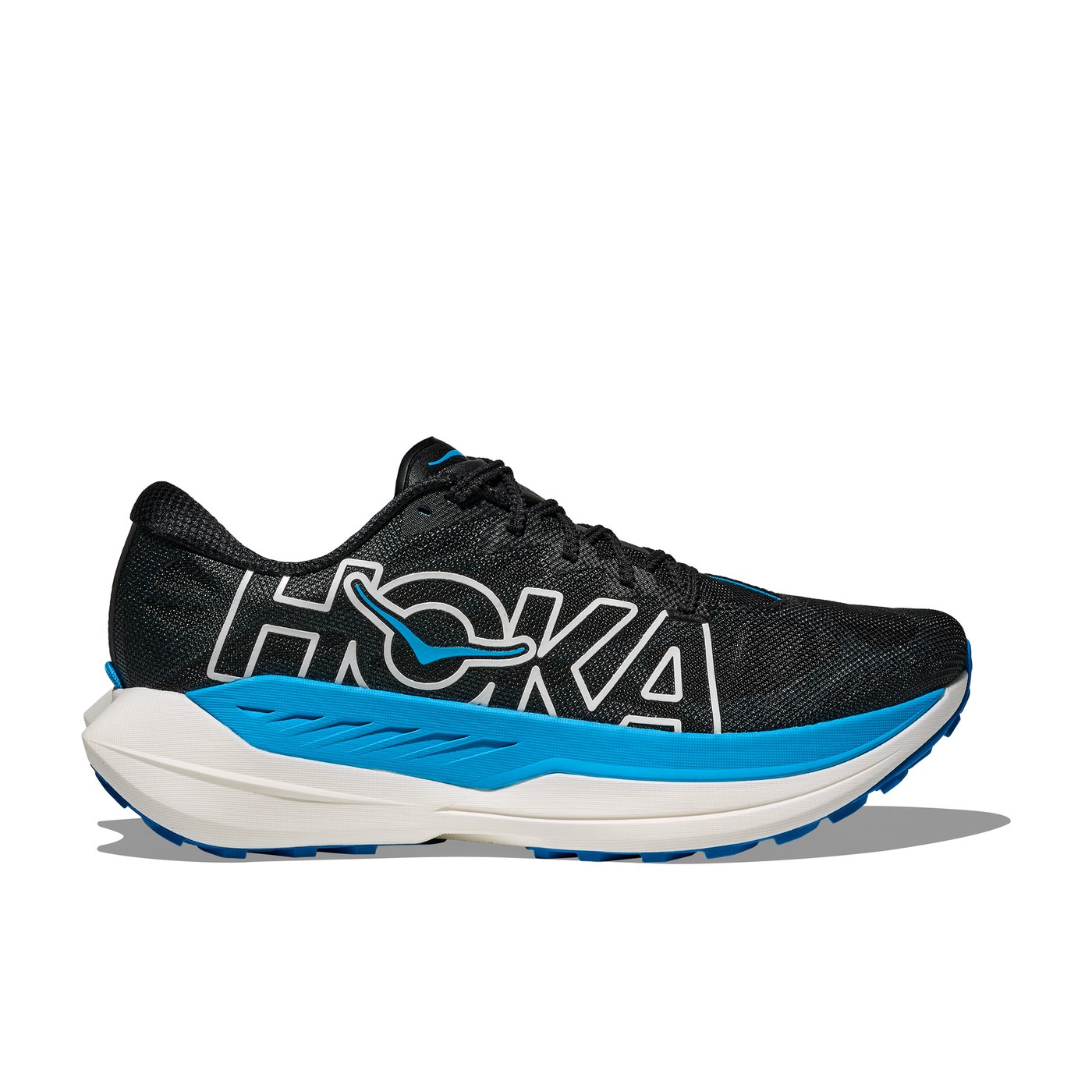
© Hoka, official photo used for editorial purposes
The essentials in 3 sentences
The Rocket X Trail is Hoka's first trail shoe to pair A-TPU foam (already used on the road by Puma and Asics) with an H-shaped carbon plate, and the result is built exclusively for fast, dry, runnable trails. Independent French-language tests measured it at 248 g, 20 g lighter than the 268 g Hoka claims, but they also confirm limited grip from 3 mm lugs with no Vibram rubber. This is a pure performance shoe for hardpack, not an all-rounder trail shoe.
7.8
/ 10 · RunMorph overall score
Who is it for?Experienced trail runners chasing speed on runnable trails, dirt roads or gravel, and ultra runners who want high cushioning on non-technical courses.
Who should skip it?Runners on rocky, muddy or highly technical terrain, and anyone who expects a Vibram outsole or a Matryx upper at this price.
Hoka switches playgrounds with its first A-TPU carbon trail shoe
Hoka built its reputation on maximal cushioning and comfort. With the Rocket X Trail, the brand makes a different bet: bringing the codes of fast road racing onto the trails. It's the third Hoka trail shoe to get a carbon plate, after the Tecton X 3 and the Mafate X, but the first to use A-TPU, a firmer and snappier foam than the PEBA found in almost every race shoe today.
Where it was validated tells you a lot about how the shoe is positioned: the Rocket X Trail didn't prove itself on a technical skyrace, but at the Hardrock 100 in Colorado, a notoriously demanding ultra where a good part of the course stays runnable. Ludovic Pommeret wore it to win there two years in a row, in 2024 and 2025. Fuzhao Xiang took a Western States podium in the same shoe. That record validates it over the distance of an ultra, but says nothing about how it behaves on a muddy trail in central France on a November Sunday, a setting it simply isn't designed for.
RunMorph's advice: pick the Rocket X Trail as a second pair, not as your only shoe. If your usual terrain mixes runnable trails and technical sections, keep a deep-lugged pair like the Speedgoat 7 for rainy days and sloppy ground.
Rocket X Trail specs: what Hoka claims
| Brand | Hoka |
| Model | Rocket X Trail |
| Release | September 1, 2025 |
| Type | Trail, racing on runnable terrain |
| Drop | 6 mm |
| Forefoot / heel stack (measured) | about 36 mm / 42 mm |
| Claimed weight (Hoka, US) | 268 g (9.45 oz) |
| Measured weight (2 French testers, EU 42 2/3) | 248 g |
| Foam | Dual-layer supercritical A-TPU |
| Plate | Carbon, H-shaped, two partially independent segments |
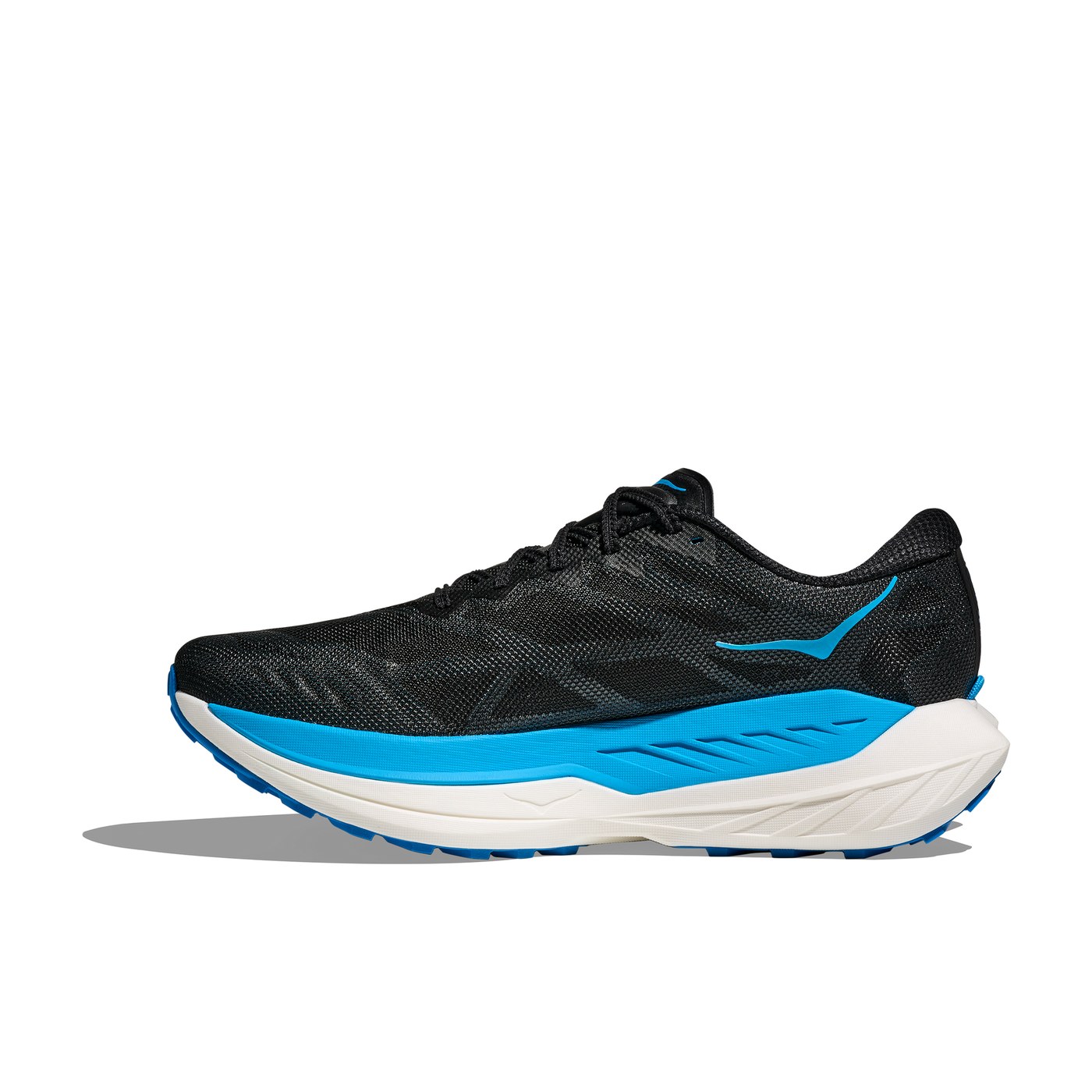
| Outsole | Hoka proprietary rubber, no Vibram |
| Lugs | 3 mm |
| Upper | Thin nylon mesh, no Matryx, gaiter loops |
| Colorway | Black / Skyward Blue (only colorway at launch) |
| Official price | 225 € (France) / 250 $ (United States) |
Rocket X Trail: what Hoka claims vs what was measured
On this shoe, the gap between claim and measurement works in the product's favor, and that deserves to be flagged just as clearly as a gap the other way. Two independent testers, writing for different publications, weighed the same size (EU 42 2/3) and got almost identical results: 248 g, against the 268 g listed on Hoka's US spec sheet (9.45 oz). That's 20 g, or 7.5 % lighter than claimed.
| Metric | Claimed (Hoka) | Measured (independent French tests) |
| Weight (EU 42 2/3) | 268 g | 248 g (gap -20 g, -7.5 %) |
| Drop | 6 mm | 6 mm (confirmed) |
| Left / right difference within one pair | not disclosed | 12 g difference recorded on one pair (242 g / 254 g) |
| Price | 250 $ (US) | 225 € seen in France (2 sources) |
First takeaway: a carbon-plated trail shoe can list a conservative official weight rather than an optimistic one, the opposite of what you see across part of the market. Second, more anecdotal but telling about quality control: one tester recorded a 12 g difference between the left and right shoe of the same pair, a minor but real manufacturing flaw that no product page mentions.
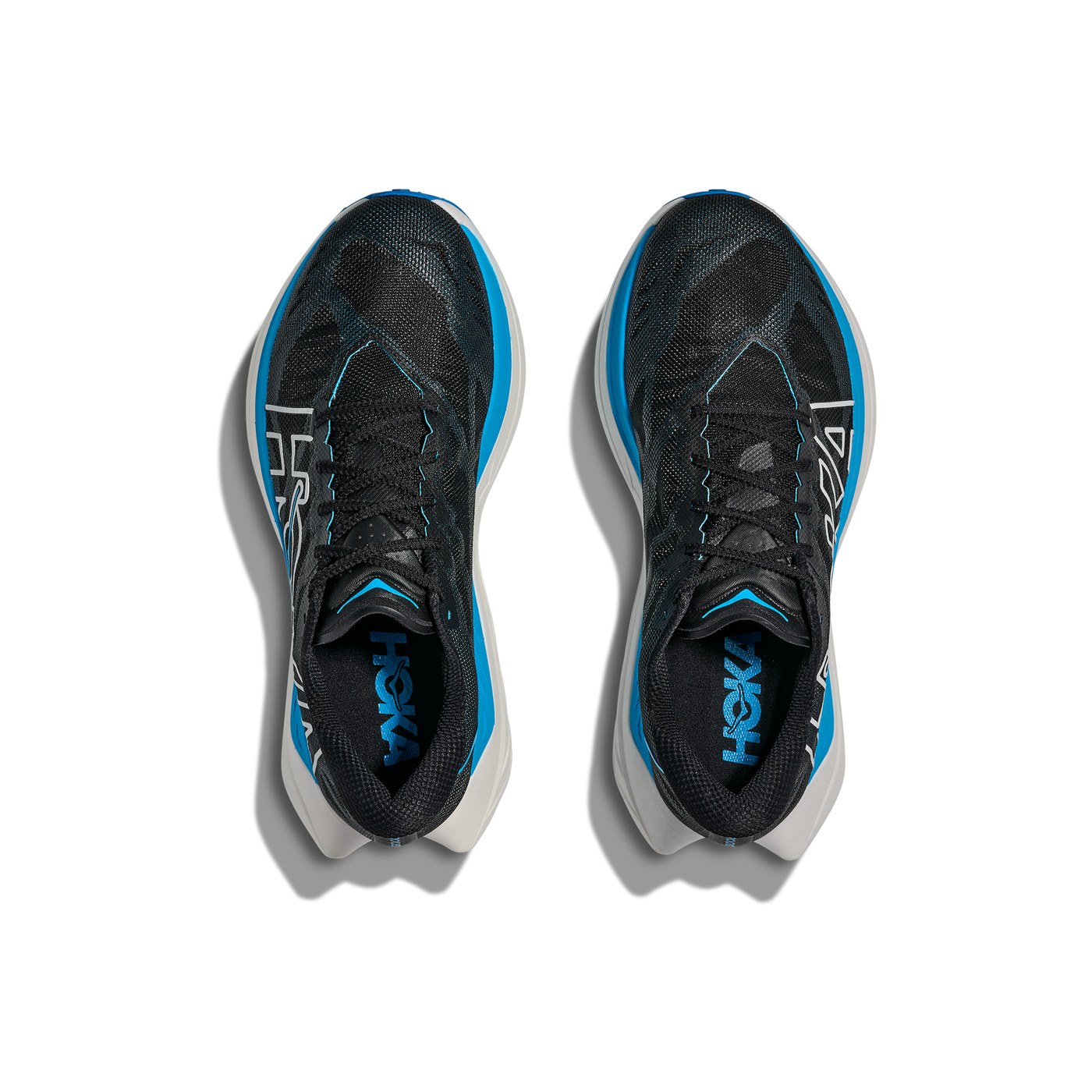
© Hoka, official photo used for editorial purposes
A-TPU and the H-shaped plate: what changes underfoot?
A-TPU (aliphatic thermoplastic polyurethane) isn't exclusive to Hoka: the material already features in road models like the Puma Fast-R Nitro Elite 3 and the Asics Metaspeed Ray. Compared with PEBA, which has dominated the racing market for several years, A-TPU is billed as firmer, with better durability potential over time. The three French-language testers who ran in the Rocket X Trail confirm the firm feel: the foam gives back a lot at high cadence, but it's clearly less plush than a classic PEBA on impact, a sensation that matches the material data rather than just marketing talk.
The H-shaped carbon plate follows the principle already used on the Tecton X 3: two segments that work partially independently, delivering longitudinal stiffness (propulsion) while keeping some lateral tolerance, which you need on terrain that's never perfectly flat. All three sources describe the rocker as aggressive, with a heel-to-toe transition that feels more like a road shoe than a classic trail shoe.
Fit: a roomy forefoot, a heel that struggles to lock in
No independent lab data is available yet on the exact vertical toe box volume of this specific model. Field feedback does, however, converge on two precise points. First, all three sources describe the forefoot as roomy, to the point that one of them explicitly recommends going half a size down from your usual size. Second, heel hold is the weak spot everyone flags: one tester says he systematically has to use the extra lacing eyelet to compensate for a heel that keeps moving, and the other confirms play at the back of the foot that calls for the same fix.
The tongue, very thin and not very mobile, is also criticized by both testers who ran in the pair: you need to reposition it carefully after loosening the laces, or you'll get uncomfortable creases against your instep.
The field test: what runners who actually wore it say
Three independent French tests were read in full before writing this article. The first, published in October 2025, describes a shoe that sets the tone from the very first strides: the A-TPU foam combined with the plate delivers a clear kick, with energy return that becomes especially noticeable as soon as the pace picks up. The second, published a few days later in a different outlet, confirms a feeling of efficiency superior to a classic PEBA foam and praises the stability of the widened heel base, despite a high stack that could otherwise be a concern. The third, more focused on technical data and race results, frames the shoe as a transfer of road standards to trail rather than a classic evolution of the segment.
On grip, the consensus is clear and unambiguous: on dry, compact ground, the 3 mm lugs bite well and both field testers find the traction convincing. On wet, greasy ground, though, the limit comes fast. One of the two describes slipping on an off-camber muddy section, badly enough to lose ankle support, an observation serious enough to report as is rather than water down into a vague sentence. Both testers recommend keeping the pair for dry, runnable terrain: forest roads, gravel paths or non-technical trail marathons.
On lateral protection, one point of divergence is worth noting: both field testers find the protection a bit thin for a trail shoe at this price, and advise against daily use on rocky terrain. Neither, however, reports any particular discomfort from stones during their test runs, which suggests a precautionary reservation rather than a flaw actually experienced during the trials.
Which terrain and which pace bring out the best in the Rocket X Trail
Dry, fast, runnable trails: this is the terrain the shoe was designed for and the only one where all three sources agree without reservation. Hard-packed dirt roads, gravel, compact forest trails: the plate and rocker do the work, with sensations close to a road shoe.
Ultras on non-technical courses: the high stack (36/42 mm) and the wide heel base are reassuring over long distances, a point confirmed by Ludovic Pommeret's use of it over 160 km at Hardrock. The measurable cause of this stability is geometric: a heel platform about 1 cm wider than the Tecton X 3 reduces the lever arm that usually destabilizes high-stack shoes.
Tempo pace and intervals on runnable trails: the H-shaped carbon plate and aggressive rocker clearly encourage cadence, a behavior confirmed by both testers, who describe a shoe that "makes you want to push" as soon as the pace rises.
Technical trails and scree: this is where the shoe falls off, for a precise geometric reason: 3 mm lugs combined with reduced lateral protection aren't built to absorb the irregularities of rocky terrain, unlike models with 4 to 5 mm lugs and a dedicated rock plate.
Greasy, muddy or waterlogged ground: this is the clearest breaking point, documented by a real off-camber slip reported by one tester. The cause ties directly to the lack of Vibram rubber and the shallow lugs, two design choices Hoka made deliberately to keep weight down, but which you pay for dearly as soon as the ground gets slippery.
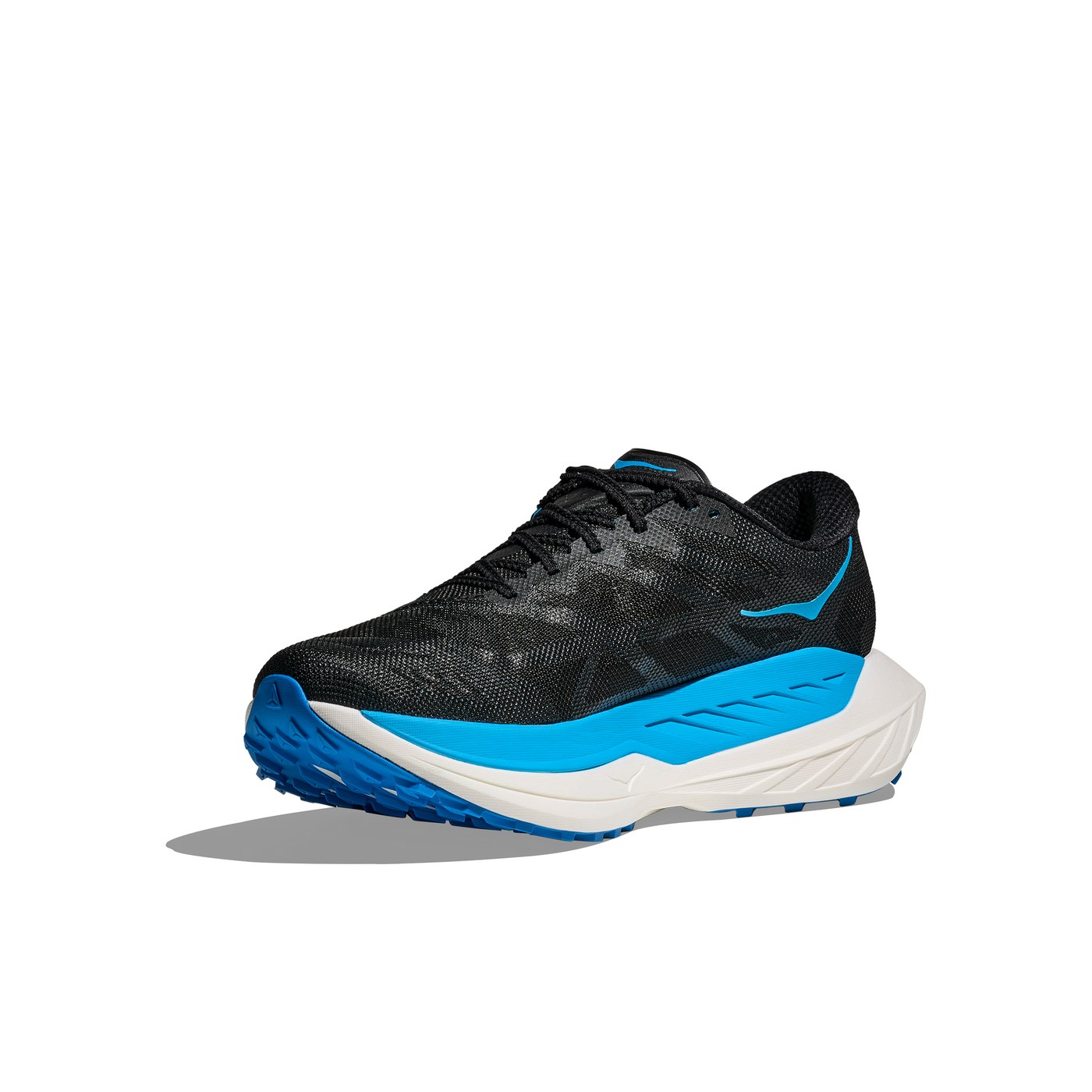
© Hoka, official photo used for editorial purposes
The flaw that really limits its use in France: 3 mm lugs with no Vibram
In a French market where a good share of trail runs happen on mixed terrain, often wet for much of the year, 3 mm lugs with neither Vibram nor Contagrip rubber are a real limitation, not a spec sheet detail. For comparison, the Speedgoat 7 packs 5 mm Vibram Megagrip lugs, and most technical trail shoes on the market sit between 4 and 6 mm. The off-camber slip one tester reported on a muddy section isn't an isolated accident: it follows directly from this design choice, which Hoka made to cut weight and keep the shoe's road spirit.
The flaw that raises the most questions about the price: no Vibram, no Matryx, at 225 €
Both field testers voice the same reservation in similar words: at 225 €, the combined absence of a Vibram outsole and a reinforced Matryx upper is hard to justify. The Tecton X 3, the Rocket X Trail's technological sibling at Hoka, has both for a similar price. One tester sums up the product's tension bluntly: the shoe justifies its price through its performance on the terrain it was designed for, but not through its materials, which belong to a lower segment.
Rocket X Trail vs Tecton X 3: which Hoka carbon trail shoe should you pick?
| Criterion | Rocket X Trail | Tecton X 3 |
| Measured weight | 248 g | 283 g (claimed) |
| Outsole | Proprietary rubber, no Vibram | Vibram Megagrip |
| Upper | Simple nylon mesh | Reinforced Matryx, integrated bootie |
| Foam | A-TPU | PEBA |
| Target terrain | Runnable, dry, compact | Technical, mountain, mixed |
The simple reading: the Rocket X Trail is faster on runnable ground and lighter, but the Tecton X 3 protects your foot better and holds up on more types of terrain thanks to its rubber and reinforced upper. If you mostly race trail marathons or non-technical ultras, the Rocket X Trail is the smarter pick. If you regularly tackle technical mountain terrain, you're better off sticking with the Tecton X 3, even if it costs you a few grams.
Rocket X Trail vs Nike ACG Ultrafly 2 and On Cloudultra Pro
| Criterion | Rocket X Trail | Nike ACG Ultrafly 2 | On Cloudultra Pro |
| Foam | A-TPU | ZoomX | Dual-density Helion HF |
| Outsole | No Vibram | Vibram Megagrip | Missiongrip |
| Price | 225 € | about 245 € | about 270 € |
| Positioning | Runnable and dry only | Versatile long distance | Versatile elite ultra |
Against these two direct rivals, the Rocket X Trail is the cheapest and the lightest, but also the only one of the three that skips Vibram rubber entirely. The decision rule is simple: if your target course mixes terrain types, the Ultrafly 2 or the Cloudultra Pro cover more scenarios for a modest extra cost. If the course stays runnable from start to finish, the Rocket X Trail makes more targeted use of every euro you spend.
Pros
- Measured weight of 248 g, 20 g under the manufacturer's claim
- Propulsion and efficiency rated better than a classic PEBA by all three sources we read
- Widened heel base that offsets a high stack (36/42 mm)
- Real elite track record over 160 km ultras (Hardrock 100, two wins)
Cons
- 3 mm lugs with no Vibram, documented slip on greasy off-camber ground
- Weak heel hold, extra lacing eyelet almost mandatory
- Neither Vibram nor Matryx at 225 €, unlike the similarly priced Tecton X 3
- 12 g manufacturing difference recorded between the two shoes of one tested pair
Grip and durability: what the price per kilometer is really worth
No independent tester has yet logged several hundred kilometers in this specific shoe: it came out in early September 2025 and the tests available so far are limited to a few runs per tester, with no wear reported over that time. Based on the lack of reported degradation after the 160 km of Hardrock 100 that Ludovic Pommeret covered in a single pair, and on the consensus of available tests showing no sign of premature wear, a cautious estimate puts the lifespan of the A-TPU sole in a 350 to 450 km range, in line with the carbon trail segment average. On that basis, the cost per kilometer lands between 0.50 € and 0.64 €, at the upper end of the average for carbon-plated trail shoes, without the benefit of Vibram rubber, generally associated with better abrasion resistance on rock.
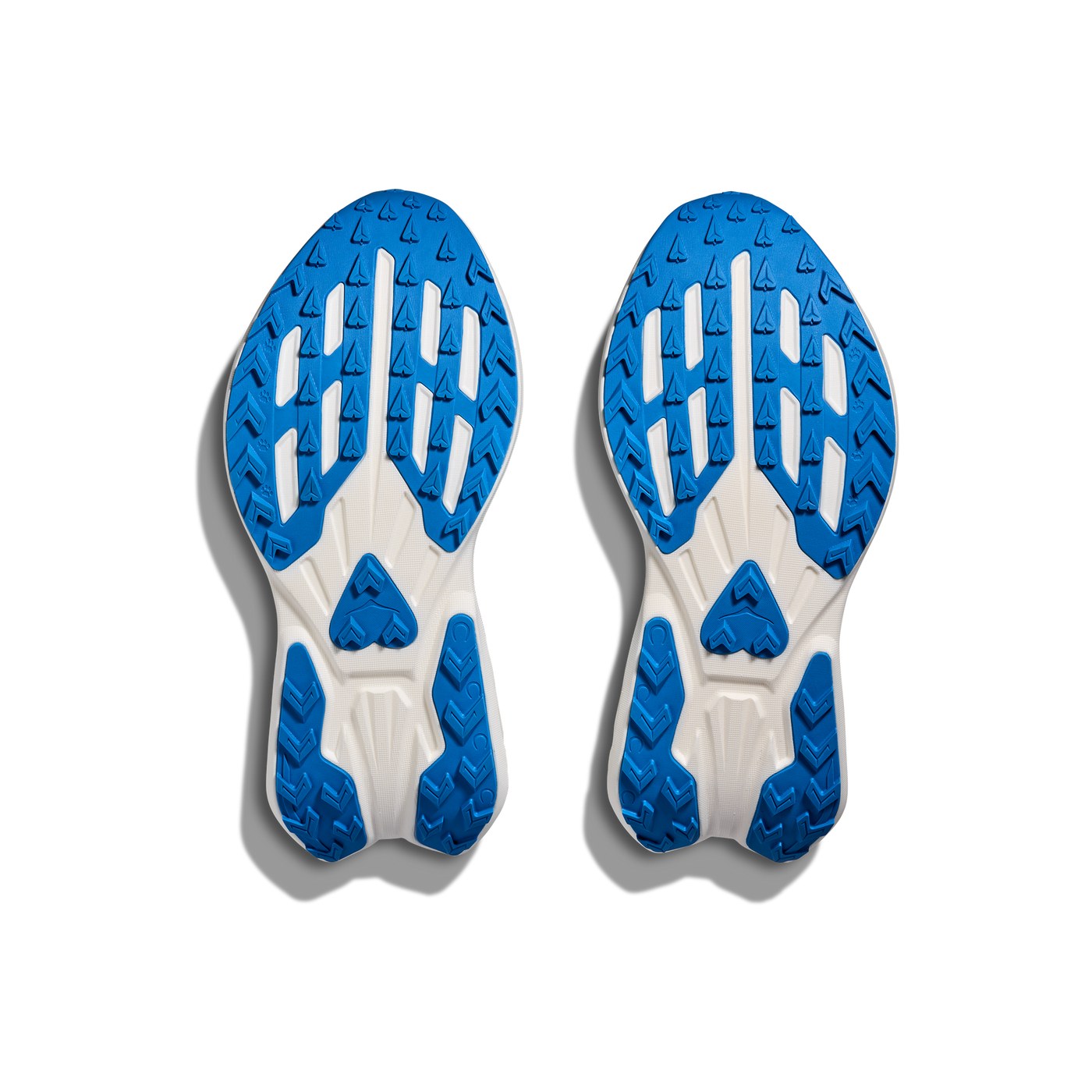
© Hoka, official photo used for editorial purposes
Our field verdict: who does the Rocket X Trail really make sense for?
The Rocket X Trail targets a precise profile: the trail runner who already knows how a carbon-plated shoe feels and who logs most of their volume on runnable, dry courses with few technical sections. On a trail marathon like the Trail du Saint-Jacques, an Alsace UTMB or an EcoTrail, or on the runnable stretches of a CCC for an experienced runner, it delivers on its promises. On the GR20 or an alpine skyrace, it's out of its depth.
To fit such a specialized shoe into a serious training block, the key is to save it for the sessions that match its favorite terrain: threshold runs on runnable trails, track intervals, or the fast portions of an ultra long run. RunMorph's trail training plans include this kind of targeted session so you never take a shoe out of its comfort zone. Discover RunMorph's training plans to structure your fast runs without sacrificing your technical terrain sessions.
The RunMorph Coach's verdict
The Rocket X Trail makes a precise promise and keeps it well: on runnable, dry terrain, the combination of A-TPU and an H-shaped carbon plate delivers a feeling of efficiency few trail shoes offer today, with a measured weight of 248 g that puts it among the lightest in its category at Hoka. The overall score of 7.8/10 weighs this technical success against two concrete realities: 3 mm lugs that restrict it to specific weather and terrain, and a 225 € price tag that comes with neither Vibram nor Matryx, unlike its own technological sibling, the Tecton X 3. This is not a general-purpose trail shoe. It's a performance tool for a narrow niche, reserved for runners who know exactly why they're buying it.
Key takeaways for your training
- 248 g measured: 20 g less than the 268 g Hoka claims, a rarity in a segment where the opposite is more common.
- 3 mm lugs, no Vibram: keep this pair for dry, runnable trails, not for rainy days.
- 225 € without Vibram or Matryx: always compare with the Tecton X 3's price before buying if versatility matters to you.
- Heel base about 1 cm wider than the Tecton X 3: that's what stabilizes a 36/42 mm stack.
- Extra lacing eyelet almost mandatory to lock down a naturally loose heel.
Frequently asked questions about the Hoka Rocket X Trail
Is the Hoka Rocket X Trail suitable for beginner trail runners?
No. A carbon plate combined with lugs of only 3 mm requires well-established running technique. A runner with less than 2 years of trail experience is better off choosing a more versatile model before investing 225 € in this pair.
What is the Rocket X Trail's real weight compared with Hoka's claim?
Two independent testers measured 248 g in EU size 42 2/3, against the 268 g listed on Hoka's US spec sheet, a 20 g gap (-7.5 %) in favor of the actual product.
Does the Rocket X Trail hold up on muddy terrain?
No: the 3 mm lugs, with no Vibram rubber, caused a documented off-camber slip on a muddy section during a field test. It's designed for dry, runnable ground.
Should you buy the Rocket X Trail in your usual size?
All three sources consulted describe the forefoot as roomy, and one of the testers explicitly recommends going half a size down from your usual size.
What's the difference between the Rocket X Trail and the Tecton X 3?
The Rocket X Trail weighs 35 g less (248 g vs 283 g claimed) but gives up the Vibram rubber and Matryx upper the Tecton X 3 keeps, at a comparable price of around 225 to 230 €.
© Hoka, official photo used for editorial purposes