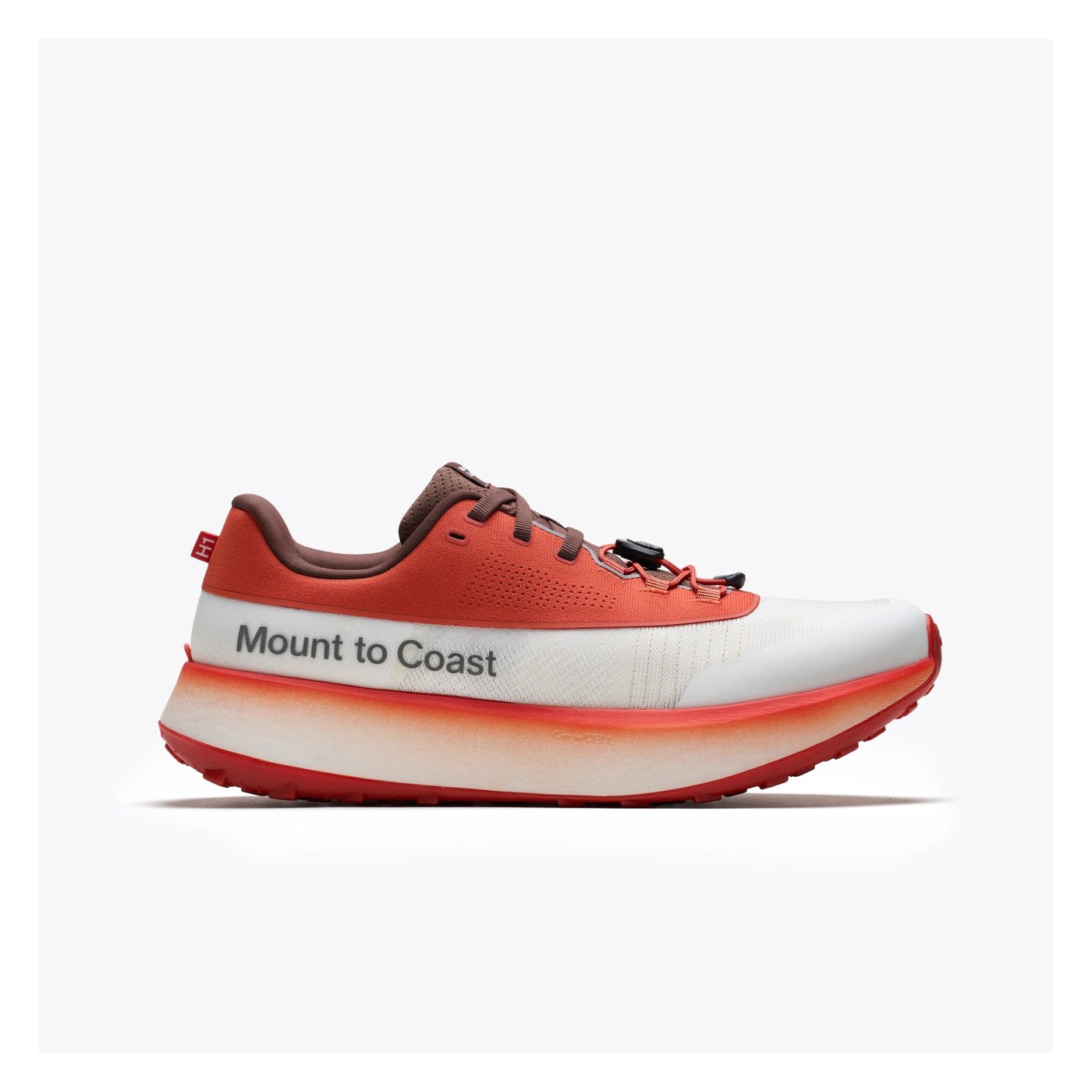
Jamil Coury raced among the best on Arizona's trails before founding Mount to Coast with one obsession: building the shoe that follows the runner everywhere, from morning asphalt to evening trails, without ever forcing a compromise. The H1 is the first result of that promise. At €170, with 242 g on the scale and bio-based CircleCELL foam, it has landed on the French market without fanfare. We tested it on road and trail for several weeks to see if it delivers on its claims.
Mount to Coast H1 Review: Bio-Based Road-to-Trail Built to Last
8/10
The essentials in 3 sentences
CircleCELL foam delivers dense, bouncy cushioning with a claimed lifespan twice that of standard PEBA. The TUNEDFIT dual lacing and aramid-fiber upper lock the foot in precisely on any terrain. The VersaGrip outsole (2 mm lugs) excels on runnable trails and wet pavement, but hits its limits in deep mud or on rocks.
8
/ 10 · RunMorph overall score
Who is it for?Versatile road-and-trail runners, ultra-distance fans, eco-conscious runners who refuse to sacrifice performance.
Who should skip it?Highly technical terrain (scree, mud), racers looking for a carbon super shoe, severe overpronators who need strong support.
The H1: a bio-based foam that redefines durability
Mount to Coast's main selling point fits in one word: CircleCELL. This foam is made from organic waste (about 9 kg per pair), which puts it in a class of its own in a market dominated by petroleum-based PEBA and EVA. The difference doesn't stop there. Mount to Coast claims twice the lifespan of standard PEBA when it comes to retaining its cushioning properties. In practical terms, where a standard PEBA starts to pack out around 600-800 km, CircleCELL would hold its properties beyond 1,000 km, according to the brand's internal data. That's hard to verify over a few weeks of testing, but after roughly 200 km in total, the foam showed no sign of breaking down.
With a stack height of 35 mm at the heel and 29 mm at the forefoot (6 mm drop), the H1 sits in the well-cushioned category without tipping into maximalism. It feels like a stable, comfortable platform, with noticeable bounce that never gets excessive. For the runner who heads out for a 3 h mixed-terrain long run with 400 m of elevation gain, that's exactly the balance you want.
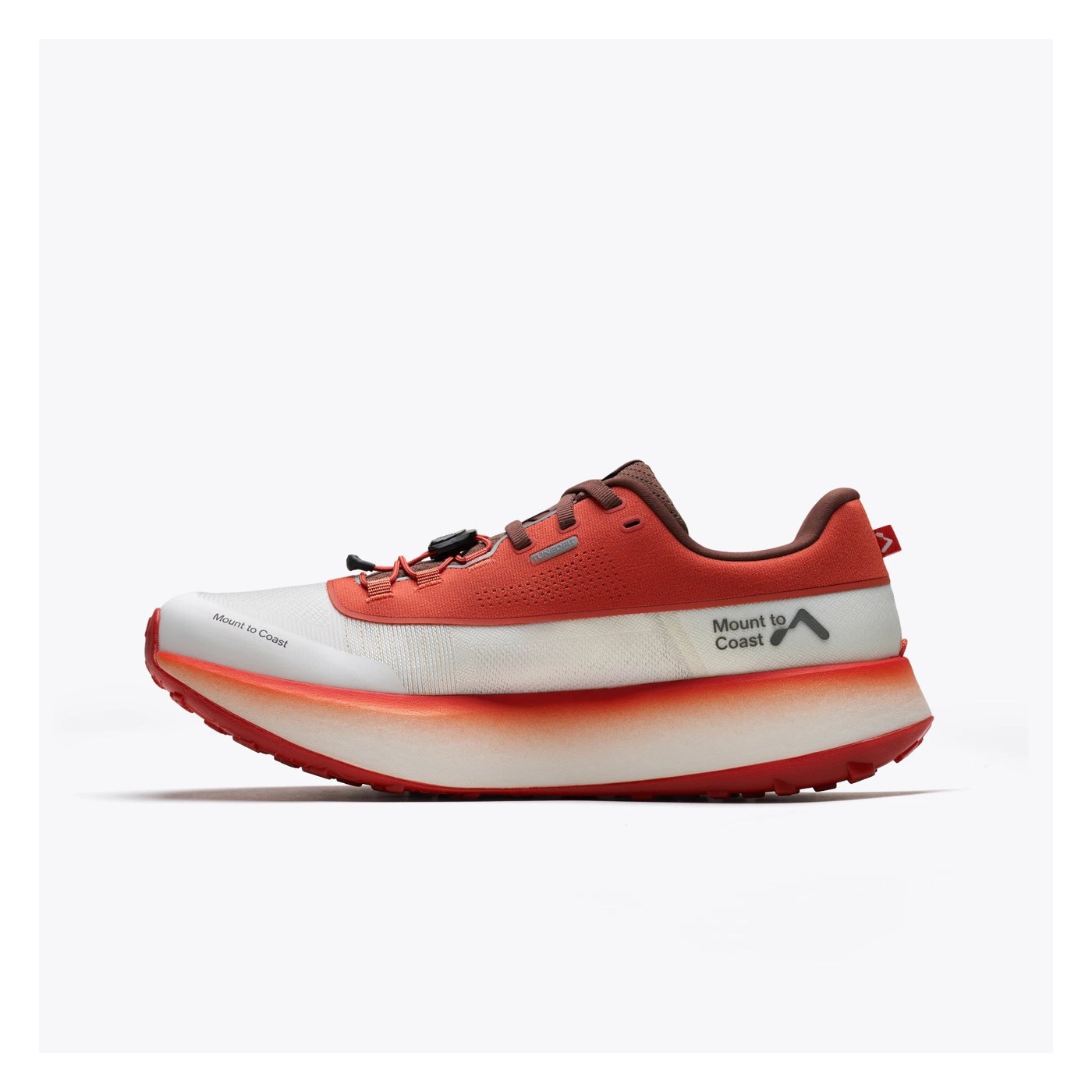
© Mount to Coast, official photo used for editorial purposes
RunMorph tip: the H1 is built for versatile long runs of 15 to 30 km with moderate elevation gain. If you run mostly on road with a few trail sections, it can replace both a trail pair and a road pair, and do the job better. If your usual terrain is technical, pair it with a model that has more aggressive lugs.
Objective technical data
| Feature | Value |
|---|---|
| Weight (EU 43) | 242 g |
| Heel / forefoot stack | 35 mm / 29 mm |
| Drop | 6 mm |
| Foam | CircleCELL (bio-based, 9 kg of organic waste per pair) |
| Outsole | VersaGrip, 2 mm lugs |
| Lacing system | TUNEDFIT (dual zone, independent laces) |
| Upper | Aramid fiber (Kevlar) + breathable mesh |
| Use | Road-to-trail (mixed) |
| Suggested price | €170 |
| Availability in France | Official website, Alltricks, Ekosport, Snowleader |
Who is the Mount to Coast H1 for?
The versatile runner who hates switching pairs
If your week mixes towpaths, forest tracks and country roads, the H1 was designed for you. Its VersaGrip outsole with 2 mm lugs offers decent grip on all these surfaces, and the shoe doesn't turn uncomfortable on asphalt (rarely the case with an aggressive trail shoe). You move from one surface to the next without losing comfort or traction.
The eco-conscious runner who won't give up performance
Bio-based CircleCELL is no marketing gimmick. It delivers perceived cushioning on par with the best PEBA foams on the market while cutting the carbon footprint of manufacturing. If the claimed durability holds up beyond 1,000 km, the life-cycle math becomes clearly favorable. For runners who count their pairs each year and wear them until they're worn out, that's a concrete argument.
The runnable-trail runner (15-30 km, moderate elevation gain)
Woodland paths, grassy ridgelines, gravel sections: this is where the H1 excels. The 2 mm lugs bite well enough on dry or slightly damp ground. For a 20-25 km run with 400-600 m of elevation gain, it will be more at home than on an alpine trail with scree and heavy mud.
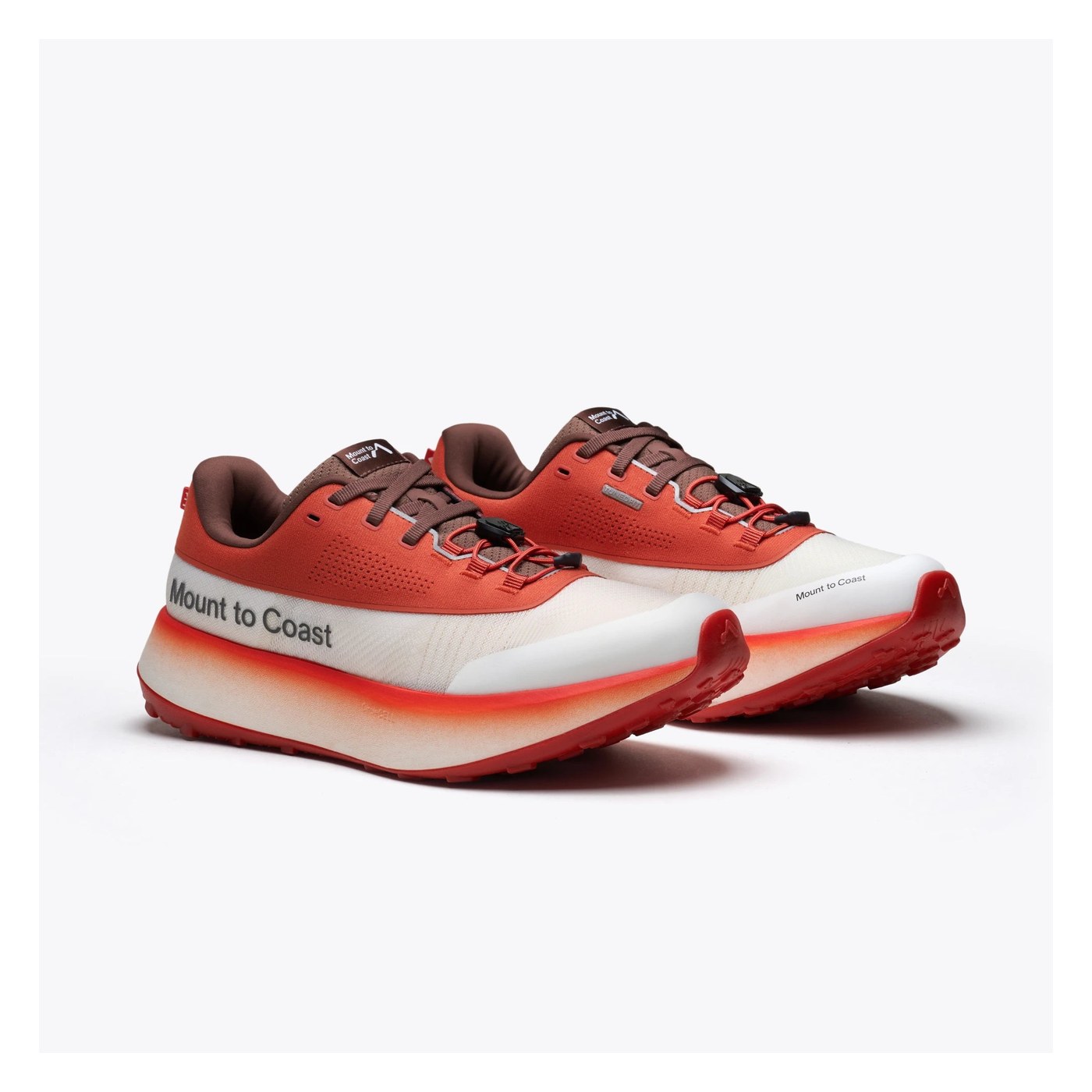
© Mount to Coast, official photo used for editorial purposes
Comfort, CircleCELL cushioning and behavior on terrain
First lace-up, first stride: the H1 surprises with the density of its CircleCELL foam. It isn't soft like a max-cushion shoe, but it isn't firm like a speed model either. The feel is close to a mid-range PEBA, with a clear rebound and no perceptible "lag" phase. It often gets compared to a Hoka Challenger for cushioning, but with a lower platform and therefore better proprioception.
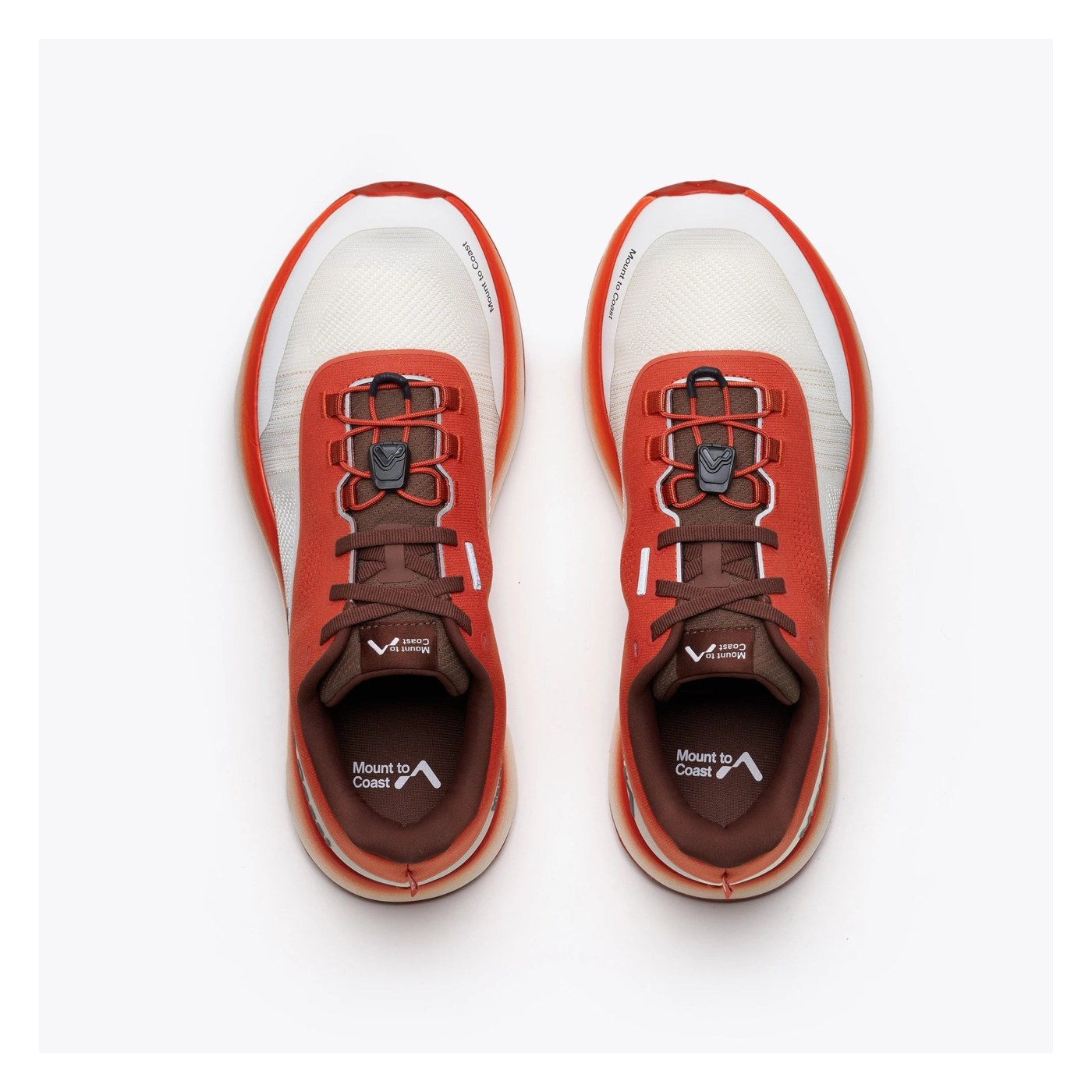
The TUNEDFIT system deserves its own paragraph. Two independent lacing zones (forefoot and midfoot/heel) let you adjust tension to your foot shape. A runner with a narrow heel and a wide forefoot can dial in both zones precisely without restricting circulation or creating pressure points. Tested on a 3 h run with 500 m of elevation gain: no hot spots.
The aramid-fiber upper (the same material used in bulletproof vests and some performance tires) provides well-above-average resistance to lateral abrasion. The mesh stays breathable enough to prevent overheating in summer, and the aramid reinforcement keeps stones and twigs out of the upper without weighing down the build.
Identified weak point: the VersaGrip's 2 mm lugs. On waterlogged ground, heavy clay or slushy snow, the H1 lets go where a more aggressive trail shoe would still hold. For 80% of typical races or mixed-terrain runs, that's enough. But if you regularly head out on long-distance hiking trails in wet weather, plan on an alternative.
Mount to Coast H1 vs. the competition: the comparison
| Model | Weight (EU 43) | Drop | Heel stack | Use | Price |
|---|---|---|---|---|---|
| Mount to Coast H1 | 242 g | 6 mm | 35 mm | Mixed road-trail | €170 |
| Hoka Challenger 7 | 263 g | 5 mm | 37 mm | Mixed trail | €145 |
| Merrell Morphlite | 220 g | 8 mm | 28 mm | Door-to-trail | €130 |
| Salomon Genesis | 270 g | 6 mm | 36 mm | Versatile trail | €145 |
| Inov-8 TrailFly Max V2 | 258 g | 4 mm | 38 mm | Max-cushion trail | €165 |
The H1 sits between the Merrell Morphlite (lighter, less cushioned, better on pure asphalt) and the Hoka Challenger 7 (slightly heavier, higher stack, a bit more trail-oriented). What sets it apart is the bio-based foam and TUNEDFIT, two technologies its direct competitors lack. At €170, it's priced like a high-end trail shoe but offers the versatility of a hybrid. Against the Salomon Genesis, the Salomon has better grip on technical descents, but the H1 takes back the edge in comfort over long road distances.
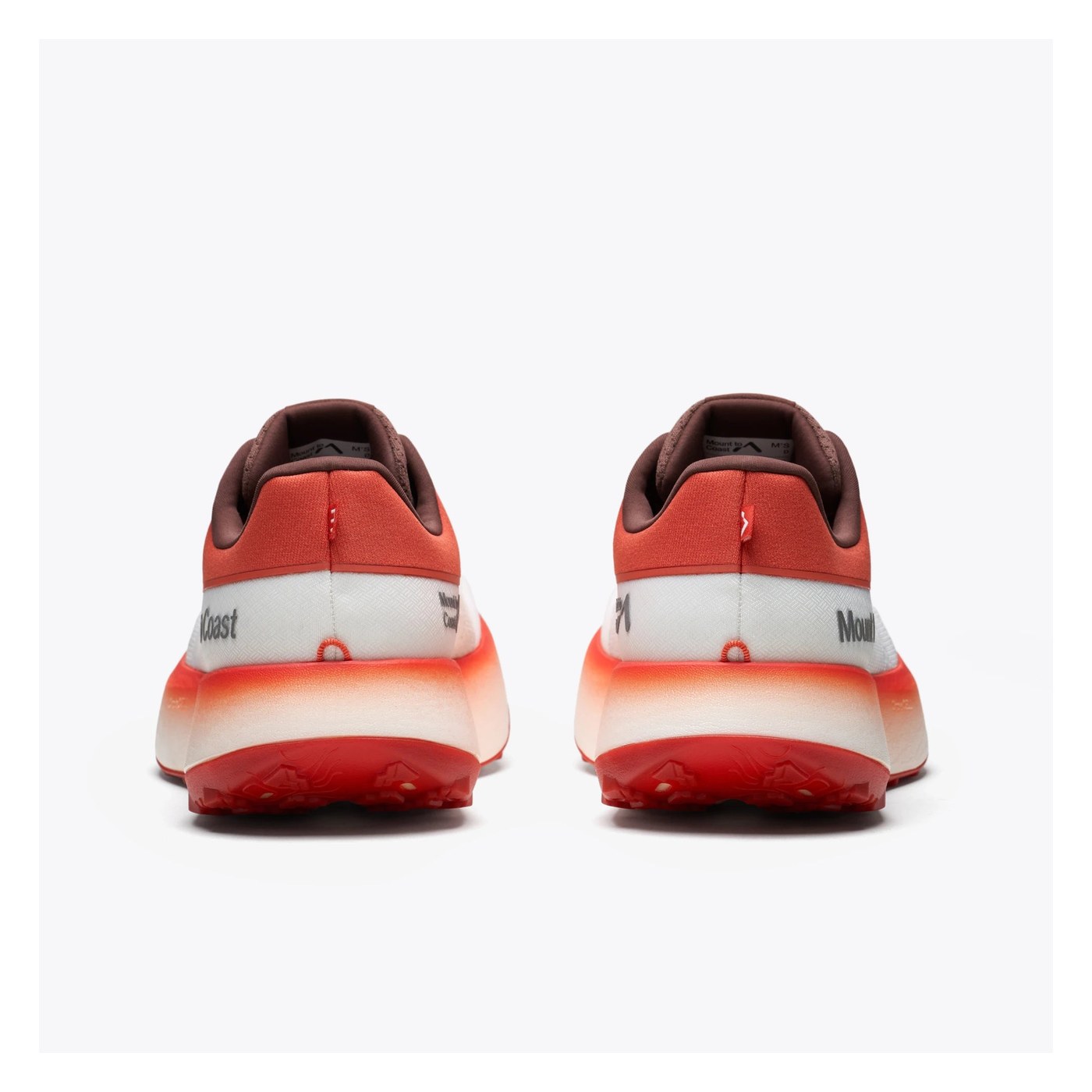
© Mount to Coast, official photo used for editorial purposes
Pros
- Bio-based CircleCELL foam, superior durability
- Very precise TUNEDFIT dual lacing
- Abrasion-resistant aramid upper
- 242 g: light for a cushioned hybrid
- Road-to-trail versatility with no major compromise
Cons
- 2 mm VersaGrip lugs struggle in mud or technical terrain
- Brand still little known in France (customer service yet to be tested)
- €170: a premium price for a brand's first shoe
- 6 mm drop: may throw off zero-drop regulars
How to fit the Mount to Coast H1 into your RunMorph training plan
The H1 is a volume shoe. It shines on long runs of 1 hour 30 minutes to 3 hours, at a moderate to comfortable pace (zones 1 and 2). Its 6 mm drop and 35 mm stack make it an ideal tool for active recovery easy runs in the woods or for the long specific runs of a training block. It's less suited to quality track sessions or short road intervals, where a more responsive shoe is the better call.
Sample versatile week with the H1: Monday recovery (5-8 km, asphalt), Wednesday mixed long run (18-22 km, 300-500 m of elevation gain), Saturday moderate trail run (12-15 km, 400 m of elevation gain). The H1 handles all three without a shoe change. For tempo sessions or 10 km races, go with a lighter road shoe.
RunMorph Coach's verdict
8/10
The Mount to Coast H1 is a success for a first shoe. It doesn't try to do everything; it tries to do everything well within its lane: comfortable road-to-trail running over long distances. Bio-based CircleCELL is a genuine innovation, TUNEDFIT is a real plus for atypical feet, and the 242 g never weighs on you over the long haul. It loses a few points on grip in sloppy terrain and on the brand's still-emerging profile in France. But if you're looking for a durable, light, well-built hybrid shoe at €170, the H1 clearly deserves your consideration.
© Mount to Coast, official photo used for editorial purposes
Key takeaways for your training
- Bio-based CircleCELL offers dense cushioning and a claimed durability of 1,000+ km, better than standard PEBA.
- TUNEDFIT (independent dual lacing) allows precise zone-by-zone adjustment, ideal for asymmetrical feet or feet whose volume varies.
- The VersaGrip outsole (2 mm) is enough on runnable trails, but hits its limits in deep mud or very technical terrain.
- At 242 g with a 6 mm drop and 35 mm of stack, the H1 fits perfectly into a weekly volume program (mixed Z1-Z2 runs).
- Available at Alltricks, Ekosport and Snowleader for €170, it offers good value for its lifespan compared with its direct competitors.