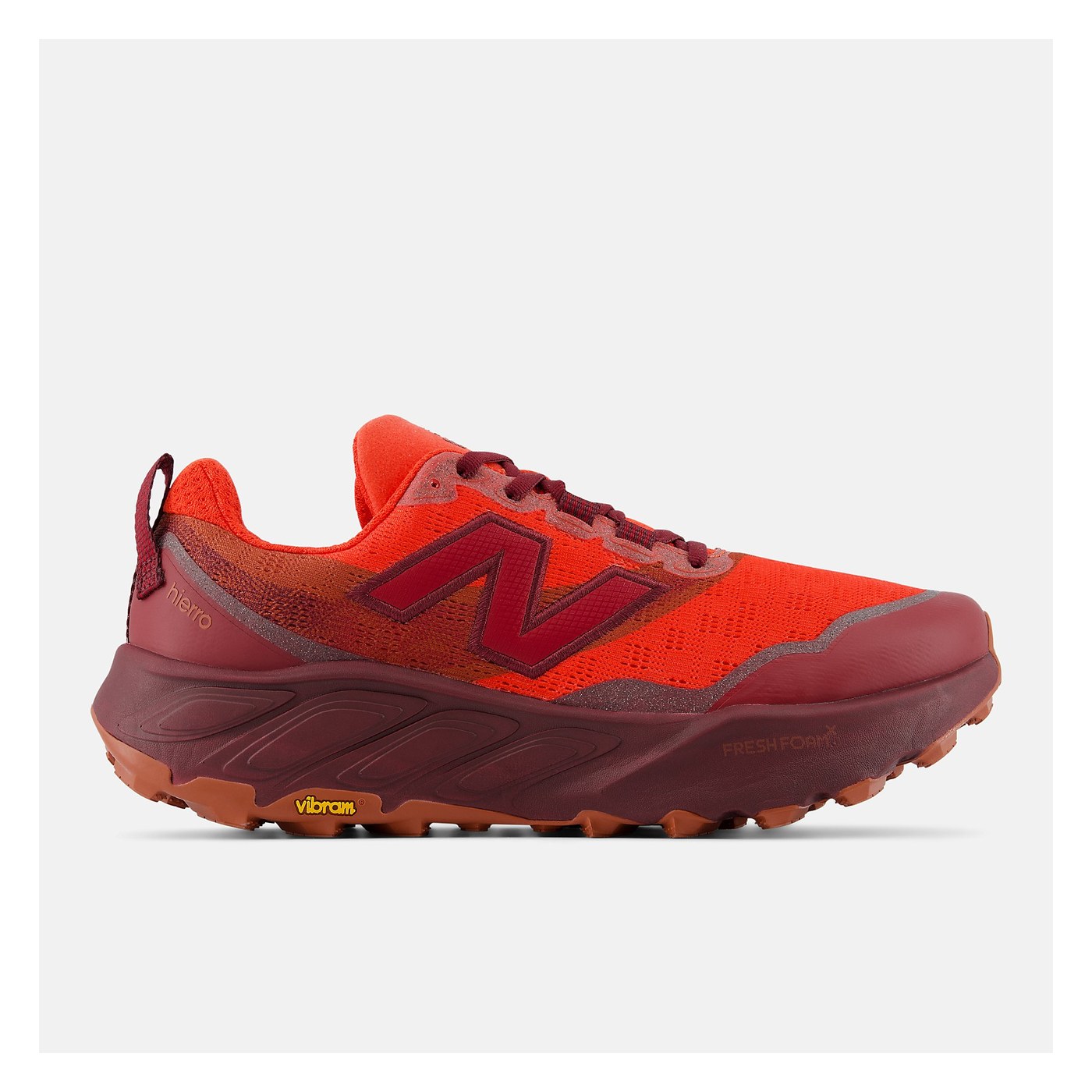
The Hierro is New Balance's best-selling max-cushion trail shoe. For version 9, the brand started from a blank page: a new Vibram Megagrip outsole with 6 mm lugs, a drop cut to 4 mm, and dual-density Fresh Foam X. Out on the trails, two independent testers weighed it at 304 and 309 g, under the 310 g New Balance claims. A gap in that direction is rare, but one number doesn't tell the whole story: the big outsole behind this outstanding grip also has its limits on off-camber ground.
© New Balance, official photo used for editorial purposes
New Balance Hierro v9: the max-cushion benchmark starts from scratch
The Hierro is New Balance's best-selling trail shoe, and by a wide margin. After a version 8 that had already shifted the formula without winning everyone over, the brand is billing version 9 as a complete overhaul rather than a simple update. The midsole moves to dual-density Fresh Foam X (firm close to the ground, softer under the foot), the drop falls from 6 to 4 mm, and the Vibram Megagrip outsole gets deeper 6 mm lugs, with small extra nubs for mud and wet ground. On paper, the goal is clear: stay the comfort and grip benchmark of the lineup without giving up stability, despite a very wide outsole base.
New Balance claims 310 g for its reference size. Two independent testers measured 304 g (at a press event organized by the brand) and 309 g (in personal use, EU 42.5), so 1 to 6 g under the claim. That kind of pleasant surprise is rare, but it doesn't make the Hierro v9 a light shoe: on this metric it still sits at the heavy end of the max-cushion trail pack.
RunMorph's advice: if you want a max-cushion shoe that's more stable on technical terrain, look at the Hoka Speedgoat 7 instead. The Hierro v9 shines on runnable, rolling trails, much less on rugged mountain ground.
New Balance Hierro v9: brand claims vs what was measured
| Metric | Claimed (New Balance) | Measured (independent tests) |
|---|
| Weight (men's, EU 42.5) | 310 g | 304 g and 309 g in two separate tests (-1 to -6 g) |
| Heel stack | 42 mm | 37 mm measured by one tester (-5 mm) |
| Drop | 4 mm | 4 mm (confirmed, consistent across sources) |
The stack gap deserves to be flagged, not smoothed over: only one tester measured the stack height, at 37 mm at the heel against the 42 mm claimed, so 5 mm less. RunMorph found no second independent measurement to confirm it: treat it with the usual caution for a single source, but it points the same way as the measured weight, under the claim.
© New Balance, official photo used for editorial purposes
Fit: roomy up front, locked down at the midfoot
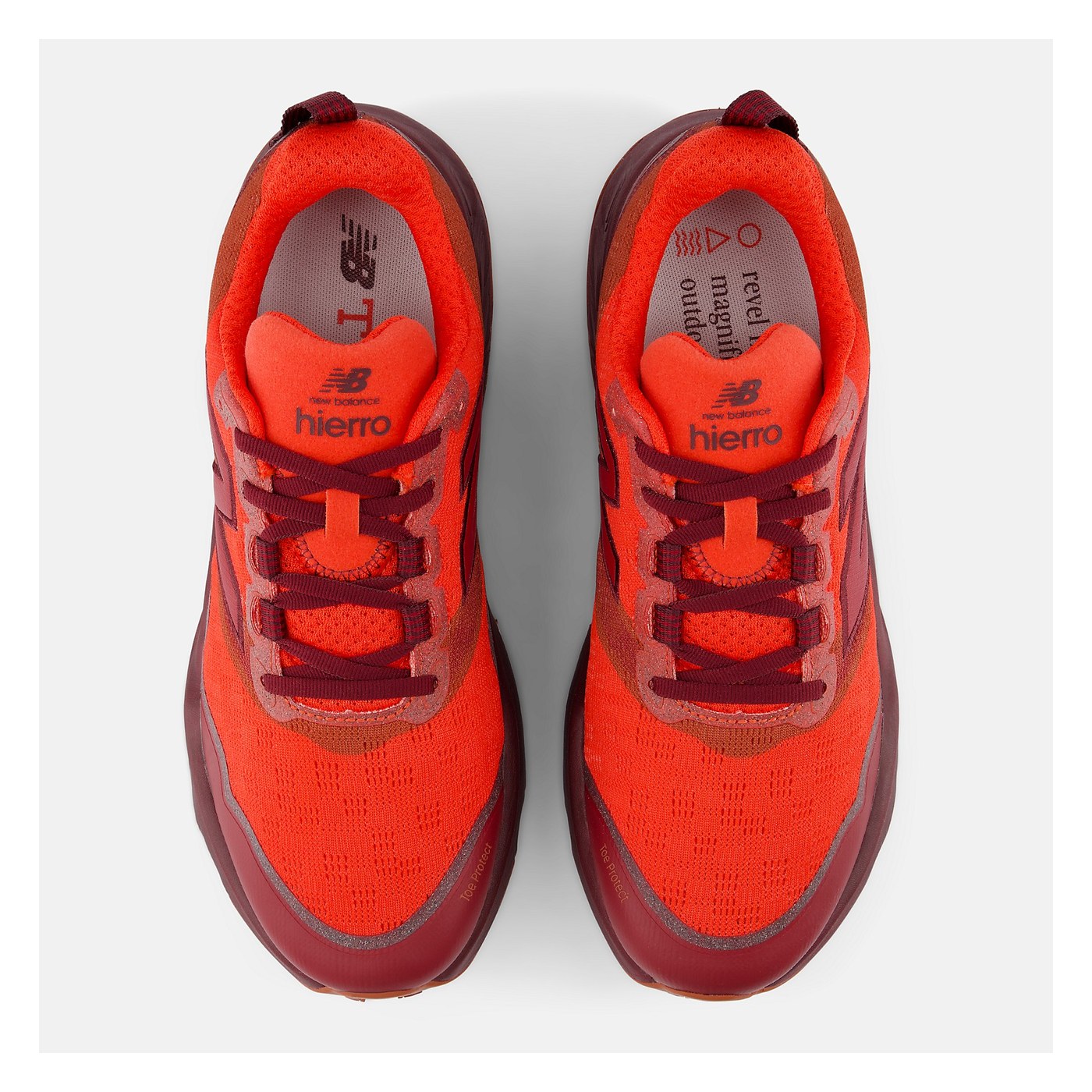
The upper is thick and padded, with a heel held firmly in a counter and an extended rock guard at the front. The fit is generous and the toe box lets your toes move freely, but the instep is held tight, a feeling some testers find excessive on first wear before it fades once you're running. Sizing runs small: two independent sources recommend going half a size up from your usual, especially for long runs when your feet swell.
On the trail: outstanding grip, stability with caveats
On grip, the two testers who ran the Hierro v9 on real trails agree without reservation: the Vibram Megagrip outsole bites just as well on dry, dusty ground as on descents, and the 6 mm lugs with micro-nubs inspire confidence on technical sections. One source says it couldn't test in very wet or greasy conditions, but expects good grip there too, in line with the rest of its observations. Thirty runners at a group test in the Meudon forest, on a loop mixing climbs, descents and muddy ground, backed up that impression over nine kilometers of varied trails.
On cushioning, the dual-density Fresh Foam X delivers: clear comfort, a stable feel underfoot, and no sense of the foam bottoming out. The pronounced rocker helps you roll through your stride on runnable, rolling terrain, to the point that one tester forgot about the claimed weight.
Flaw #1: stability that gives way on off-camber ground
One tester reports feeling the shoe "slide out sideways underfoot" on broken ground with rocks and roots, despite the good upper lockdown and the outsole's very solid grip. It's a classic limitation of max-cushion shoes with a wide base, but it partly contradicts the improved stability the brand is pushing for version 9. Keep it for runnable to moderately technical terrain rather than very rugged high mountains.
Flaw #2: weight still at the heavy end of the segment despite the favorable gap
Even measured under the claim (304 to 309 g), the Hierro v9 is one of the heaviest shoes in its category. According to field feedback, the rocker and cushioning mask it while you run, but the raw number remains a weak point against lighter max-cushion rivals.
Which paces it handles, and where it falls off
Easy runs and base endurance: completely at home, this is the shoe's main playground thanks to the generous cushioning and the rocker.
Long runs and ultra: a strength confirmed by both field testers, with protection and comfort that hold up over time.
Trail marathon pace on runnable ground: good running economy thanks to the pronounced rocker, without being a pure performance shoe.
Short, fast trail runs: not the model's strong suit, the weight and the comfort-first cushioning take the edge off its responsiveness.
Technical terrain with off-camber sections: this is the real limit identified on the trail, avoid it on very rugged sections and when traversing slopes.
New Balance Hierro v9 vs Hierro v8: should you upgrade?
| Criterion | Hierro v8 | Hierro v9 |
|---|
| Drop | 6 mm | 4 mm |
| Lugs | Smaller, flexible | 6 mm, micro-nubs, deeper |
| Weight | Lighter | +roughly 15 to 50 g depending on the source |
| Positioning | Versatile, short to mid distances | Max cushion, long distances and ultra |
Who should upgrade: runners targeting ultras who want maximum protection and grip. Who can stick with the old one: those who used the v8 for short to moderately technical trail runs where responsiveness mattered more than pure comfort.
New Balance Hierro v9 vs Hoka Speedgoat 7 vs Asics Trabuco Max 5: the comparison
| Model | Weight | Drop | Outsole | Price |
|---|
| New Balance Hierro v9 | 310 g claimed / 304-309 g measured | 4 mm | Vibram Megagrip 6 mm | 160 € |
| Hoka Speedgoat 7 | 286 g | 4 mm | Vibram Megagrip | 165 € |
| Asics Trabuco Max 5 | 296 g | 8 mm | AHARPLUS | 170 € |
The short version: the Hierro v9 is the cheapest of the three but also the heaviest, even with the favorable measured gap. On pure grip, it matches the Speedgoat 7 thanks to its Vibram Megagrip outsole. On stability over technical terrain, the Speedgoat 7 keeps the edge based on the cross-checked feedback from both tests. For runnable trails and long runs on a tighter budget, the Hierro v9 remains a smart pick.
How to fit the Hierro v9 into your RunMorph training plan
The Hierro v9 belongs on the long runs of your RunMorph trail plan, especially in ultra-prep blocks where comfort and grip matter more than pure speed. Use it for weekend long runs and base endurance runs on runnable trails, and keep a lighter, more stable pair for speed sessions or very rugged routes with lots of off-camber ground.
RunMorph Coach verdict
The New Balance Hierro v9 lives up to its reputation as a reliable partner for long distances: the Vibram Megagrip grip and dual-density cushioning are where you'd expect them, and for once the measured weight comes in slightly under the claim. But the promise of improved stability doesn't fully hold up on the trail: one independent tester clearly felt the shoe let go on off-camber ground, despite the wide outsole base. For runnable terrain and ultras on not-too-technical trails, it remains a safe bet. For rugged high mountains, look elsewhere. 7.9/10.
FAQ
What is the real weight of the New Balance Hierro v9?
New Balance claims 310 g for its men's reference size. Two independent tests measured 304 g and 309 g, so 1 to 6 g less than claimed.
Is the Hierro v9 suited to ultras?
Yes, that's its home turf: both field tests highlight its comfort and protection over long distances.
What grip, and for which terrain?
6 mm Vibram Megagrip lugs with micro-nubs: excellent on dry, dusty ground and on descents, but limited stability on steep off-camber sections.
How much does the New Balance Hierro v9 cost?
160 €, which is 5 to 10 € less than its direct rivals, the Hoka Speedgoat 7 (165 €) and the Asics Trabuco Max 5 (170 €).