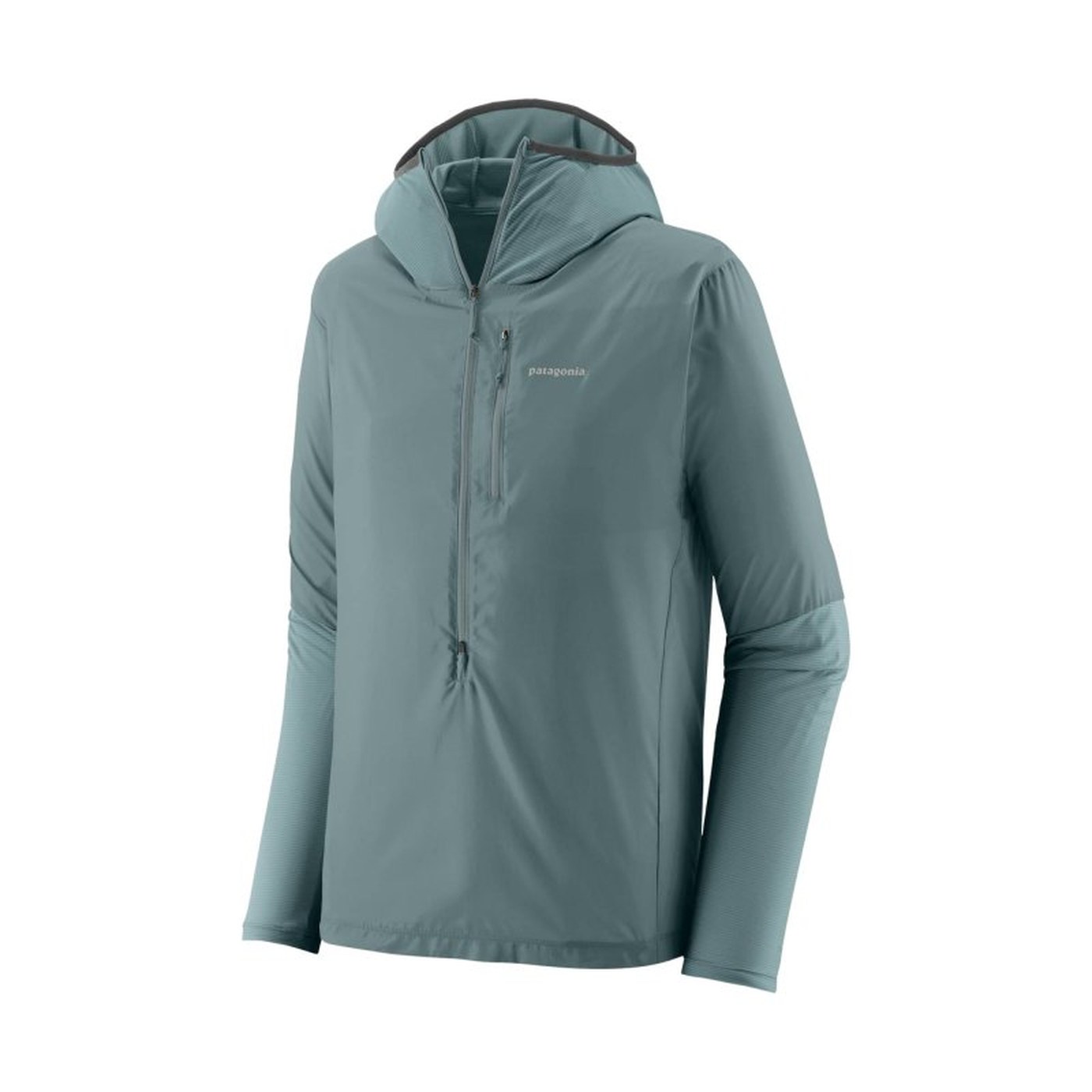
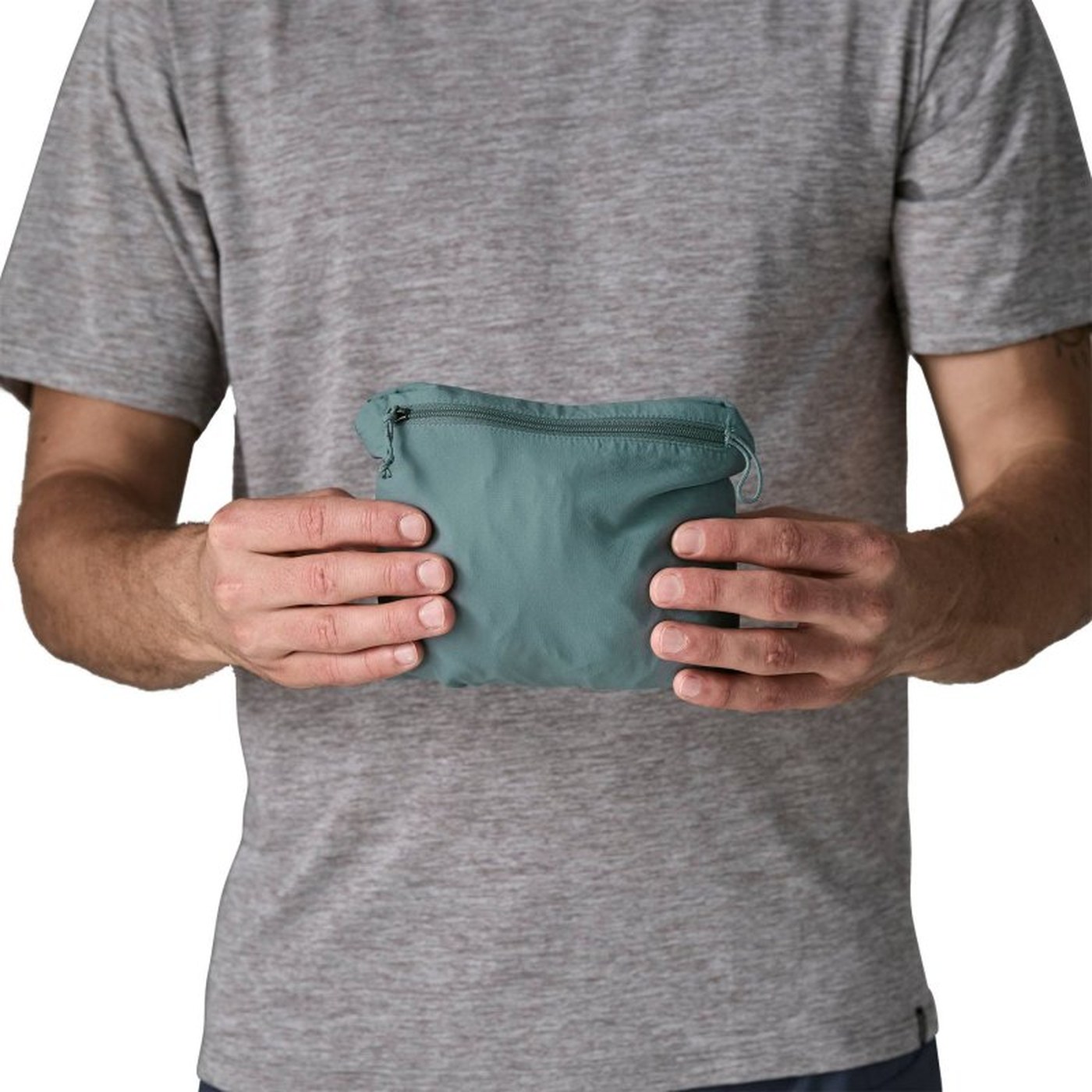
105 grams, a hood, a pocket that doubles as a stuff sack. On paper, the Patagonia Airshed Pro ticks every box a trail runner wants from a packable windbreaker. Except it isn't really one: only the torso blocks the wind, while the arms and hood let everything through. And that's exactly why some runners live in it all winter.
© Patagonia, official photo used for editorial purposes
Patagonia Airshed Pro: a T-shirt that blocks the wind, not a jacket
Patagonia files the Airshed Pro under its mountain running range, next to the Houdini Air Jacket. The two pieces don't do the same job. The Houdini protects. The Airshed Pro gets worn.
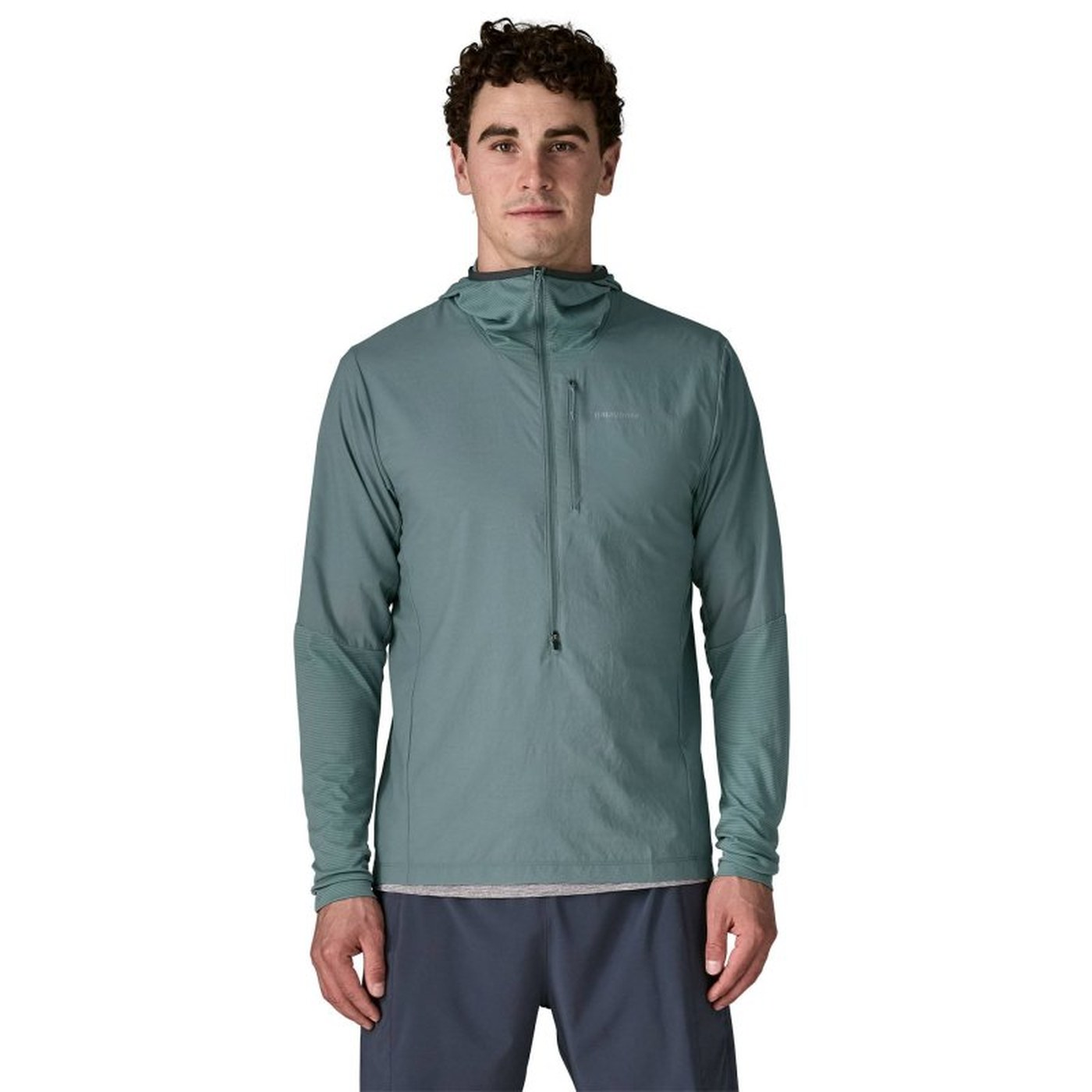
The idea fits in one sentence. A stretch woven fabric, 100% recycled polyester with a PFC-free water-repellent finish, covers the chest, back and shoulders. The forearms and hood switch to a thin Capilene knit, the fabric Patagonia uses for its base layers. Once it's on, you get a technical T-shirt with a windproof front panel.
That choice comes at a cost. It makes the Airshed Pro excellent when you run fast in cold air, and disappointing as soon as a crosswind picks up or drizzle sets in. This whole review revolves around that trade-off.
RunMorph's advice: if you're torn between the Airshed Pro and the Houdini Air, ask yourself one question. Do you want a layer you keep on for two hours, or protection you pull out at the summit? For the first, the Airshed Pro. For the second, the Houdini Air. And for rain, neither: go for a Salomon Bonatti Trail.
At 105 g, the Airshed Pro sits right in the average for packable windbreakers. That's 3 g more than the Houdini Air (102 g) and 33 g less than the Kiprun Run 900 Wind (138 g in size L).
Claimed vs measured: from 99 to 128 g depending on who weighs it
The real weight varies more than the spec sheet suggests. Three readings are out there, on different sizes and generations.
| Data point | Claimed | Measured |
|---|
| Weight (men's M) | 105 g | 99 g, weighed by a North American tester after two months of use |
| Weight (size not stated) | 105 g | 113 g, weighed by French magazine Journal du Trail |
| Weight (men's M, previous generation) | 105 g | 128 g, lab measurement |
| Wind protection | "Windbreaker" | Torso only: sleeves and hood let air through in the hair-dryer test |
Bottom line: count on 100 to 130 g depending on your size and production year. The most telling gap isn't the weight. It's the word "windbreaker", true for the torso and false for the arms.
© Patagonia, official photo used for editorial purposes
Field test: between 1 and 6 °C, from 10 km runs to multi-hour outings
Four published tests feed this review. Journal du Trail wore it in the Écrins, a North American tester through two months of trail running, hiking and cross-country skiing. On top of those come a running-jacket comparison bench and a British ultrarunner on 10 km runs. None lasted more than a few months. So nobody has long-term data on wear after several winters.
On one point, all four agree: comfort. Journal du Trail calls it a real success and says they pulled it on whenever they needed extra warmth crossing a pass. The comparison bench ranks it among the most pleasant jackets in its line-up, with a hood so snug it replaces a beanie in cool weather.
The use window is fairly clear. The North American tester wore it between 1 and 6 °C, at a hard trail pace. An hour of running deliberately overdressed didn't soak it. Their back still ended up wet under the hydration vest, and the fabric dried quickly afterwards.
The disagreement is about breathability. For that tester, it's one of the most breathable windbreakers they've worn. The comparison bench is more cautious: the close fit presses the knit against the skin and limits airflow, less well than a jacket with large mesh panels. Honestly, it depends on your benchmark. Next to a classic windbreaker, the Airshed Pro breathes far better. Next to a technical T-shirt alone, it's still one more layer.
The two-way half zip splits opinion too. Journal du Trail uses it to regulate heat without taking the top off. The comparison bench finds the bottom opening too small to really vent. Mostly, rely on the main zip: that's the one that moves the air.
One detail comes up with the British ultrarunner. The sleeves are extended to cover your hands and skip gloves. He would have preferred thumb loops. On a cold run, that changes how well the sleeves stay put.
Sleeves and hood: the wind gets in, and so does the rain
This is the first major flaw, and there's no arguing with it. One tester put it through a hair-dryer test: the torso blocks the air, the knit on the arms and hood lets it stream through. On a windy ridge, your forearms cool down fast.
Same story in the rain. The water-repellent finish holds on the torso for a few minutes of drizzle. The Capilene knit, on the other hand, stops nothing. The comparison bench describes it as completely permeable, and the forearms get wet as soon as the rain starts in earnest.
In practice, the Airshed Pro never replaces a rain jacket in your pack. Wear it underneath, or on its own in dry weather.
© Patagonia, official photo used for editorial purposes
A slim fit that rules out a fleece underneath
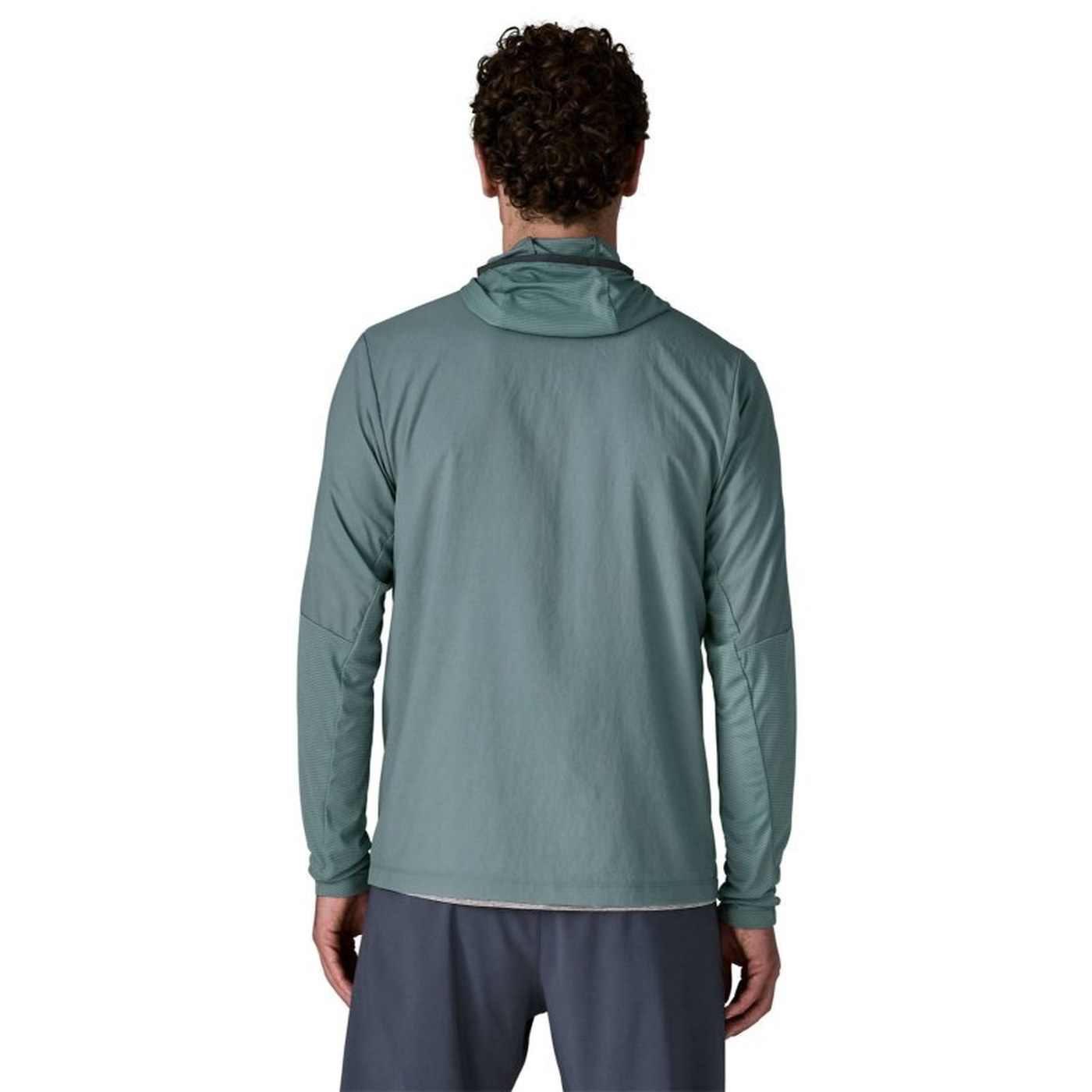
Second flaw, more subtle. The Airshed Pro fits like a close-cut T-shirt, not a jacket. One tester who wore it for two months is categorical: you can't fit anything thicker than a thin base layer underneath.
If you planned to wear it over a fleece at 0 °C, forget it. The right combo is a merino tee like the Icebreaker 200 Oasis underneath, and a waterproof jacket in your pack. Journal du Trail also points out that it's too light to count as the warm layer in the UTMB mandatory kit. Check your race rules before relying on it.
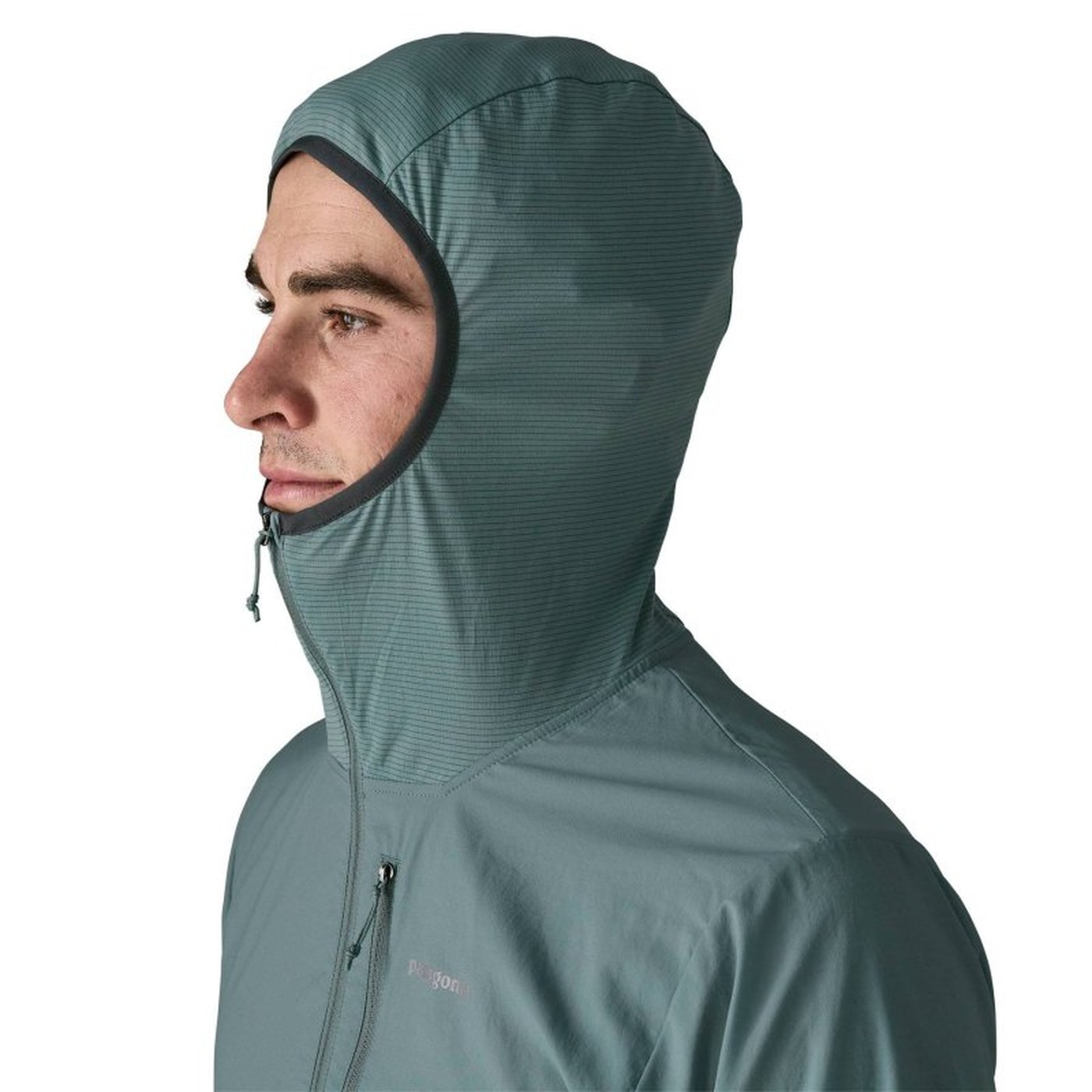
The hood is a plus. Snug, stretchy, no drawcord, it follows your head without flapping. It fits under a cap.
© Patagonia, official photo used for editorial purposes
Who is it for?
The trail runner who heats up fast
You head out in a T-shirt, freeze for ten minutes, then sweat like it's summer? The Airshed Pro is made for you. You can keep it on from start to finish without the pressure-cooker effect.
The winter road runner, in dry weather
For intervals at 2 °C without rain, it makes an excellent single layer over a technical T-shirt. Sleeves that push up onto your forearms help you regulate during the warm-up.
The ultrarunner who wants a light night layer
In a running vest, its 105 g and stuff pocket disappear. It works as a mid-layer under the waterproof jacket when the temperature drops at night.
Head-to-head with the competition: Airshed Pro, Houdini Air and Run 900 Wind
| Criterion | Patagonia Airshed Pro | Patagonia Houdini Air | Kiprun Run 900 Wind |
|---|
| Retail price | €140 | €159,90 | €39,99 |
| Weight | 105 g claimed | 102 g | 138 g (L) |
| Fit | Half-zip top, close to the body | Full-zip jacket | Full-zip jacket, adapts to a pack |
| Wind protection | Torso only | Full body | Full body |
| Breathability | Very high (knit sleeves) | High for a full windbreaker | Decent |
| RunMorph score | 7,5/10 | 8/10 | 8/10 |
The simple rule: if you want to block the wind, get a full-zip jacket. The Houdini Air protects your whole body for €20 more. The Kiprun Run 900 Wind does the same for €100 less, with 33 g extra. The Airshed Pro only wins in one case: when you keep it on for the whole effort. As an emergency layer at the bottom of your pack, it loses to both.
The Nike Windrunner targets road and city runs instead. It's still a jacket, with a jacket's protection.
Pros and cons
Pros
- Top-tier comfort: soft, stretchy fabric, praised by all four tests.
- Far more breathable than a classic windbreaker: an hour of running overdressed without getting soaked.
- Snug hood that replaces a beanie in cool weather.
- Chest pocket that doubles as a stuff sack, 105 g claimed.
- Recycled polyester, PFC-free water repellent, Fair Trade manufacturing.
Cons
- Wind goes through the sleeves and hood, confirmed with a hair dryer.
- Permeable knit on the arms: wet forearms from the first real rain.
- Too slim to wear over a fleece.
- No thumb loops, despite extended sleeves.
- €140 for a garment without full protection, three and a half times the price of a Kiprun.
© Patagonia, official photo used for editorial purposes
How to fit it into your RunMorph training plan
The Airshed Pro belongs in winter sessions where the intensity climbs: hill repeats, intervals on trails, long runs with elevation gain in dry weather. On a slow easy run at 0 °C, it's not enough on its own. Add a warm layer or pick a jacket.
Training for a spring trail race and stacking up winter runs in the mountains? The
RunMorph trail plan schedules your hill sessions and long runs week after week. With the right layer on your back, you get through winter without breaking your build-up.
The RunMorph Coach's verdict
The Airshed Pro is the most pleasant top in its category, and that's both its strength and its limit. It breathes, you forget it's there, it packs into its own pocket. But it only blocks the wind on the torso and doesn't stand up to rain.
The 7,5/10 score is weighted mainly on comfort and breathability, which matter most for a layer worn all the time. It loses points on price: €140 for partial protection is expensive. Buy it if you'll wear it all winter on hard, dry runs. Otherwise, the Kiprun Run 900 Wind at €39,99 covers your needs better.