Topo Athletic is still largely unknown to the French running public, but the Massachusetts brand has just launched its very first Pro Series line with the Specter 3. It's a plateless super trainer that drops the firm PEBA foam of earlier versions for an all-new ATPU compound. This is the brand's first appearance in a RunMorph review, and a chance to find out whether Topo's signature wide, anatomical shape can really take on the market's benchmarks.
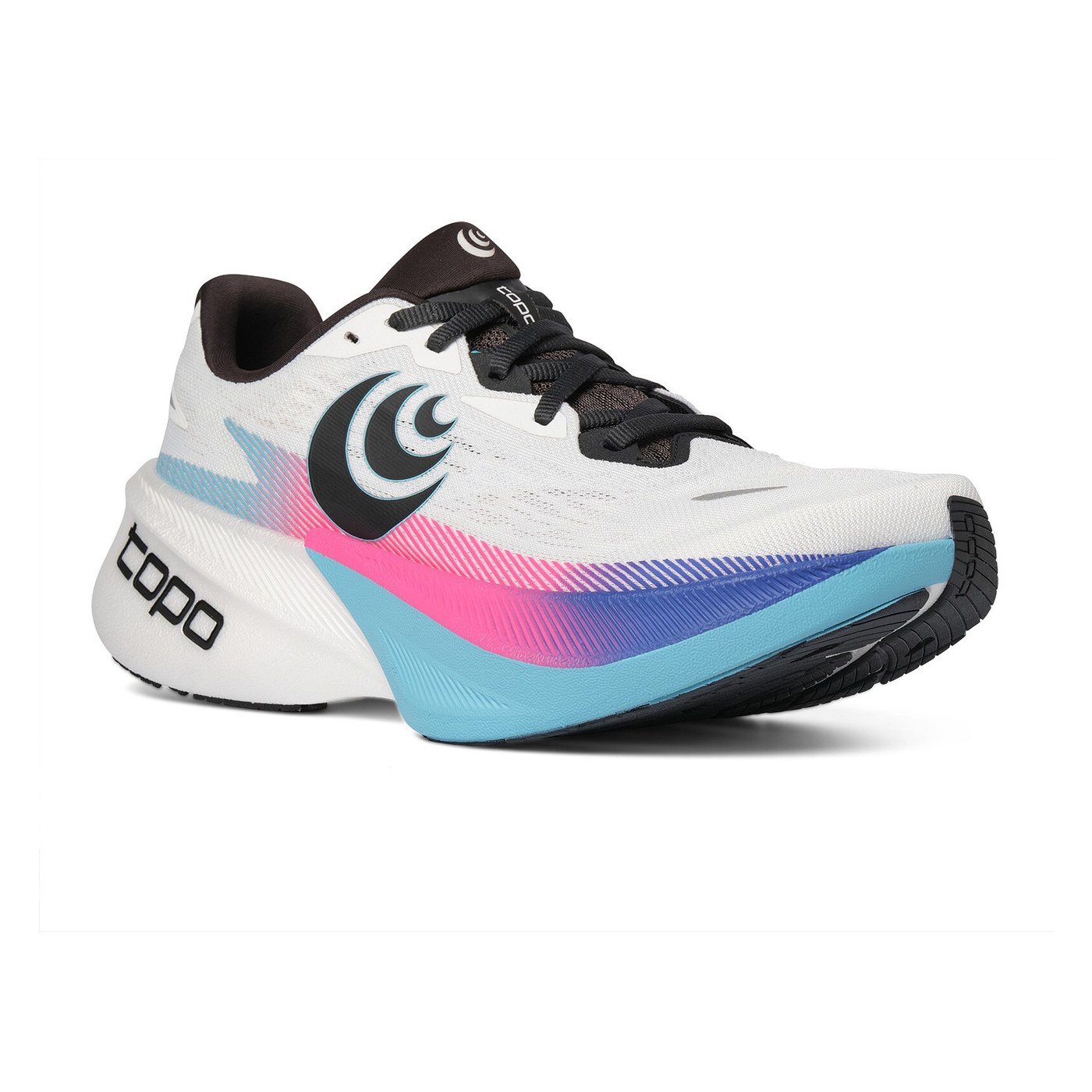
© Topo Athletic, official photo used for editorial purposes
Topo Athletic Specter 3: a plateless super trainer bet, finally sold in France
For more than ten years, Topo Athletic has built its reputation on one argument: a wide toe box, while the rest of the industry narrows the front of its running shoes for looks rather than biomechanics. Yet the brand stayed a niche player, popular with minimalist and low-drop fans and off the radar of performance runners. The Specter 3 changes that. It opens Topo's Pro Series line and brings an all-new ATPU foam, RevFoam, which replaces the firm, stingy PEBA of the Specter 1 and 2.
The bet is clear. Instead of adding a carbon plate like almost every premium super trainer on the market, Topo relies on geometry and foam alone to generate speed. At RunMorph, we see this choice putting the Specter 3 in a fast-growing category: high-stack plateless super trainers, already home to the Asics Superblast 3 and the Saucony Endorphin Speed 5. The question is whether a challenger brand like Topo can really hold its own against benchmarks that have been refined over several generations.
RunMorph tip: if you're torn between the Specter 3 and a more established super trainer like the Asics Superblast 3 or the New Balance SC Rebel v1, don't ask which one is best in absolute terms. Ask which one matches the width of your foot and the way you strike the ground.
RevFoam technology: what changes underfoot?
The Specter 1 and Specter 2 used a PEBA/EVA blend and then full PEBA, two compounds that almost every tester who ran in them found firm and short on bounce. The Specter 3 starts from scratch with an ATPU foam called RevFoam, a material Topo had never used before. Stack height goes up by 2 mm over version 2 (39/34 mm versus 37/32 mm), while weight drops by almost 17 g in the same size. On paper, that's the opposite of the usual trade-off: more foam, less weight.
The geometry has also been overhauled. The heel gets a very pronounced bevel that shifts your weight forward as soon as you touch down, while the forefoot gets an aggressive rocker paired with a lot of toe spring. This combination clearly favors midfoot strikers and penalizes hard heel strikers, who get thrown further along the sole than usual. Topo claims a 3 mm ATPU insole adds bounce right underfoot, a point where independent measurements agree less than expected (see below).
The field test: from marathon pace to hard tempo
Before writing this review, RunMorph read in full at least three independent tests of this exact Specter 3, not of a generic product page: a clinical, component-by-component assessment by a team of sports physical therapists, a multi-tester trial by three different runners over several weeks, and a French review published in early August 2026. We also factored in the editorial scores of a specialist French comparison site.
The clearest point of agreement across every source: RevFoam is a major step up from the Specter 2, which even its own testers found firm and uninspiring. No one disagrees on that. Opinions split sharply, though, on the pace range where the shoe feels most at home. The clinical test finds the forefoot rocker and toe spring too aggressive once you go faster than marathon pace, causing discomfort and the feeling that your foot "falls off" the front of the shoe when you accelerate. The multi-tester trial says the opposite: the shoe only comes alive from marathon pace up to hard tempo, with very high scores (above 9/10 from two of the three testers) in exactly that pace range. At RunMorph, we read this split as a runner-profile signal rather than a contradiction. Runners with a strong forefoot strike and a high cadence seem to get more out of the rocker than heavier or slower runners, who find it a handicap.
Second point of agreement: the base under the heel and midfoot is narrow for this much cushioning. Several testers independently flagged the resulting lack of stability at slow paces or late in a run when fatigue sets in. The clinical test goes as far as advising against the shoe for runners with marked overpronation or a pronounced heel strike, precisely because of that narrow base. Third point, and a more surprising one: one of the three testers in the multi-tester trial pulled out the insole and measured a real thickness of under 1.5 mm in places, far from the 3 mm Topo claims. In his view, that explains an unusually firm feel from the board inside the shoe (the "strobel board"). The French review published in early August, shorter and less technical, stays positive on the overall feel (comfort, stability on climbs, no pressure points) and doesn't mention this finishing flaw, which could point to production variability rather than a systematic defect.
RunMorph tip: if you're a pronounced heel striker, or if you weigh more than 75 kg, try the Specter 3 on in a store before buying online. The narrow base and aggressive rocker don't suit every stride, unlike a more crowd-pleasing super trainer such as the Asics Superblast 3.
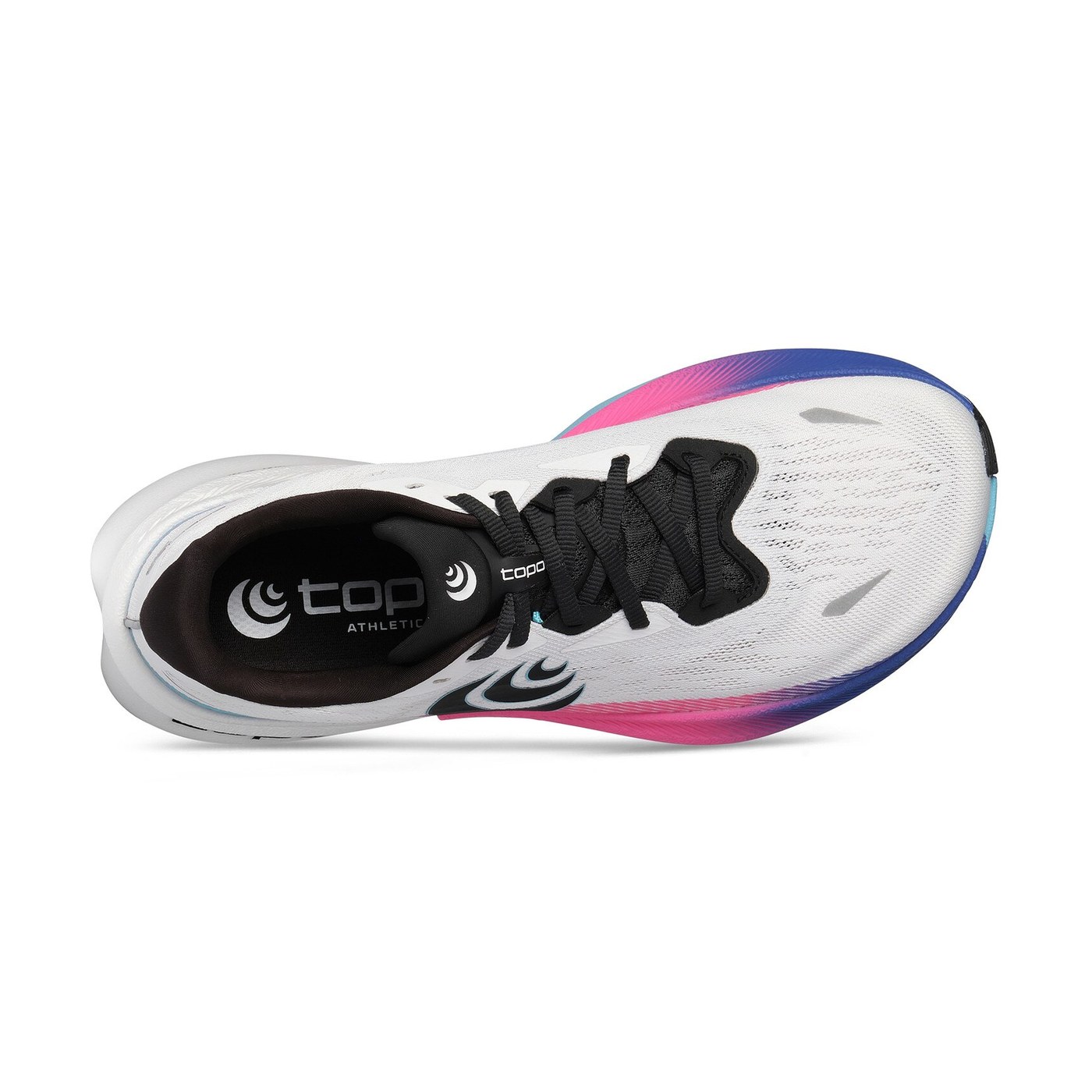
© Topo Athletic, official photo used for editorial purposes
Topo Specter 3 vs Asics Superblast 3: the comparison
Both shoes share the same philosophy: a big stack, no carbon plate and the ambition to cover most of your training in a single pair. Beyond that, their approaches could hardly be more different.
| Criterion | Topo Specter 3 | Asics Superblast 3 |
| Weight | 218 g | 227 to 239 g depending on the measurement |
| Stack height (heel / forefoot) | 39 mm / 34 mm | 46.5 mm / 38.5 mm |
| Drop | 5 mm | 8 mm |
| Foam | Single-density RevFoam ATPU | Dual foam, FF LEAP + FF BLAST PLUS |
| Toe box | Wide, Topo's signature anatomical shape | Standard, classic Asics fit |
| Price in France | €194.95 | around €190 on average |
The Superblast 3 relies on a much higher stack and a wider base to stay stable at every pace, including the slowest. The Specter 3 plays the opposite card: less foam and a narrower base, but a lower weight and a far roomier toe box. If you have wide feet and feel cramped in most performance shoes, the Topo fills a real gap that the Asics leaves open.
Our take: who it's for, and where it fits in a training plan
The Specter 3 suits neutral midfoot strikers who regularly run between marathon pace and hard tempo, and who have always struggled to find a wide enough toe box. It's a shoe for uptempo long runs and threshold sessions, not for short intervals or very slow recovery runs.
In a marathon or half marathon RunMorph training plan, the Specter 3 naturally slots into long runs with goal-pace segments and into tempo sessions, where its geometry encourages a high cadence and a sustained rhythm. For recovery runs or very slow outings, pick a more stable, more cushioned pair.
The RunMorph Coach verdict
The Specter 3 is the best shoe Topo Athletic has ever made, by a wide margin. RevFoam wipes out the brand's main weakness in one go: the firm, stingy ride that kept previous Specters confined to a very small audience. The problem is that Topo didn't fix its two other long-standing weak spots at the same time: a narrow base that limits stability for some runners, and a finish (here, the insole) that isn't yet on par with the market's benchmarks. It's far from a bad shoe. It's a very successful super trainer for a specific type of runner, but not yet a universal alternative to the Superblast 3 or the Endorphin Speed 5.
8.5/10