All reviews
September 22, 2026

Adidas Adizero Adios Pro 5: 30 g lighter and a heel that's finally stable, but the bite fades

7.8/10
Adidas Adizero Adios Pro 5: 30 g lighter and a heel that's finally stable, but the bite fades
  • Much safer heel than the Pro 4, thanks to the midfoot cutout being gone (testers and lab)
  • 170.3 g in the lab, about 30 g lighter than the Pro 4 (200 g), confirmed by several testers' weigh-ins
  • Forefoot cushioning better than the Pro 4's and built to last: only 3.6 % loss between 10 and 40 km in simulation
  • Less bite below 10 km pace than a classic full-width carbon plate

Updated September 28, 2026: an independent lab report has now been published for this model, and two testers have added their durability feedback. The real drop, the measured energy return, the volume of the fit and the early wear on the forefoot are now factored in, and the score has been revised from 8.3 to 7.8/10.

Twenty months separate the Adios Pro 4 from this fifth generation, and Adidas's press release hammers one number: nine percent more energy return. That figure comes from the brand's in-house lab, and the first independent measurement published since then doesn't back it up: under the same protocol, the Pro 5 actually returns slightly less energy than the Pro 4. RunMorph cross-checked that lab report against seven real-world tests published by French and English-language outlets whose testers actually ran in it. Their verdict lands on one point the launch release keeps quiet about: the Pro 5 fixes the Pro 4's real flaw (the heel), but it does so by giving up some of the bite that built its reputation at faster paces, and its exposed forefoot foam wears out too quickly for the price.

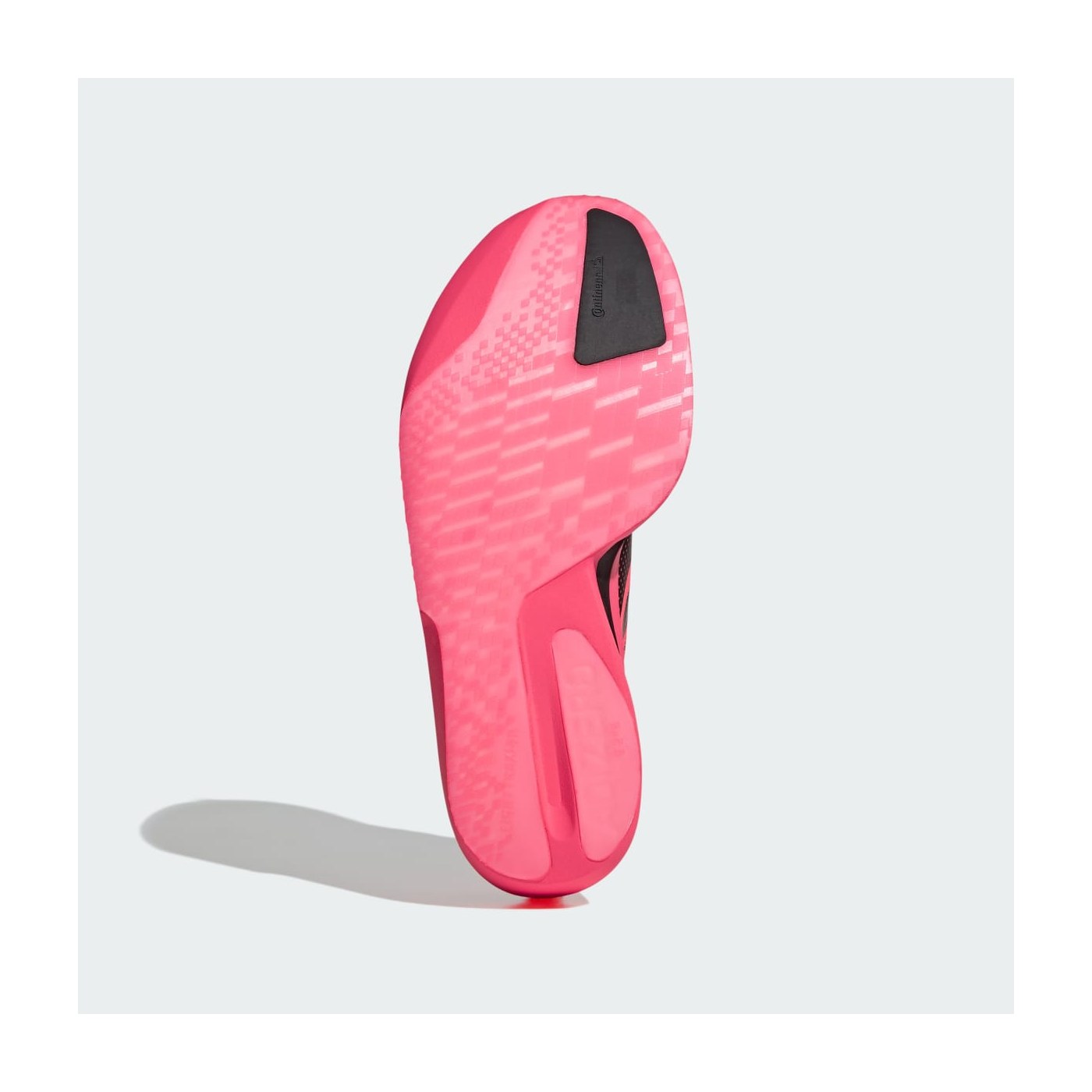
Adidas Adizero Adios Pro 5, three-quarter front view

© Adidas, official photo used for editorial purposes

The key points in 3 sentences

The Adidas Adizero Adios Pro 5 swaps the Pro 4's five Energy Rods carbon rods for a perimeter carbon ring, the Energyrim, which frees up room for Lightstrike Pro foam directly underfoot and cuts about 30 g from the shoe (170 g on an independent lab scale in US9, versus 200 g for the Pro 4). Real-world tests and the lab data agree on a heel that feels safer than the Pro 4's, but also on less bite, a measured energy return below the Pro 4's despite the claimed +9 %, a real drop of 7.3 mm against the 4 mm listed, and forefoot foam that starts wearing within the first few dozen kilometers according to three testers. It's built for the experienced runner training for a fast 10 km up to the marathon, not for the heel striker who wants maximum stability or the runner with wide feet.

7.8
/ 10 · RunMorph overall score
Responsiveness
8.5 / 10
Comfort and support
8.5 / 10
Stability
7 / 10
Fit
6.5 / 10
Durability
5.5 / 10
Value for money
6.5 / 10
Who is it for?The experienced runner chasing a time from 10 km to the marathon who lands on the midfoot or forefoot, with a narrow to normal foot.
Who should skip it?The pronounced heel striker, the wide foot that swells on the run, and the runner looking for one versatile pair for everyday training.

Adidas relaunches the Adios Pro without waiting for the usual cycle

Adidas didn't stick to the calendar it had set alongside its direct rivals. Nike and Asics refresh their flagship models every twelve to eighteen months; Adidas let twenty months pass between the Pro 4 (January 2025) and this fifth generation, launched worldwide on September 22, 2026, just days before the Berlin Marathon, where several testing editorial teams plan to race in it. The timing is no accident: this is the marathon, a major historically tied to the brand since 2011, where Adidas wants to plant its new benchmark against the Nike Alphafly 4, released five days earlier.

The technical leap comes from higher up the range: the Adios Pro 5 borrows the architecture of the Adizero Adios Pro Evo 3, the 500 euro model Sebastian Sawe wore for the first official sub-two-hour marathon in April 2026. The Pro 5 itself didn't run that record, but its carbon ring technology comes straight from it. The question that always follows this kind of technology transfer is the same: does what works on a 500 euro prototype survive in the version sold at 260 euros, designed to last several hundred kilometers rather than a single record?

Adidas Adizero Adios Pro 5 specs

SpecValue
BrandAdidas
ModelAdizero Adios Pro 5
ReleaseSeptember 22, 2026 (simultaneous global launch)
TypeRoad, carbon-plated racer
Claimed drop4 mm
Drop measured by an independent lab7.3 mm (US9)
Claimed forefoot / heel stack35 mm / 39 mm
Measured forefoot / heel stack30.9 mm / 38.2 mm
Claimed weight180 g (men's, reference size not specified by the brand)
Independently weighed170.3 g in the lab (US9), 170 to 190 g on testers' scales depending on size (US9 to US10)
Carbon structureEnergyrim (perimeter ring), replaces the Pro 4's Energy Rods 2.0
FoamNew-formula Lightstrike Pro, two layers according to the specialist press (PEBA on top, ATPU at the base)
UpperLightlock 2.0, mesh with dedicated ventilation zones
OutsoleLighttraxion, Continental rubber on the propulsion zone
Claimed energy return+9 % vs the Pro 4 (brand figure, not confirmed by an independent lab, see below)
Recommended distance10 km to marathon
Official price in France260 €
Official US price275 $ (about 253 € at today's exchange rate)

Adidas Adizero Adios Pro 5: what the brand claims vs what's been verified

At launch, the testers' scales were the only way to check Adidas's claims. A full independent lab report is now available for the Pro 5 (a US9 pair bought by the lab, not supplied by the brand), using the same protocol that lab applied to the Pro 4. That finally makes it possible to compare the two generations on equal terms. One caveat, though: don't compare these percentages with the 80.4 % energy return quoted elsewhere for the Pro 4. That number comes from a different lab using a different method.

Data pointAdidas claimIndependently verified
Weight (reference size)180 g, size not specified170 g recorded on a US9 pair and 190 g on a US10 pair by two separate testers, a 20 g gap explained by the size, which the brand doesn't spell out
Weight reduction vs the Pro 4-12.5 % claimed-14 % found by a tester who weighed his own Pro 4 (198 g) next to his Pro 5 (170 g), a gap that for once works in the runner's favor
Lab weight180 g170.3 g measured in US9, which confirms the testers' weigh-ins
Energy return+9 % vs the Pro 4Not confirmed: 84.4 % at the forefoot and 82.3 % at the heel, excellent numbers in absolute terms but lower than the Pro 4 measured with the same protocol, in both zones
Drop4 mm7.3 mm measured (38.2 mm at the heel, 30.9 mm at the forefoot), 3.3 mm more than claimed; the Pro 4 already came in at 8.1 mm real for 6 mm claimed
Stack39 mm / 35 mm38.2 mm / 30.9 mm: the heel matches, the forefoot has 4 mm less foam than claimed
CushioningSofter, thicker foam underfootConfirmed: the forefoot absorbs more energy than the Pro 4's at every force tested, and loses only 3.6 % of its cushioning between 10 and 40 km in a long-run simulation
Bending stiffnessStiffness retained despite dropping the rodsConfirmed: 25.2 N/mm, slightly stiffer than the Pro 4

The scorecard is mixed. The weight promise holds up, and the cushioning genuinely improves and goes the distance better than the Pro 4's. But the two headline numbers don't survive measurement: energy return dips slightly instead of gaining 9 %, and the real drop exceeds the claim by 3.3 mm, exactly like the previous generation. If you were picking the Pro 5 specifically for its low drop, that's a dealbreaker-level detail: underfoot, it behaves like a mid-drop shoe, which matches one tester's impression that the drop "feels more like 6 mm".

Energyrim technology: what switching from rods to a carbon ring changes underfoot

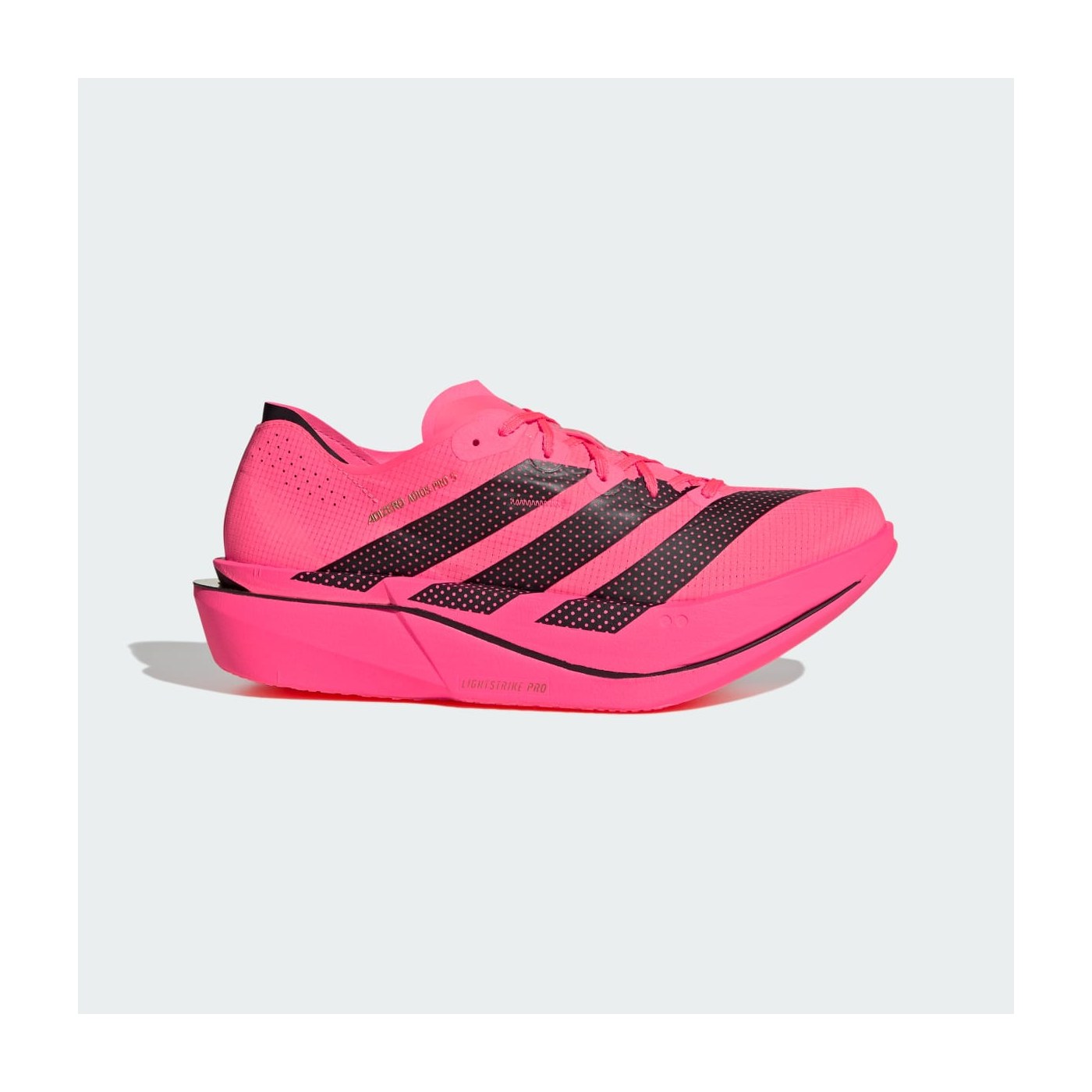
The Pro 4 used five individual carbon rods (Energy Rods 2.0) embedded in the foam, with an open window under the arch that showed the carbon and, according to independent tests of the previous generation, created a slight wobble at midstance. The Pro 5 fills in that window, as confirmed by the independent lab and one tester, and replaces the rods with a continuous carbon ring running around the entire perimeter of the midsole, a technology lifted straight from the Adios Pro Evo 3.

The change has a specific mechanical consequence, confirmed by the tests read for this article: the longitudinal stiffness that gave the Pro 4 its unmistakable carbon-plate feel is still there along the edges of the sole, but the center, now filled with foam instead of empty space, compresses more underfoot. One tester describes a feeling of foam that loads and compresses with every step rather than a plate rigidly guiding the stride. Another notes that bending stiffness remains comparable to a classic carbon plate along the edges, but that the midfoot now passes through a noticeably softer zone than before. The lab data backs this up: the forefoot is softer under compression than the Pro 4's, while bending stiffness (25.2 N/mm) is actually slightly higher.

Adidas Adizero Adios Pro 5, side view showing the midsole

© Adidas, official photo used for editorial purposes

Fit: volume stays low despite a slight widening

The independent lab measurement finally settles the volume question. The toe box is very low: 5.7 mm below the reference height for a true-to-size fit (a 5.2/10 score on that criterion), which can put pressure on the top of your toes if your forefoot is high-volume or swells late in a race. Forefoot width, on the other hand, is normal (0.6 mm above the reference at the metatarsal heads, 95 mm internal width), but the arch is very narrow: 6.6 mm below the reference. Length is rated perfectly true to size. A note on method: this lab expresses toe box height as a deviation from a size reference rather than as a raw value compared to a market average, so the figure in RunMorph's usual format (height in mm vs market average) remains unavailable until another report is published.

What the real-world tests do agree on, without ambiguity: the fit is still something to watch. Several testers describe an upper that hugs the foot without squeezing it at the midfoot but tightens quickly toward the front. One tester reports two blisters on the medial arch of both feet after a half marathon, while pointing out that he wore thin socks rather than technical running socks, an aggravating factor he acknowledges himself; no other tester has reported blisters so far, but that is precisely where the lab measures the arch at its narrowest. On sizing, opinions differ: several testers and the lab rate it true to size, while RUN'IX finds it runs "particularly short", calling for at least half a size up, advice shared by one English-language tester for the marathon. According to a tester who compared both pairs side by side, Adidas has slightly widened the forefoot compared with the previous generation, but the difference is minor and doesn't solve the problem for wide feet.

The field test: what the seven real-world sources report

Seven real, independent tests were read for this article, all published in launch week: four French ones, named below, and three English-language ones, used internally in line with the RunMorph editorial charter. Since September 28, they have been supplemented by an independent lab report and by durability updates from two testers. Race feedback from the September 27 Berlin Marathon, where several testers ran in this pair, had not yet been published at that date.

Running4All highlights the weight loss as the most noticeable change straight out of the box and praises a fit that is now truer to real size than the Pro 4's, while pointing out that the width is still too narrow for non-standard feet and that two testers developed hot spots on fast runs.

Quatorze Running emphasizes the smooth transition delivered by the carbon ring and cushioning that stays lively even on long runs beyond 25 km, but recommends keeping the pair for quality sessions rather than daily training, since a supercritical foam wears faster than a classic EVA foam.

RUN'IX weighed its pair at 172 g, 21 g less than its Pro 4 in the same size, and rates the Pro 5 as more responsive and more stable than its predecessor, though a little less comfortable in return. Above all, the team notes visible signs of wear after just a few kilometers, and a shoe that runs short.

21Run confirms soft cushioning on landing combined with an aggressive toe-off as soon as the pace picks up, a combination the brand was explicitly chasing by replacing the rods with the perimeter ring.

The internal consensus from the English-language testers lands on a point the French sources mention less directly: the unstable heel that held back the Pro 4 is fixed, and the shoe is now stable from heel to forefoot instead of rewarding only midfoot strikers like its predecessor. The lab adds nuance: the heel is still narrow (78 mm wide at ground level) and overall stability scores just 5.8/10, even if losing the midfoot cutout makes the Pro 5 easier to control than the Pro 4. Safer than its predecessor, then, but not stable in absolute terms. On the flip side, several testers notice a loss of bite below 10 km pace, which the measurements confirm: a softer forefoot and lower energy return than the Pro 4. Finally, one tester reports the foot being pushed toward the inside in corners; no other source has confirmed it since, and two sources point out instead that the midfoot cutout he blamed is gone. So that one remains an isolated report.

RunMorph's advice: if the Pro 4's heel problem made you hesitate, the Pro 5 deserves a spot on your shopping list. If you mostly run fast 5 km and 10 km races and loved the Pro 4's very pronounced bite, keep yours or look at the Nike Alphafly 4.
Where it shines and where it falls off, pace by pace

Easy runs and base endurance: not recommended. This is a carbon-plated racer, not a daily trainer; burning through a supercritical foam on slow easy runs just speeds up wear with no benefit at that pace.

Long runs: a strong point. Several testers have logged over 40 km cumulatively without discomfort, and one tester in particular reports a 25 km run at moderate pace with no sense of the foam bottoming out, the 39 mm heel stack staying protective over the distance.

Marathon pace: this is the bullseye. Every source agrees on maximum bounce and smoothness at this pace, with the foam loading and returning energy optimally around 4 min/km according to one tester's data.

Threshold and half marathon pace: also very good. One tester who strung together several threshold blocks reports a shoe that responds instantly as soon as the pace tightens to around 3 min 30/km.

Short intervals: this is where the Pro 5 falls off. Losing the central stiffness, now replaced by compressible foam, takes away some of the crisp propulsion you want on short, fast reps. Several testers recommend a stiffer plate, like the Nike Alphafly 4's, for that kind of specific session.

Major flaw: a fit that still causes blisters

This isn't a new flaw (the Pro 4 already suffered from a snug fit), but it persists despite the announced slight widening of the forefoot. The independent lab now puts numbers on it: a toe box 5.7 mm lower and an arch 6.6 mm narrower than the size reference. One tester reports two blisters on the arch of both feet after a half marathon run in thin socks rather than technical running socks, a factor he admits made things worse but that doesn't explain everything: the insole itself is described as slightly slippery, letting the foot shift a few millimeters inside an upper that is otherwise well locked down. If you're planning a full marathon in this pair, the practical takeaway is clear: test the shoe on at least one 15 to 20 km run in the socks you plan to race in before trusting it for a goal race lasting several hours.

Major flaw: the bite fades below 10 km pace

Replacing the carbon rods with the perimeter ring fixes the Pro 4's stability problem, but it comes at a cost the launch release doesn't mention: the rigid-plate feel that gave the Adios Pro line its razor edge fades as soon as the pace goes beyond 10 km threshold speed. One tester describes the shoe as less at ease on fast short intervals than a shoe with a classic full-width plate, with the compressible foam in the center absorbing part of the energy instead of returning it right away. The lab data now backs up these impressions: the Pro 5's forefoot is softer than the Pro 4's at every force tested, its energy return is lower, and the lab explicitly recommends the Pro 4 to anyone who prefers a firmer, snappier forefoot. The medial bias in corners reported by one tester, however, has not been confirmed by any other source.

Major flaw: exposed forefoot foam that wears too early

This is the point that has shifted the most since launch. On release day, only one tester reported light wear on the Lightstrike Pro foam left exposed at the forefoot after 56 km. Two more sources have since pointed the same way: RUN'IX sees fairly visible signs of wear after just a few kilometers and calls the shoe "relatively fragile" for 260 euros, and an English-language tester, after runs deliberately done on asphalt to speed up wear, calls the wear on the outer edge under the toes, where no rubber protects the foam, "unacceptable", to the point of no longer recommending the shoe at this price. The testers who detail the outsole's condition do agree, however, that the Lighttraxion rubber and the Continental patch show no wear at all. It's not a performance loss yet, but it is a design flaw that shortens the useful life of a shoe sold among the most expensive in its segment.

Adidas Adizero Adios Pro 5 vs Adidas Adizero Adios Pro 4: head to head

SpecAdios Pro 5Adios Pro 4
Carbon structureEnergyrim, perimeter ringEnergy Rods 2.0, five individual rods
Claimed drop4 mm (lab-measured: 7.3 mm)6 mm (lab-measured: 8.1 mm)
Weight170.3 g in the lab (US9), 170 to 190 g on testers' scales200 g (measured by an independent lab)
Heel stabilityClearly improved according to testers and the lab, but narrow heel (5.8/10 in the lab)Identified weak spot, 6.8/10 stability score at RunMorph
Bite at fast pacesWeaker below 10 km pace, softer forefoot and lower energy return in the labVery pronounced, 9.8/10 responsiveness score at RunMorph
Official price in France260 €250 € at launch
RunMorph overall score7.8 / 109.3 / 10

The bottom line: if you already land on your midfoot or forefoot and were never bothered by the Pro 4's heel instability, keep your pair; it's still sharper at fast paces. If that heel problem held you back, or you mostly target 10 km to the marathon rather than short intervals, you'll gain from moving to the Pro 5 despite the 10 euro price difference, as long as you accept that forefoot durability needs watching.

Adidas Adizero Adios Pro 5 vs Nike Alphafly 4 and Saucony Endorphin Pro 5: head to head

SpecAdios Pro 5Nike Alphafly 4Saucony Endorphin Pro 5
ReleaseSeptember 22, 2026September 17, 2026 (wide availability on October 29)January 15, 2026
Drop4 mm claimed, 7.3 mm measuredNot yet specified, architecture close to the Alphafly 38 mm
Weight170.3 g in the lab (US9)Not yet independently weighed206 g (size 42)
Official price in France260 €About 280 €220 €
RunMorph overall score7.8 / 107.4 / 10 (brand data, no long-term third-party test yet)9.0 / 10

The bottom line: the Pro 5 sits between the two. It costs less than the Alphafly 4 and already has an independent lab report and seven real-world tests behind it, a clear edge over an Alphafly 4 still judged on brand data alone. Against the Endorphin Pro 5, it costs 40 euros more for a narrower fit and a lower claimed drop (the real gap is smaller, 7.3 mm measured), two traits that suit the experienced runner but make the Endorphin Pro 5 more approachable for an intermediate runner discovering carbon shoes.

Pros and cons

Pros

  • Much safer heel than the Pro 4, thanks to the midfoot cutout being gone (testers and lab)
  • 170.3 g in the lab, about 30 g lighter than the Pro 4 (200 g), confirmed by several testers' weigh-ins
  • Forefoot cushioning better than the Pro 4's and built to last: only 3.6 % loss between 10 and 40 km in simulation
  • Smooth transition and strong bounce at marathon and threshold pace, confirmed by every source
  • Dries very fast and absorbs little water, a real plus in a rainy marathon

Cons

  • Less bite below 10 km pace than a classic full-width carbon plate
  • Exposed forefoot foam that starts wearing within the first few dozen kilometers, according to three sources
  • Measured energy return lower than the Pro 4's, far from the claimed +9 %
  • Real drop of 7.3 mm for 4 mm claimed
  • Very low toe box and very narrow arch in the lab, blisters reported by one tester

Grip and durability: what 260 euros buys you per kilometer

No tester has passed the hundred-kilometer mark in this pair yet, and no high-mileage durability data exists so far. Still, every available signal points the same way. The outsole holds up: the Lighttraxion rubber and the Continental patch stay intact for the testers who detail the outsole's condition, and grip on wet roads gets praise. The foam also holds up under compression: the independent lab's long-run simulation shows only a 3.6 % loss of cushioning between 10 and 40 km. The problem lies elsewhere: the Lightstrike Pro left unprotected on the outer edge of the forefoot shows visible wear within the first few dozen kilometers according to three sources, one of which calls that wear unacceptable at this price. At launch, RunMorph estimated the useful life at 200 to 300 km like a typical super shoe, meaning 0.87 € to 1.30 € per kilometer. Given this feedback, a cautious scenario of 150 to 250 km looks more realistic, meaning 1.04 € to 1.73 € per kilometer (260 € divided by 150 to 250 km), an estimate to be confirmed as soon as higher-mileage feedback is published. For comparison, the Saucony Endorphin Pro 5 at 220 € works out to 0.73 € to 1.10 € per kilometer over the same usage range, a gap that widens sharply in the Saucony's favor if the cautious scenario is confirmed.

Our take from the road: who is it for, and for what goal?

The Pro 5 is for the runner training for a fast 10 km, a half or a marathon, with a midfoot or forefoot strike and a normal to narrow foot. At RunMorph, we recommend it to anyone who has owned a Pro 4 and regretted its heel instability late in races, while keeping it for key sessions and races to spare a fragile forefoot foam.

To turn this pair into real PRs rather than just a purchase, pair it with a structured plan: the Pro 5 reaches its full potential in the goal-pace weeks of a marathon or half marathon build.

See the RunMorph marathon training plan

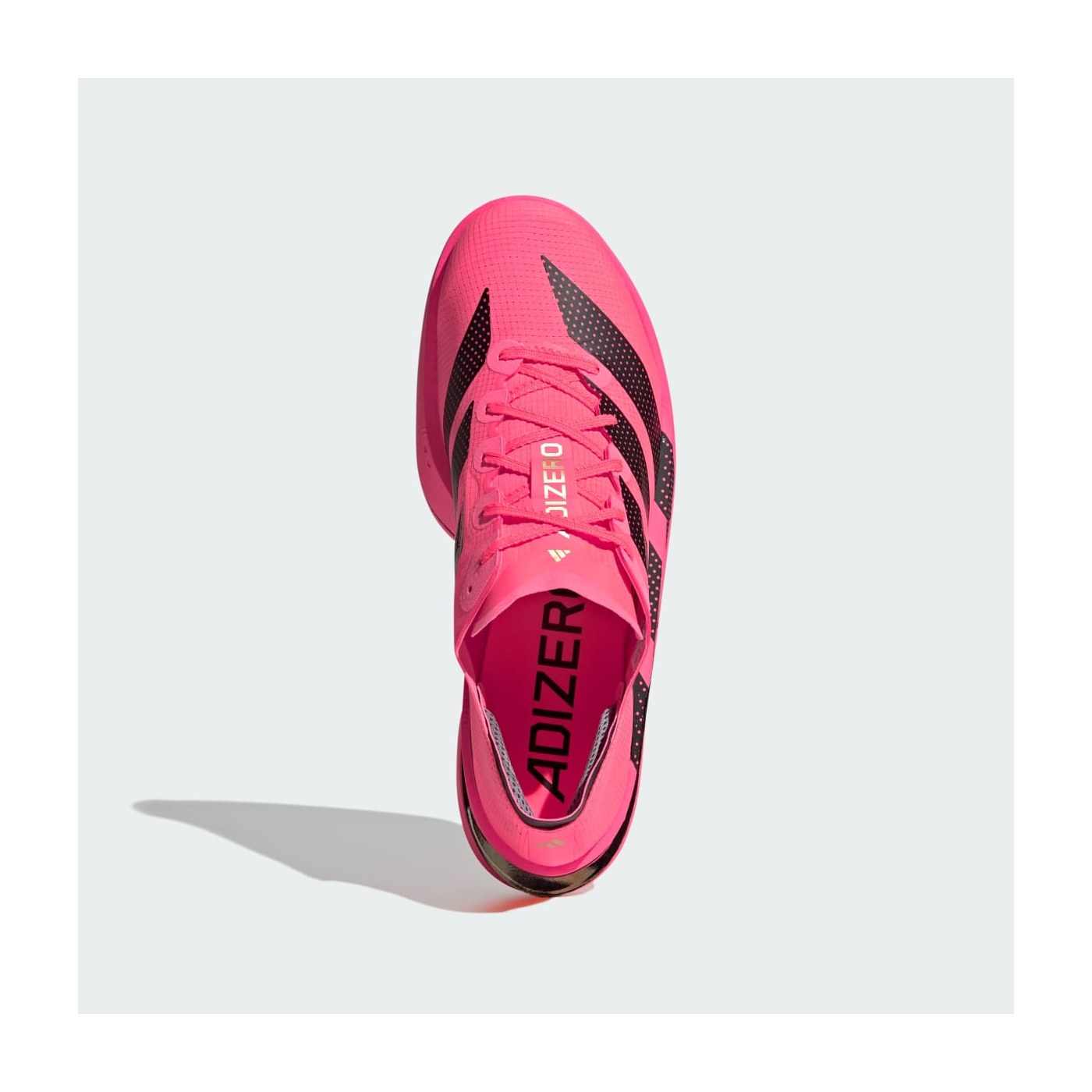
Adidas Adizero Adios Pro 5, view of the upper and lacing

© Adidas, official photo used for editorial purposes

The RunMorph Coach's verdict

The Adidas Adizero Adios Pro 5 fixes the Pro 4's real flaw: the heel becomes much safer now that the midfoot cutout is gone, even if the lab points out that it stays narrow. It sheds about 30 g along the way (170.3 g measured) and gains cushioning that lasts longer, two improvements that are now verified. But the independent measurement published since launch contradicts the two headline figures in the press release: energy return dips slightly instead of gaining 9 %, and the real drop hits 7.3 mm for 4 mm claimed. Add to that weaker bite below 10 km pace, a very low toe box and, above all, exposed forefoot foam that wears too early according to three sources. 7.8/10 (down from 8.3 at launch): an excellent marathon shoe on paper and underfoot, but one whose numbers don't all hold up and whose durability weighs heavily at 260 euros.

Key takeaways for your training

  • 170.3 g measured in the lab: about 30 g less than the Pro 4's 200 g, a real gain and not just a claim.
  • Real drop of 7.3 mm for 4 mm claimed: don't count on it to transition to a low drop.
  • Safer heel than the Pro 4, but still narrow: 5.8/10 for stability in the lab.
  • Less bite below 10 km pace: keep your Pro 4 or look at the Alphafly 4 if you mostly run short, fast intervals.
  • Fit still narrow: test it for at least 15 to 20 km in your racing socks before trusting it for a full marathon.
  • 1.04 to 1.73 euros per kilometer estimated over 150 to 250 km, factoring in the early forefoot wear, versus 0.73 to 1.10 euros for the Endorphin Pro 5.

FAQ

Is the Adidas Adizero Adios Pro 5 worth 260 euros?

For an experienced runner chasing a time from 10 km to the marathon, yes: it's 30 g lighter, has a safer heel and cushioning that holds up better under compression than the Pro 4, for just 10 euros more, but its exposed forefoot foam wears fast. For more all-round use, the Saucony Endorphin Pro 5 at 220 euros is still more versatile.

What does the Adidas Adizero Adios Pro 5 really weigh?

Adidas claims 180 g without specifying the size. The independent lab measures 170.3 g in US9, and testers' weigh-ins range from 170 to 172 g in US9 up to 190 g in US10.

Does the Adidas Adizero Adios Pro 5 run big or small?

Length is true to size according to the lab and several testers, but RUN'IX finds it particularly short. The toe box is very low (5.7 mm below the reference) and the arch very narrow (6.6 mm below the reference), which justifies going half a size up for a full marathon or a high-volume forefoot.

Is the Adidas Adizero Adios Pro 5's drop really 4 mm?

No. The independent lab measures 38.2 mm at the heel and 30.9 mm at the forefoot, a real drop of 7.3 mm. Adidas already understated the Pro 4's drop (8.1 mm measured for 6 mm claimed).

What's the difference between the Adidas Adizero Adios Pro 5 and the Pro 4?

The main difference comes down to one number: about 30 g less (170 to 190 g versus 200 g measured in the lab for the Pro 4), thanks to replacing the five carbon rods with a single perimeter ring, the Energyrim. In return, bite below 10 km pace drops off, and the lab measures energy return slightly lower than the Pro 4's.

Is the Adidas Adizero Adios Pro 5 a good marathon shoe?

Yes, it's its home turf: real-world tests and the independent lab agree on an optimal feel at marathon pace, around 4 minutes per kilometer according to one tester's data, with a 38.2 mm measured heel stack that stays protective over a run of more than 25 kilometers.

← Back to reviews