Bose took a radically different path from traditional sports earbuds. Neither in-ear nor bone conduction, the Ultra Open Earbuds clip around your outer ear like a cuff and channel sound toward the ear canal without ever blocking it. It's a bold promise for city runners who want to stay tuned in to their surroundings.
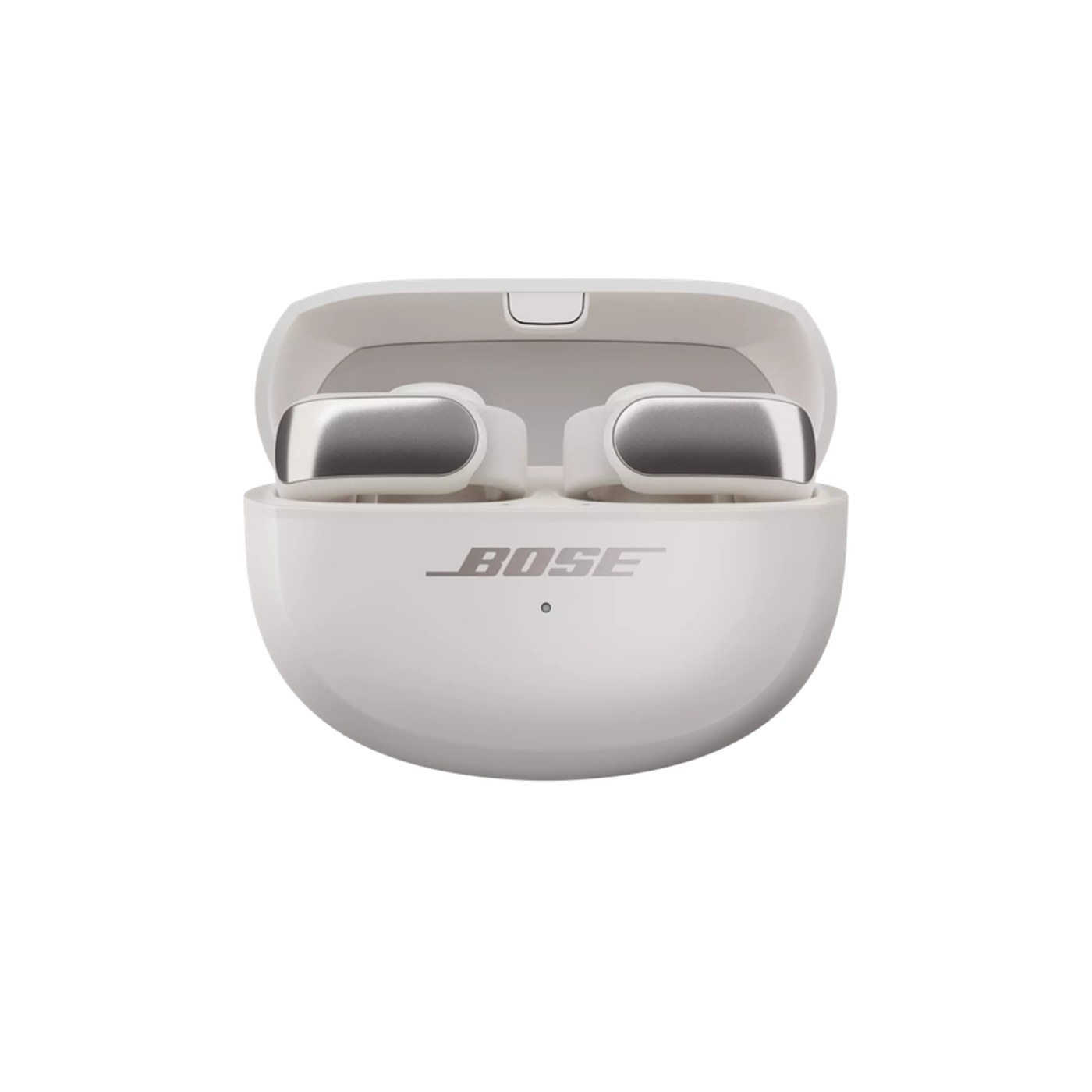
Bose Ultra Open Earbuds in White Smoke, charging case open. Bose, official photo used for editorial purposes.
Bose Ultra Open Earbuds: the audio leader's take on the open-ear revolution
For years, the sports earbud market split into two camps: in-ear models with active noise cancellation (Apple AirPods Pro, Bose QuietComfort Earbuds) and bone conduction open-ear models (Shokz, Suunto). Each has its strengths and its limits. With the Ultra Open Earbuds, Bose offers a third way: a "cuff" design that wraps around the outer ear and directs sound through a small opening, without ever blocking the ear canal.
This format, which Bose calls OpenAudio, is not bone conduction. A tiny speaker produces the sound, and an acoustic deflector steers it toward the entrance of the ear canal. The result is striking: a far richer soundstage than bone conduction, with clear mids and precise highs, while you stay fully aware of your surroundings.
OpenAudio technology: how Bose delivers sound without plugging your ear
OpenAudio rests on sophisticated acoustic engineering. Instead of vibrating the skull bones like bone conduction, or spreading sound through the air like a conventional speaker, Bose designed a small transducer that emits directional sound waves. A deflector focuses those waves toward the entrance of the ear canal and keeps sideways leakage to a minimum.
From the first listen, what stands out is how clear the mids and vocals are. Bone conduction tends to make sound metallic and thin in the mids. Bose's OpenAudio, by contrast, delivers warm, intelligible vocals. That's a major advantage for podcasts, calls and vocal-heavy tracks.
The physical limit remains the low end. With no isolation and no direct bone contact, low frequencies (below 100 Hz) get lost in the surrounding air. Bose partly makes up for it with digital processing that boosts bass harmonics, creating a sense of depth without the physical pressure of sub-bass. The effect works well for listening on the run, but rap and electro fans will find the sound light.
Immersive Audio: spatial sound that changes the game
Bose's Immersive Audio is the real differentiator here. It uses a signal-processing algorithm to build a wider soundstage, as if the music came from two speakers placed in front of you rather than from points stuck to your ears.
On the run, this transforms the experience. Instead of music "inside your head," you feel like a soundtrack is running alongside you. It cuts listening fatigue on long runs and makes listening feel more natural. The catch: Immersive Audio uses 40% more battery, cutting battery life from 7.5 h to 4.5 h per charge.
At RunMorph, we recommend saving Immersive Audio for long runs and switching it off on short sessions when battery life comes first.
Field test: fit, sweat and noisy environments
We tested the Bose Ultra Open Earbuds over about fifteen kilometers split between city roads, parks and a dirt track, and they showed clear strengths and clear limits.
Secure fit: the cuff design wraps firmly around the outer ear without putting pressure on the ear canal. After 90 minutes of running, we felt no pain and no fatigue. The earbuds stay put through surges and changes of direction, although a sharp head movement can knock them slightly off-axis. Over long sessions, they're far more comfortable than in-ear models.
IPX4: the rating handles sweat and light splashes, but it won't get you through a run in steady rain. That's a weak spot compared with the Shokz OpenRun Pro 2 (IP55) or the Suunto Wing 2 (IP67). If you're a trail runner who heads out in all weather, this isn't the ideal pick.
Noisy environments: on busy roads or in the subway, the sound gets hard to hear even at high volume. That's the built-in trade-off of open-ear: no isolation, so the music never dominates. In a mid-size city or on a track, the volume is enough. In central Paris or along an expressway, it's borderline.
RunMorph's advice: the Ultra Open Earbuds shine on group runs and city runs at conversational pace. For hard solo intervals or noisy mountain trails (rushing streams, wind), go for the Shokz OpenFit 2 or in-ear models with ANC.
Bose Ultra Open Earbuds vs Shokz OpenRun Pro 2: which one to pick
| Criterion | Bose Ultra Open Earbuds | Shokz OpenRun Pro 2 |
|---|
| Technology | OpenAudio (air + deflector) | DualPitch bone conduction |
| Sound | Rich mids/highs, light bass | Different balance, bone vibrations |
| Battery life | 7.5 h (27 h with case) | 12 h (no case, USB-C) |
| Water resistance | IPX4 | IP55 |
| Long-wear comfort | Excellent (no pressure) | Very good (light, stable) |
| Immersive Audio | Yes (spatial) | No |
| Price | €299.95 | €199 |
The choice comes down to how you'll use them most. The Bose win on sound quality, spatial audio and everyday versatility (calls, music, podcasts). The Shokz stay ahead in extreme conditions (rain, dust, ultra distances with no case to recharge) and on price.
Which runners are the Ultra Open Earbuds made for?
The connected city runner
You run in the city, cross at crosswalks, share the path with cyclists and want to hear horns and conversations. The Ultra Open Earbuds keep you alert without giving up your music. This is their ideal playground.
The group run regular
You run with a partner or a group and want to chat without taking your earbuds out. The open-ear design lets you keep listening and talk naturally, with no fiddling with ear tips.
The multi-activity user
You switch from running to cycling, from walking to the office. The Ultra Open Earbuds aren't just sports earbuds: their discreet design and call quality make them a credible everyday companion.
How to fit the Ultra Open Earbuds into your RunMorph training
Music can be a powerful ally in your training, as long as you use it wisely. At RunMorph, we recommend different strategies depending on the type of session:
- Recovery easy run: make the most of Immersive Audio for a relaxing experience. The open-ear design keeps you aware of your surroundings while you switch off mentally.
- Intervals: pick upbeat tracks with a BPM that matches your target pace. With no isolation, you have to stay focused, which makes it a good mindfulness exercise.
- Long run: alternate between music and podcasts. Podcasts sound especially good through Bose's OpenAudio thanks to its clear vocals.
👉 Explore RunMorph training plans and sync your music with your sessions.
RunMorph Coach's verdict
The Bose Ultra Open Earbuds are a technical success. Bose has built an open-ear product that genuinely sounds good, with immersive spatial audio that has no equal on the market. Comfort is excellent and the everyday versatility is real.
The limits are known and owned: no deep bass, no isolation, and IPX4 isn't enough for rain. These aren't go-anywhere earbuds; they're earbuds for the city and for dry tracks.
At €299.95, they're expensive. But if you want a premium open-ear model with sound that clearly outclasses bone conduction, they justify their price. On a tighter budget, the Shokz OpenFit 2 at €189 remain a solid alternative, less immersive but more affordable.
RunMorph score: 8/10. Excellent for city running, held back by IPX4 and the price.