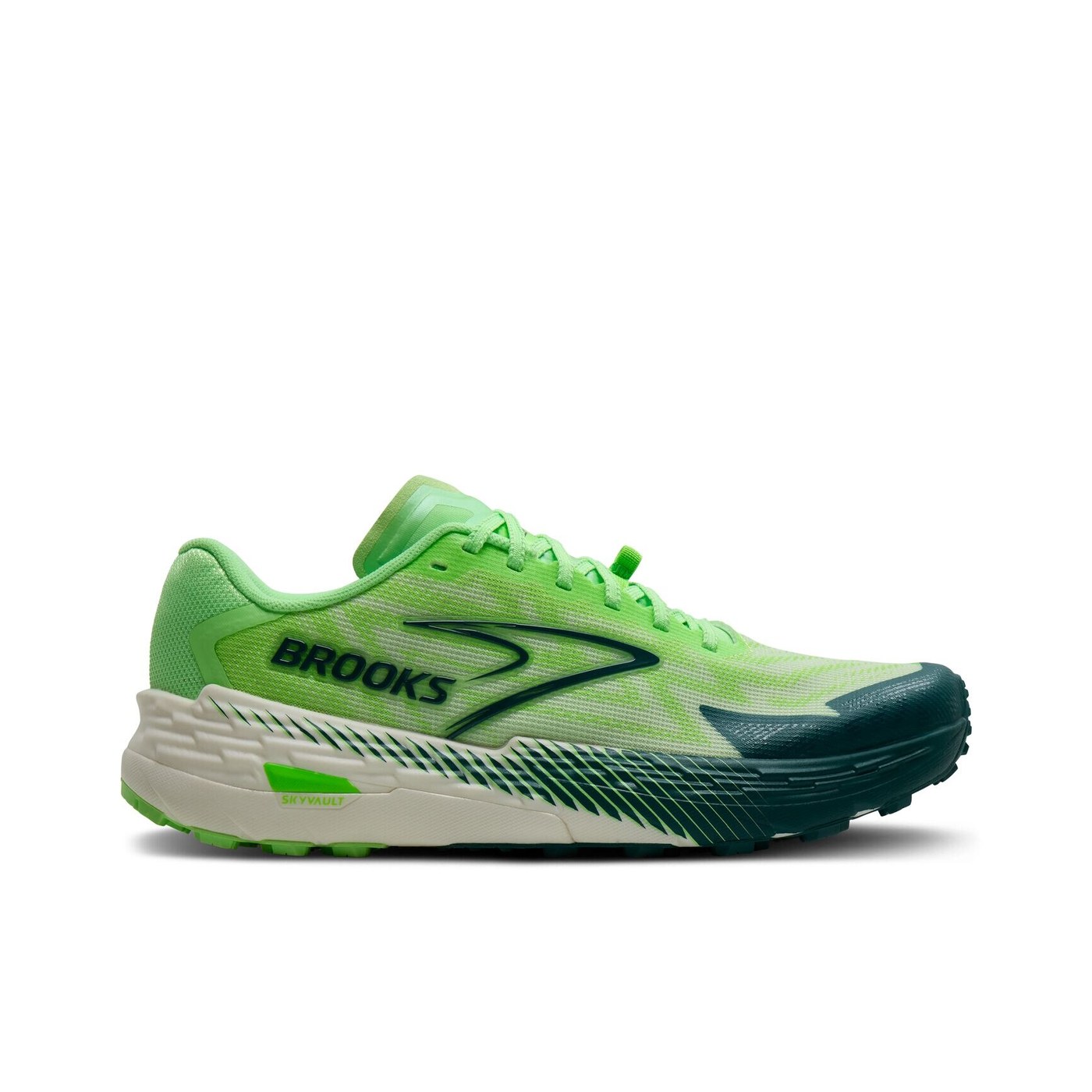
Since 2020, Brooks has sold the Catamount as its fast trail shoe, built for short races. Version 4 changes the pitch: more foam, a more curved plate, and a promise to go the distance. Out on the trails, two independent testers weighed it at 275 g in a size 42.5, 6 g more than the 269 g Brooks claims. A small gap, but a telling one: the Catamount 4 may not be quite the do-it-all shoe Brooks describes.
© Brooks Running, official photo used for editorial purposes
Brooks Catamount 4: the fast shoe that wants to be an all-rounder
Brooks launched the Catamount in 2020 to give its trail lineup a snappy model built for short races and hard efforts, a counterpoint to the more versatile, more protective Cascadia. Then the Catamount Agil arrived in 2024 and reshuffled the deck: it took over the role of pure short-trail racer, pushing the Catamount toward a slightly broader brief. Version 4 owns that shift. The midsole gains 2 mm of stack (34 mm at the heel versus 32 mm on version 3), the SkyVault plate gets a double curve to smooth out the stride, and Brooks now talks about a shoe that can handle 60 to 70 km, versus 40 to 50 km for the previous version. The drop stays at 6 mm.
On paper, the promise is clear: keep the pop that made the model a hit while widening its range. Our field test, cross-checked against three independent French sources, confirms the first half of that promise and seriously qualifies the second.
RunMorph's advice: if you're torn between the Catamount 4 and a more protective shoe for ultras, look at the Cascadia Elite or the Speedgoat 7 instead. The Catamount 4 is at its best in races from 25 to 60 km, not beyond.
Brooks Catamount 4: what the brand claims vs what was measured
On weight, the gap is modest but real: Brooks claims 269 g as its reference, while an independent tester from RunMag measured 275 g in a size 42.5, so +6 g (+2.2 %). Nothing dramatic, but the gap runs against the marketing story about the shoe getting lighter from one version to the next.
| Metric | Claimed (Brooks) | Measured (independent test) |
|---|
| Weight (men's, 42.5) | 269 g | 275 g (+6 g) |
| Drop | 6 mm | 6 mm (confirmed, consistent across sources) |
| Lugs | 3.5 mm (Brooks spec sheet / Le Comparatif du Trail) | Listed at 4 mm by one source, not confirmed by the other two |
That last point deserves to be flagged rather than smoothed over: two French sources agree on 3.5 mm lugs, a third says 4 mm. RunMorph goes with the figure confirmed by two independent measurements (3.5 mm), which matches the limited grip we felt on the trail.
© Brooks Running, official photo used for editorial purposes
The fit: an upper that feels tight out of the box
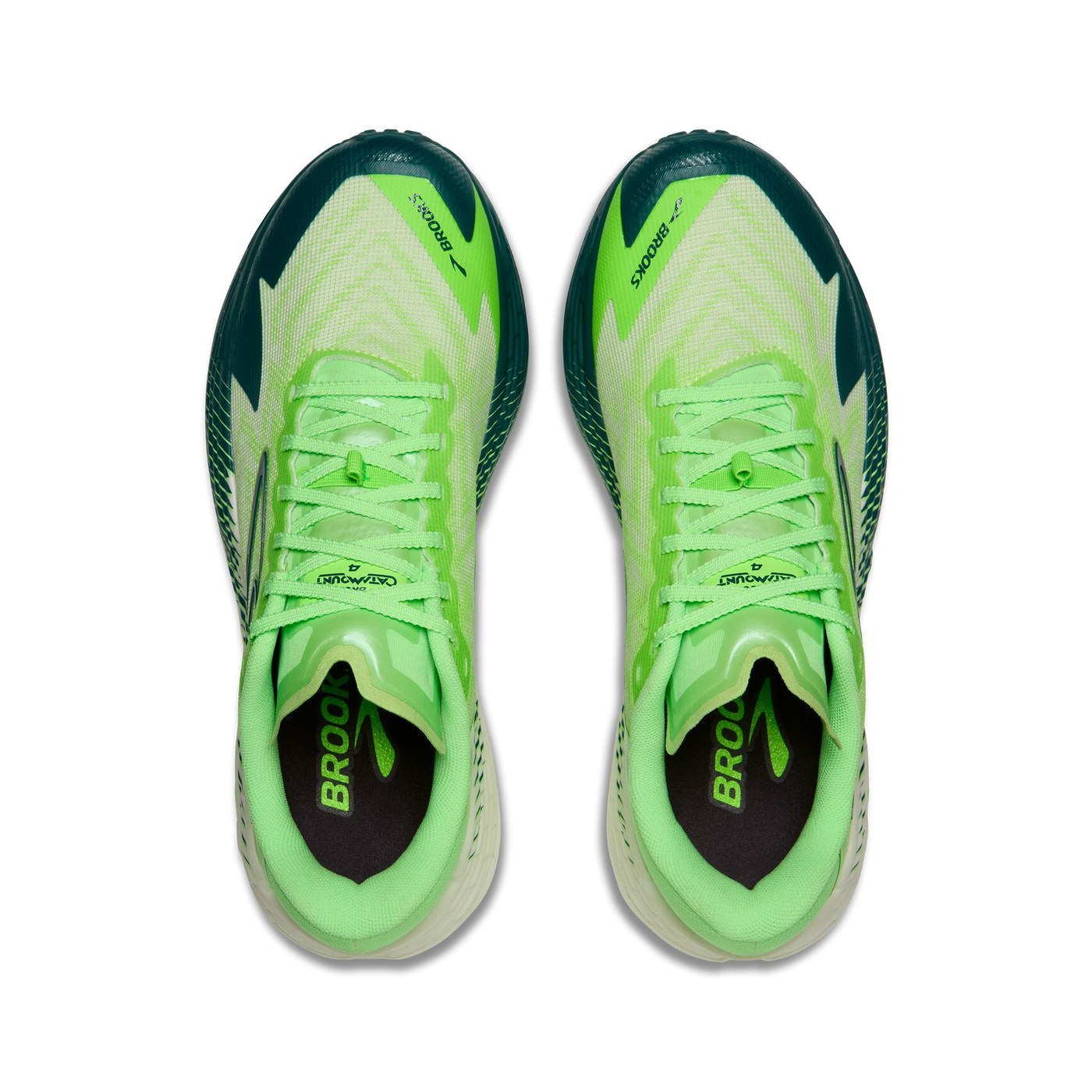
Brooks lists the fit as standard, unchanged from version 3. On the trail, a tester with wide feet reports a clear squeezing sensation when sliding the shoe on, like laces pulled too tight, which fades after the first few kilometers. That fits the shoe's new positioning: the toe box is roomier than the Catamount Agil's, but noticeably narrower than the Cascadia's or the Caldera's. Sizing also tends to run large: going up half a size from your usual is enough, whereas some runners go up a full size on other trail models.
The field test: 25 to 60 km on hardpack trails
From the first strides, the shoe rolls forward nicely and hints at the promised propulsion. Once you're up to speed, the SkyVault plate does its job: on runnable sections and fast singletrack, the rebound is sharp and the stride stays smooth, despite a slight stiffness when cold that eases after a few hundred meters. On more technical ground, littered with rocks or roots, foot placement is precise, but ground feel is far from fine: the cushioning and plate take over from any sense of the terrain.
The two sources that tested the shoe in real conditions agree on one thing: one tester never got to run the Catamount 4 in the rain or on soaked ground, for lack of the right weather, while another source mentions a rainy run with no notable slipping. RunMorph takes the more cautious reading, which matches the outsole design: a wide central strip of the outsole has no lugs at all, which mechanically limits grip on loose, wet or muddy terrain, whatever the weather on test day. On hardpack and dry ground, whether runnable or rocky, grip is not an issue.
Over distance, impressions differ slightly depending on the runner: one tester who logged several short runs and one 25 km long run reports cushioning that stays firm under the heel after several hours, while another puts the comfort limit closer to 60-70 km, versus 40-50 km for version 3. At RunMorph, we don't see these two takes as truly contradictory: the Catamount 4 improves on the previous version without becoming an ultra shoe.
Which paces it works at, and where it falls short
Easy runs and base endurance: fine, but the firmness of the DNA Flash v2 foam shows on relaxed runs where you want plushness rather than bounce.
Long run (25 to 40 km): this is the shoe's natural playground, where the 34 mm stack and the SkyVault plate find their balance.
Trail marathon distance (up to 60-70 km): doable depending on the runner, but the firm heel cushioning makes itself felt after several hours of effort, according to cross-checked field feedback.
Threshold pace and fast short trail: the model's strong suit, thanks to the Pebax plate's propulsion and a reasonable weight despite the 6 g gap noted above.
Technical and steep terrain: stability holds up thanks to the flexibility of the Pebax, but the limited grip forces you to ease off on wet or loose sections.
Flaw #1: grip that gives out on loose or wet ground
The central zone of the TrailTack Green outsole has no lugs, and the lugs that are there top out at 3.5 mm. On dry hardpack trails, you won't notice. On mud, sand or soaked ground, grip drops sharply: several testers point to this as the model's most concrete limitation, and RunMorph rates it a dealbreaker for regular use in wet mountain terrain.
Flaw #2: a fit that rules out wide feet
The fit is billed as standard but feels tight when you put it on, especially at the midfoot and toe box, for anyone with feet wider than average. It loosens up after a few kilometers, but a runner with wide feet will either need to go up half a size or look elsewhere in the Brooks lineup.
Brooks Catamount 4 vs Catamount 3: should you upgrade?
| Criterion | Catamount 3 | Catamount 4 |
|---|
| Heel stack | 32 mm | 34 mm |
| Drop | 6 mm | 6 mm |
| Use range | Short trail, 40-50 km | Short to mid-distance trail, 60-70 km |
| Plate | Flat SkyVault | Double-curved SkyVault |
| Feel | Tamer, softer | More aggressive, more responsive |
Who should upgrade: version 3 owners who want to stretch their distances toward trail marathons without switching lines. Who can stick with the old one: runners who only use the Catamount 3 on short, fast trails, where version 4's gains show up mostly over time on feet, not at high intensity.
Brooks Catamount 4 vs Hoka Tecton X 3 vs Salomon S/Lab Genesis: the comparison
| Model | Weight | Drop | Plate | Price |
|---|
| Brooks Catamount 4 | 269 g claimed / 275 g measured | 6 mm | Pebax (SkyVault) | €170 |
| Hoka Tecton X 3 | 259 g | 4 mm | 2 parallel carbon plates | €230 |
| Salomon S/Lab Genesis | 269 g | 8 mm | No rigid plate | €200 |
The short version: the Catamount 4 is the cheapest of the three and stays competitive on weight despite the measured gap, but it gives ground on technical grip to these two pricier rivals. For short, runnable trails on a sensible budget, it easily holds its own. For demanding mountain terrain, the Tecton X 3 keeps the edge.
How to fit the Catamount 4 into your RunMorph training plan
The Catamount 4 naturally belongs in the sessions of a RunMorph trail plan that target sustained paces on runnable terrain: hill repeats, threshold sessions on trails, long runs up to trail marathon distance. Save it for dry days or hardpack terrain, and keep a grippier pair in your bag for rainy runs or the ultras on your race calendar.
RunMorph Coach's verdict
The Brooks Catamount 4 delivers on its promise of pop and gains comfort over version 3, without becoming an ultra shoe. Its real weakness isn't the cushioning, it's the grip: an outsole built for hardpack and dry ground that lets go abruptly on loose or wet terrain. Add a fit that rules out wide feet, and you get a specialist shoe rather than a true all-rounder, whatever Brooks' marketing suggests. 7.8/10: a very good fast trail shoe, on the right terrain, for the right foot.
FAQ
What does the Brooks Catamount 4 really weigh?
Brooks claims 269 g for its men's reference, while an independent test measured 275 g in a size 42.5, a 6 g gap (+2.2 %).
Is the Catamount 4 suited to ultras?
Field feedback puts its comfort limit between 50 and 70 km depending on the runner, far from ultra distances of 100 km and more.
What lugs, what grip?
3.5 mm deep in a chevron pattern, with a lugless central outsole zone: enough on dry hardpack, limited in mud.
How much does the Brooks Catamount 4 cost?
€170, €30 to €60 less than direct plated rivals such as the Hoka Tecton X 3 (€230) or the Salomon S/Lab Genesis (€200).