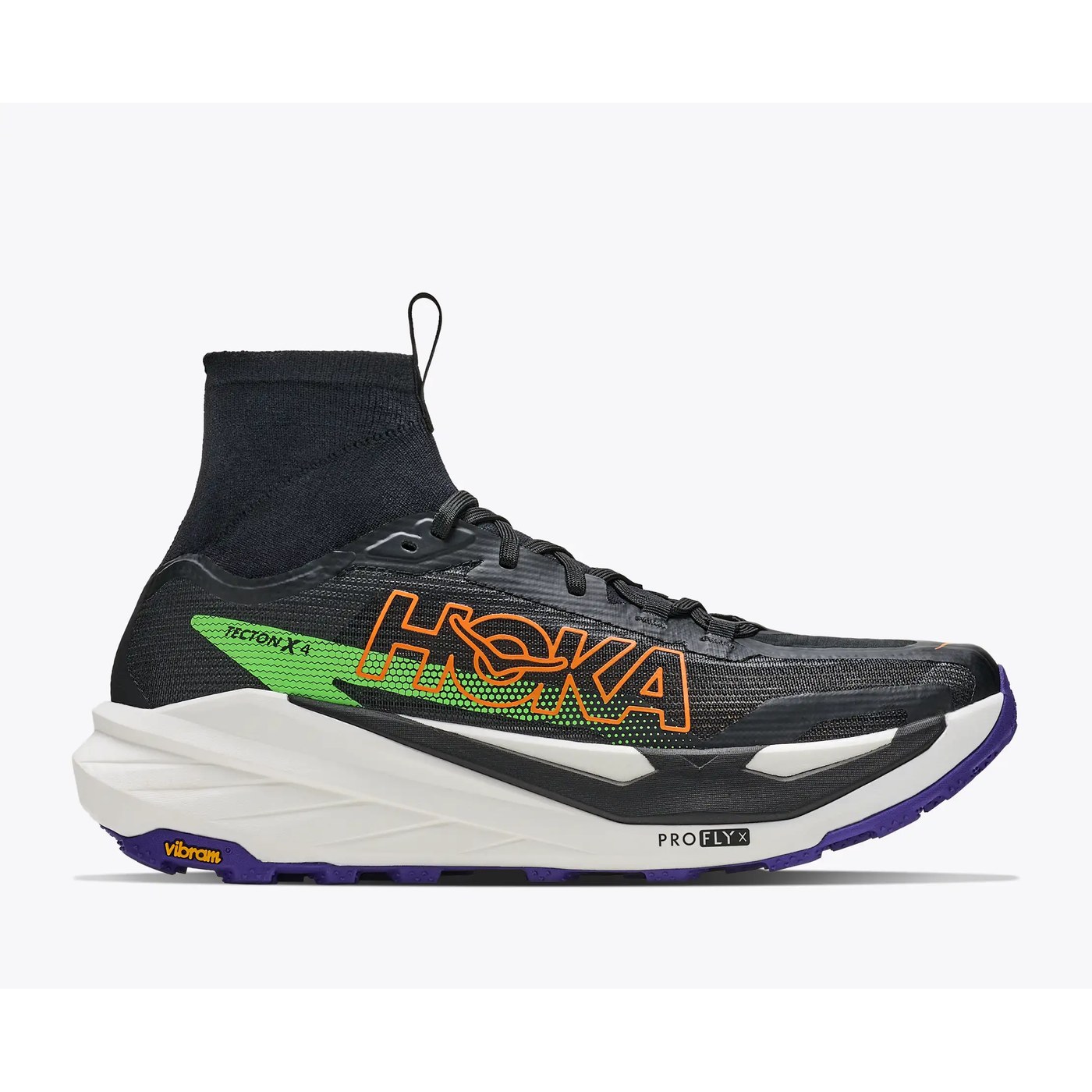
Hoka Tecton X 4: 270 g measured, two parallel carbon plates, the full review before UTMB
8/10
Hoka claims 275 grams for the Tecton X 4. Two independent testers, one French and one American, weighed their own pairs at 270 and 271 grams. At RunMorph, we cross-checked three full reviews to figure out what this fourth generation of carbon trail super-shoe really brings to the table, just days before UTMB.
The Tecton X 4 lands on 20 August 2026, a few days before UTMB, with a ProFly X platform and two refined parallel carbon rods. All three sources we read praise a clear sense of propulsion and much better stability than version 3, but they split on sizing and on how firmly the heel is held. This is a race shoe built for runnable to moderately technical terrain, not a machine for chewing through deep mud.
Who is it for?Experienced runners preparing a goal race between 40 km and 100 miles on runnable to moderately technical terrain, who are happy to pay for a specialist shoe kept for race day.
Who should skip it?Runners who regularly head into very technical or muddy terrain, anyone looking for a versatile daily trainer, or anyone on a tight budget: the Tecton X 4 still costs 250-275 euros.
Hoka Tecton X 4: why review it now?
The Hoka Tecton X 4 came out on 20 August 2026, timed to the day to arrive just ahead of UTMB, the biggest date on the global trail calendar. The Tecton X line already has a serious track record: Jim Walmsley wore a prototype when he won UTMB in 2023, then Vincent Bouillard took UTMB 2024 in a production version. RunMorph has already reviewed the Hoka Tecton X 3 and the Hoka Speedgoat 7: the X 4 fine-tunes the formula of the former without overhauling it.
RunMorph's advice: if your goal race sits between 40 km and 100 miles on mostly runnable trails, the Tecton X 4 deserves a spot in your race rotation. If you are targeting very technical, broken ground, look at the Hoka Mafate 5 instead, whose lugs grip better according to Journal du Trail.
Spec sheet: what Hoka claims
Brand
Hoka
Model
Tecton X 4
Release
20 August 2026
Type
Carbon trail super-shoe, race day and ultra-trail
Claimed drop
5 mm
Claimed stack
40 mm heel, 35 mm forefoot
Claimed weight
275 g (Hoka claim) according to We Rock Sport, 261 g on the US spec sheet for a US size 9 according to an American review site
Foam
ProFly X, dual layer of supercritical PEBA
Plate
Two independent parallel carbon rods
Upper
Ultra-thin Matryx Micro, knit collar with built-in gaiter
Outsole
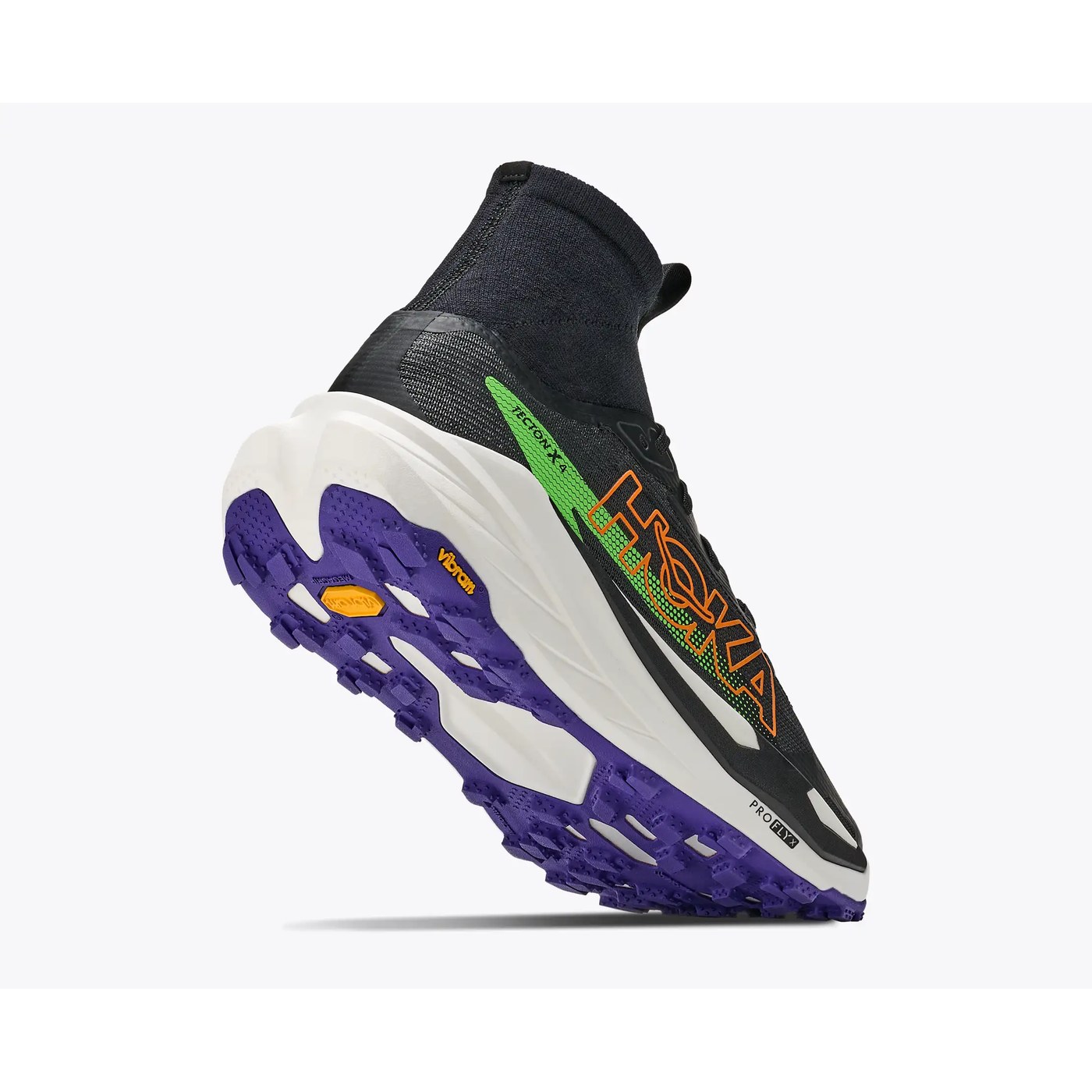
Vibram Megagrip Litebase, 4 mm Traction Lug
Available widths
Standard only
Official price
250 € (275 $ in the United States)
Tecton X 4: what Hoka claims vs what was measured
On weight, the sources disagree slightly, but in a direction RunMorph rarely sees: the spec sheet relayed by We Rock Sport says 275 grams, while the two testers who weighed their own pairs found them lighter. Vincent, from the French site Journal du Trail, weighed 270 grams in EU 42 2/3. On the other side of the Atlantic, an American review team recorded 271 grams on a pair in US M10.5. Two independent measurements, two continents, and a gap of 4 to 5 grams under the official claim.
Metric
Claimed (Hoka)
Measured (independent testers)
Weight
275 g (We Rock Sport) / 261 g US spec sheet, size 9 (American review site)
270 g (Journal du Trail, EU 42 2/3) and 271 g (American review team, US M10.5)
Drop
5 mm
5 mm confirmed by all three sources, no gap found
Heel stack
40 mm
40 mm confirmed by Journal du Trail with a ruler
This is the reverse of what RunMorph usually finds on other models: here, the real shoe is lighter than the marketing sheet, not heavier. The drop does not move by a single millimetre between claim and trail, which is not that common on a shoe with such a tall platform.
ProFly X, dual carbon plate and Matryx Micro: what really changes
The Tecton X 4 is built on the ProFly X platform, a dual layer of supercritical PEBA foam sandwiching two independent parallel carbon rods. This two-piece setup, rather than one single rigid plate, lets the sole twist and adapt to uneven ground, something Journal du Trail explicitly highlights as a stability factor on off-camber sections.
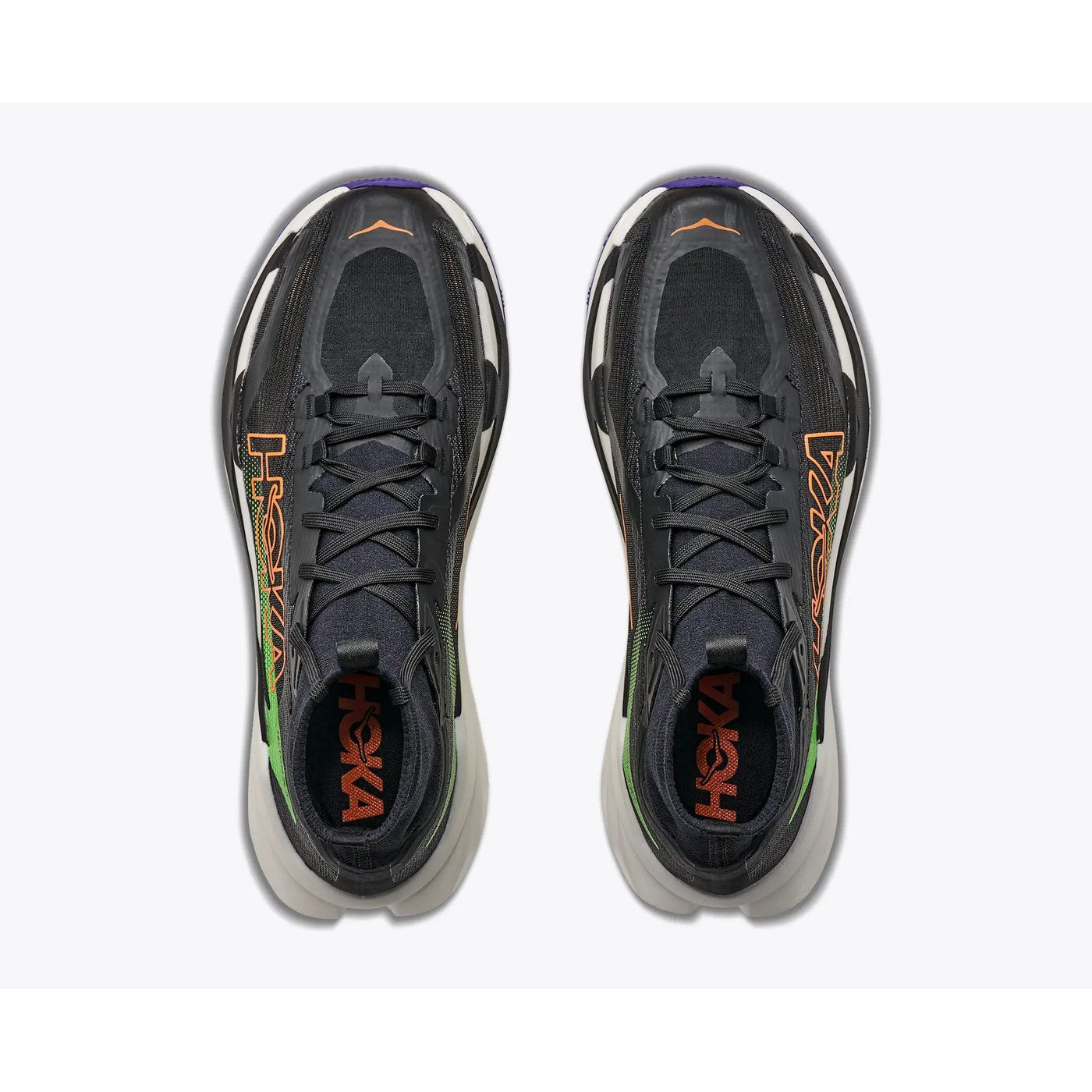
The upper moves to an unprecedentedly thin Matryx Micro weave: Journal du Trail describes it as so open that you can make out your toes through the mesh. That lightness comes at a price, covered further down in the watch-outs. The collar is still knitted with a built-in gaiter, a Tecton signature since version 2, and gains a new extra eyelet for a runner's loop lacing to lock the heel down better, an addition the three American testers we read tried out and approved.
This is the most useful disagreement RunMorph found on this model. The three American testers all recommend going up half a size, especially for long runs or steep, committed descents. Vincent at Journal du Trail, on the other hand, advises sticking with your usual size, arguing that length and forefoot volume stay in line with the brand's standards, even if the stretchy gaiter can give a misleading impression of a snugger fit.
RunMorph would rather report this split than settle it arbitrarily: the feel seems to depend on foot shape and on how long the test runs were. With a narrow foot and shorter runs, your usual size seems to work. With a wider foot or for efforts lasting several hours, when your feet swell, going up half a size looks like the safer bet.
On the trail: what the three sources say
RunMorph read three independent sources in full before making a call: a multi-tester review from an American site with three cross-checked opinions, the full field test from Journal du Trail carried out by Vincent Gaudin on his French training trails, and the field test by We Rock Sport with Private Sport Shop.
All three sources agree on the essentials: a clear push at every step, especially noticeable on climbs, and stability rated far better than version 3. The American team sums up version 4 as the most polished and complete in the line. We Rock Sport stresses that the shoe never gets unstable on descents despite its high stack, quite a feat for such a tall sole. Journal du Trail agrees: the shoe tracks straight and feels reassuring even on steep off-camber ground, thanks to the combined action of the two independent carbon rods.
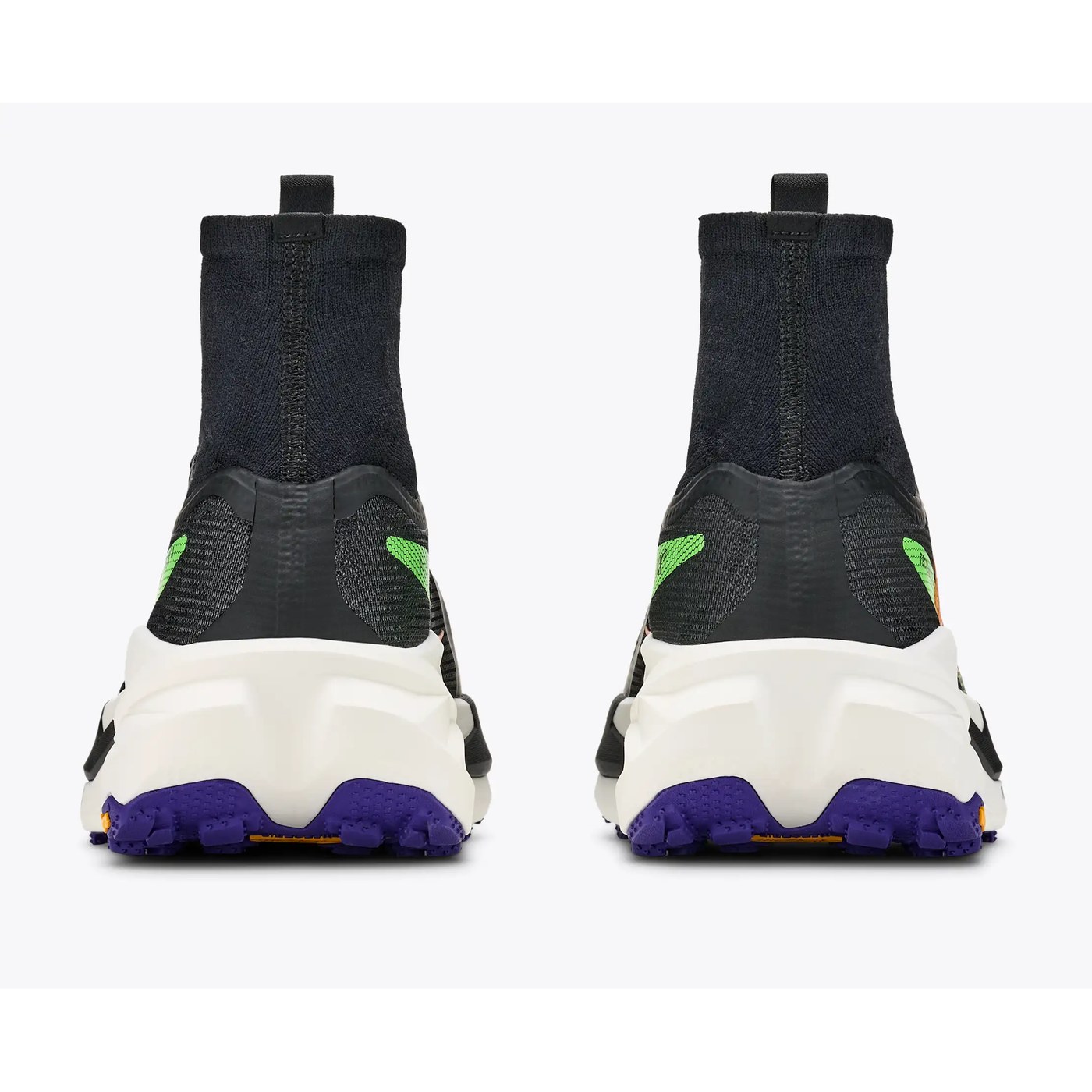
The sharpest disagreement, beyond sizing, concerns heel hold. One of the American testers found that the new collar padding solved the Achilles irritation he had with the Tecton X 3. Vincent at Journal du Trail, by contrast, points to a heel counter he finds too soft, able to fold slightly backwards and rub the tendon on climbs or during power hiking. RunMorph notes that the extra runner's loop lacing, praised by the American testers, could explain part of this difference in feel between the two reviews.
What pace and what terrain it works for
Runnable long-distance ultra-trail: the terrain all three sources agree on, between 40 km and 100 miles on mostly clean trails.
Sustained climbing: the push from the two carbon rods is clearly felt, at the cost of more calf load than in a shoe without a plate, as Journal du Trail notes.
Moderately technical descents: all three sources praise stability far above version 3, and none of them ever describes the shoe as unstable, even off-camber.
Very technical, rocky, committing terrain: decent without being ideal. Journal du Trail explicitly prefers the lug design of the Hoka Mafate 5 for this kind of ground.
Deep mud and waterlogged ground: the known weak spot. The Traction Lug studs, only 4 mm deep as confirmed by We Rock Sport, favour efficiency on dry, runnable ground at the expense of traction in thick mud.
First watch-out: durability of an extremely thin upper
Journal du Trail describes the Matryx Micro weave on the Tecton X 4 as so thin and translucent that you can clearly see your toes or the background through the mesh. That extreme lightness raises an obvious question about how it will hold up to repeated abuse from the trail, rocks and roots first of all. None of the three sources could give a definite answer: Journal du Trail admits it would take several hundred kilometres to know more, and the American team reports that the open mesh lets fine dust in more easily on dry, dusty trails, without it causing any major issue during their test period.
Second watch-out: heel hold that divides opinion
As mentioned in the cross-reviews, rear foot hold is up for debate between the sources. The heel counter, described as "very soft" by Journal du Trail, can fold backwards and rub the Achilles tendon during hiked climbing sections, a flaw the American team had already flagged on version 3. Yet the same team considers the problem largely fixed thanks to the new collar padding and the runner's loop lacing. RunMorph recommends making full use of this extra lacing option before concluding there is a design flaw.
Pros and cons
Pros
Clear propulsion confirmed by all three sources, especially on climbs
Stability much improved over version 3 despite a high stack
Reliable Vibram Megagrip traction on dry ground, rock and runnable trails
Highly breathable Matryx Micro upper that dries and drains fast
Measured weight of 270 to 271 g, under the official 275 g claim
Cons
Durability of the ultra-thin upper still unknown, no source has covered enough kilometres
Testers disagree on heel hold
No lace garage to tuck away the extra lace
Much less bite in deep mud, with lugs of only 4 mm
High price of 250 to 275 euros, a race-day-only shoe
Tecton X 4 vs the previous version: is the upgrade worth it?
Criterion
Tecton X 3
Tecton X 4
Weight
264 g claimed
270-271 g measured, under the 275 g claimed
Official price
230 €
250 € (275 $ in the United States)
Upper
Standard Matryx, integrated bootie
Much thinner Matryx Micro, runner's loop lacing added
Plate
Two parallel carbon rods
Same architecture, geometry refined for more pop
Collar hold
Flagged as a source of tendon irritation by some testers
Padding reworked, but opinions still split on the heel counter
Who should upgrade to version 4: runners who owned a Tecton X 3 and wanted more stability and better lacing, even if it means paying 20 euros more. Who can stick with the old one: those who were never bothered by the heel hold on version 3 and for whom the price gap matters more than incremental tweaks to the upper.
Tecton X 4 vs the Rocket X Trail and the Inov-8 TrailFly Speed V2
Model
Measured weight
Plate
Price
Hoka Tecton X 4
270-271 g
Two parallel carbon rods
250 €
Hoka Rocket X Trail
248 g (RunMorph review)
A-TPU plate, no carbon
Not specified
Inov-8 TrailFly Speed V2
274 g
No plate, G-GRIP graphene outsole
160 €
The short version: the Rocket X Trail, which RunMorph reviewed and found 20 g off its claimed weight, is still lighter and rolls more easily than the Tecton X 4, but it has no carbon plate and no Vibram outsole, which points it at less technical terrain. The Inov-8 TrailFly Speed V2 bets everything on grip, with a graphene outsole claimed to bite 50 % harder on wet rock, at a much lower price, but without the Hoka's carbon propulsion. If your priority is propulsion on runnable to moderately technical terrain, the Tecton X 4 keeps the edge. If you mainly want grip on wet rock for less money, the Inov-8 is worth a look.
How to fit it into your RunMorph training plan
In a trail rotation of 3 or 4 pairs, the Tecton X 4 is the race shoe you keep for goal events: 40 km, 80 km, 100 km or 100 miles on mostly runnable to moderately technical courses, like the CCC or Western States formats described by Journal du Trail. Keep a versatile daily trainer such as the Hoka Speedgoat 7 for your weekly volume and runs on mixed terrain, and save the Tecton X 4 for key sessions at race pace and for race day itself.
To build an ultra-trail build-up around this kind of super-shoe, the RunMorph trail training plans with a race-specific block at the end of the cycle (8 to 10 weeks) are a good fit: progressive long runs on runnable terrain let you validate the fit and the runner's loop lacing before racing in them, rather than discovering the pair on race day.
Durability and cost per kilometre: what it really costs
None of the three sources gives a precise mileage for the Vibram Megagrip Litebase outsole, but they all stress how reliable it is on dry ground. The real question mark is the Matryx Micro upper, whose extreme thinness has not yet been tested over enough distance to judge its abrasion resistance. With no hard data, RunMorph goes with a cautious estimate of 400 km, shorter than a classic training shoe, which fits the model's pure racing positioning.
At 250 euros and an estimated 400 km, the Tecton X 4 works out at around 0.63 euro per kilometre, well above the average for daily trainers. That is the usual price of a race-day super-shoe: the Tecton X 4 is not designed to rack up big weekly volume, but to come out of the box for the races that really matter.
RunMorph review verdict
The Hoka Tecton X 4 delivers on the essentials: clear propulsion, stability far better than version 3, and a real-world weight closer to 270 grams than the claimed 275, which is rare in that direction. The ProFly X platform and the two parallel carbon rods still do the job that built the Tecton line's reputation at the biggest races in the world.
The two watch-outs we identified, the uncertain durability of the Matryx Micro upper and the heel hold that splits testers, are not enough to call the shoe's overall concept into question. They do, however, make a strong case for trying before buying if you can, given how much opinions on sizing and fit vary with foot shape.
For 250 euros, you are buying a specialist racing machine, not a do-it-all pair. It is a deliberate choice, and one most runners looking for this kind of product will accept without a second thought.
8/10.
Key takeaways for your training
Real weight is around 270-271 g, under the official 275 g claim: good news for once.
Check your size before buying: opinions split between going up half a size and staying true to size, depending on foot shape.
Keep it for runnable to moderately technical terrain: in deep mud, the 4 mm lugs show their limits.
Expect around 400 km before replacing it, which means a cost of about 0.63 euro per kilometre.
Use the runner's loop lacing to lock in your heel if it feels loose at the back.
The RunMorph Coach's verdict
As a coach, what I take away from the Hoka Tecton X 4 is a shoe that does what it promises without trying to do everything. The push from the two carbon rods and the stability regained over version 3 make it a credible option for attacking an ultra-trail goal race on runnable terrain. That said, I recommend trying the pair on in a store before buying online: the gap between our sources on sizing and heel hold is not a minor detail, and only your own foot can settle it. The overall score of 8.0/10 rewards solid execution on the essentials, propulsion and stability, without ignoring the lingering doubt about the durability of such a thin upper and a price that reserves this pair for runners who know exactly why they are buying it.
FAQ
How much does the Hoka Tecton X 4 really weigh?
Hoka claims 275 g, but two independent testers measured 270 g and 271 g on their own pairs, which is 4 to 5 g less than the official figure.
What is the real drop of the Tecton X 4?
The 5 mm drop claimed by Hoka is confirmed with no gap by all three sources, a rarity on a shoe with a platform as tall as 40 mm at the heel.
Should you go up half a size?
Opinions differ: the three American testers we read recommend it, while Journal du Trail advises sticking with your usual size. It clearly depends on your foot shape.
How many kilometres can you expect from a pair?
No source gives an exact figure yet. RunMorph goes with a cautious estimate of 400 km, in line with the model's race-day positioning, for a cost of about 0.63 euro per kilometre.