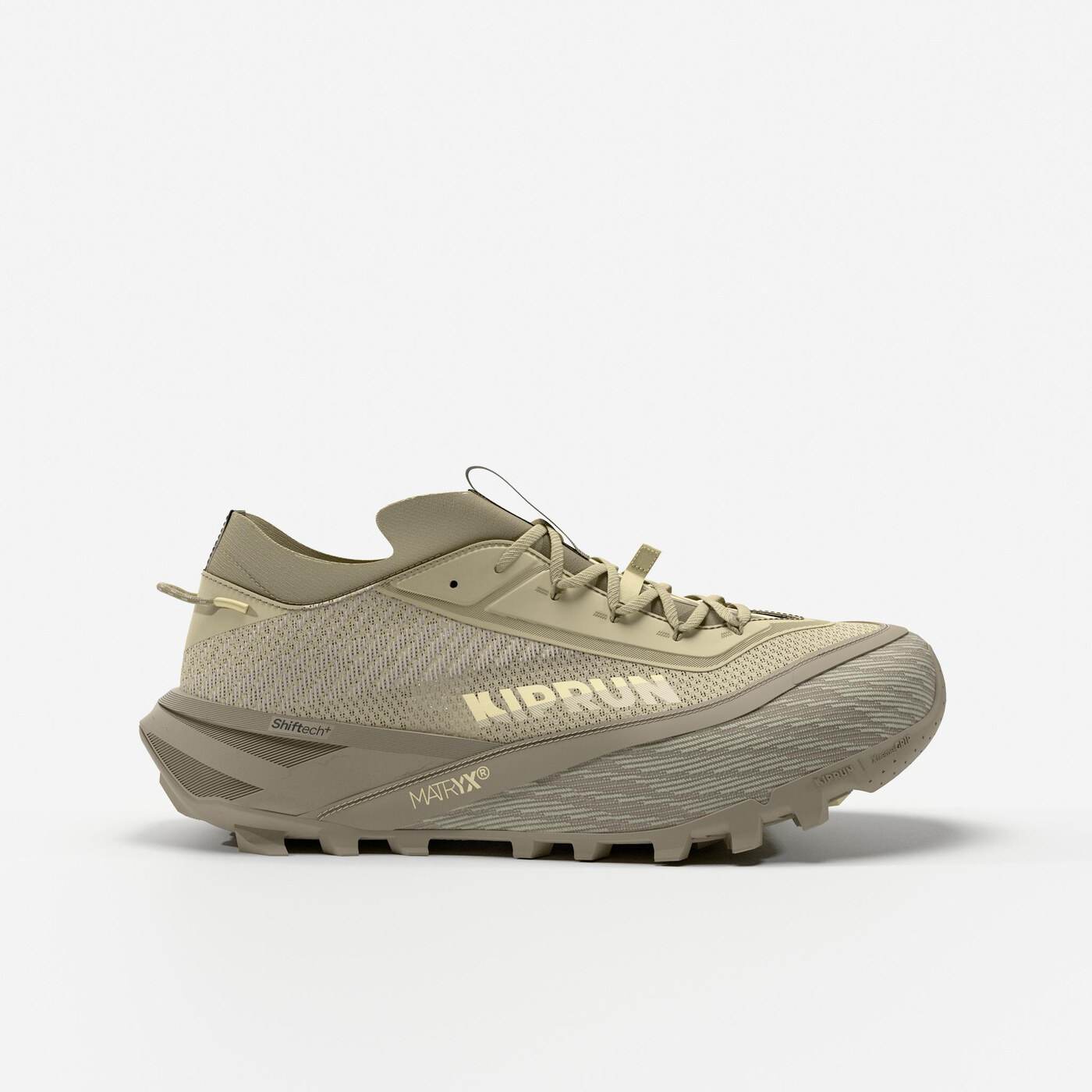
Kiprun launches a fourth trail line in June 2026, and this time the brand isn't chasing versatility. Decathlon bills the Kipclimb Max as the most technical and most aggressive shoe in the entire Kiprun range, built for scree fields, steep slopes and rough, broken trails where a regular trail shoe starts to hit its limits. Matryx upper, Shiftech+ foam, 5 mm lugs and a reinforced rock guard: the spec sheet ticks every box for high-mountain trail running. At €149.99, we put this pair through its paces to see whether it lives up to that promise and, above all, whether it's worth it for most runners.
Kiprun builds its trail range around four lines
With the Kipclimb Max, Kiprun rounds out a trail range that now has four clearly distinct families. The Kipsummit Race targets fast running on smooth terrain, the Kipsummit Max covers versatile ultra-trail running with its FASTECH+ foam and Vibram outsole, and the Kipstorm Elite handles road marathons with a carbon plate. The Kipclimb arrives with a clear, deliberately narrow mission: keep your footing secure where the terrain turns rough, unstable and steep.
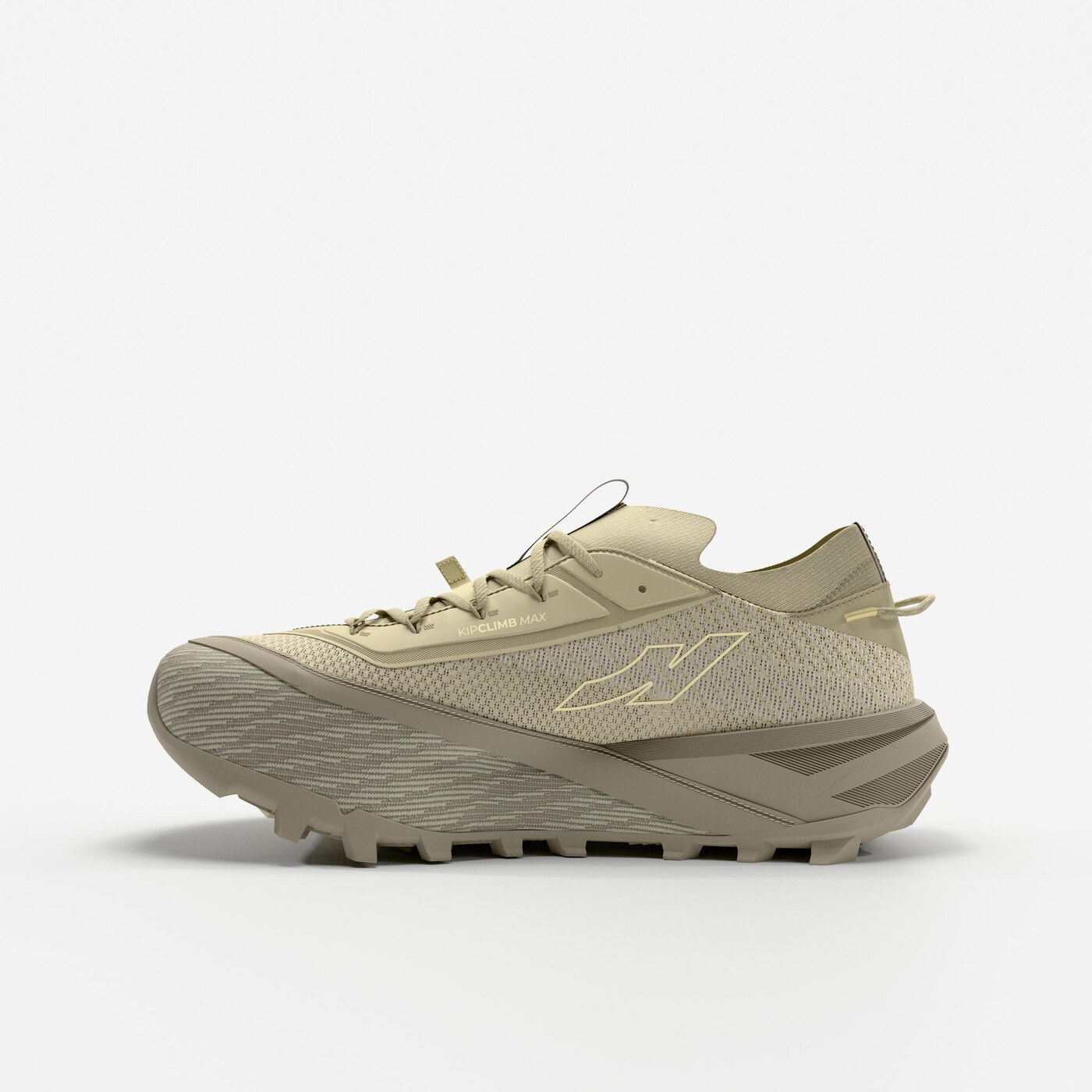
Two versions launch at the same time. The "standard" Kipclimb at €100 uses a dual-layer technical mesh without Matryx and a 6 mm drop. The Kipclimb Max, reviewed here, steps up with a Matryx upper, a more generous stack height (around 34 mm at the heel, 30 mm at the forefoot) and a drop cut to 4 mm. Kiprun's message leaves no room for doubt: maximum protection and grip first, no compromise toward versatility. Before launch, the shoe was tested in real conditions in the Calanques near Marseille, terrain that matches its hunting ground exactly.
| Price | €149.99 |
|---|
| Weight (men's, 42) | 315 g |
|---|
| Drop | 4 mm |
|---|
| Stack height | 34 mm heel / 30 mm forefoot (approx.) |
|---|
| Midsole | Kiprun Shiftech+ with Fastech insert |
|---|
| Outsole | In-house EVA/synthetic rubber compound, 5 mm lugs, reinforced rock guard |
|---|
| Upper | Matryx mesh, heat-welded overlays |
|---|
| Use | Technical trails, high mountains, rough and unstable terrain |
|---|
| Waterproofing | Not waterproof |
|---|
| Availability | June 2026 |
|---|
Three numbers to remember: 315 g in size 42 (Kiprun talked about 280 g for a long time before launch, but the official weight turned out much heavier), a tight 4 mm drop paired with an already substantial stack, and a €149.99 price tag that stays very reasonable for this level of technical gear.
Matryx and Shiftech+: the spec sheet decoded
The Matryx upper is the Kipclimb Max's most visible selling point. This composite material, already used by premium brands like NNormal and Salomon on their technical models, combines woven fibers with a reinforcement that resists abrasion far better than standard mesh. On scree and rock, where your foot rubs against stone all the time, that choice makes sense: the upper takes the punishment without tearing, and lateral hold stays solid even when your foot is hunting for purchase on an off-camber slope.
Underfoot, the Shiftech+ foam with Fastech insert favors firmness and stability over energy return. That fits the intended use: on unstable scree, a foam that's too soft would cost you precision with every foot strike. The Kipclimb Max goes for structure, not a fun ride. The 5 mm lugs, paired with a reinforced guard that shields the front of the foot from impacts, round out a shoe designed as a mountain safety tool rather than a performance machine.
On committing scree or a steep, broken slope, the priority is no longer the clock but knowing your foot will hold. That's exactly the terrain the Kipclimb Max was built to shine on, and where the Kipsummit Max, better suited to smoother ground, shows its limits.
The real flaw: specialization that costs a lot of versatility
Let's be blunt here, because Kiprun only half owns up to it in its marketing. The Kipclimb Max deliberately sacrifices versatility, and that choice has concrete consequences the spec sheet doesn't always spell out.
First, weight. At 315 g in size 42, it's heavy for a technical trail shoe in 2026. For comparison, the NNormal Kjerag 2, which targets exactly the same terrain (technical mountains, scree, precise footing), weighs 90 g less with a lower stack. The Hoka Speedgoat 7 comes in around 285 g for similar use. So the Kipclimb Max isn't just firm and protective: it's also much heavier than most of its direct rivals in this segment, and that hurts agility as soon as the pace picks up or the terrain calls for quick changes of footing.
Second, the lack of a Vibram outsole is a surprise at this price and positioning. Technical rivals (Kjerag 2, Speedgoat 7, Trabuco Max 5) almost always go with Vibram Megagrip for grip on wet ground or smooth rock. Kiprun uses an in-house EVA/synthetic rubber compound here that does the job on dry rock but struggles on wet slabs or wet roots, exactly the situations where a high-mountain shoe most needs to inspire confidence.
Finally, the deliberately stiff Shiftech+ and the 34 mm stack with just a 4 mm drop create a firm feel that takes real time to get used to. If you mostly run on smooth or semi-technical terrain, that firmness doesn't translate into more comfort. It translates into a shoe that lacks energy return and wears your legs down late in the run. In other words, the Kipclimb Max excels on its home turf but quickly becomes a poor choice once you step outside that very specific niche. This isn't a shoe for most trail runners, not even those who enjoy technical terrain now and then.
Check before you buy: if your runs mix technical and smooth sections, the Kipclimb Max is likely to frustrate you on the smooth parts. Look at how often you actually run on truly rough terrain before you invest.
The RunMorph field test
On scree and rocky trails, the Kipclimb Max delivers. The 5 mm lugs bite hard into dry rock, the front guard does a good job against knocks on boulders, and the firm Shiftech+ gives a sense of control that reassures as soon as the terrain turns unstable. It's the kind of shoe that gives you the confidence to plant your foot on a wobbly rock without a second thought.
On steep climbs, the 4 mm drop and the Matryx hold do the job: your foot stays stable and the upper doesn't shift sideways, even when you push hard off the forefoot. On technical descents in dry conditions, grip stays solid and predictable. It's far less convincing once the ground is wet: without Vibram, the in-house rubber loses bite on wet roots or polished slabs, an area where premium rivals do better.
On smooth or semi-technical terrain, the shoe loses its appeal. The firmness that reassures on scree turns into a lack of energy return on regular trails, and the 315 g weight makes itself felt as soon as the pace rises. As good a tool as the Kipclimb Max is on its home turf, it's clearly not meant to be the only shoe in your rotation.
Kipclimb Max vs NNormal Kjerag 2: which technical trail shoe to choose
| Kiprun Kipclimb Max | NNormal Kjerag 2 |
|---|
| Price | €149.99 | €190 |
| Weight | 315 g | 225 g |
| Drop | 4 mm | 6 mm |
| Stack height | 34 mm / 30 mm | 26 mm / 20 mm |
| Outsole | In-house compound, 5 mm lugs | Vibram Megagrip Litebase, 3.5 mm lugs |
| Upper | Matryx | Matryx Light Jacquard |
| Profile | Maximum protection, very rough terrain | Lightweight precision, fast technical terrain |
The comparison is revealing because it shows two opposite ways of tackling the same terrain. The NNormal Kjerag 2 goes for precision and low weight with a low stack and a Vibram Megagrip Litebase outsole, even if that means giving up a little protection on the biggest impacts. The Kipclimb Max takes the opposite route: more foam, more protection and a reinforced guard, at the cost of much more weight and an outsole that performs worse on wet terrain. On dry scree, the two are evenly matched. On wet ground or fast technical terrain, the Kjerag 2 keeps the edge. On budget, the Kipclimb Max is still €40 cheaper, and that counts for something.
The comparison also makes sense against the iconic Salomon Speedcross 6, which relies on even longer lugs for greasy, muddy ground rather than dry rock. Both shoes target technical terrain, but not exactly the same surface: the Speedcross remains the benchmark in deep mud, the Kipclimb Max on scree and rock.
Strengths
- Excellent grip and protection on scree and dry rock
- Highly abrasion-resistant Matryx upper
- Solid lateral hold on unstable terrain
- Reasonable price (€149.99) for this level of technicality
Weaknesses
- 315 g, heavy for a technical trail shoe in 2026
- No Vibram outsole, weaker grip on wet ground
- Almost no versatility outside very technical terrain
- Firm feel that takes real time to get used to
Our take from the trail
The Kipclimb Max does exactly what it promises on the terrain it was designed for: keeping your footing secure in technical high mountains. But it's a specialist's tool, not an all-round rotation shoe, and its weight and lack of Vibram are two very real limitations you need to know about before you buy.
RunMorph verdict
Kiprun hits hard with this fourth trail line: the Kipclimb Max is an honest, coherent and effective shoe on its home turf, technical and rugged high-mountain terrain. The Matryx upper delivers on its promise, the grip on dry rock is convincing, and the price stays very competitive against premium rivals at €190 or more.
But let's be clear about what this shoe is not. It's not a versatile trail shoe, it's not a light shoe, and the missing Vibram outsole shows as soon as the ground gets wet. Kiprun has gone all in on extreme specialization, and that choice inevitably narrows the group of runners who really benefit from buying it. If most of your runs are on Alpine or Pyrenean scree and secure footing is your top priority, the Kipclimb Max is an excellent buy at €149.99. For everyone else, the more versatile and lighter Kipsummit Max is probably still the better choice.
Key takeaways
Kiprun Kipclimb Max: 315 g, 4 mm drop, 34/30 mm stack, Matryx upper, Shiftech+ foam, 5 mm lugs, €149.99. Excellent on scree and very technical terrain, but heavy and without Vibram: save it for truly committing mountain runs, not your main rotation.