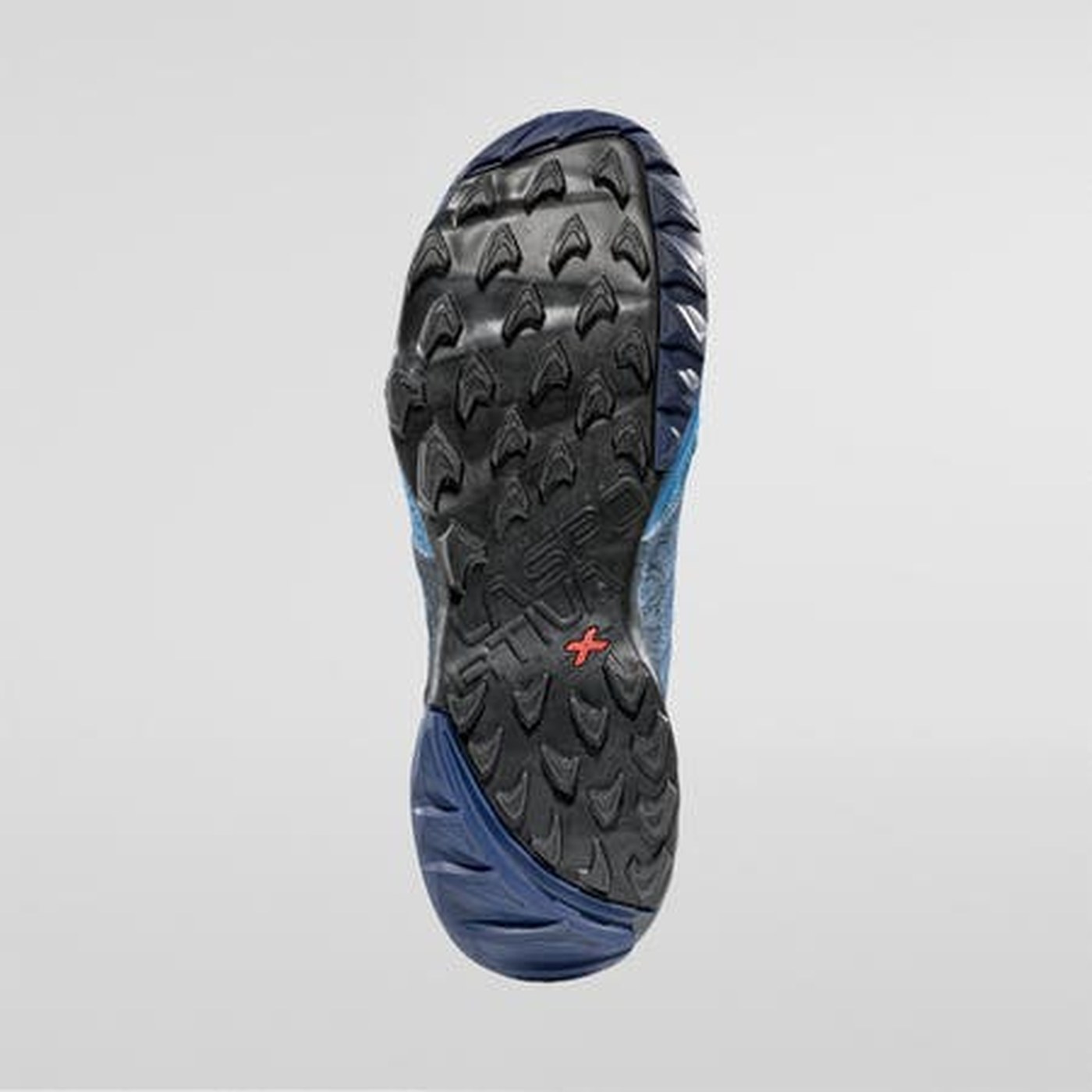
La Sportiva Akasha II: 10 mm claimed, 6 mm measured, the unfiltered review
8.2/10
On the La Sportiva spec sheet, the Akasha II claims a 10 mm drop. Out on the trail, two independent testers (one French, one American) measure a 31 mm heel stack and a 25 mm forefoot stack: that is 6 mm in reality. The gap is not a footnote: it changes how your foot hits the ground on long descents. At RunMorph, we cross-checked the measurements, read the French and English-language reviews, and here is what a 4 mm gap really changes for an ultra-trail runner.
The Akasha II claims a 10 mm drop, but two independent measurements converge on 6 mm in reality, a gap the brand never mentions. Weight also climbs from a claimed 310 g to a measured 321-325 g, without undermining grip and protection that remain the benchmark of La Sportiva's long-distance range. This is a technical ultra-trail shoe, not a speed shoe: excellent for multi-hour mountain runs, far less relevant for intervals or short trail races.
8.2
/ 10 · RunMorph overall score
Grip
9.5 / 10
Protection and cushioning
8.5 / 10
Stability and lockdown
9 / 10
Responsiveness
6 / 10
Value for money
7.5 / 10
Who is it for?Trail runners who stack up ultras and long mountain runs, want maximum protection on technical terrain, and will accept a few dozen extra grams in exchange for grip and stability at the top of the category.
Who should skip it?Runners looking for a lively shoe for short trail races, intervals or faster paces: the measured 321 to 325 g and the firm cushioning hold back every surge compared with models 30 to 40 g lighter.
La Sportiva Akasha II: why review it now?
The La Sportiva Akasha II is not a 2026 launch: it came out in 2022 and, four years later, is still one of the pillars of the Italian brand's Mountain Running range. That is exactly what makes this review useful today. A shoe still sold at full price (155 euros on lasportiva.com) and still getting glowing feedback (67 reviews, 4.9/5 average on the official site as of 17 September 2026) deserves a check on whether the claimed spec sheet matches what runners actually measure on the trail, rather than a rewrite of the brand's press release.
In the La Sportiva lineup, the Akasha II covers the max-protection, long-distance segment, alongside the Jackal II (lighter, snappier) and the Ultra Raptor II (more technical, heavier). RunMorph already tested the La Sportiva Prodigio 2, which targets a more versatile use: the Akasha II is aimed squarely at runners focused on mountain ultras.
RunMorph's advice: if you are training for an ultra with lots of technical elevation and your top priority is protecting your footstrike over the long haul, the Akasha II is a serious contender. If your goal is a short trail race or intervals on smooth singletrack, look at the Hoka Speedgoat 7 instead, 41 to 45 g lighter depending on the measurements.
Spec sheet: what La Sportiva claims
Brand
La Sportiva
Model
Akasha II
Release
2022 (still on sale in 2026)
Type
Ultra-distance trail, high protection
Claimed drop
10 mm
Claimed weight
310 g (single shoe, official spec sheet)
Foam
Dual-injected MEMlex EVA + Cushion Platform insert
Outsole
Dual-compound FriXion Red, 4.5 mm lugs, Impact Brake System
Akasha II: what La Sportiva claims vs what was measured
This is the table that justifies the review. Two independent testers, one French (U-Run, field test on Réunion Island) and one American (several years of use and successive pairs), each measure a 31 mm heel stack and a 25 mm forefoot stack. Do the math: that is a 6 mm drop, not 10. The French site Pacing Trail repeats the brand's 10 mm figure in its text, while publishing the same 31 and 25 mm stack in its own spec table, without flagging the contradiction. That is exactly the kind of lazy consensus RunMorph would rather verify than repeat.
Data
Claimed (La Sportiva)
Measured (independent tests)
Drop
10 mm
6 mm (31 mm heel / 25 mm forefoot, U-Run and a US long-term test)
Weight (size EU 42-42.5)
310 g
321 to 325 g per Pacing Trail and a US long-term test
Lugs
4.5 mm claimed
4.5 to 6 mm depending on the outsole zone (Pacing Trail)
The weight gap is subtler but just as real: 310 g claimed versus 321 g measured by Pacing Trail in size 42 and 325 g actually weighed by the American tester in US M9 / EU42. Two independent measurements, two different methods, and a gap that lands in the same range: 11 to 15 g more than claimed, roughly 4 to 5% above the official figure.
FriXion Red and Trail Rocker: what changes underfoot?
The dual-compound FriXion Red outsole, paired with the Impact Brake System, is the one element all four sources consulted by RunMorph rank as the top strength. On wet, dry, rocky or volcanic ground (the U-Run test was run on the lava flows of Piton Maïdo, on Réunion Island), the grip never gives way. It is also the only criterion where RunMorph gives a score above 9 out of 10 in the scorecard above.
The Trail Rocker, an outsole geometry that guides the heel-to-toe transition, partly explains why the real 6 mm drop does not feel minimalist: the rocker makes up for some of the difference with a smooth roll-through, even if the raw stack measurement stays exactly as reported above.
On cushioning, the dual-injected MEMlex EVA foam gets an extra 3 mm insert (Cushion Platform) on this second version, sitting between the Ortholite Hybrid insole and the main foam body. The result reported by all four sources: cushioning that is firm but never mushy, built to absorb thousands of footstrikes over a multi-hour run rather than to return energy at high pace.
Fit: generous volume, but not for every foot
All four sources describe the Akasha II as having generous internal volume, with a gusseted tongue (attached at the sides) that improves lockdown without creating pressure points. One English-language review explicitly rates it roomier than the average technical trail shoe, though not as wide as Altra models, the market reference on that specific point.
None of the four sources publishes an exact toe box height in millimeters: RunMorph flags that rather than inventing a number. What U-Run and Pacing Trail do confirm independently is the absence of any squeeze even after several hours of effort, a key point when your feet swell during an ultra. Heel hold earns unanimous praise: the heel counter, neither too high nor too low, combined with the collar padding, prevents any slipping, even on long off-camber sections.
Field test: what runners who actually wore it say
RunMorph read four independent tests in full before making a call: a qualitative English-language review (verdict and pros/cons list), the U-Run field test on Réunion Island over the volcanic flows of Piton Maïdo, Pacing Trail's detailed, scored review (4.3 out of 5, the equivalent of 8.6 out of 10), and a long-term American test whose reviewer has run in the Akasha since the first version and has several years of trail feedback on this exact model.
All four sources agree on the essentials: grip at the top of the category, protection and lateral stability well above average, firm cushioning that stays comfortable over the distance. U-Run sums up its experience after several kilometers on basalt this way: grip and traction remain the absolute strengths, to the point of feeling confident on demanding rocky or vegetated sections. Pacing Trail gives 5 out of 5 to both grip and protection/lockdown, but only 3 out of 5 to responsiveness.
Where the sources differ slightly is on weight and how it feels: U-Run finds it a bit heavy but happily accepts it in exchange for the level of support, while Pacing Trail makes it one of the three explicit negatives in its test, alongside breathability and a lack of pop. RunMorph chooses to report this disagreement rather than smooth it over: weight is an accepted trade-off for some testers and a real sticking point for others, depending on intended use.
At which pace it works, at which pace it falls off
Easy runs and base endurance: fine, but not the model's strong suit. The MEMlex EVA foam is firm rather than bouncy (3 out of 5 for responsiveness from Pacing Trail), so the Akasha II gets the job done without lifting an easy run.
Long run: this is where the shoe makes complete sense. The 31 mm heel stack and the 3 mm Cushion Platform insert absorb repeated impacts over several hours, which U-Run and the American long-term tester confirm independently after runs of several dozen kilometers.
Marathon pace on smooth terrain: average. The real 6 mm drop encourages a midfoot rather than heel strike, but the measured 321 to 325 g and the firm foam limit how snappy your surges feel at that pace.
Threshold and half marathon pace: falls behind. Pacing Trail's 3 out of 5 responsiveness score holds true at this pace: the lack of a reactive foam or propulsion plate shows as soon as the pace picks up.
Short intervals: the model's acknowledged weak spot. One English-language review says it plainly (not for fast runs), and La Sportiva itself positions the Jackal II for this use, 34 g lighter (287 g versus 321 g measured).
The understated weight: 15 g that change how the shoe stacks up
La Sportiva lists the Akasha II at 310 g. Two independent testers, using two different weighing methods, measure 321 g (Pacing Trail, size 42) and 325 g (the American tester, US M9 / EU42). The 11 to 15 g gap does not change what the shoe is, but it does change where it sits against its direct rivals: at a measured 321-325 g, the Akasha II is closer to the Saucony Xodus Ultra 4 (318 g claimed) than to the 310 g figure it claims for itself, and drifts a little further from the Salomon Ultra Glide 4 (280 g measured, 41 to 45 g less).
In practice, if you are choosing between two pairs based on listed weight, the real gap with the competition is consistently bigger than the respective spec sheets suggest. RunMorph would rather point that out than copy the marketing figure without checking it.
Breathability: the price of maximum protection
The second recurring flaw across all four sources: breathability. One English-language review sums it up in a word (so-so) and blames it directly on the TPU overlay covering a large part of the forefoot for impact protection. Pacing Trail rates it decent but below the more minimalist models in the category. Even the American long-term tester, broadly enthusiastic about the shoe, notes that the perforated AirMesh on this second version drains water better and dries faster than the first generation, without putting the Akasha II among the benchmarks for ventilation.
The cause is measurable and built into the design itself: the Dynamic ProTechTion overlays and the TPU toe cap, which explain the very good impact protection (8.5 out of 10 in the scorecard above), cover part of the surface that a more breathable model would leave as open mesh. It is a design trade-off, not a manufacturing flaw: more protection, a bit less airflow.
Akasha II vs Akasha I: is the update worth it?
Criterion
Akasha I
Akasha II
Claimed weight
330 g
310 g (-20 g, or -6%)
Upper
Standard mesh, no recycled materials
Perforated AirMesh, 100% recycled laces
Stability
Medial/lateral TPU STB only
TPU STB + extra 3 mm EVA insert
Toe cap
Standard protection
Reinforced TPU, denser and more flexible at the same time (US long-term test)
Outsole
First-generation FriXion XT
FriXion XT 2.0, more wear-resistant
Who should upgrade: owners of a worn-out first Akasha, and anyone looking to save weight and gain breathability without giving up protection. The claimed 20 g saving (still real even after correcting for the measurement gap identified above) and the improved water drainage justify the switch to version 2 on their own. Who can keep the old one: runners who already own a first Akasha in good shape and were never bothered by its weight: the version 2 changes are incremental improvements, not an overhaul.
Akasha II vs the Salomon Ultra Glide 4 and the Hoka Speedgoat 7
Model
Drop
Heel/toe stack
Measured weight
Estimated durability
Price
La Sportiva Akasha II
6 mm (measured)
31 mm / 25 mm
321 to 325 g
~750 km
155 €
Salomon Ultra Glide 4
6 mm
41 mm / 35 mm
280 g
~600 km
150 €
Hoka Speedgoat 7
5 mm
40 mm / 35 mm
280 g
not provided by RunMorph
165 €
The short version: at almost the same price, the Salomon Ultra Glide 4 offers more stack (41 mm versus 31 mm measured) for 41 to 45 g less, but with a shorter claimed lifespan (600 km versus about 750 km for the Akasha II) and grip judged improvable on wet slabs in RunMorph's Ultra Glide 4 review. The Hoka Speedgoat 7 bets on short-to-long versatility rather than pure protection: also 41 to 45 g lighter measured, with a very complete Vibram Megagrip, but less specialized for mountain ultras than the Akasha II. If grip and protection on technical terrain are your absolute priority and weight comes second, the Akasha II stays ahead of both. If you mostly run on hardpack trails and every gram counts, both rivals take the edge.
Pros and cons
Pros
Grip rated flawless on volcanic, rocky and wet ground (U-Run test, Réunion Island)
Lateral support and ground feel rated 5 out of 5 by Pacing Trail, even on long off-camber sections
Official weight cut by 20 g compared with the Akasha I (330 g to 310 g claimed)
Proven durability: a La Sportiva customer reports over 750 km per pair on his 8th Akasha
Generous internal volume that avoids foot squeeze after several hours (U-Run, Pacing Trail)
Cons
Measured weight of 321 to 325 g, 11 to 15 g more than the claimed 310 g
Real drop measured at 6 mm versus 10 mm claimed, missing from official communication
Responsiveness rated only 3 out of 5 by Pacing Trail, poorly suited to intervals or short trail races
Breathability rated decent but below more minimalist models (Pacing Trail, an English-language review)
Grip and durability: the real cost per kilometer
On durability, RunMorph relies on two converging signals: the American long-term tester, who regularly gets 450 to 500 miles (720 to 805 km) out of a pair of Akashas before replacing it, and a customer review posted on the official La Sportiva product page (17 September 2026), where a runner says he is on his 8th pair, each one having passed 750 km without issues. RunMorph uses a conservative estimate of 750 km.
At 155 euros and an estimated 750 km, the Akasha II works out to about 0.207 euro per km. For a direct comparison, the Salomon Ultra Glide 4 sells for 150 euros with a claimed lifespan limited to 600 km in RunMorph's review of that model, about 0.25 euro per km. The Akasha II's sticker price is close to its direct rival's, but its real cost of use is about 17% lower, thanks to a FriXion XT 2.0 outsole known for its wear resistance.
Our field verdict: who is it really for?
The Akasha II targets a specific profile: the trail runner aiming for ultra distances in the mountains, on technical terrain, who puts protection and grip ahead of low weight. If you are training for a goal race of several dozen kilometers with demanding elevation, this pair is one of the serious options on the market right now. If, on the other hand, your RunMorph training plan includes interval sessions or runs at sustained pace, keep the Akasha II for weekend long runs and plan a lighter pair for midweek quality sessions: that is exactly the kind of trade-off RunMorph helps you build into a personalized training plan, so a single pair of shoes does not have to cover contradictory uses.
RunMorph Coach verdict
As a coach, I see the Akasha II as an honest shoe on the essentials (grip, protection, stability) whose numbers need correcting with independent measurements: a real 6 mm drop rather than 10, and 321 to 325 g rather than 310. The overall score of 8.2/10 reflects that balance: it rewards a very solid product for its target use (grip 9.5/10, stability 9/10), without ignoring its accepted limits on responsiveness (6/10) and value for money that is decent without being exceptional (7.5/10) once the real weight is factored in. It is not a do-everything shoe; it is a very good shoe at what it does.
Key takeaways for your training
The real drop is 6 mm, not 10: adjust your transition if you are coming from a high-drop shoe, as a midfoot strike will feel more natural than expected.
Count on a real 321 to 325 g, not 310 g, when comparing weight with another pair in your rotation.
Save it for runs over 2 hours: that is where the 31 mm stack and the 3 mm Cushion Platform insert earn their weight.
Plan on about 750 km before replacing it, a cost of use of about 0.21 euro per km.
Do not count on it for intervals: for that job, a pair 30 to 45 g lighter will do better.
FAQ
What is the real drop of the La Sportiva Akasha II?
La Sportiva claims a 10 mm drop, but two independent tests measure a 31 mm heel stack and a 25 mm forefoot stack, which gives a real drop of 6 mm, 4 mm less than the official claim.
How much does the Akasha II really weigh?
The official spec sheet says 310 g. Independent measurements range from 321 g (Pacing Trail, size 42) to 325 g (US long-term test, US M9/EU42), a gap of 11 to 15 g from the stated figure.
How many kilometers can you expect from a pair?
Based on a long-term test (450 to 500 miles, or 720 to 805 km) and a customer review reporting over 750 km per pair, RunMorph uses an estimate of 750 km, for a cost of use of about 0.21 euro per kilometer.
Is the Akasha II suitable for short trail races or intervals?
No: at a measured 321-325 g, it weighs 34 to 38 g more than the La Sportiva Jackal II (287 g claimed), which the brand itself positions for faster use.