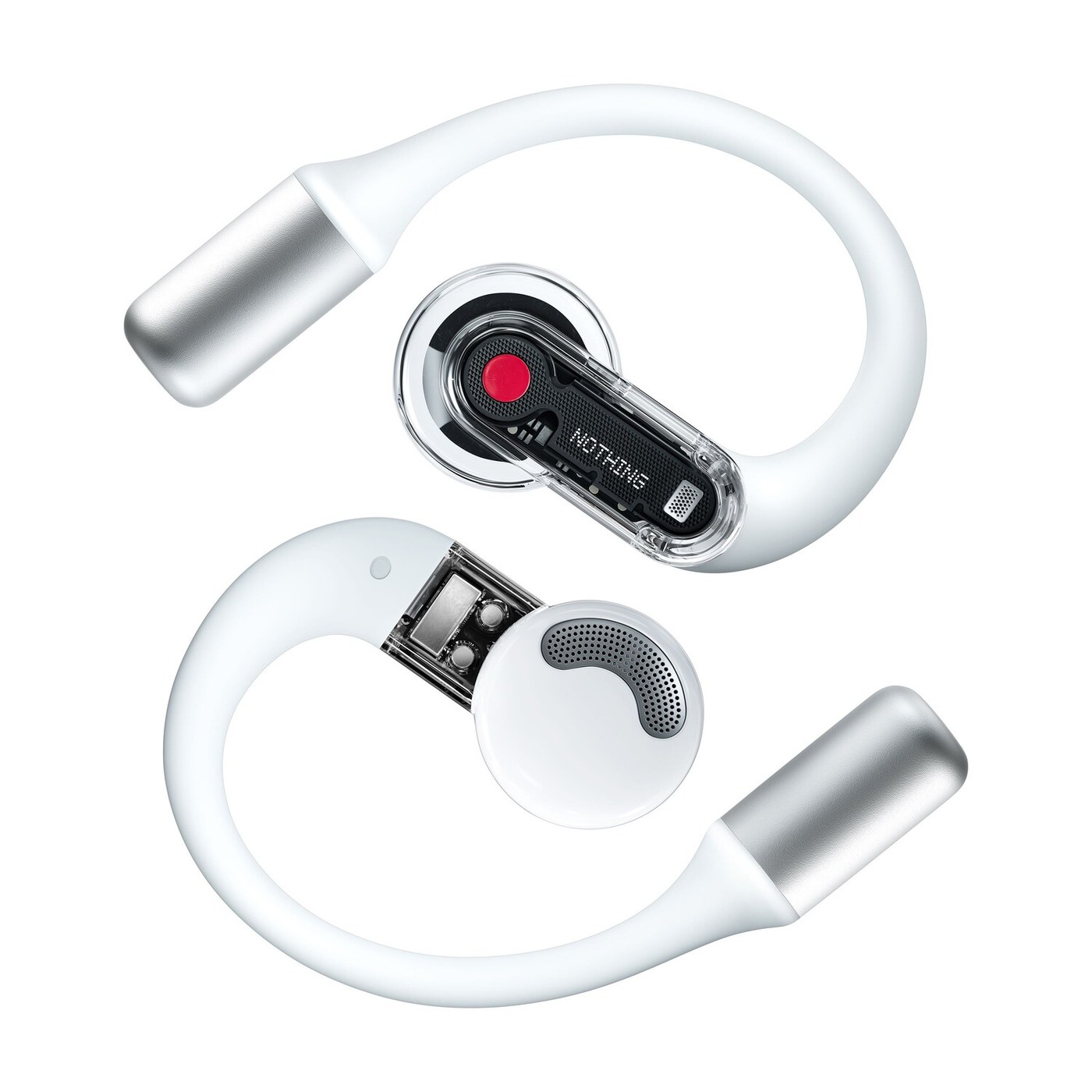
At €99, the Nothing Ear (open) bets on an open-ear, air-conduction design with no in-ear tips, in a sports market still largely dominated by Shokz-style bone conduction. The promise: full awareness of the noise around you, a decisive safety factor when you run or ride on the road, without giving up the musicality bone conduction has always struggled to deliver.
Nothing Ear (open) Review: Open-Ear Safety for €99
7.3/10
Specs
| Feature | Value |
|---|---|
| Price | €99 |
| Weight per earbud | 8.1 g |
| Dimensions per earbud | 51.3 x 41.4 x 14.4 mm |
| Charging case | 125.9 x 44 x 19 mm, 63.4 g |
| Drivers | 14.2 mm, titanium-coated diaphragm |
| Water resistance | IP54 (earbuds and case) |
| Battery life, earbuds only | 8 h |
| Battery life with case | 30 h |
| Connectivity | Bluetooth 5.3, AAC/SBC codecs, Multipoint |
| Features | Google Fast Pair, Microsoft Swift Pair, low-latency mode, Clear Voice Technology (calls) |
| Colors | White |
Safety and situational awareness: the core argument
This is the starting point for any open-ear earbud, and it's where the sources agree most clearly. Yoann, at runactu.com, tested the Ear (open) for a month on road runs and trails, and his verdict on stability leaves no doubt: "the earbuds don't move at all," even with glasses on, a common weak spot for ear-hook designs. On ambient awareness, the open format does its job. Yoann reports hearing traffic and his surroundings normally in the city and on the trail. That's the safety argument that justifies this kind of product over a classic in-ear earbud.
Sound quality: two French reviews, two clear verdicts
This is where opinions split, and the gap deserves to be flagged rather than smoothed into an artificial average. Clara, on the Son-Vidéo.com blog, is enthusiastic from the first listen: "the Nothing Ear (Open) impress from the very first listens," with "deep, punchy bass" she credits to the 14.2 mm titanium-coated drivers. In a head-to-head, she prefers them to the Shokz OpenRun Pro, which she finds less musical despite better isolation.
Yoann, at runactu.com, is far more reserved on the same point after a month of extended sports use: "Nothing's earbuds aren't the best performers and struggle to compete with classic in-ear earbuds." He still rates them above pure bone-conduction options. He also notes they're more exposed to ambient noise in dense urban settings, which follows from the open format itself but can hurt listening in some situations.
Context of use explains part of this gap. Clara judges the product in fairly static, comparative listening, while Yoann puts it through long outdoor workouts, where wind and ambient noise weigh more on what you hear. A verified customer review on the official Son-Vidéo.com product page, signed jean michel, broadly sides with Clara while tempering her take: he calls the sound "very satisfying" and rates it above the Koss Porta Pro wired headphones he used before, without describing the bass in such strong terms.
Battery life and everyday comfort
The 8 hours of continuous playback and 30 hours in total with the case match the market standard for sports earbuds at this price, without standing out. The weight of 8.1 g per earbud, confirmed by the official spec sheet and consistent with the lightness Yoann reported over his month of testing, explains the stability he saw even on the move. Independent measurements of the product, however, point out that the open format isn't ideal for intense training or roadside use. Several testers also flagged frustration with how well they hold up under prolonged sweating, despite the IP54 rating.
What IP54 covers and what it doesn't
IP54 protects against dust and water splashes from every direction, which covers rain and normal sweat, but rules out any immersion, including an accidental dunk while crossing a ford or a long, heavy downpour. That's a lower rating than the IP55 or IP57 some bone-conduction rivals offer in the same price bracket, a trade-off you need to know before buying if you train in all weather.
Strengths
- Stability on the move confirmed over a month of real sports testing, even with glasses.
- Awareness of your sound environment stays intact, the core safety argument of the open format.
- More musical than bone-conduction options, according to both reviews consulted.
- Wide compatibility (Bluetooth 5.3, Multipoint, Fast Pair, Swift Pair) and a reasonable €99 price.
- Light (63.4 g), compact case for use on the go.
Weaknesses
- Sound quality judged very differently depending on use: convincing for relaxed listening, more mixed during long workouts according to one tester.
- Only IP54, with no immersion protection, a step behind some bone-conduction rivals.
- Format rated as needing work for intense roadside use by independent measurements.
- Standard battery life (8 h / 30 h with case), with no real edge over the competition.
The essentials in 3 sentences
The Nothing Ear (open) delivers on stability and situational awareness, two criteria confirmed over a month of real sports testing. Sound quality is another story: verdicts split sharply between relaxed listening, rated impressive, and long workouts, where it feels ordinary next to a classic in-ear earbud. At €99, it's a smart pick if you put safety and ambient awareness ahead of pure audio performance.
Overall score
7.3/10
7.3/10
Who is it for?
- Road runners and cyclists who want to stay aware of traffic and their surroundings
- Glasses wearers looking for a secure fit without a stiff ear hook
- Anyone who puts safety ahead of pure audio performance
- Mixed use between sport and daily life, calls included
Who should skip it?
- Anyone who wants sound quality on par with premium in-ear earbuds above all
- Running in heavy rain or with a risk of immersion (IP54 only)
- Long, intense roadside sessions, where several testers report limits
- Anyone who wants the best possible isolation in noisy environments
RunMorph verdict
The Nothing Ear (open) nails the essentials of an open-ear sports earbud: it stays put on the move, doesn't shift with glasses, and keeps you aware of your sound environment, the safety argument that justifies this format over a classic in-ear earbud. Musicality is less clear-cut. The two French reviews we consulted don't quite tell the same story, between relaxed listening rated impressive and long workouts where it feels ordinary. At €99, with an IP54 rating that limits running in heavy rain, it's a sound choice if you put safety ahead of pure audio performance, and a harder sell if what you want most is audio on par with high-end in-ear earbuds.