Osprey relaunched its Duro range in 2026. The Duro 6 is built for short runs. The Duro Pro 10 is built for ultras, with 4 L more volume and, on the scale, a few grams less. Four runners have worn it, from Chamonix to Australia's Blue Mountains, by way of summer trails in full heat. Their verdict is positive. Two reservations still matter before you spend €180.
Osprey Duro Pro 10 review: 10 L for 210 g, the ultra vest tested
8/10
- Lower rear pocket is small and hard to reach without taking the vest off.
- Thin quiver fabric: poles go in less easily than with a stiffer Salomon quiver.
- Slightly boxy cut with little stretch for one tester, and low front pockets that bounce against the ribs when loaded.
- Lower rear pocket is small and hard to reach without taking the vest off.
The essentials in 3 sentences
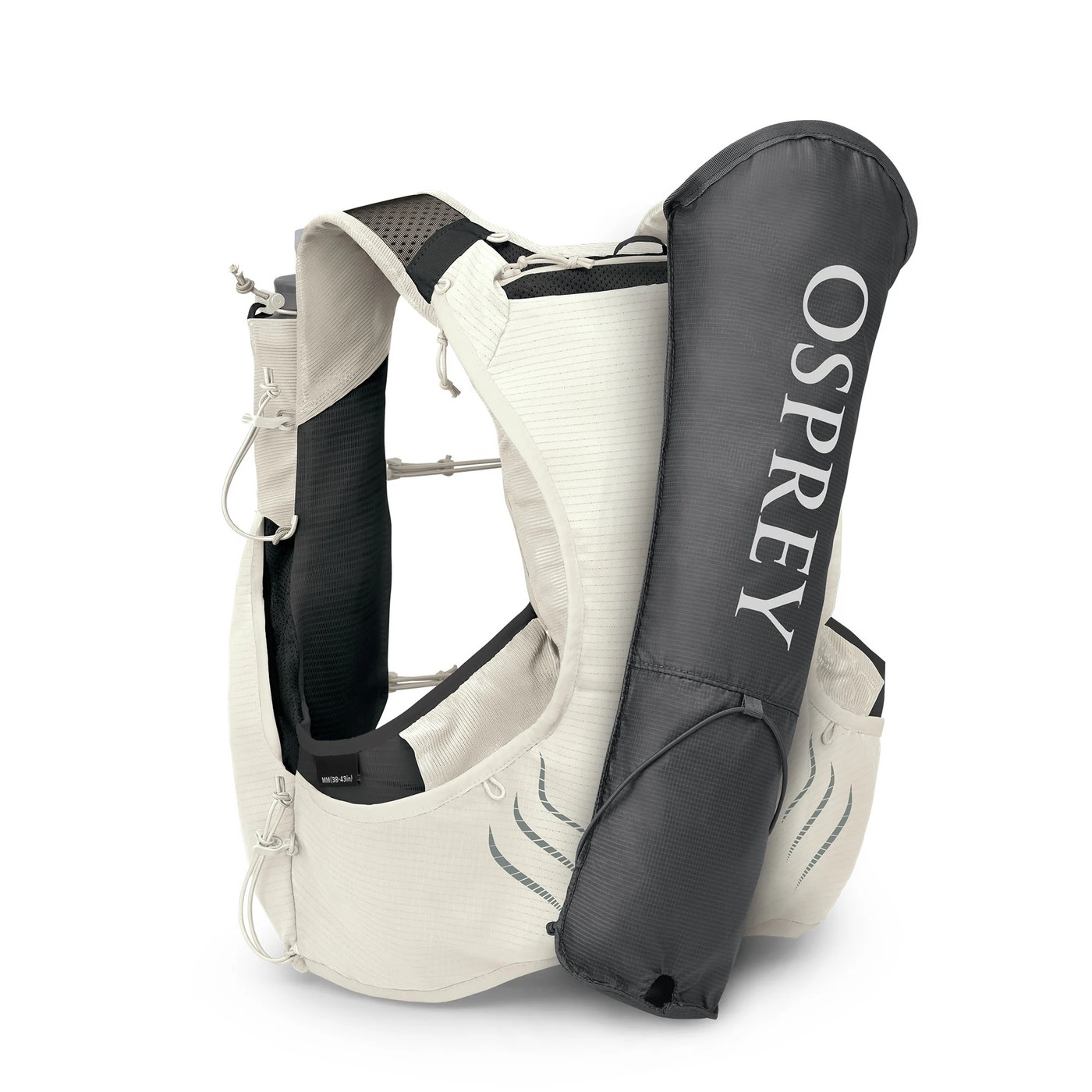
The Osprey Duro Pro 10 gives you 10 L for about 210 g in size M, with two 500 ml flasks and a removable pole quiver in the box. Three testers out of four find it stable and comfortable over several hours, and one of them compares it to a well-organised 12 L. It falls short on its lower rear pocket, hard to reach on the run, and on a quiver made of fabric that is too thin.
8,0
/ 10 · RunMorph overall score
Who is it for?The trail runner training for a 40 to 80 km race with poles who wants a light vest, quiver and flasks included.
Who should skip it?The one-hour runner, or anyone who drinks from a reservoir and expects a fully finished system.
Osprey Duro Pro 10: the Duro built for ultras
The Duro range came back in Osprey's spring-summer 2026 collection. The Duro 6 covers short runs. The Duro Pro 10 goes a step further: more volume, a quiver in the box, and a brand pitch aimed at long days in the mountains. It has been on sale since the start of the year, so it has less than a year of track record at the time of this review.
The weight is the surprise. Our Duro 6 review lists 220 g. The Pro 10 claims about 210 g in size M. Four litres more, ten grams less. Osprey gets there with a thinner mesh (recycled 30D polyester) and a structure that relies on stretch fabric rather than reinforcements.
The price follows the extra volume: €180 RRP, against €145 for the Duro 6. That matches the Hoka Trail Run Vest 10L, its most direct rival. On sale, it has dropped to €143,90 at a French retailer.
RunMorph's tip: between the Duro 6 and the Duro Pro 10, the real question isn't price, it's how long you run. Under 2 h 30, the Duro 6 is plenty. Beyond that, or as soon as you run with poles, the Pro 10 earns its place. For an ultra with bulky mandatory kit, compare it with the Salomon Adv Skin 12 too.
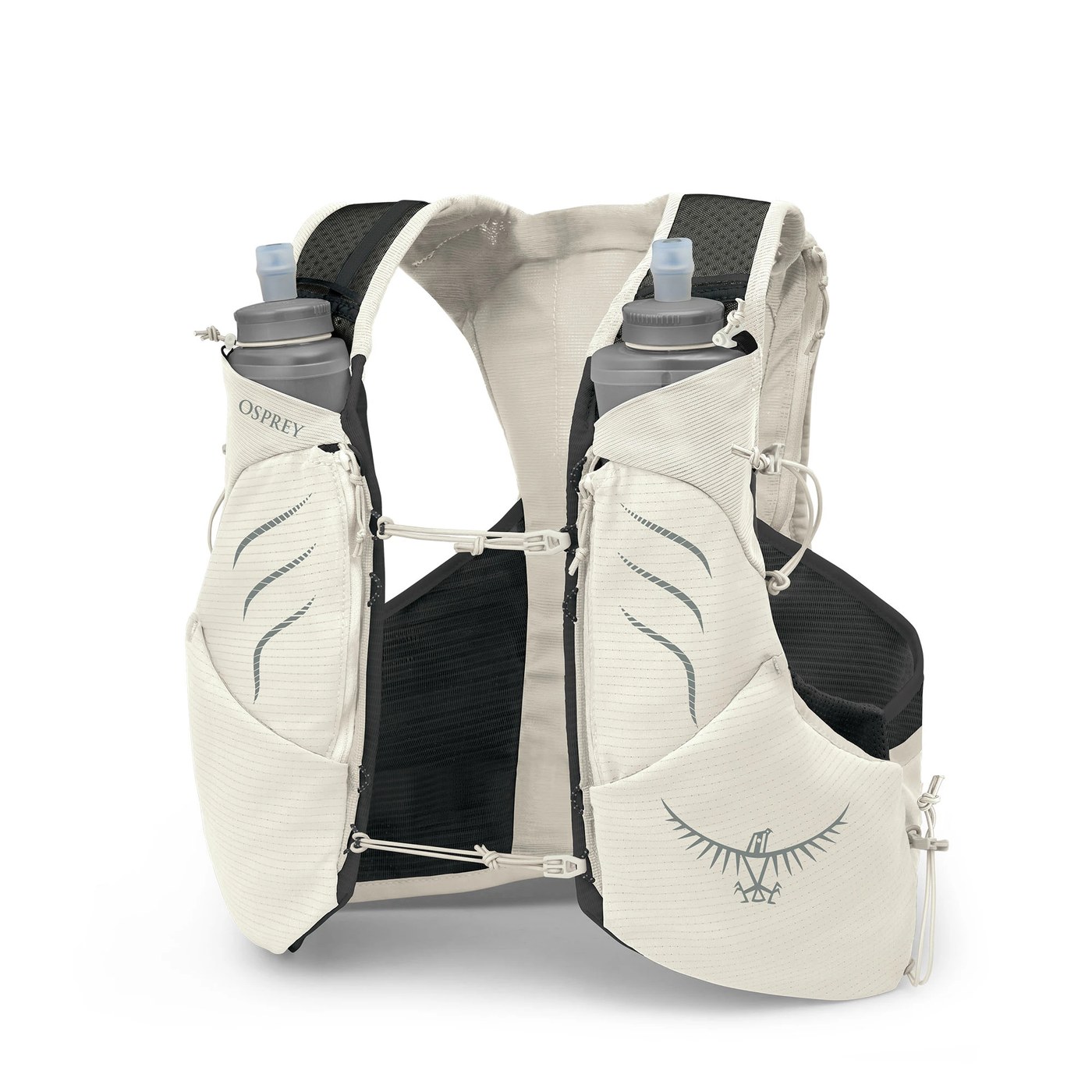
© Osprey, official photo used for editorial purposes
Pros and cons
Pros
- About 210 g in size M for 10 L, 10 g less than the 6 L Duro 6.
- Stable on the run: three testers out of four say it barely moves, on short runs and over more than 19 hours in total.
- Removable 26 g quiver and two 500 ml flasks included, nothing extra to buy.
- Flasks slide easily into their pockets, held by removable stays and an adjustable cord.
- Generous real volume: one tester compares it to his old Salomon Adv Skin 12.
Cons
- Lower rear pocket is small and hard to reach without taking the vest off.
- Thin quiver fabric: poles go in less easily than with a stiffer Salomon quiver.
- Slightly boxy cut with little stretch for one tester, and low front pockets that bounce against the ribs when loaded.
- White colourway shows dirt, and machine washing is not recommended.
- Compatible with a 1,5 L reservoir, sold separately, with integration judged unfinished.
Objective technical data
| Brand | Osprey |
| Model | Duro Pro 10 (spring-summer 2026 collection) |
| Volume | 10 L |
| Empty weight | About 210 g in M according to the brand (206 g in S, 220 g in L) |
| Sizes | S, M, L (chest: 88 to 94 cm, 94 to 108 cm, 108 to 118 cm) |
| Front pockets | 2 flask pockets, 2 zipped pockets, stretch open pockets below |
| Rear pockets | Large zipped pocket, small top zipped pocket, lower pass-through pocket, separate lower pocket |
| Reservoir compatibility | Hydraulics LS 1,5 L (sold separately) |
| Flasks included | 2 x 500 ml Hydraulics, removable WingStay stays |
| Materials | 86 % recycled 75D polyester, 14 % elastane, recycled 30D polyester mesh, bluesign certified |
| Pole carry | Removable Duro Dyna Pro Quiver (26 g), vertical or diagonal carry |
| Reflective details | Yes |
| Whistle | Yes, built into the fabric |
| UTMB mandatory kit | Depends on your kit: enough for one tester who fits the equivalent of a 12 L, too tight for a buyer who filled it with a full mandatory kit |
| Price | €180 RRP, seen at €143,90 on sale in November 2026 |
Who is the Osprey Duro Pro 10 for?
You run one to two hours, without poles
It works, but you'll pay €35 extra for volume and a quiver you won't use. The Duro 6 weighs almost the same and costs less. Answer: not the best pick.
You're training for a 40 to 80 km trail race, with poles
This is its target. The runner who wore it for six months while preparing his first 100 km ran with poles and a first-aid kit on remote trails. He kept the Pro 10. The quiver mounts vertically or diagonally, and the 10 L swallow a jacket, a headlamp and food for the day. Answer: yes.
You're aiming for an ultra with full mandatory kit
Honestly, it depends on your list. One tester finds it as roomy as his old Salomon Adv Skin 12. An American buyer finds it too small for his mandatory kit. With a compact waterproof jacket and trousers, it fits. Add a thick insulated jacket and you should look at the Salomon Adv Skin 12 or the Salomon S/Lab Ultra 12. Answer: yes, if your kit is compact.
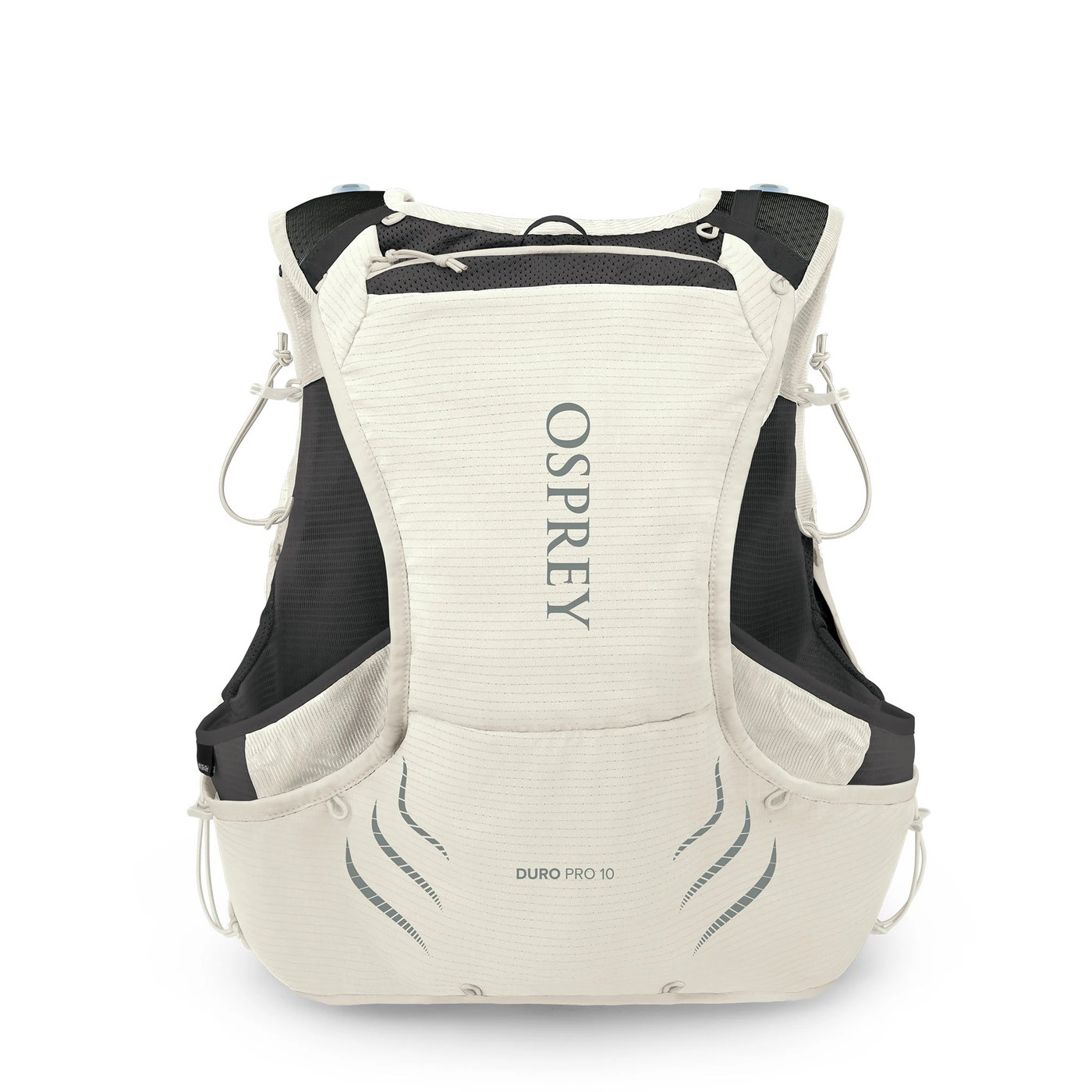
© Osprey, official photo used for editorial purposes
The field test: what four runners say
Four detailed reviews of this vest exist. The first comes from Runpack: a trip to Chamonix organised with Osprey, mostly short runs. The tester is 1,90 m tall and weighs 75 kg, with a slim upper body, and chose size S. He gives it 10 out of 10 for comfort, 9 for storage and stability, 8 for ease of use.
The next two come from a private test run by Outzer. The first tester, 28, has already run with a Salomon Adv Skin 12 and a Millet Trilogy 15. He wore it on several trail runs in strong heat, lightly or heavily loaded, and gives it 10 out of 10. The second, 39, 1,78 m and 73 kg, went for size M. He logged more than 19 hours of racing with it, from short trail to ultra, and gives it 9 out of 10.
The fourth is an Australian runner. He wore it for six months while preparing his first 100 km, after a Black Diamond Distance 8 and a Salomon Adv Skin 12. He is the toughest judge, with 79 out of 100.
One thing to keep in mind: the first three testers received the vest for free or on a trip with the brand. That tends to make reviewers lenient. The handful of American buyer reviews, less enthusiastic (3,9 out of 5 from 9 reviews), act as a counterweight.
Comfort and stability: steady, as long as you pick the right size
On comfort, the reviews line up. The Runpack tester reports no pressure points and notes that the shoulder-strap mesh limits chafing. The Australian finds the back stays cool even with the vest fully loaded. Nobody reports rubbing on the neck.
Stability splits opinion more. For three testers, the vest barely moves. The second Outzer tester adds that it sits high on the back. The Australian finds it a little boxy, with little stretch. Its front pockets sit low, and whatever he packs there bounces against his ribs.
So what does it come down to? Mostly your build and the size you order. The 1,90 m tester took an S. The 1,78 m tester asked for advice before ordering an M, and says it fits true. Put simply, the Pro 10 doesn't forgive a size too big: try it in store, or order the smaller size if you're unsure.
Pockets and access: a true 10 L, maybe more
Depending on how you count, the Pro 10 offers seven to nine storage spaces. Up front, two flask pockets, two zipped pockets for phone and keys, and stretch open pockets below for gels. The Runpack tester grabs flasks and food without taking the vest off. At the back, a large zipped pocket, a small top pocket and a wide pass-through pocket at the base of the back.
The real volume beats the label. The first Outzer tester writes that it behaves like a well-optimised 12 L. The Australian agrees: the Pro 10 seems to give him far more than 4 L over the Duro 6. The pass-through pocket, bigger than on the Duro 6, swallows a jacket stuffed in a ball.
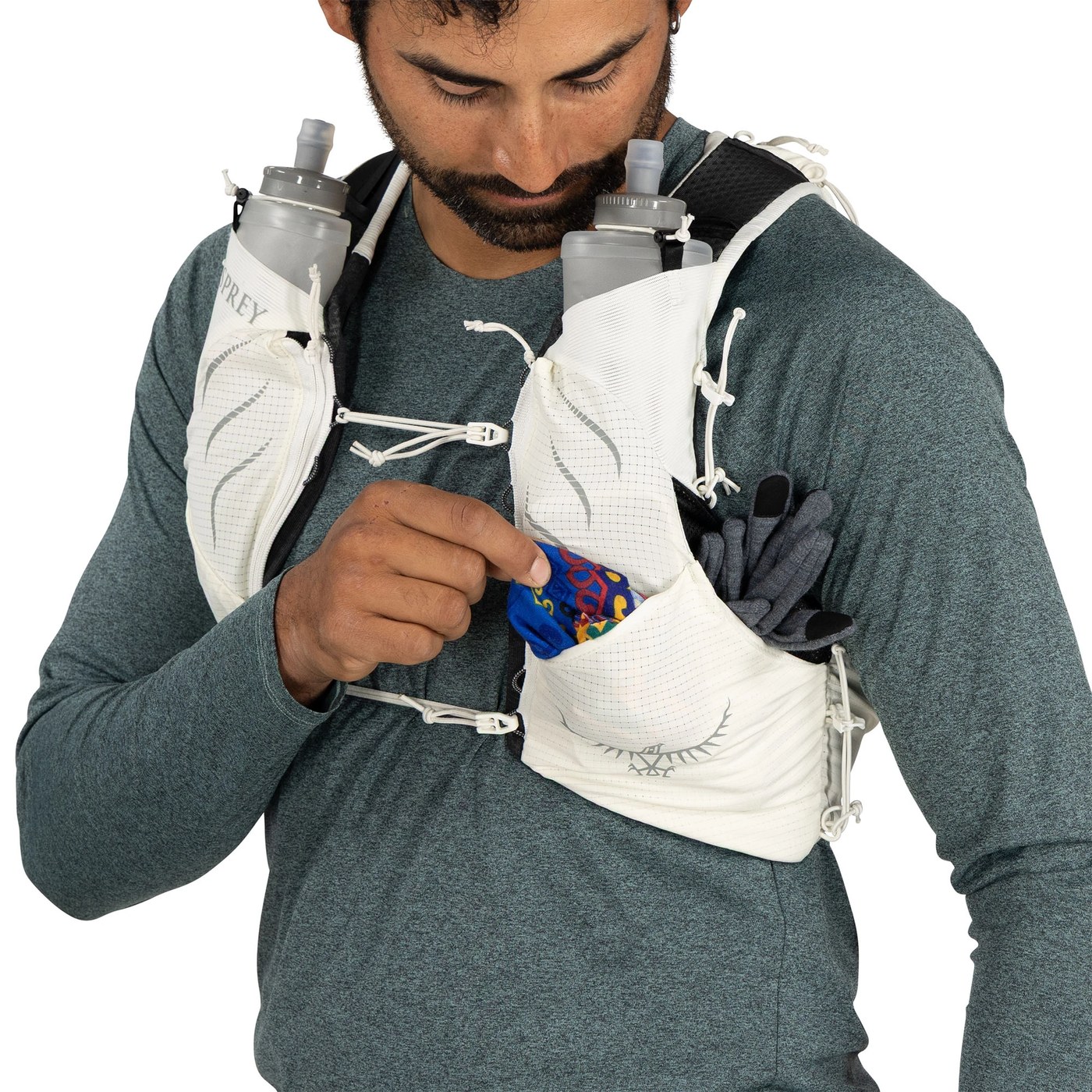
© Osprey, official photo used for editorial purposes
The lower rear pocket, the real storage flaw
Even the most enthusiastic tester flags a flaw. The lower rear pocket is small and hard to reach. The Runpack tester even suggests merging it with the compartment above, or widening its opening. For a vest designed for ultras, that's a pity: it's exactly where you stash the windbreaker or gloves you want to grab without stopping.
In practice, keep this pocket for things you'll only take out at aid stations: emergency blanket, first-aid kit, battery pack. Anything you need on the move goes up front or in the pass-through pocket.
The removable quiver: handy, but the fabric is too thin
Shipping the quiver with the vest is a real plus. It weighs 26 g, mounts vertically or diagonally, and comes off when you run without poles. The first Outzer tester reckons the quiver alone justifies the roughly €20 gap with some rivals.
The second Outzer tester is more guarded. The fabric is thin, and poles slide in less easily than in Salomon's stiffer quivers. On an ultra, you take your poles out and stow them dozens of times. Every second spent aiming for the opening ends up counting. American buyers point it out too.
Hydration: good flasks, reservoir optional
The two 500 ml Hydraulics flasks go down well. Removable WingStay stays keep them upright, and an adjustable cord holds them in place. The second Outzer tester calls them his favourite feature: they slide easily into their pockets, and the distance from bite valve to mouth is well judged. The Australian notes they sit higher than on Salomon or The North Face vests. So you can drink without pulling them out.
The reservoir story is weaker. The vest takes a 1,5 L Hydraulics LS, sold separately. The Australian calls the reservoir features half-finished. One buyer regrets there is no mount for a magnetic hose clip on the sternum. If you mostly drink from a bladder, this isn't the most polished vest.
One last detail matters in summer: 1 L of water in flasks is not much on an ultra in strong heat. Plan an extra flask in a front pocket, or closely spaced aid stations.
Osprey Duro Pro 10 vs Hoka Trail Run Vest 10L: the comparison
| Osprey Duro Pro 10 | Hoka Trail Run Vest 10L | |
|---|---|---|
| Volume | 10 L | 10 L |
| Weight | About 210 g in M | 250 g in M, quiver included |
| Quiver | Removable, 26 g | Integrated, sewn on |
| Storage | 7 to 9 pockets | 12 pockets |
| RRP | €180 | €180 |
Same volume, same price. The Hoka Trail Run Vest 10L holds more small items and keeps its quiver permanently in place. The Osprey is lighter and lets you remove the quiver on days without poles. The decision rule is simple. If you often run without poles, take the Osprey. If they're almost always on your back and you like every gel in its own slot, take the Hoka.
Against the Duro 6 (6 L, 220 g, €145), the Pro 10 costs €35 more for 4 L and a quiver. At the other end, the Salomon S/Lab Ultra 12 claims 205 g for 12 L, with a rear pocket you can finally reach on the run. That is exactly the Osprey's weak spot.
How to fit the Duro Pro 10 into your RunMorph training plan
The Pro 10 is mainly for weekend long runs, the 3 to 6 hour outings where you carry poles, a jacket and food. That's the time to dial in its size and straps, and to decide what goes in each pocket. On race day, you won't have to think about it.
For short midweek sessions (hill repeats, intervals on trails), remove the quiver and keep a single flask. The vest stays stable, but 10 L for an hour of hills is overkill. If you're preparing a trail race or your first ultra, the RunMorph trail plan sets the length of each long run week by week. You'll know in advance when to bring out the Pro 10.
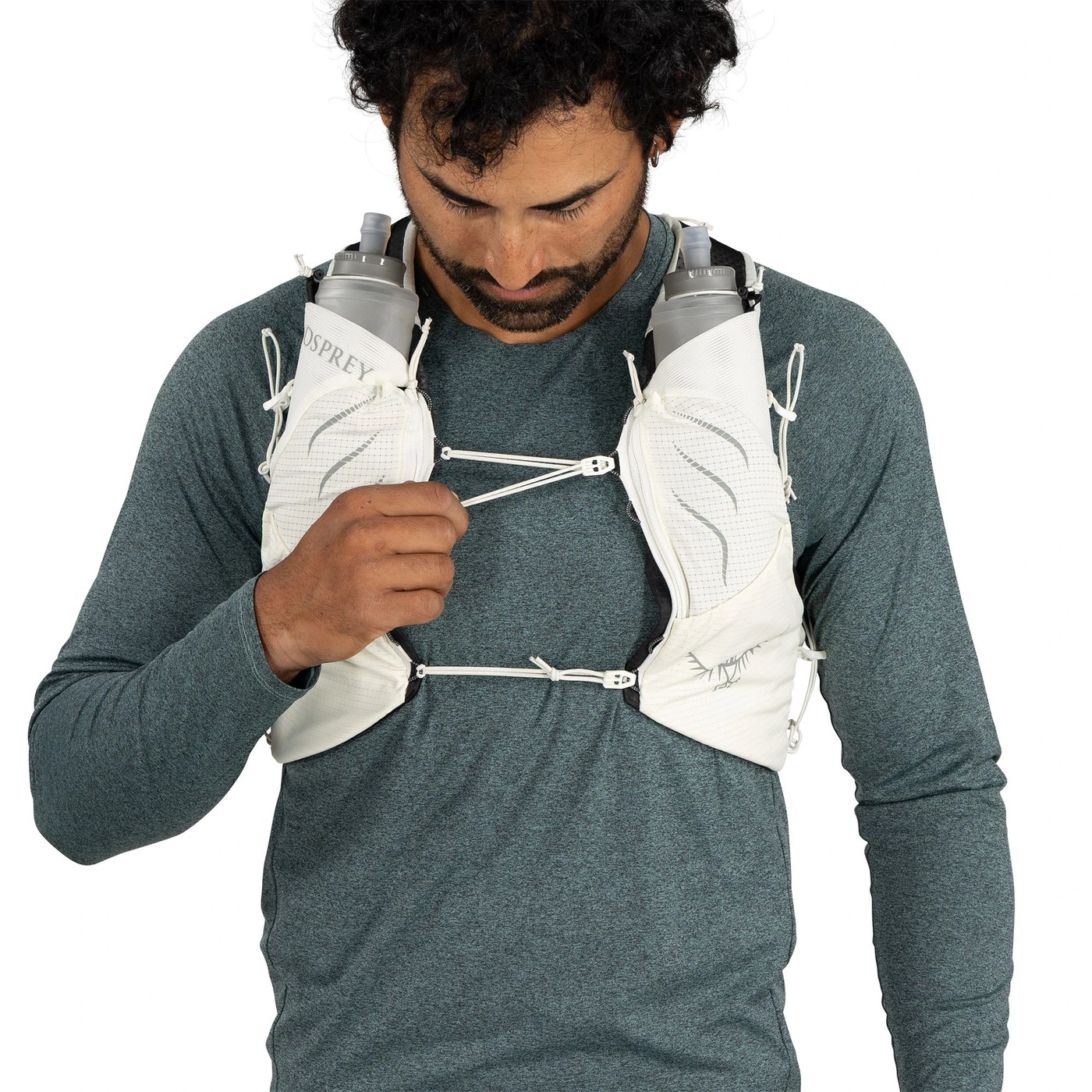
© Osprey, official photo used for editorial purposes
The RunMorph Coach's verdict
Osprey got the essentials right. The Duro Pro 10 is light, stable when the size is right, and it holds more than its 10 L. The flasks sit well, and the quiver comes in the box. Two things keep it below the very best: a poorly designed lower rear pocket and a quiver too floppy for taking poles in and out again and again.
For the score, comfort and capacity weigh the most, because they decide an ultra. They deliver. Accessibility and the reservoir setup pull the total down. Buy it if you run with poles on outings of 3 hours or more. If you mostly run without poles for under 2 h 30, the Duro 6 is enough. If you want a rear pocket you can reach on the run, look at the Salomon S/Lab Ultra 12.
RunMorph score: 8/10. A very good long-trail vest, worth buying on sale at around €145 if you can find it.
© Osprey, official photo used for editorial purposes
Key takeaways for your training
- Go for the smaller size if in doubt: a Pro 10 that's too big bounces, a well-fitted one barely moves.
- Pack smart: the lower rear pocket for emergency kit, the front for what comes out on the run.
- Practise with the quiver: its soft fabric takes a few runs before you can stow poles without looking.
- Carry more than 1 L in strong heat: the two flasks included hold 500 ml each.
- Hand-wash it: the machine isn't recommended, and the white fabric quickly keeps mud stains.