For years, Hoka acted as if it didn't need a trail vest. The brand that revolutionized road cushioning focused on its running shoes, leaving the hydration vest market to Salomon, Compressport and NNormal. Then, in 2024, it released the Hoka Trail Run Vest 10L with a radical design bet: build the whole vest around a quiver sewn into the fabric, non-removable and fully integrated. Two years later, we can say the bet has paid off.
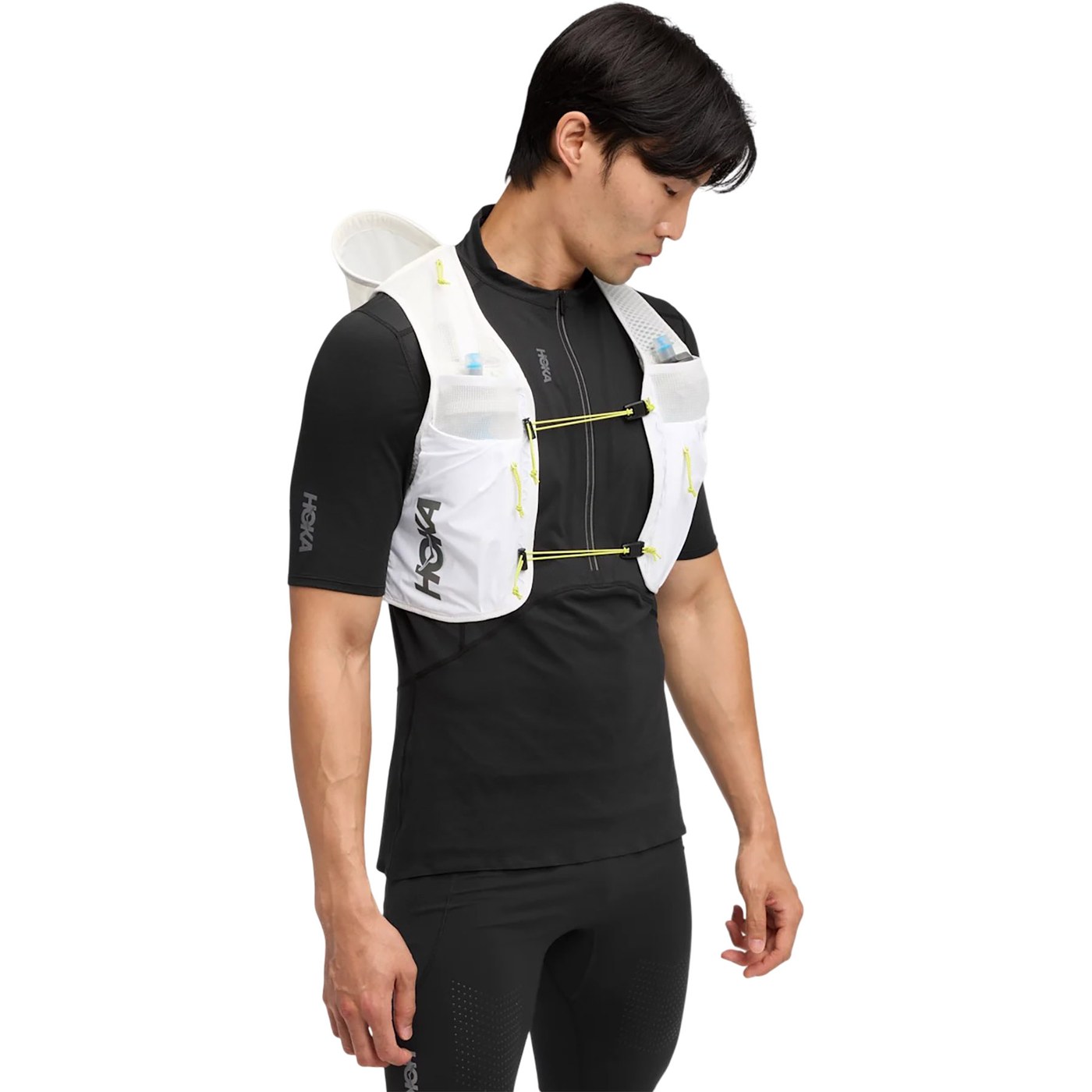
© Hoka, official photo used for editorial purposes
Hoka Trail Run Vest 10L: a giant returns to a market it had abandoned
Hoka had already tried its hand at trail packs a few years ago with an "Evo" range, worn notably by Ludovic Pommeret when he won UTMB. Those models, closer to hybrid backpacks than true trail vests, quickly disappeared from the catalog. The brand went back to focusing on running shoes, its core business.
The Hoka Trail Run Vest 10L changes the game. It's not a style exercise or a filler product to round out a catalog: it's a technical vest, built around a radical, deliberate design choice. Hoka decided to sew the quiver directly onto the vest, build the entire back structure around it, and make it the centerpiece of the experience. That breaks with everyone else on the market, where the quiver is usually removable, often unstable, and treated as an accessory.
For a V1, the result is stunning. This vest clearly targets the performance segment, from fast 30 km races to supported 100 km ultras. It's built for trail runners who use poles and want maximum stability without sacrificing accessibility.
Hoka Trail Run Vest 10L specs
| Brand | Hoka |
| Model | Trail Run Vest 10L |
| Product code | 1175570 |
| Volume | 10 L (compact) |
| Empty weight | 250 g (size M, with quiver) |
| Sizes available | S, M, L, XL (unisex) |
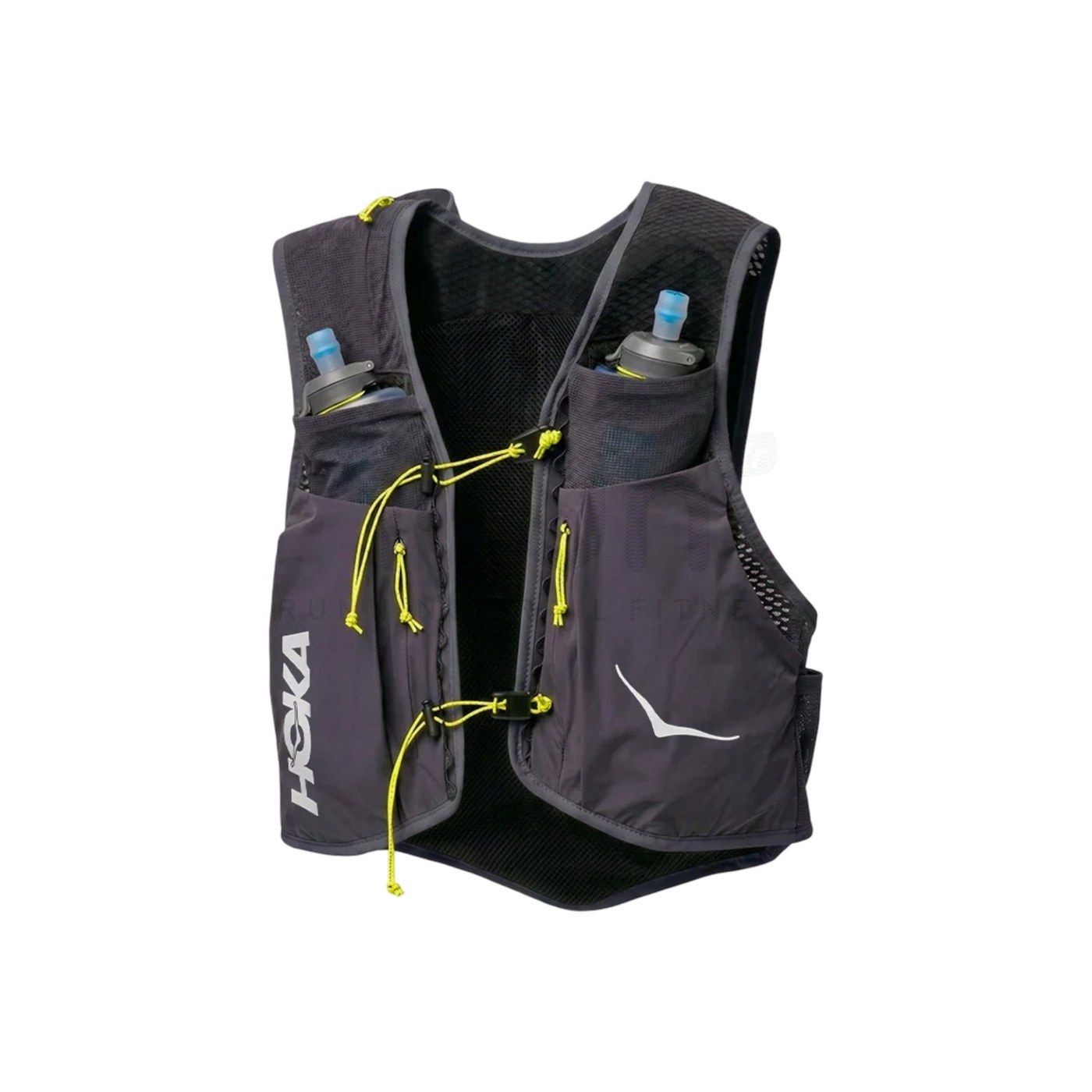
| Front pockets | 6 (2 flask sleeves + 2 zippered stretch + 2 side-opening) |
| Back pockets | 3 (1 large upper zippered + 2 lower tunnels) |
| Shoulder pocket | 1 zippered (built-in whistle) |
| Side pockets | 2 small |
| Total pockets | 12 |
| Hydration bladder compatible | No |
| Flasks included | 2 x 500 mL HydraPak (built-in valve) |
| Pole carry | Integrated sewn-in quiver (non-removable) |
| Material | Stretch mesh + non-stretch mesh + elastane (100% recycled) |
| Reflective details | Yes (rear logo) |
| UTMB mandatory gear compatible | Yes (hydration bladder to be added separately) |
| Colorways available | White (WHT), Black (BLK), Squadron/Night (SQDNK) |
| Official price | €180 |
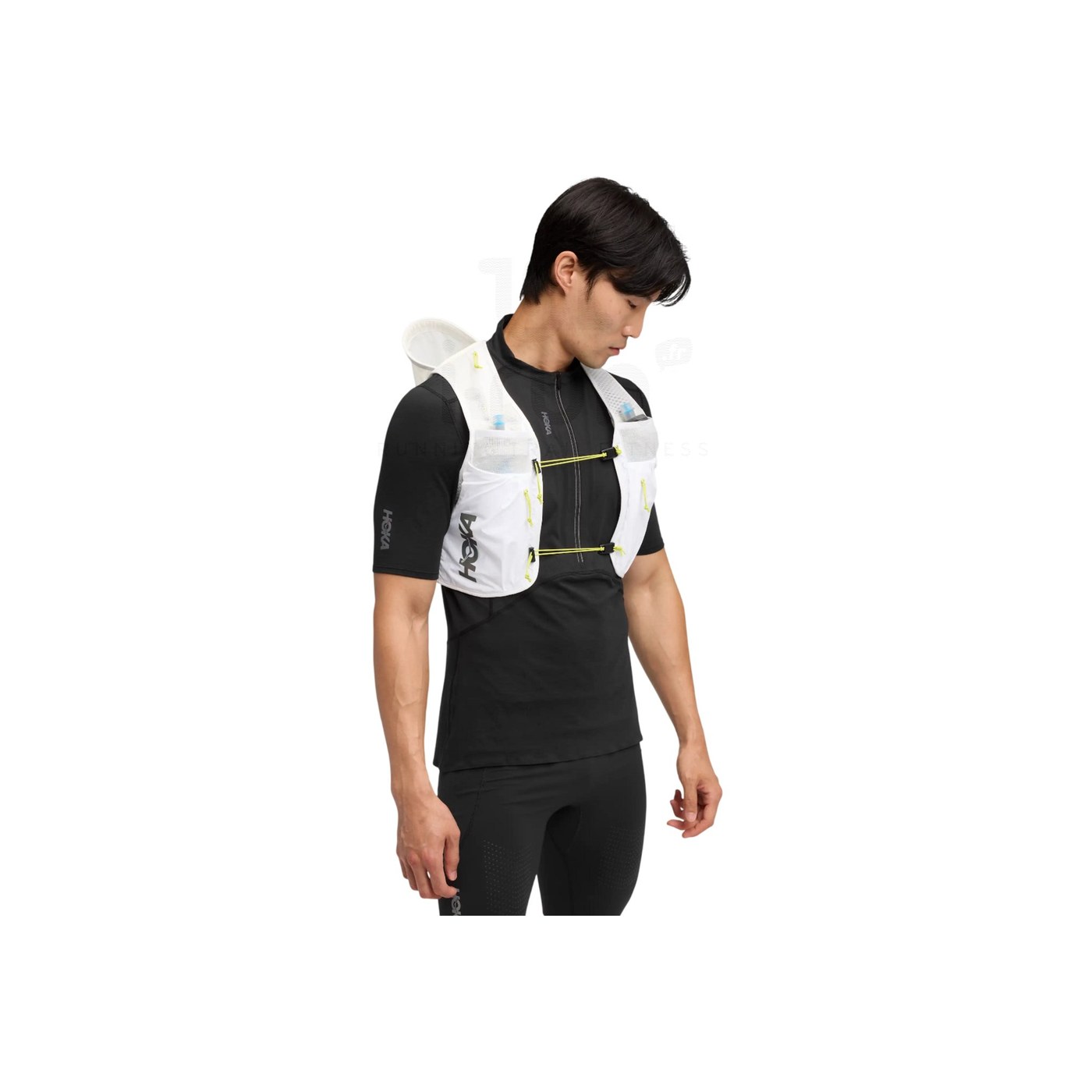
© Hoka, official photo used for editorial purposes
RunMorph tip: If you're torn between the Hoka Trail Run Vest and the Salomon S/Lab Ultra 12, the key question is this: do you always race with poles? If so, the Hoka wins hands down on quiver stability. If you rarely run with poles, go for the Compressport Ultrun Evo 10 V2 (114 g, €180) or the NNormal Race Vest 5L for a lighter, more modular format.
The sewn-in integrated quiver: what does it really change?
This is the detail that changes everything. On other vests, the quiver is usually a separate piece, attached with straps or clips, often at an angle and sometimes unstable. Hoka went the other way: the quiver is sewn directly into the vest's back structure. The entire back is built around it.
The result is pole stability unmatched on the market. No side-to-side wobble, no sway, whether the vest is full or nearly empty. The quiver's rigid collar makes it easy to insert and remove your poles on the move. The foam insert behind the base keeps any pressure off your back. Over 100 km with 4000 m of elevation gain, at 5 to 8 km/h depending on the section, you never feel the quiver, even when the poles aren't in use.
The trade-off is real: the quiver isn't removable. If you never run with poles, you end up with a useless structured element that adds weight and dictates how the back space is organized. That's the central compromise of the Hoka Trail Run Vest, and you need to know it before you buy.
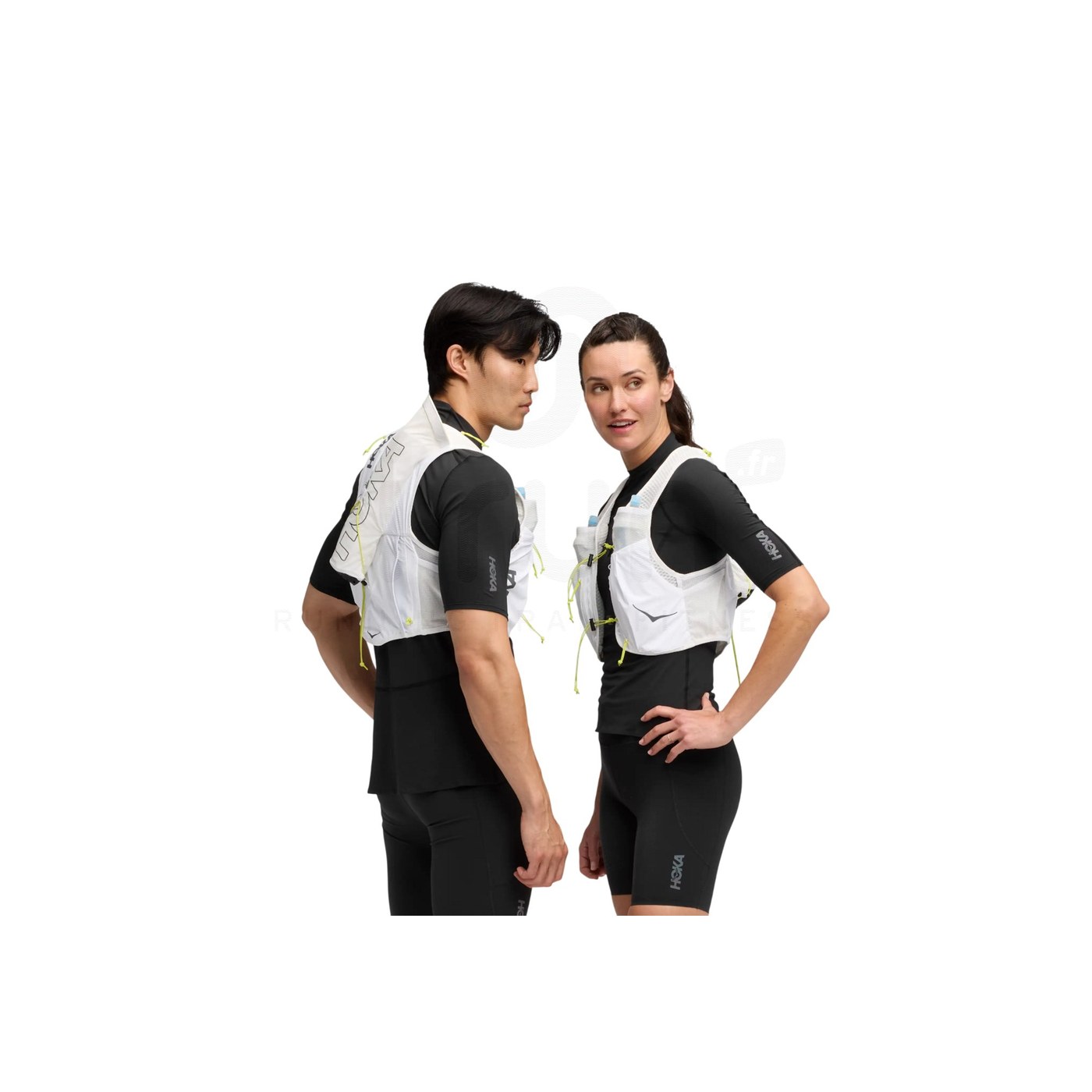
© Hoka, official photo used for editorial purposes
Field test: 200 km, the Templiers, from fast 30 km runs to 100 km ultras
We tested the Hoka Trail Run Vest 10L for a little over six weeks in very varied conditions: short runs at a fast pace (4 to 5 min/km), long mountain sessions at 6 to 7 min/km, and the Templiers race (100 km / 4000 m elevation gain, with technical and runnable sections). In total, roughly 200 to 300 km with this vest on our backs.
Stability is the first strength that stands out. Whether the flasks are full, half empty or nearly empty, they stay pressed against your chest. On technical descents, the vest doesn't move. During intervals on flat ground, it doesn't ride up. That's rare for 10L vests, which usually force a trade-off between lightness and bounce.
The fit is another success. The magnetic hook closure works well and is quick to operate mid-race. The front elastic straps adjust in height, so you can dial the fit to your body shape. It feels like a piece of race clothing rather than a pack: no compression, no restricted breathing, no pressure points.
Front pocket access is well thought out. All 6 front pockets are usable without breaking stride. The two lower back tunnels are less intuitive to reach (they open downward), but they turn out to be practical once you've learned the move. The large upper zippered pocket, however, can't be reached on the run: it's reserved for mandatory or spare gear.
Volume is the most debatable point. 10 L on the label, but it's a "small 10L": the UTMB mandatory kit fits, but only if your gear is streamlined. Packable layers, soft flasks, no room for extras. For a race where the cold-weather kit is required, plan on adding a running belt.
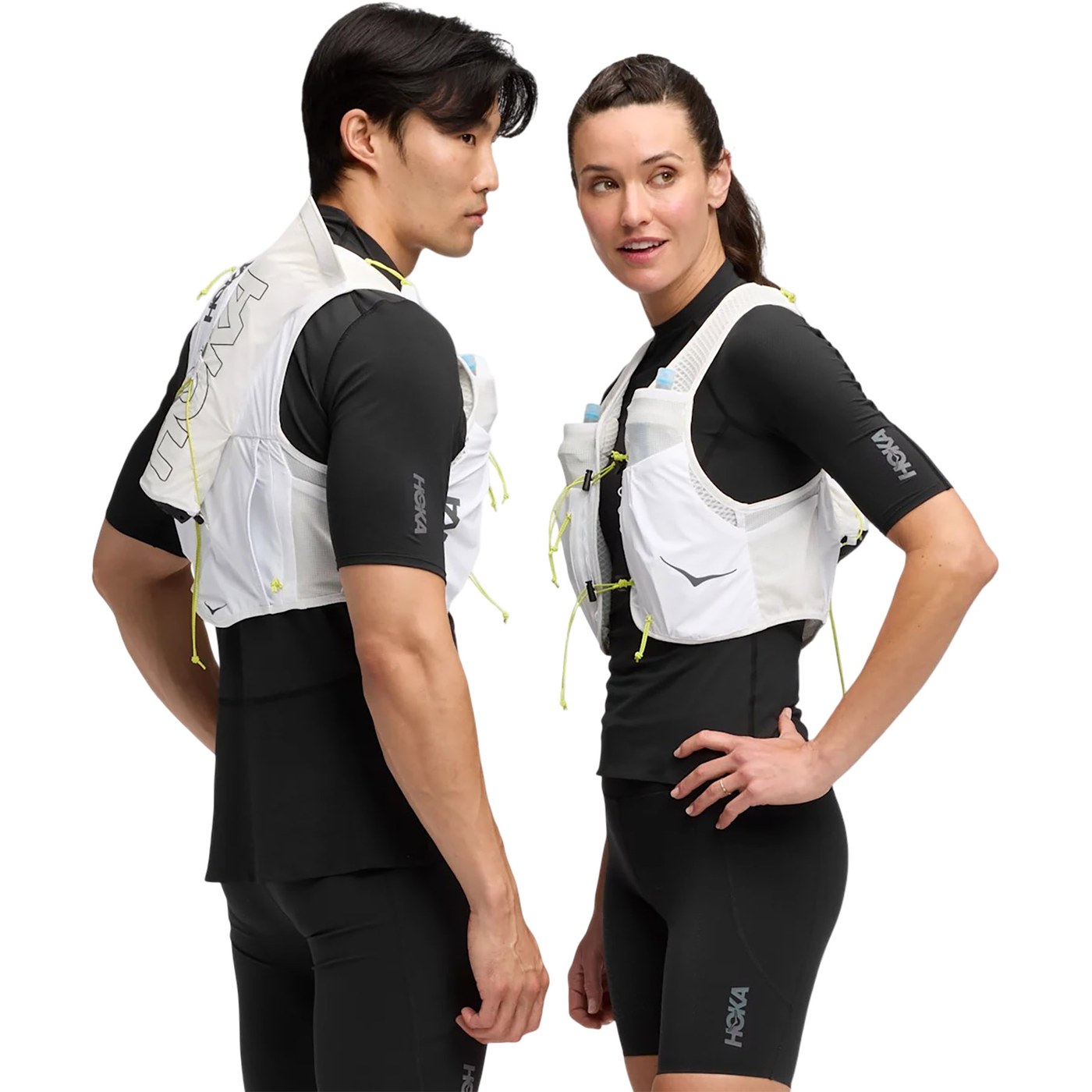
© Hoka, official photo used for editorial purposes
Hoka Trail Run Vest 10L vs the competition: comparison
| Criterion |
Hoka Trail Run Vest 10L |
Compressport Ultrun Evo 10 V2 |
Salomon S/Lab Ultra 12 |
NNormal Race Vest 5L |
| Volume | 10 L | 10 L | 12 L | 5 L |
| Weight | 250 g | 114 g | 205 g | 174 g |
| Price | €180 | €180 | €200 | €135 |
| Quiver | Sewn-in integrated (fixed) | Elastic, rear | Custom Quiver (+€30) | Elastic, front |
| Hydration bladder | No | No | Yes | No |
| Flasks included | 2 x 500 mL | 2 x 500 mL | 2 x 500 mL | 2 x 500 mL HydraPak |
| Stability | Exceptional | Very good | Very good | Good |
| Target profile | Poles + ultra | Ultralight ultra | Ultra 50-120 km | Skyrace 20-50 km |
Against the Compressport Ultrun Evo 10 V2, the Hoka is 136 g heavier but gains in stability and quiver ergonomics. The Compressport remains the number one choice for runners who want the lightest possible vest at the same price.
Against the Salomon S/Lab Ultra 12, the Hoka is 45 g heavier and offers 2 L less, but its integrated quiver is clearly more stable. For very long races with self-supported sections, the S/Lab Ultra 12 remains more versatile thanks to its volume and a back pocket you can reach on the run.
+ Pros
- Exceptional stability, for both flasks and quiver
- Sewn-in quiver: the most stable on the market
- Very precise fit, feels like race clothing
- 12 pockets easy to reach on the move
- Lasting comfort on ultras (200+ km with no sore spots)
- 100% recycled material
- Cons
- Non-removable quiver (a deal-breaker if you don't use poles)
- Compact volume (a small 10L, streamline your kit)
- Not compatible with a back hydration bladder
- Elastic front pockets a little small
- €180: high price vs the Compressport (which weighs half as much)
Who do we recommend the Hoka Trail Run Vest 10L for?
The trail runner with poles (30 km to ultra)
This is the ideal profile. If you run regularly with poles, on technical 30 km races or 80-100 km formats with plenty of elevation gain, the Hoka Trail Run Vest has the best quiver on the market, period. Pole stability changes your race comfort, especially on fast descents or technical sections. This vest was designed for you.
The performance ultra runner with a streamlined kit
If your race kit is compact (thin layers, soft flasks, minimal mandatory gear), the Hoka Trail Run Vest covers 50-120 km formats very well. It meets UTMB mandatory gear requirements with enough capacity for a standard summer kit. At the big races (UTMB, CCC, Maxi Race), it becomes a very good choice if you run with poles.
The versatile runner with no preference for poles
In that case, look instead at the Compressport Ultrun Evo 10 V2 (114 g, same price) or the Osprey Duro 6 (220 g, €145, hydration bladder compatible). The non-removable quiver becomes a constraint with no added value, and the Hoka's compact volume limits its general appeal.
Prepare for your next trail race with RunMorph
The Hoka Trail Run Vest 10L covers formats from 30 km to ultra. To get the most out of your long runs and trail intervals, RunMorph offers structured plans over 8 to 24 weeks, from beginner 30 km to 100 km ultra.
See RunMorph training plans
© Hoka, official photo used for editorial purposes
RunMorph coach's verdict
The Hoka Trail Run Vest 10L is a remarkably polished V1. The brand didn't do things halfway: it made a strong design choice, the sewn-in integrated quiver, and executed it with precision. This vest's stability, for both flasks and poles, is above anything we've tested in this weight range.
The limits are known: compact volume, non-removable quiver, no back hydration bladder. These aren't finishing flaws. They're deliberate choices that define the target profile very clearly. This vest is built for trail runners with poles who want the best possible stability from 30 km to 100 km, with a streamlined race kit.
At €180, the price is high compared with its direct competitors. The Compressport Ultrun Evo 10 V2 costs the same for half the weight (114 g vs 250 g), even if it's less comfortable to carry. The Hoka justifies its price with a better user experience for regular pole users.
RunMorph score: 8 / 10