With the Vantage M3, Polar lands a heavy punch in the mid-range GPS watch segment. An AMOLED display, 30 hours of GPS and Polar's full training ecosystem: on paper, the value for money looks excellent. But how does it really stack up against a Garmin Forerunner 265 or a Coros Pace 3?
Polar Vantage M3 Review: The Complete RunMorph Test
8.2/10
The essentials in 3 sentences
The Polar Vantage M3 is a running and multisport GPS watch with an AMOLED touchscreen, 30 hours of battery life in GPS mode and Polar's complete set of training algorithms. It takes the best of the Vantage V3 and puts it in a more compact case at a more affordable price, without built-in maps or wireless charging. It's a top pick for recreational to experienced runners who want in-depth training data without breaking the bank.
8.2
/ 10 · RunMorph overall score
Who is it for?Recreational to experienced runners, data lovers, and anyone who wants an AMOLED display and Polar metrics without paying Vantage V3 prices.
Who should skip it?Demanding trail runners (no maps), pro triathletes (no advanced multisport features), or anyone who wants built-in maps.
Polar Vantage M3: the mid-range watch that steps up
Polar's lineup is clear: the Vantage V3 rules the high end with maps, wireless charging and premium sensors, while the Vantage M3 targets the mid-range without cutting the essentials. Released at the end of 2024, the M3 brings the biggest upgrade the M series has seen in a long time: an AMOLED touchscreen, until now reserved for pricier models.
That new display changes everything. Readability in direct sunlight is much better, colors are vivid, and the touch interface makes navigation far more intuitive than the MIP screens of previous generations. Polar also went with a more compact case (43 mm) than the V3 (47 mm), which makes it a better fit for slim wrists.
RunMorph's advice: If you're torn between the Vantage M3 and the Forerunner 265, know that the Polar excels at recovery and training load metrics, while the Garmin offers more customization options and a richer app ecosystem. For pure runners, the Polar is often the smarter pick.
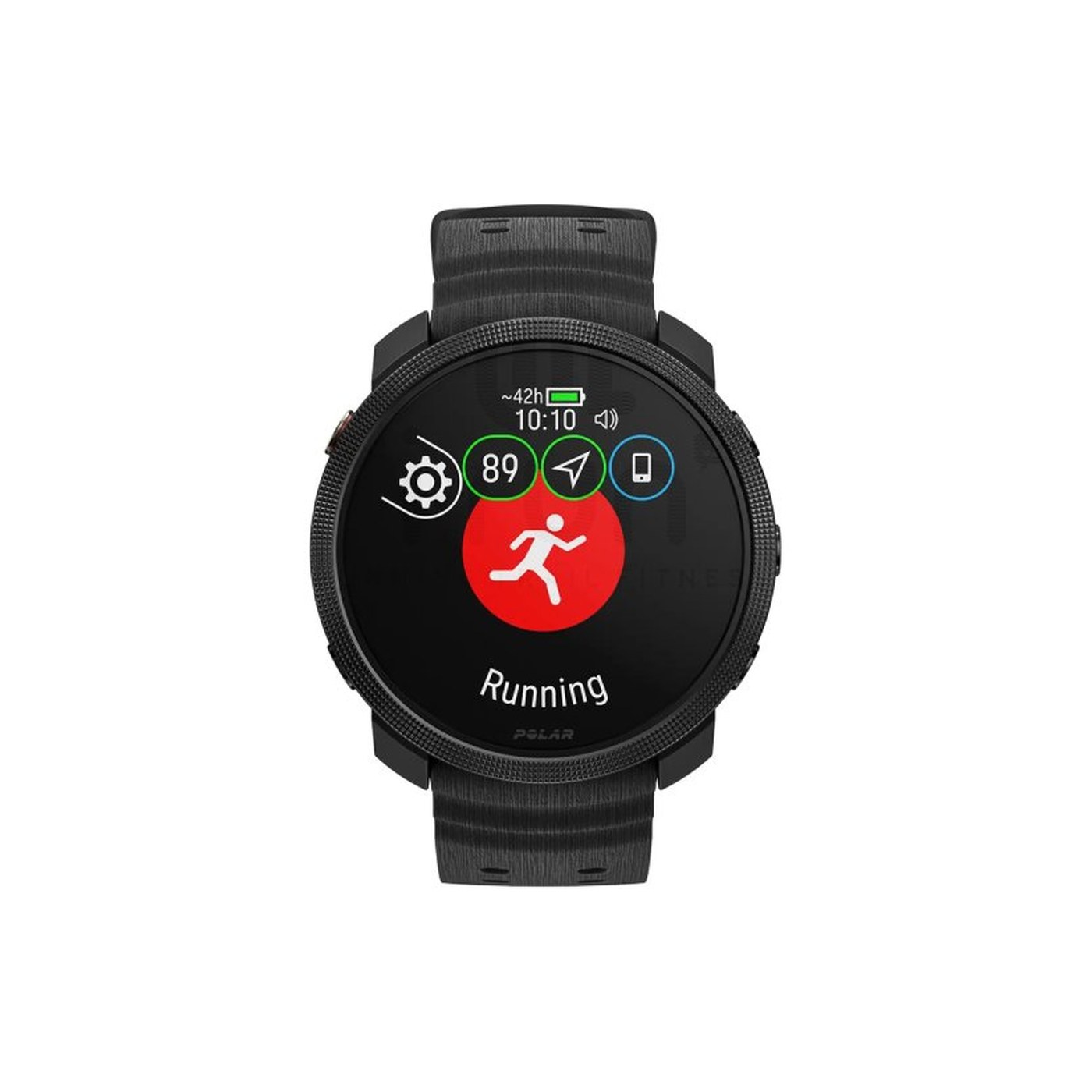
Polar Vantage M3 in black: 3/4 front view with the AMOLED display on. © Polar, official photo used for editorial purposes.
Polar Vantage M3 specs: what you need to know
| Brand | Polar |
| Model | Vantage M3 |
| Release | November 2024 |
| Type | Running, multisport, fitness |
| Display | AMOLED touchscreen, 1.28 inch, 416 x 416 px |
| GPS battery life | ~30 hours |
| Smartwatch battery life | ~7 days (AMOLED always-on off) |
| Sensors | Optical heart rate sensor (Polar Precision Prime), SpO2, temperature |
| GPS | Multi-band (L1+L5), dual-frequency GNSS |
| Maps | No |
| Key metrics | Running Index, Training Load Pro, Recovery Pro, Nightly Recharge, Sleep Plus Stages, FuelWise, Hill Splitter |
| Water resistance | WR50 (50 meters) |
| Connectivity | Bluetooth LE, ANT+, Wi-Fi (sync) |
| Music storage | No |
| Weight | ~39 g (case) |
| Official price | €329 |
AMOLED display and usability: the M3's big leap forward
The switch to AMOLED is the most visible change on the Vantage M3. After years of MIP (Memory in Pixel) screens that were readable but low on contrast, Polar finally adopts high-resolution touch technology. The result is striking: training widgets are colorful, heart rate graphs are sharp, and swiping through menus feels natural.
The 1.28-inch display has a resolution of 416 x 416 pixels, on par with what Garmin offers on its Forerunner 265. Brightness adjusts automatically, and always-on mode stays readable in daylight. At RunMorph, we especially liked how readable the data is mid-run: pace and distance figures are sized just right, even when you glance at your wrist on the move.
The 43 mm case is a good compromise. It doesn't swamp slim wrists, unlike the Vantage V3 (47 mm) or some Coros watches. All five physical buttons are still there, so you can control the watch with gloves on in winter, a feature button purists will appreciate.
GPS and heart rate: is the accuracy there?
The Vantage M3 packs a multi-band GNSS chipset (L1 + L5), a first at this price point for Polar. Dual frequency improves accuracy in tricky environments: forests, dense city centers, deep valleys. According to independent field measurements, the distance error on a 10 km urban course sits around 0.5 to 1%, which puts the M3 among the front-runners in its segment.
The Polar Precision Prime heart rate sensor (3rd generation) remains a benchmark. On steady runs, it tracks almost exactly with a chest strap. On short intervals or hill repeats, it sometimes lags by a few seconds, but nothing dramatic. Blood oxygen (SpO2) and skin temperature tracking are nice bonuses for monitoring overnight recovery.
One caveat: the Vantage M3 has no built-in maps. No colored tracks over a map background, no visual turn-by-turn navigation. For city runners or anyone plotting road routes, that's not a problem. For trail runners who want to follow a mountain route, it's a notable gap. Navigation is limited to a direction arrow and the distance to the next waypoint.
Training metrics: Polar's expertise on your wrist
Load and recovery analysis has always been Polar's strong suit. The Vantage M3 inherits the Finnish brand's full set of algorithms:
- Running Index: an estimate of your VO2max based on your speed and heart rate. Ideal for tracking your progress over the long term.
- Training Load Pro: breaks your load down into cardio, muscle and perceived load. It helps you avoid overload and plan your weeks.
- Recovery Pro: assesses your recovery through orthostatic tests and sleep analysis. A valuable tool for adjusting your volume.
- Nightly Recharge: analyzes your sleep and overnight autonomic nervous system activity to give you a recovery score every morning.
- FuelWise: reminds you to drink and eat during long runs, based on your energy expenditure.
- Hill Splitter: automatically detects climbs and descents to analyze your uphill-specific power.
These metrics are laid out clearly in the Polar Flow app, available on smartphone and web. The interface is less flashy than Garmin Connect, but many runners find it easier to read and less intimidating for beginners.
Polar Vantage M3 vs Garmin Forerunner 265 vs Coros Pace 3: the comparison
| Criterion | Vantage M3 | Forerunner 265 | Coros Pace 3 |
|---|---|---|---|
| Price | €329 | €349 | €229 |
| Display | AMOLED 1.28" | AMOLED 1.3" | MIP 1.2" |
| GPS battery life | ~30h | ~24h | ~38h |
| Maps | No | No | No |
| Heart rate | Precision Prime (excellent) | Elevate V4 (very good) | Optical (good) |
| Metrics | Running Index, Training Load Pro | Training Readiness, VO2max | EvoLab, Training Load |
| App | Polar Flow (clear) | Garmin Connect (feature-rich) | Coros (minimalist) |
Polar Vantage M3 pros and cons
Pros
- AMOLED touchscreen, at last
- Solid battery life (30h GPS)
- Highly advanced Polar training metrics
- Benchmark heart rate sensor
- Accurate multi-band GNSS
- Clear, intuitive interface
Cons
- No built-in maps
- No onboard music
- No wireless charging
- Less open ecosystem than Garmin
- Limited on trails without visual navigation
Who is the Polar Vantage M3 for?
The improving recreational runner
You run 2 to 4 times a week, you're training for a 10 km or a half marathon, and you want data to get better. The Vantage M3 gives you objective indicators (Running Index, Training Load Pro) without drowning you in useless data. It's the ideal watch to structure your progress.
The data lover who wants clarity
You love analyzing your sessions but find Garmin Connect too cluttered. Polar Flow presents data in a clean, actionable way. The M3's value for money is excellent for this profile: you get high-end algorithms at a mid-range price.
The road and track runner
You mostly run on roads, in the city or on the track. The multi-band GPS is accurate, the AMOLED display is easy to read, and 30 hours of battery life covers several weeks of training without a recharge. On the other hand, if you run technical trails, the lack of maps will likely frustrate you.
How to fit the Vantage M3 into your RunMorph training plan
The Vantage M3 fits into any RunMorph training plan. Use the Running Index to track your long-term progress: a 1-point increase equals roughly a 30-second improvement on your 10 km. Training Load Pro helps you stick to the recovery weeks built into your plan: if your muscle load climbs too high, that's your signal to back off.
For intervals, wrist-based heart rate is responsive enough. For maximal aerobic speed (MAS) tests or very hard sessions, a Polar H10 chest strap is still the way to go for maximum accuracy. Hill Splitter is a real asset for hill sessions: it shows your uphill-specific power, which helps you fine-tune intensity.
RunMorph Coach verdict
The Polar Vantage M3 is a success. It finally brings a modern display to a lineup that badly needed one, without giving up the brand's strengths: some of the most relevant training metrics on the market and a benchmark heart rate sensor. Its main rival is still the Garmin Forerunner 265, slightly more expensive and more versatile, but less intuitive when it comes to load analysis.
RunMorph score: 8.2/10
It loses points for the lack of maps and onboard music, two features that are becoming standard at this price point. But for pure runners who want reliable data and a clear interface, the Vantage M3 is one of the best choices of 2025.
Key takeaways for your training
- Track your Running Index: it's the best indicator of your long-term progress.
- Respect Training Load Pro: excessive muscle load is the first sign of overtraining.
- Do your MAS tests with a chest strap: optical heart rate sometimes drops out during very hard intervals.
- Use Nightly Recharge: your morning recovery score helps you adjust the intensity of the day's session.
- Keep charging in mind: the Vantage M3 charges via USB, so plan a regular charging routine if you run more than 4 times a week.