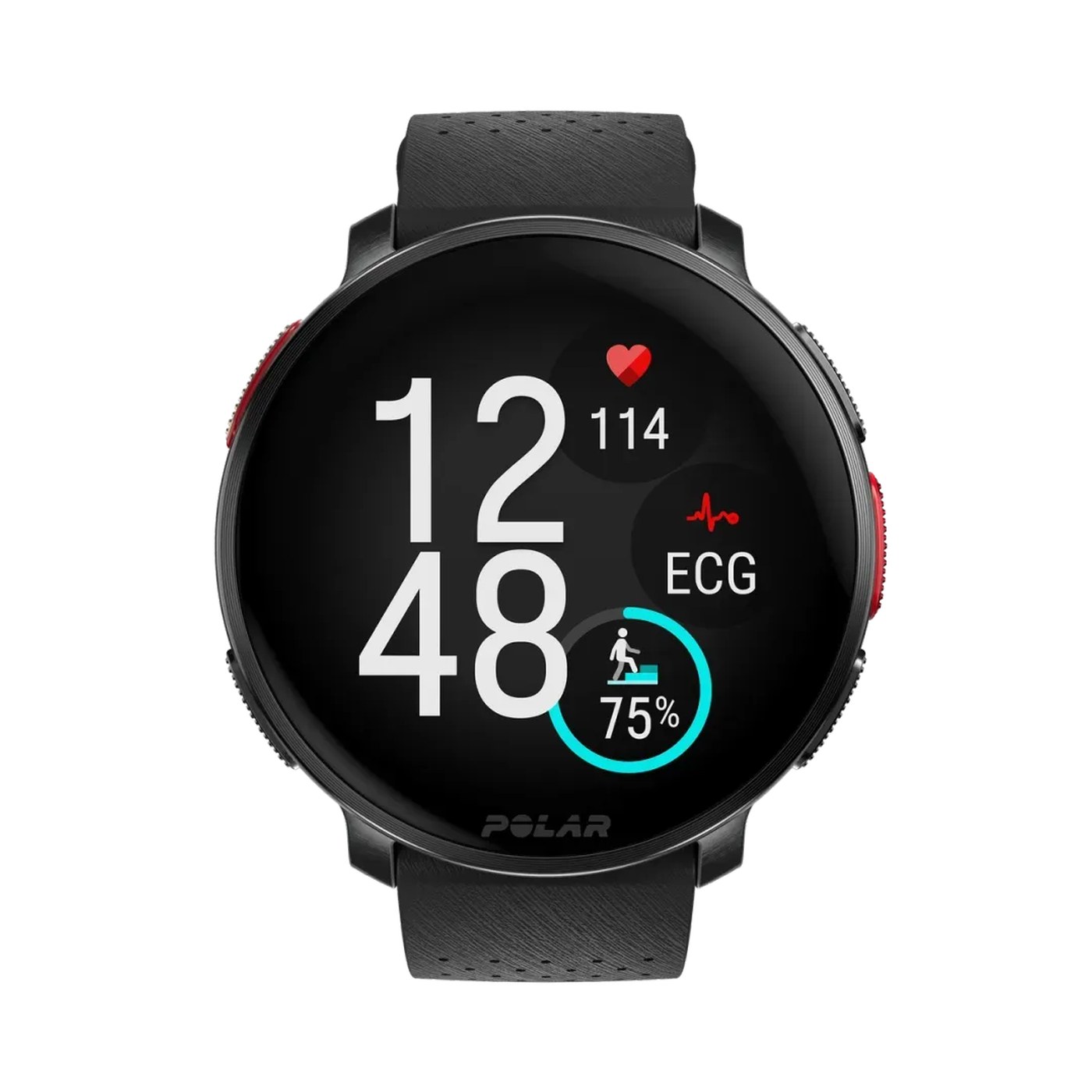
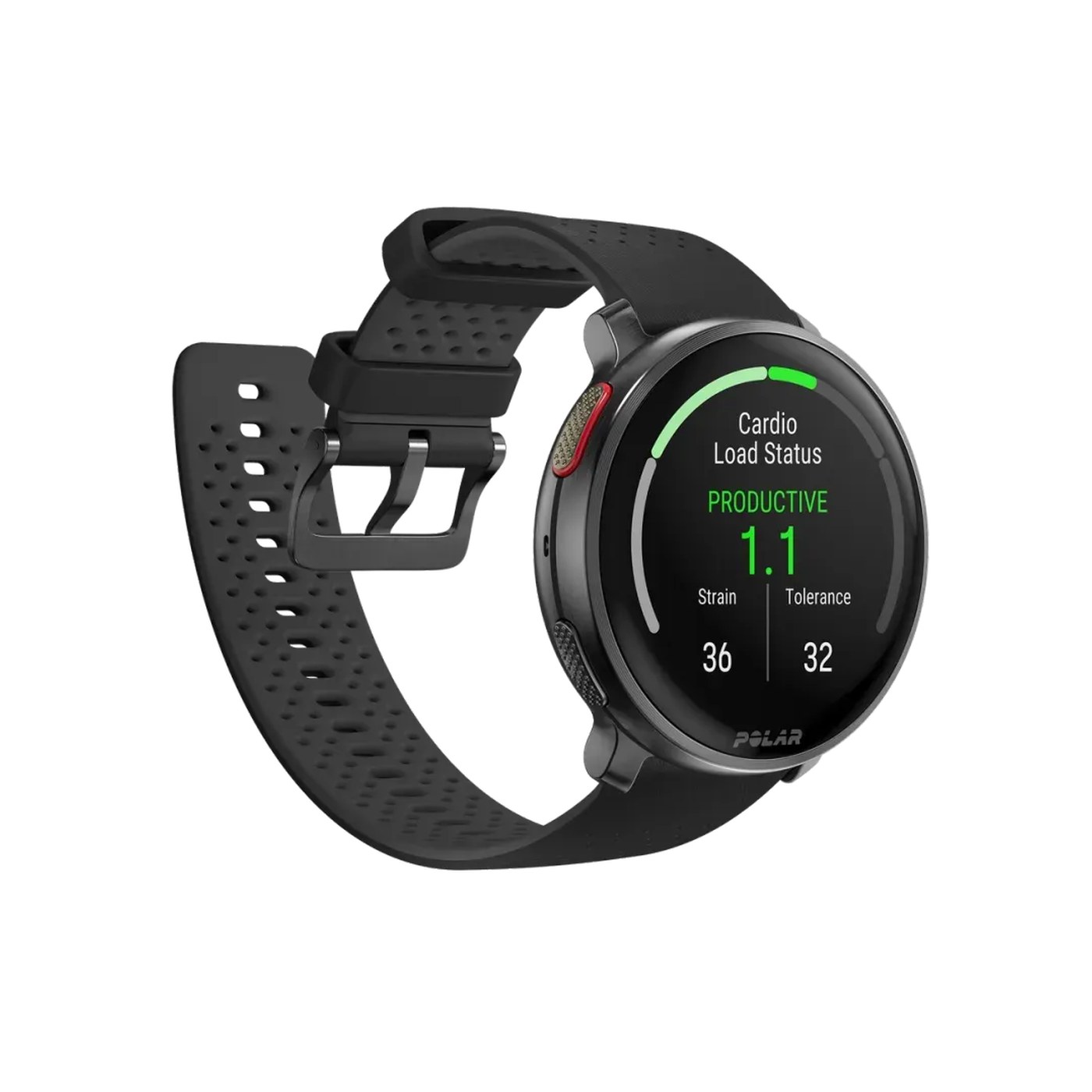
The Vantage V3 puts Polar back in the big leagues. Released in October 2023 at €599, it brings the Finnish brand back into the high-end fight with a 47 mm aluminum case, a 1.39" AMOLED, dual-frequency L1+L5 GPS, wrist ECG and the Elixir suite of biometric sensors. The pitch isn't to copy Garmin or Coros, but to go back to what has always made Polar a legend: heart rate. Here's our full review.
Polar Vantage V3 Review: Wrist ECG and Elixir Sensors at €599
8.5/10
Polar Vantage V3: Polar's big comeback, led by heart rate
For five years, Polar had lost its footing. The 2020 Vantage V2 had no color screen, and the competition had pushed it into the background. The Vantage V3 fixes everything in one go: 454x454 px 1.39" AMOLED, 47.3 mm aerospace-grade aluminum case, L1+L5 dual-band GPS, offline maps, wrist ECG, SpO2, skin temperature. All for €599 at launch.
What sets the V3 apart from the Garmin/Coros ecosystem is its philosophy. Polar bets on physiological depth rather than piling up features. The new Elixir suite combines ECG, SpO2, skin temperature and the Gen 4 optical heart rate sensor in a single module. The idea: turn every night and every session into a clinical read of your fitness. For the demanding runner who gives Nightly Recharge, Training Load Pro and Recovery Pro their full weight, this is exactly what they've been waiting for since the M460 and the V800. For the runner who mostly wants a reliable everyday watch, the picture is more mixed. The optical heart rate sensor stumbled on early firmware versions, and the lack of onboard music reveals a positioning that has never tried to compete with the Forerunner.
RunMorph's advice: the Vantage V3 has a very specific audience. If you're already used to advanced physiological platforms (Polar Flow, Polar plans, H10 chest strap), it remains the most coherent watch for taking your analysis all the way. If you're just starting out or want plug-and-play with a large app ecosystem, look at the COROS Pace Pro at €349 or the Garmin Forerunner 170 at €299 instead.
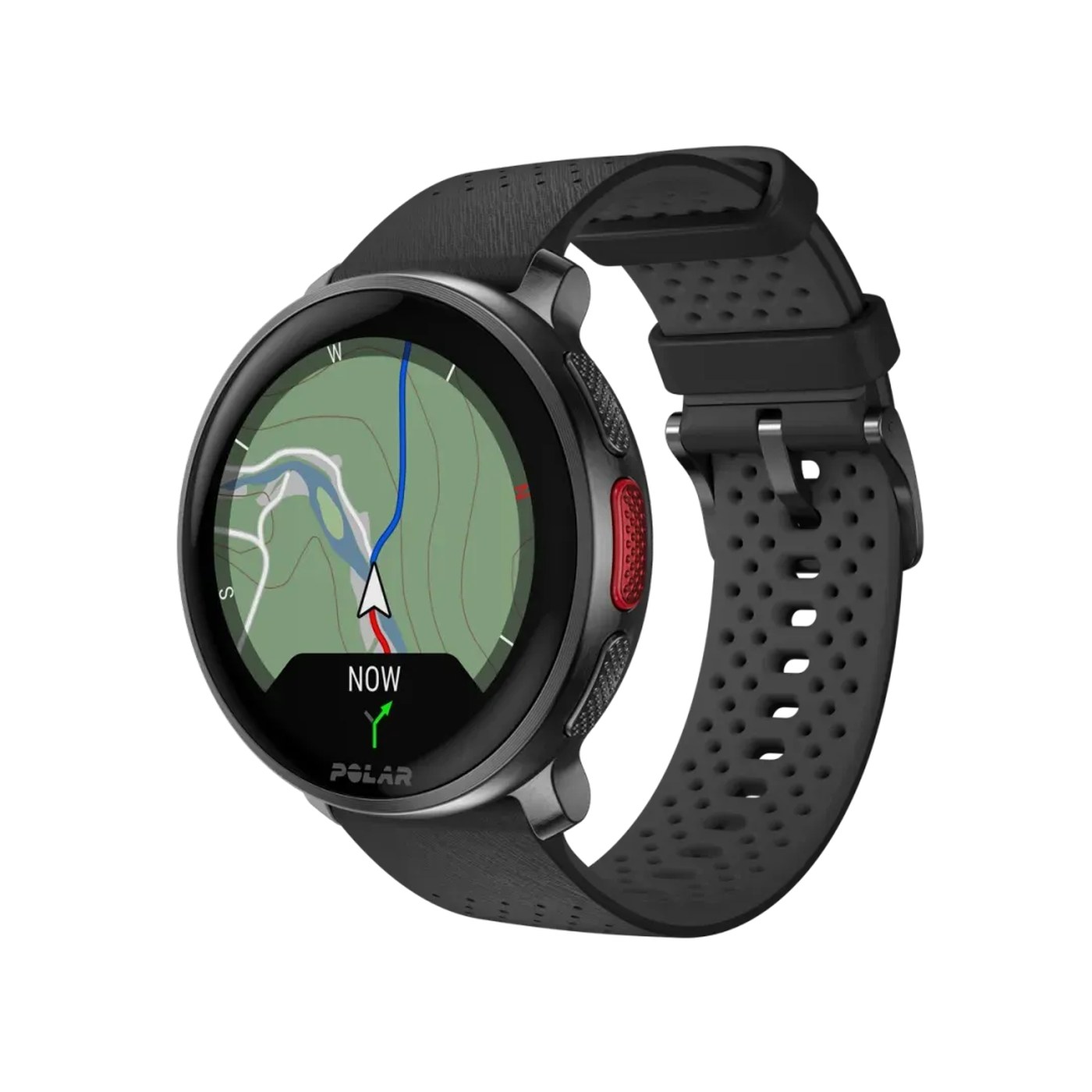
© Polar, official photo used for editorial purposes
Technical specifications
| Brand | Polar |
| Model | Vantage V3 |
| Official release | October 11, 2023 |
| Case | 47.3 x 47.3 x 13.5 mm, aerospace-grade aluminum, domed Gorilla Glass 3 |
| Weight | 57 g with silicone strap, 39 g without strap |
| Display | 1.39" AMOLED, 454x454 px, 326 ppi, touchscreen, Always-On available |
| GNSS | Dual-frequency L1+L5 (GPS, GLONASS, Galileo, BeiDou, QZSS), Assisted GPS |
| Heart rate | Optical Gen 4 (Polar Elixir), 30 s wrist ECG, SpO2, overnight skin temperature |
| Additional sensors | Barometer, magnetic compass, accelerometer, gyroscope |
| Mapping | Offline topographic maps downloadable via Polar Flow Web, turn-by-turn navigation via Komoot, breadcrumb, Back to Start |
| Sport profiles | More than 150 (running, trail, swimrun, triathlon, skiing, cycling, strength...) |
| Music storage | No (smartphone music control only) |
| Contactless payment | No |
| Water resistance | WR50 (50 m, surface swimming) |
| Battery | 488 mAh Li-Pol. 10 days in smartwatch mode, 43 h in Performance training mode, 140 h in Eco training mode |
| Connectivity | Bluetooth LE, USB-C (Charge 2.0), 2.4 GHz Wi-Fi for maps |
| Memory / storage | 275 MHz CPU, 37 MB RAM, 32 GB storage |
| Platform | Polar Flow + 60 days of Strava, 60 days of Komoot Premium, 30 days of TrainingPeaks Premium included |
| Official price | €599.90 |
Who is the Vantage V3 for?
The heart-rate-obsessed runner who measures everything
The first and most obvious target. If Nightly Recharge, FitSpark, Running Index, Training Load Pro and Recovery Pro mean something to you, and you already follow a personalized Polar Flow plan or calibrate your sessions by precise zones, the V3 is made for you. The new Elixir chip adds SpO2 (RMSE below 3.5% according to independent lab measurements), overnight skin temperature and a 30-second wrist ECG. That's a complete physiological stack, more subtle than that of a Garmin Forerunner 970, which leans harder on mapping and sport profiles.
The middle-distance triathlete who wants a clean wrist
57 g on the scale, 13.5 mm thick, water resistant to 50 m, and 43 h of battery life with GPS at full power. The Vantage V3 goes from bike to pool swim without a hitch, handles back-to-back disciplines and offers a full set of profiles with multisport transitions. For a 70.3 or an Olympic distance, that's enough. For a full Ironman, the Coros Pace 4 will be lighter but with less analysis, and the Forerunner 970 more complete for long-distance mapping.
The endurance trail runner looking for a Garmin alternative without paying €800
Free offline worldwide topographic maps, dual-frequency GPS, barometer, Hill Splitter, FuelWise for your fueling strategy. The V3 ticks almost every box of a modern trail watch. The catch: no flashlight, no multi-day expedition mode like the COROS APEX 4, and dual-frequency GPS battery life (43 h) sits in the upper average of the segment, nothing more. For 80-100 km ultras, that's enough; beyond that, the expedition segment still belongs to the Garmin Enduro and the Coros Vertix.
GPS accuracy and heart rate sensor
The switch to L1+L5 dual-frequency GPS is a game changer in cities and under forest cover. In "Most Accurate" mode, Polar tracks now stay clean in dense woods, in narrow streets between buildings and on top of mountain passes, where older Vantage models tended to drift. Factually, this is the V3's biggest technological leap over the single-band V2.
Multi-band accuracy puts the Vantage V3 on par with the market leaders, without beating them. The international consensus among reviewers is that the V3 sits very slightly behind the Forerunner 970 and the Suunto Race 2 on sharp changes of direction (a slight tendency to round off tight corners), but the gap has become marginal. For 95% of your sessions, you won't see the difference.
On optical heart rate, the picture is more mixed. The Polar Elixir Gen 4 is a measurable step up from the V2's Gen 3. On steady runs and in Eco mode, average deviations from an H10 chest strap stay under 2 bpm. In short intervals or strength training, however, occasional dropouts appear. Several firmware updates have tackled the issue since 2024, but Polar still has work to do on rapid pace changes. The workaround is the one Polar has always offered: pair an H10 chest strap (sold separately, €79.90) for high-intensity sessions. Paradoxically, that's where Polar is still the best: the Finnish brand remains the absolute benchmark for chest-strap heart rate.
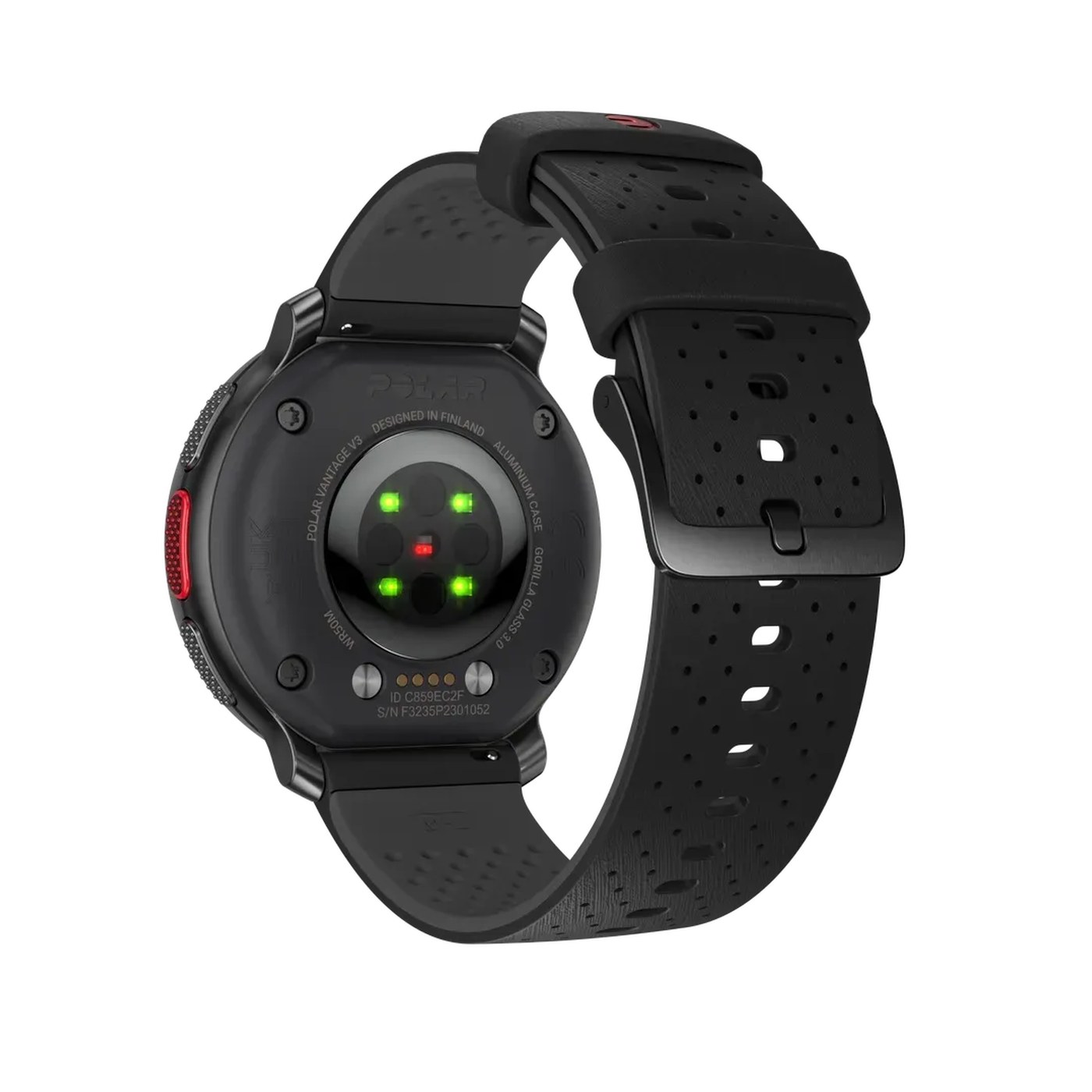
© Polar, official photo used for editorial purposes
Wrist ECG, SpO2 and skin temperature: the Elixir stack in practice
This is what sets the Vantage V3 apart. You start the wrist ECG by holding a finger on the dedicated button for 30 seconds, and it produces an electrical trace of your heart. The reading mainly serves to enrich the Polar orthostatic test (heart rate variability measured when you get up) without putting on the chest strap, and to flag rhythm anomalies that a cardiologist should confirm.
Don't fall for the marketing: the Vantage V3 ECG isn't certified as a medical device, and it doesn't automatically detect atrial fibrillation the way some competing watches do. It's a trend tool, not a diagnostic tool. Polar has been careful in how it communicates this, but we've seen clearer.
SpO2 is aimed at hikes and stays at altitude, acclimatization and restless nights. The values it collects are plausible and useful for tracking how you adapt over a week in the mountains. Overnight skin temperature mainly feeds the Nightly Recharge algorithm, which automatically becomes more reliable. This is where Polar takes back the lead over Garmin and Coros: the Vantage V3's read on sleep and recovery is still the most detailed on the market, by a significant margin.
Mapping and navigation
Polar finally catches up with the competition. Offline worldwide topographic maps, free to download via Polar Flow Web and then transferred over Wi-Fi, are stored on the 32 GB of internal memory. Continent maps come preloaded for Europe and North America, the rest on demand. Color, terrain, main and secondary roads, rivers: everything is easy to read on the 1.39" AMOLED.
Komoot turn-by-turn navigation works right from your wrist, with a graphic cue for upcoming turns. The catch is in the advanced features: no automatic rerouting when you go off course, and no points-of-interest search as advanced as Garmin's. For the trail runner who loads routes from Komoot or Polar Flow and just wants to follow a track, that's more than enough. If you want to explore freely, Garmin fenix-style, the gap is still noticeable.
Training and recovery metrics
This is Polar's other cornerstone. The V3 keeps the best of the brand and builds on it. Training Load Pro separates cardiovascular, muscle and perceived load. Recovery Pro tells you exactly how many hours you have left before you're ready for your next hard session. Nightly Recharge, now fed by skin temperature, becomes even more relevant: you know in the morning whether your night really made up for the previous day's effort.
FitSpark suggests 3 to 5 workouts every day, tailored to your physiological state. FuelWise reminds you to drink or eat during long runs, based on your weight and the intensity. Hill Splitter automatically splits climbs and descents into intervals. Running Index estimates your VO2max from every easy run. All these features exist elsewhere under other names, but Polar's combination is fifteen years ahead in algorithmic finesse: the legacy of the brand's research labs since the 1980s.
Real-world battery life
Polar claims 10 days in smartwatch mode, 43 h in Performance GPS mode (dual-band) and 140 h in Eco GPS mode. These figures hold up, with a few caveats. In real daily use with notifications, 24/7 heart rate, Always-On off and 4 to 6 h of sport per week, you get 7 to 9 days between charges. With Always-On permanently on, you drop to 5 days. On a multi-band GPS outing, count on 40 to 45 h depending on the terrain. In Eco GPS mode with the screen waking intermittently, the claimed 140 h is achievable on very long distances.
That's decent without being impressive. The COROS APEX 4 delivers 65 h in multi-band GPS, the Suunto Race 2 55 h. The V3 sits between the Forerunner 970 (21 h multi-band) and those two benchmarks. USB-C charging in under 2 h with the Polar Charge 2.0 cable is still fast.
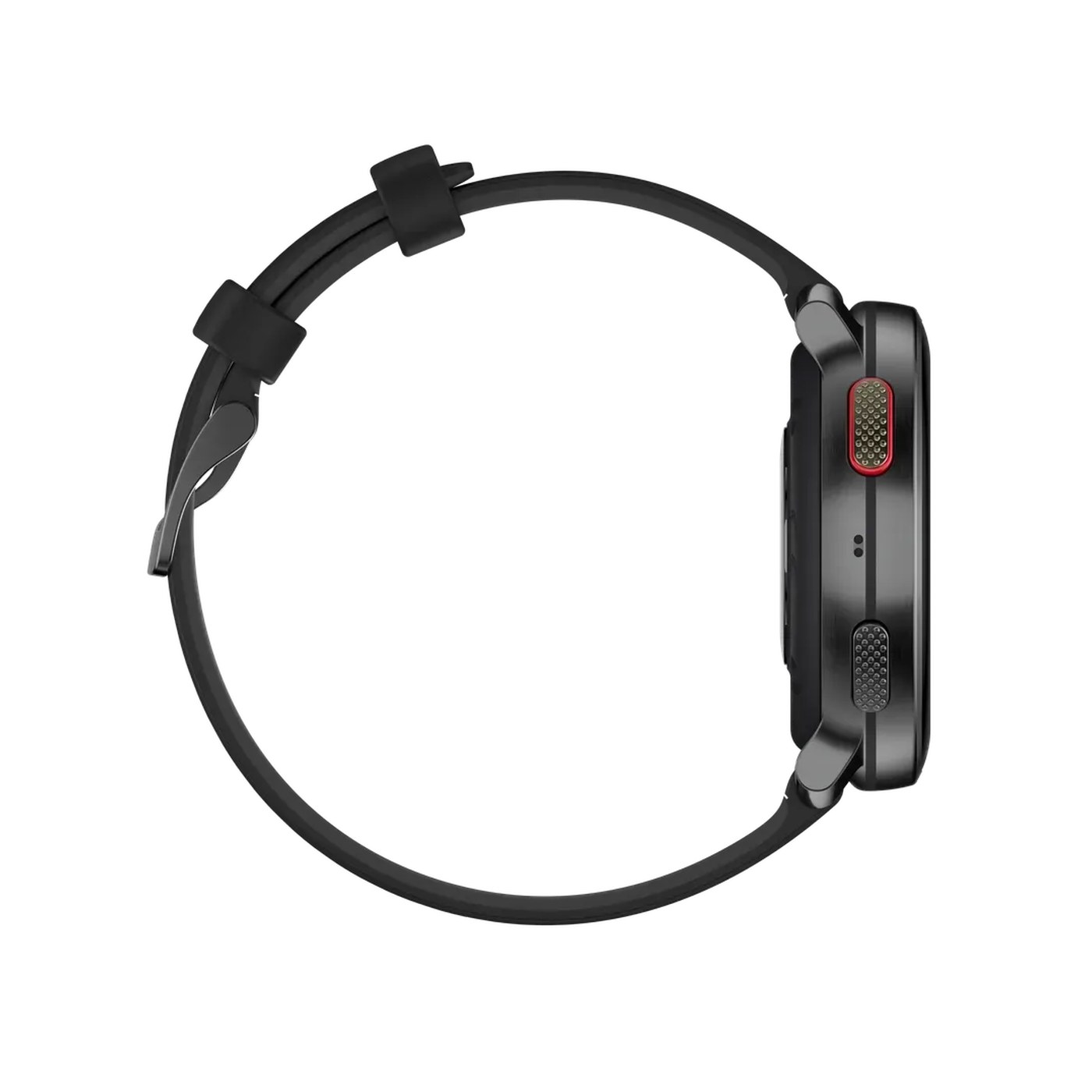
© Polar, official photo used for editorial purposes
How it stacks up against the competition
Three direct rivals in the high-end multisport AMOLED segment, priced around €500-750:
Vantage V3 (€599) vs. the Garmin Forerunner 970 (€749). The Forerunner 970 is more complete: LED flashlight, Garmin Pay, onboard music, preloaded TopoActive Europe maps, longer battery life in standard GPS mode. The Vantage V3 takes back the lead on detailed physiological tracking (Nightly Recharge, Recovery Pro, Training Load Pro), the sleep algorithm and weight (57 g vs. 56 g, a tie). If you want the most complete platform above all else, go Garmin. If you want the most detailed recovery read, go Polar.
Vantage V3 (€599) vs. the Suunto Race 2 (€599 Titanium Trail). A very close match. The Race 2 offers a larger 1.5" AMOLED, longer multi-band GPS battery life (55 h vs. 43 h), and more advanced mapping with Heatmaps and Climb Guidance. The V3 wins on ECG, SpO2, the Polar Flow physiological suite and the brand's thirty-year track record in heart rate. It comes down to the software ecosystem: Polar Flow if you love deep analysis, Suunto if you love trail running and adventure.
Vantage V3 (€599) vs. the COROS Pace Pro (€349). A €250 gap. The Pace Pro is lighter (49 g), just as well equipped with dual-band GPS and worldwide offline maps, and offers 38 h of GPS battery life. The V3 stays ahead on AMOLED screen quality (1.39" vs. 1.3"), the Elixir sensors (ECG, SpO2 and skin temperature, which the Pace Pro lacks), the depth of its recovery analysis and the Polar Coach suite. For a runner just getting into advanced analysis, the Pace Pro is enough. If you want the full premium physiological toolkit, the V3 justifies its price.
How to use it with your RunMorph training plan
The Vantage V3 is the ideal tool to get the most out of a RunMorph training plan. Heart rate zones set from your measured max HR (orthostatic test or running performance test), personalized workout suggestions (FitSpark), a morning recovery read (Nightly Recharge) and a weekly load summary (Training Load Pro) let you fine-tune every microcycle.
In practice: export your RunMorph plan to Polar Flow via TrainingPeaks Premium (free for 30 days with purchase), check Nightly Recharge every morning to adjust the day's intensity, and track your Running Index month by month to confirm your progress. The V3 turns a plan on paper into a physiological autopilot. During workouts, keep the H10 chest strap for the really hard intervals, where optical heart rate still falls short, and rely on the wrist for everything else (easy runs, long runs, recovery).
Our RunMorph verdict
The Polar Vantage V3 is the best Polar watch in ten years, and probably the most relevant watch on the market if you put physiological depth above everything else. Polar isn't playing the same game as Garmin or Coros: the Finnish brand isn't trying to stack features or win over the mass market, it's trying to give you the most precise read possible of what's going on in your body. That's exactly what the V3 delivers, with the bonus of the AMOLED screen, dual-band GPS and offline maps that were sorely missing.
Two drawbacks remain that we can't ignore: the Gen 4 optical heart rate sensor still stumbles on rapid pace changes (workaround: an H10 chest strap for demanding intervals), and the lack of both onboard music and contactless payment hurts at this price. At €599, you'd expect these features, now standard at Garmin and Coros. Polar chose physiological purity over the lifestyle smartwatch. It's consistent with the brand's DNA, but it narrows the audience.
For the runner already sold on Polar Flow who makes real use of Nightly Recharge, Recovery Pro and Training Load Pro, the V3 is a long-term investment. If you're not yet sure you'll stay in the Polar ecosystem, we recommend checking out its rivals before you buy.
RunMorph score: 8.5/10. It loses half a point for an optical heart rate sensor that still needs work and the lack of music. A watch that fully owns its premium niche identity and will delight heart rate purists.
© Polar, official photo used for editorial purposes
Key takeaways for your training
- Polar heart rate is still the benchmark: pair the V3 with an H10 chest strap for short interval sessions and you get the most accurate heart rate data on the market, all categories combined.
- Nightly Recharge is your No. 1 tool: check it every morning before you decide on your intensity. It tells you whether you can push or need to recover.
- Dual-band GPS finally fixes Polar's drift: you can trust distances and paces in the city and in the woods alike, now on par with Garmin and Coros.
- The V3 is not a smartwatch: no music, no contactless payment, limited notifications. It stays focused on sport and physiology, so don't ask more of it.
- Polar Flow is worth the learning curve: the ecosystem is dense (Training Load Pro, Running Index, FitSpark, Polar Coach adaptive plan), but once you've mastered it, no other platform takes personalized analysis this far.