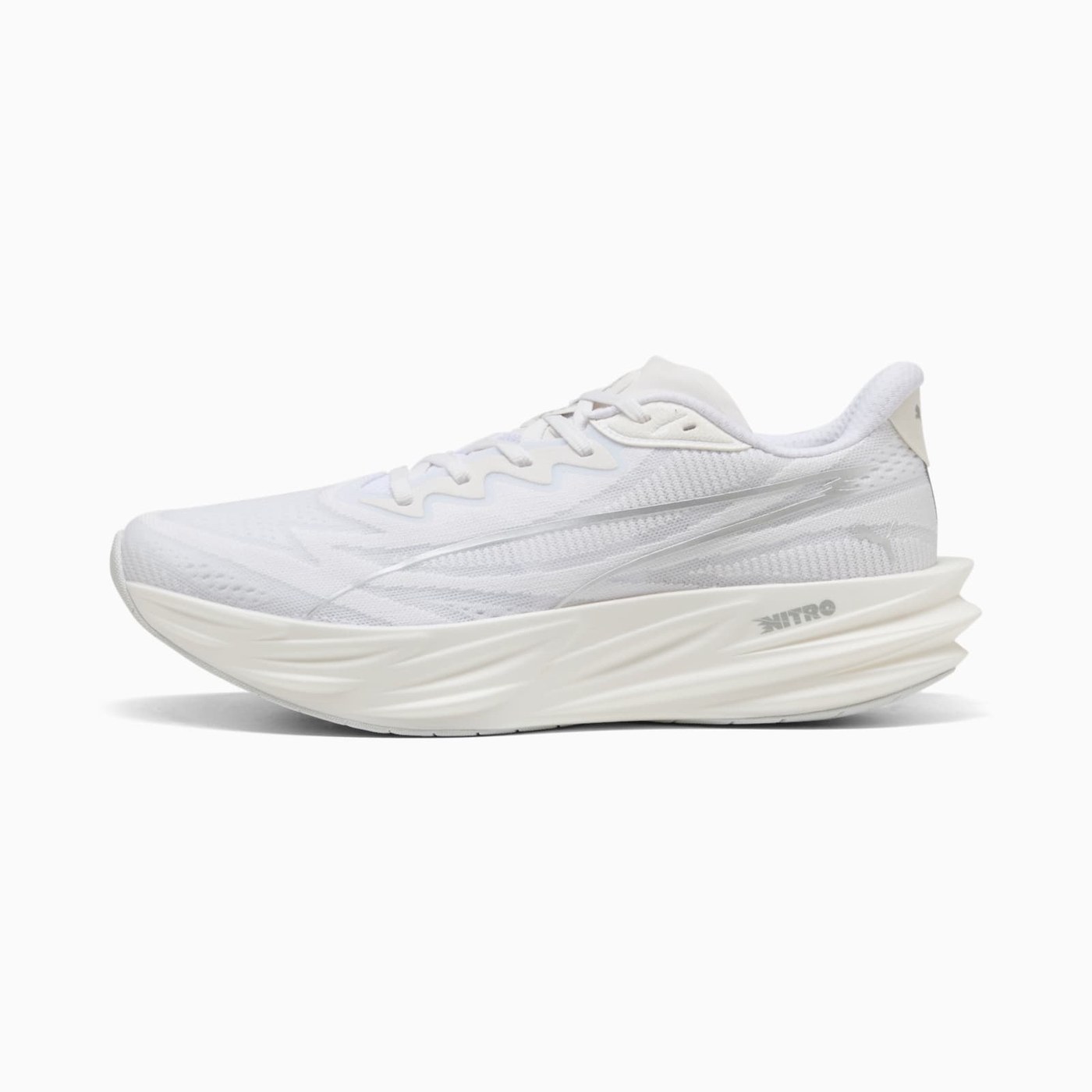
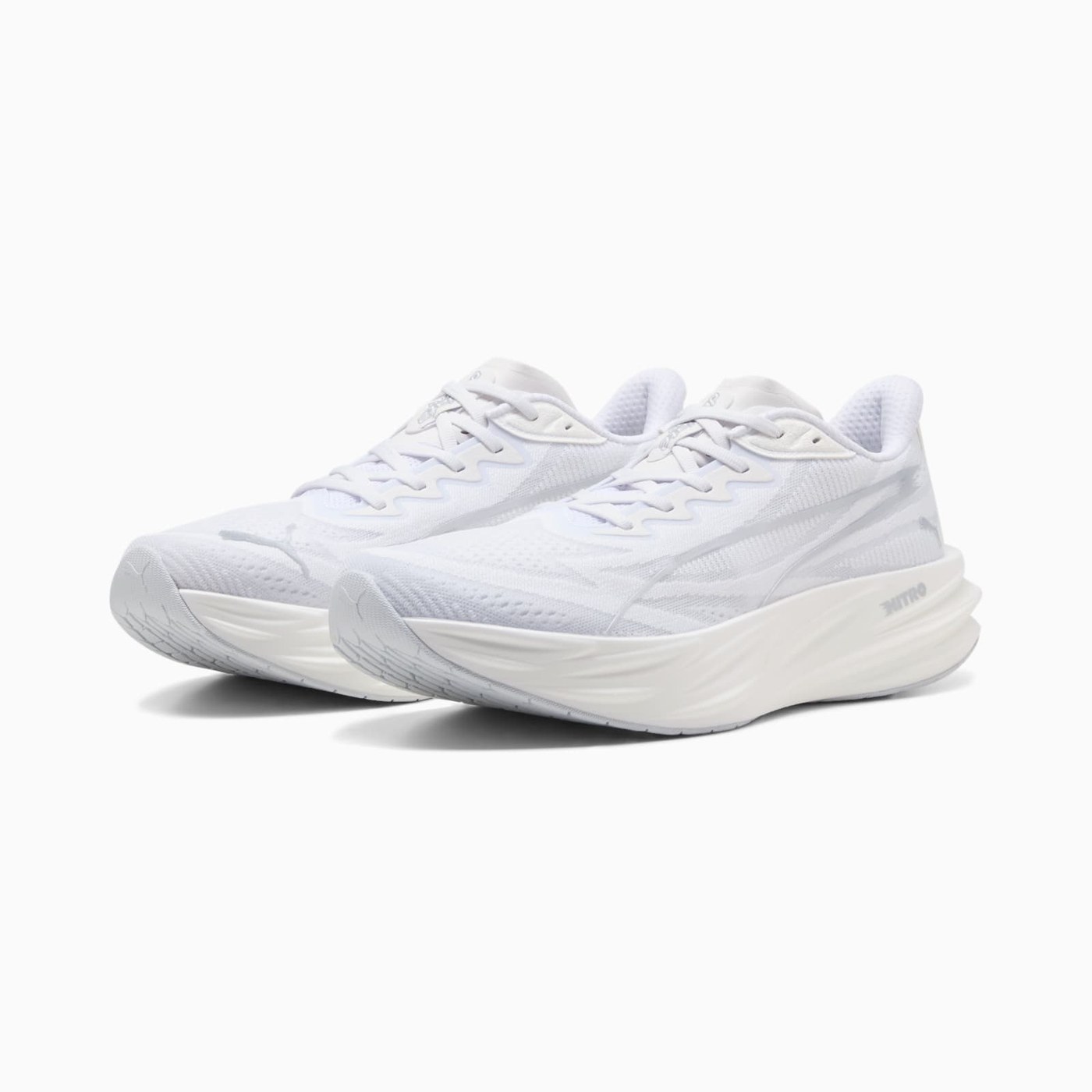
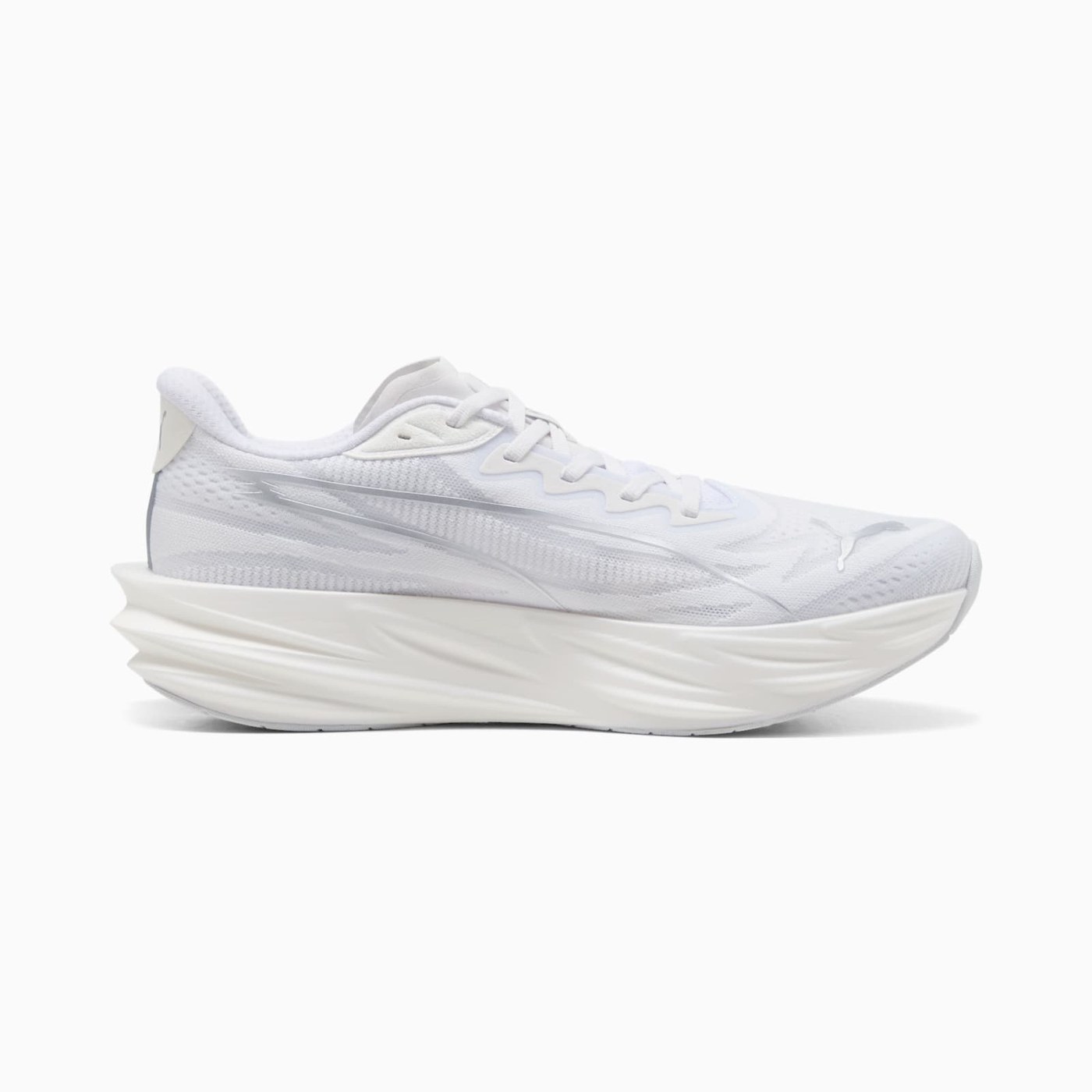
Puma claims 220 grams for the Deviate Pure Nitro in a US 9. An independent lab that buys and weighs every pair itself put its sample at just 202.6 grams, 17 grams under the official figure. A second tester, a physical therapist, lists 213 grams for the same reference size. RunMorph cross-checked three full tests of this plateless trainer which, for once, weighs in lighter than advertised.
The Deviate Pure Nitro launched on June 4, 2026 and drops the PWRPLATE found in the other Deviate models to deliver a lighter, more natural trainer at $150. All three sources agree on standout lightness and good durability, but disagree on the exact measured weight, and all of them flag a narrow fit and limited responsiveness at sustained fast paces. The lab even measured a real drop of 10.1 mm against the 8 mm claimed, due to a thinner forefoot than advertised.
Who is it for?Runners with narrow to regular feet who want a very light, versatile trainer for daily training, long runs and tempo work without blowing their budget.
Who should skip it?Runners with wide feet, anyone after a genuinely snappy racer for 5K-10K races, or those chasing the explosive bounce of a carbon-plated super shoe.
Puma Deviate Pure Nitro: why test it now?
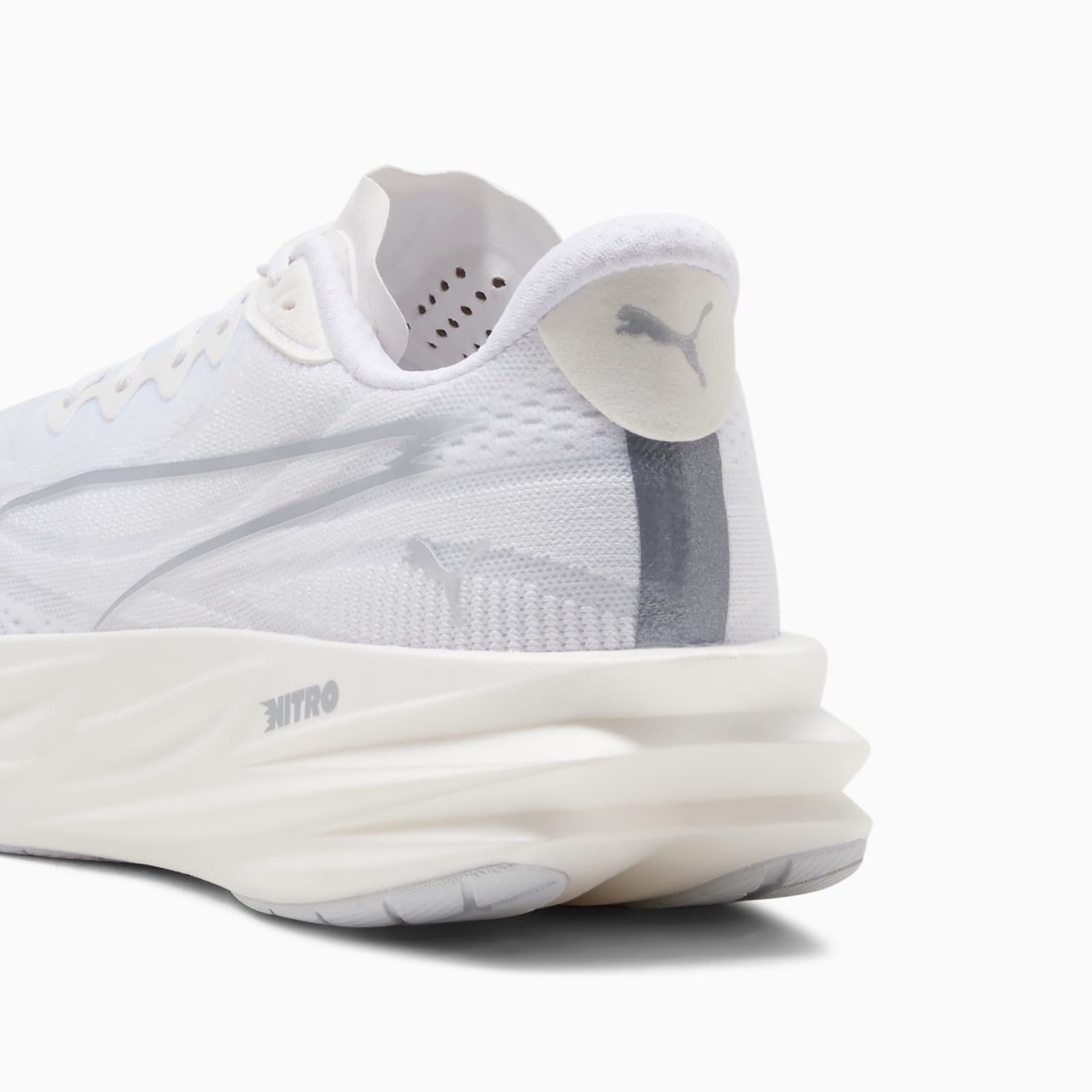
The Deviate Pure Nitro launched on June 4, 2026, and it marks a shift in Puma's Deviate line. Where the classic Deviate Nitro models pack a PWRPLATE for propulsion, this "Pure" version removes it entirely in favor of a full-length PEBA NITROFOAM midsole. According to the lab, the only reinforcement left is a small plastic heel shank that works for stability rather than propulsion. Romain Girard, VP of innovation at Puma, pitched the project as a way to make fast running accessible to a wider range of runners, in a booming segment of plateless trainers alongside the Adidas Adizero Evo SL and the Hoka Mach 7.
RunMorph's advice: if you have wide feet or a generous arch, try the Deviate Pure Nitro on in a store before buying, since all three sources agree on a narrow, typically Puma fit. If what you really want is a plated racer for competition, the Puma Deviate Nitro 4 remains the more propulsive option in the lineup.
Specs: what Puma claims
Brand
Puma
Model
Deviate Pure Nitro
Release
June 4, 2026
Type
Plateless performance trainer, from daily training to tempo
Claimed drop
8 mm
Claimed stack
38 mm heel, 30 mm forefoot
Claimed weight
220 g (US M9 / EU 42), 180 g in women's EU 37.5
Foam
Full-length PEBA NITROFOAM
Plate
No carbon plate, small plastic heel shank for stability
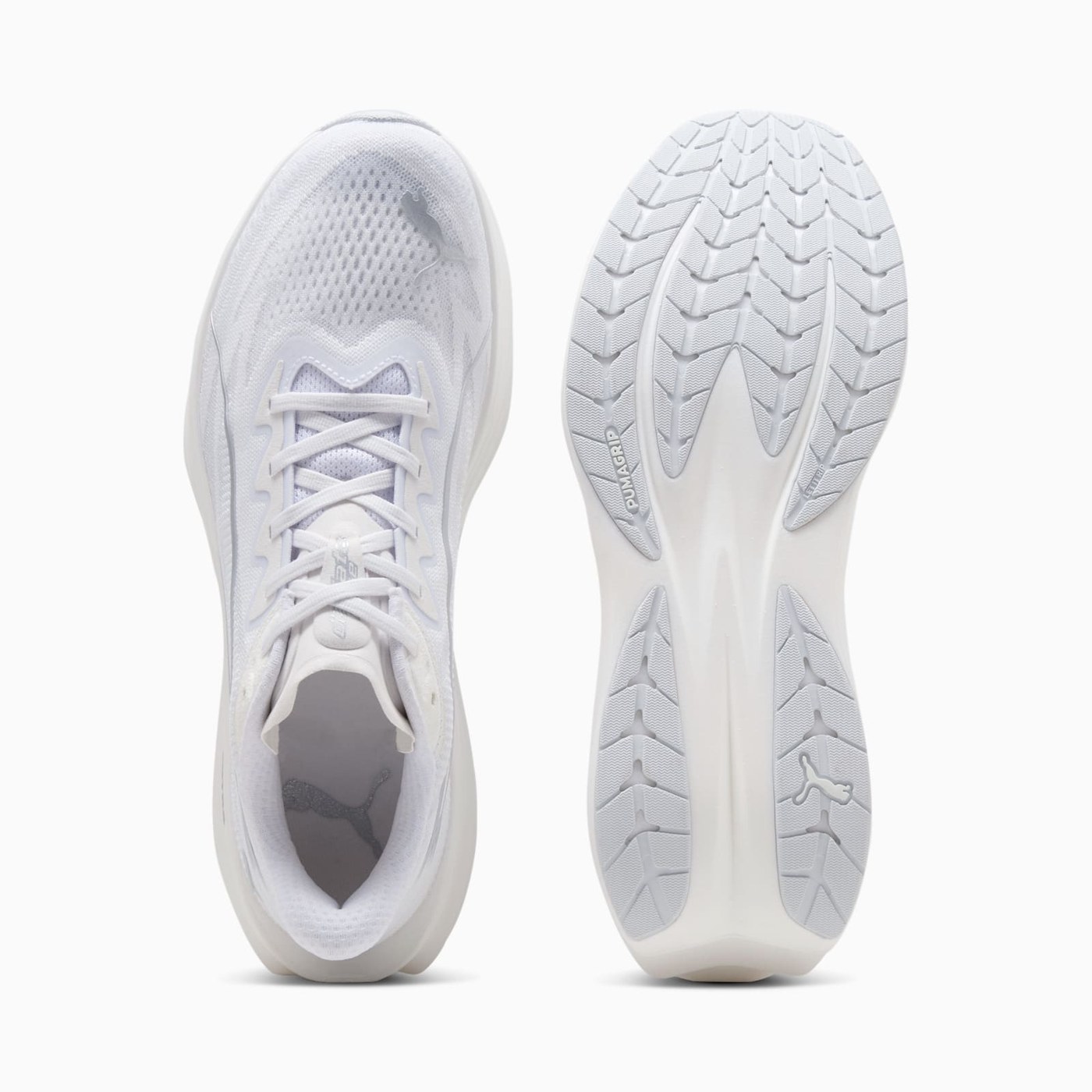
PUMAGRIP rubber, wide coverage for traction on wet roads
Available widths
Standard only
Official price
$150 / €149.95
Deviate Pure Nitro: what Puma claims vs what was measured
This is the most unusual discrepancy RunMorph found on this model: shoes usually weigh more than the official figure, but here it is the other way around. Puma claims 220 grams in a US M9. The lab, which systematically weighs every pair it buys with its own money, recorded just 202.6 grams on its test sample, 17.4 grams under the claim. The physio tester's spec sheet, also in a US 9, lists 213 grams, again below the official number. That tester did point out, though, that he personally ran in a US 10, one size up, where his pair came in at about 224 grams, closer to the claim once you account for the bigger size. The third tester, a running journalist, measured about 218 g on his US 9.5 pair.
Stack and drop hold a surprise too. Puma claims 38 mm at the heel and 30 mm at the forefoot, for an 8 mm drop. The lab confirms the heel height almost exactly at 38.2 mm, but found a forefoot of only 28.2 mm, 1.8 mm under the claim. That gap, small as it is, pushes the real calculated drop up to 10.1 mm, more than 2 mm above the official figure. Another oddity: the physio tester's spec sheet lists a 9 mm drop with a 37 mm heel and 29 mm forefoot stack, which by simple subtraction actually gives 8 mm, an inconsistency within their own sheet. In the body of the review, the tester himself describes "an 8 mm drop that feels exactly like that", matching the official claim and contradicting the 9 mm shown in his own spec box.
Data point
Claimed (Puma)
Independently measured
Weight (US 9)
220 g
202.6 g (lab) and 213 g (physio tester, spec sheet)
Heel stack
38 mm
38.2 mm (lab), virtually identical
Forefoot stack
30 mm
28.2 mm (lab)
Drop
8 mm
10.1 mm calculated by the lab; 9 mm listed but 8 mm described in the text by the physio tester
RunMorph's takeaway from this double discrepancy: the Deviate Pure Nitro is most likely a bit lighter than the label suggests, but with a slightly lower forefoot than planned, which partly explains why the lab rates forefoot comfort as improvable under heavy load.
The Deviate Pure Nitro uses the PEBA version of Puma's NITROFOAM, the same compound family as the Deviate Nitro 4 but without the PWRPLATE that gives that shoe its structure. The lab notes the model is not completely unreinforced: a small plastic heel shank adds a bit of structure, similar in principle to what the Adidas Adizero Evo SL does, but it is a far cry from a real full-length plate. The result, according to the physio tester, is a foam that feels a little firm at first and softens after 65 to 80 km of break-in to deliver a more balanced ride, with moderate bounce rather than a trampoline effect.
The journalist tester backs this up: the foam feels light, soft and "peppy", but less lively and responsive than the ATPU version of NITROFOAM used in the Puma Velocity Nitro 4. The lab puts energy return at 7.8/10 overall, decent without being exceptional, with better return at the heel (79.1%) than at the forefoot.
The fit: a warning shared by all three sources
Unlike other RunMorph tests where opinions on fit diverge, the three sources are almost unanimous here: the Deviate Pure Nitro runs narrow. The lab gives it an overall true-to-size score of 8.4/10, with true length and a fairly accommodating forefoot for a performance trainer, but flags a very narrow midfoot typical of Puma shoes (-7.2 mm versus standard width) and limited vertical volume in the toe box.
The physio tester agrees: the fit is slightly snug, especially in the forefoot, with a tapered, low-volume toe box that is closer to a racing shoe than a classic trainer. He adds that the fit loosens up over time but will mainly suit narrow feet that are not looking for extra room. The journalist tester goes the same way, describing a "long and narrow" shoe, to the point of recommending going half a size down from your usual size with Puma models.
One point only the physio tester mentions explicitly: the break-in period. By his account, it takes 65 to 80 km before the midsole and upper fully soften, something neither the lab nor the journalist flags in their shorter tests. RunMorph therefore recommends not judging the shoe on your first runs if it feels stiff out of the box.
Real-world testing: what the three sources say
RunMorph read three independent sources in full before making a call: a lab protocol with hard measurements and systematic weighing, a field test by a physical therapist who had logged 160 km at the time of publication, and a test by a running journalist covering 65 km over three days of varied sessions.
All three sources agree on the strengths: remarkable lightness that makes the shoe a pleasure to wear day to day, good stability despite the lack of a plate, and solid durability. The journalist sums up the Deviate Pure Nitro as a "jack-of-all-trades", a versatile shoe that handles most types of runs well without excelling at any one thing.
The disagreement, or rather the nuance, is about responsiveness at fast paces. The journalist explains that he switched to the Adidas Adizero Evo SL halfway through a session of long reps at half marathon pace, finding the Deviate Pure Nitro less able to drive him forward in that specific workout. The physio tester reports a similar feeling: he says he had to "rely more on his own body" than on the foam's rebound during fast efforts, without it being a dealbreaker. The lab confirms this with a snappiness score of just 6.5/10 and a rocker that "flattens easily under load".
Easy runs: this is the most unanimously approved use. The lab gives it 7.7/10 for daily training, its best usage score, and the physio tester confirms the shoe "handles extremely well" on easy runs once broken in.
Long runs: the journalist particularly liked this use, describing the shoe as "more comfortable and more supportive than most shoes this light" on a 19 km recovery run. The lab gives it 7.3/10 here, while noting that protection drops off beyond 10 to 15 km.
Tempo runs and fartlek: the physio tester approves it for fartlek and track sessions, while noting it is "not the fastest shoe". The journalist found it perfect for the steady portion of his progression run, with "some pep" for the harder section.
Short intervals and sprints: this is where the journalist was most impressed, the shoe's lightness lending itself well to short 60-second reps. The lab confirms a decent 7.4/10 for 5K/10K, while judging that it lacks the "snap" of a true racer.
Long reps at half marathon pace: the acknowledged weak spot for two sources out of three. The journalist chose to switch to the Adidas Adizero Evo SL mid-session, and the lab gives its lowest score to roll, at 6.3/10, judging that the rocker loses its shape under load.
First warning: break-in and forefoot cushioning over distance
Two technical limits deserve to be flagged together because both concern how the shoe behaves over time. On one hand, the physio tester is the only source to document a 65 to 80 km break-in period before the midsole and upper fully soften; neither the lab nor the journalist, whose tests covered a shorter period, mentions it. On the other hand, the lab puts a precise number on the drop in forefoot protection over distance: absorbed energy falls from 7.15 J at 10 km to just 6.63 J at 40 km, a sign that the shoe is better suited to short and medium runs than to very long distances.
Second warning: narrow fit and lack of pop at high intensity
This point combines two observations already detailed above that, together, sketch the profile of runner who should steer clear. The narrow fit, confirmed by all three sources (tight midfoot for the lab, tapered toe box for the physio tester, long and narrow silhouette for the journalist), rules out wide feet from the start. And the lack of responsiveness at fast paces, illustrated very concretely by the journalist swapping shoes mid-workout, means this pair should not be the only option for a runner chasing time goals on the road.
Pros and cons
Pros
Very low weight, measured even lighter than claimed by two sources out of three
Excellent durability observed by the physio tester after 160 km
Good value at $150 against rivals that often cost more
Solid stability despite having no plate, thanks to a wide platform
Good PUMAGRIP traction on the road, wet surfaces included
Cons
Narrow fit, especially through the midfoot and toe box
65 to 80 km break-in period before the shoe fully softens
Forefoot cushioning drops off noticeably beyond 15 km
Lacks pop at sustained fast paces according to two testers
Real drop measured by the lab higher than claimed (10.1 mm vs 8 mm)
Deviate Pure Nitro vs Deviate Nitro 4: plateless vs plated
Criterion
Deviate Nitro 4 (plated)
Deviate Pure Nitro (plateless)
Plate
Full-length PWRPLATE
None, just a small plastic stability shank at the heel
Weight
Heavier, about 30 g more according to Puma
202.6 to 220 g measured depending on the source
Ride
More propulsive and rockered
More natural and flexible, less leverage at toe-off
Use
Tempo and fast sessions
Everyday versatility, long runs and moderate tempo
Who should pick the Pure: runners who value lightness and a natural ride above all for their base training. Who should stick with the plated Nitro 4: those who want a single pair that can also handle the most demanding speed sessions.
Deviate Pure Nitro vs Adidas Adizero Evo SL and Hoka Mach 7
Model
Measured weight
Plate
Price
Puma Deviate Pure Nitro
202.6-220 g
Heel plastic shank only
$150
Adidas Adizero Evo SL
224 g (official)
No plate
Not specified
Hoka Mach 7
223 g (official)
No plate
Not specified
The lab is blunt about the comparison with the Adidas Adizero Evo SL: the Puma is lighter and more stable, with a thinner forefoot that absorbs less impact and gives more ground feel, making it more controlled at easy paces but less protective up front. The Adidas, on the other hand, delivers a more energetic ride better suited to sustained efforts, at the cost of feeling less stable on easy runs. The journalist confirms this on the road: he clearly preferred the Evo SL for holding a fast pace in long intervals. Against the Hoka Mach 7, often cited by all three sources as the direct benchmark in this category of light plateless trainers, the Deviate Pure Nitro stands out with a narrower fit and a generally lower weight, at a similar price point.
How to fit it into your training
In a 3 or 4 shoe rotation, the Deviate Pure Nitro naturally slots in as your daily trainer: easy runs, long runs at moderate pace, and tempo runs that are not about chasing the clock. Its lightness also makes it a good option for short 200 m to 400 m reps, where its low mass makes up for its relative lack of propulsion. Keep a more structured pair, like the Deviate Nitro 4 or an equivalent plated shoe, for long reps at half marathon pace and for race day itself.
To build a coherent plan around this pair, RunMorph's training plans help you structure your weeks by clearly separating base runs, where the Deviate Pure Nitro excels, from quality sessions that will benefit from a more responsive shoe.
Durability and cost per kilometer: what it really costs
The physio tester reports 160 km logged with only minimal outsole wear, even though the rubber is not full-length and leaves part of the midsole exposed. He expects high mileage from this pair, a conclusion consistent with the very positive durability feedback in his overall value grade (A). None of the three sources gives a precise final mileage, but RunMorph goes with a conservative estimate of 600 km given the durability observed at 160 km with no sign of breakdown.
At €149.95 and an estimated 600 km, the Deviate Pure Nitro works out to about €0.25 per kilometer, a very competitive rate for a PEBA-foam performance trainer. It is one of the best values in the light plateless trainer segment RunMorph has tested.
The Puma Deviate Pure Nitro confirms brands' growing interest in light, versatile trainers that bet on simplicity rather than a technology arms race. Its lightness, measured even lower than the official claim by two sources out of three, makes it a refreshing option in a market saturated with plated super shoes. The durability observed by the physio tester and the contained $150 price reinforce that positive impression.
The narrow fit, unanimously confirmed by all three sources, calls for a try-on in a store for anyone with wide feet. The 65 to 80 km break-in period flagged by the physio tester and the lack of pop at sustained fast paces, illustrated by the journalist swapping shoes mid-workout, also mean you need to set your expectations right: this pair shines in base training, less so in pure performance.
For $150, you get a light, stable and durable trainer, with room to improve on responsiveness and fit volume. It is an excellent choice to strengthen a training rotation, less obvious as a single shoe for anyone targeting races.
7.8/10.
Key points for your training
Real weight is often lower than claimed: 202.6 g at the lab and 213 g for the physio tester vs 220 g claimed by Puma.
Go a size down if you are unsure: all three sources agree on a narrow, typically Puma fit.
Allow 65 to 80 km of break-in before the midsole and upper fully soften.
Keep a more responsive pair for sustained fast paces: this shoe excels at base training, less at pure performance.
Expect about 600 km before replacement, which works out to roughly €0.25 per kilometer.
RunMorph Coach verdict
As a coach, I like the Deviate Pure Nitro as a solid option for building the training base of runners who pile up volume at moderate pace. Its real lightness, confirmed by two independent measurements below the official claim, makes it a pleasant daily shoe that does not tire your legs for no reason. I recommend allowing for a break-in period before judging the shoe on its first runs, and trying it on in a store if your feet are wide, since the fit is clearly designed for narrow to regular feet. For pure speed sessions, I advise keeping a more structured pair alongside it, as this Puma is first and foremost a base training shoe. The overall score of 7.8/10 rewards solid value and genuine lightness, without ignoring its limits in responsiveness at fast paces.
FAQ
How much does the Puma Deviate Pure Nitro really weigh?
Puma claims 220 g in a US M9, but the lab measured 202.6 g and the physio tester lists 213 g for the same reference size, so the shoe is generally lighter than advertised.
What is the real drop of the Deviate Pure Nitro?
Puma claims 8 mm. The lab calculates a real drop of 10.1 mm from its stack measurements, due to a forefoot about 1.8 mm thinner than the official claim.
Does it need a break-in period before you judge it?
Yes, according to the physio tester you should allow 65 to 80 km before the NITROFOAM midsole and the upper fully soften and deliver their final ride.
How many kilometers can you expect from a pair?
No source gives a final figure, but the physio tester saw only minimal wear after 160 km. RunMorph goes with a conservative estimate of 600 km, for a cost of about €0.25 per kilometer.