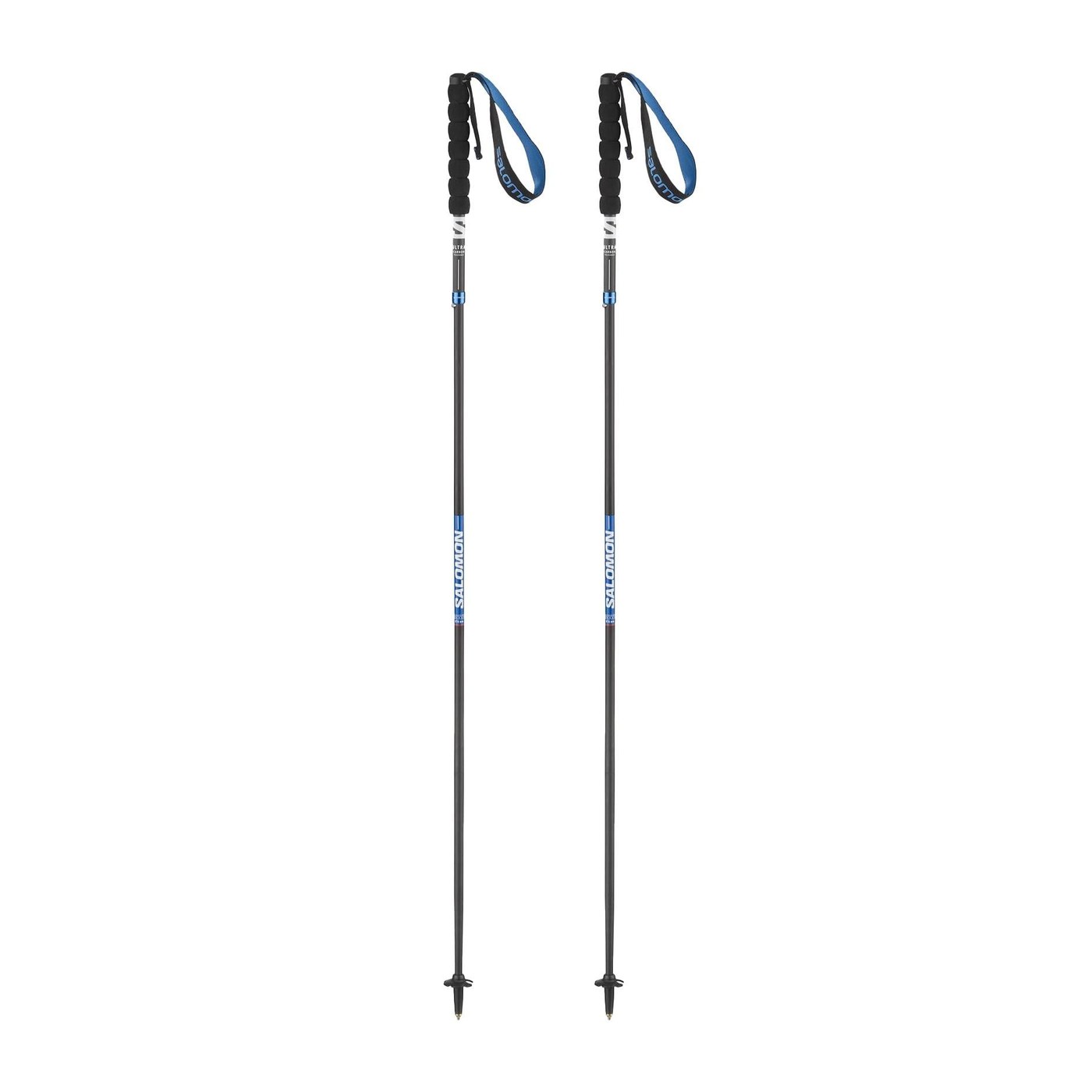
Salomon rules the trail vest and mountain shoe market, yet it had been strangely missing from the pole aisle, which it left to Leki, Black Diamond and the French specialist brands. The Ultra Carbon Foldable changes that: a 100% carbon pole that folds into 3 sections with the Split Second system, designed to slot into the Custom Quiver setup already found on Salomon packs. At 160 euros, Salomon is clearly aiming at the top of the market.
© Salomon, official photo used for editorial purposes
Salomon and trail poles: the last piece of the puzzle
Salomon built its dominance in trail running with shoes first, then packs, with the Adv Skin 12 and the S/Lab Ultra 12 now established as benchmark hydration vests. Poles were the only missing link in the lineup, left to Leki, Black Diamond, Raidlight and Komperdell. The Ultra Carbon Foldable fills that gap with a clear goal. The Custom Quiver system, already built into Salomon's latest packs, can finally carry a pole from the same brand and the same ecosystem, with the same promise of a perfect fit.
The business case is obvious. The technical one is less so: Salomon is stepping into a segment where Leki and the specialists have been refining their carbon designs for fifteen years, with models under 140 g. The Ultra Carbon Foldable doesn't try to beat that weight record. It bets on stiffness and on integration with the rest of the range.
Ultra Carbon Foldable specs: what Salomon put in the shaft
| Brand | Salomon |
| Model | Ultra Carbon Foldable |
| Product code | L47543100 (Black/Sulphur Spring) / SALO07714 (Blue) |
| Weight | 160 g to 173 g per pole depending on size |
| Shaft material | 100% carbon, 14 mm diameter |
| Folding system | Split Second Carbon, 3 sections |
| Folded length | 33 to 44 cm depending on size |
| Tip | Carbon/widia (tungsten carbide and cobalt) |
| Handle | Lightweight foam |
| Strap | Trail running, light and breathable |
| Sizes | 100 to 140 cm in 5 cm increments, unisex |
| Quiver compatibility | Salomon Custom Quiver |
| Official price | €160 |
The average rating on the official Salomon.com product page is 4.6/5 from 28 reviews. That's a solid score for the brand's very first pole, but it still has to hold up over time against models that have been around for years.
Split Second Carbon: the folding system in practice
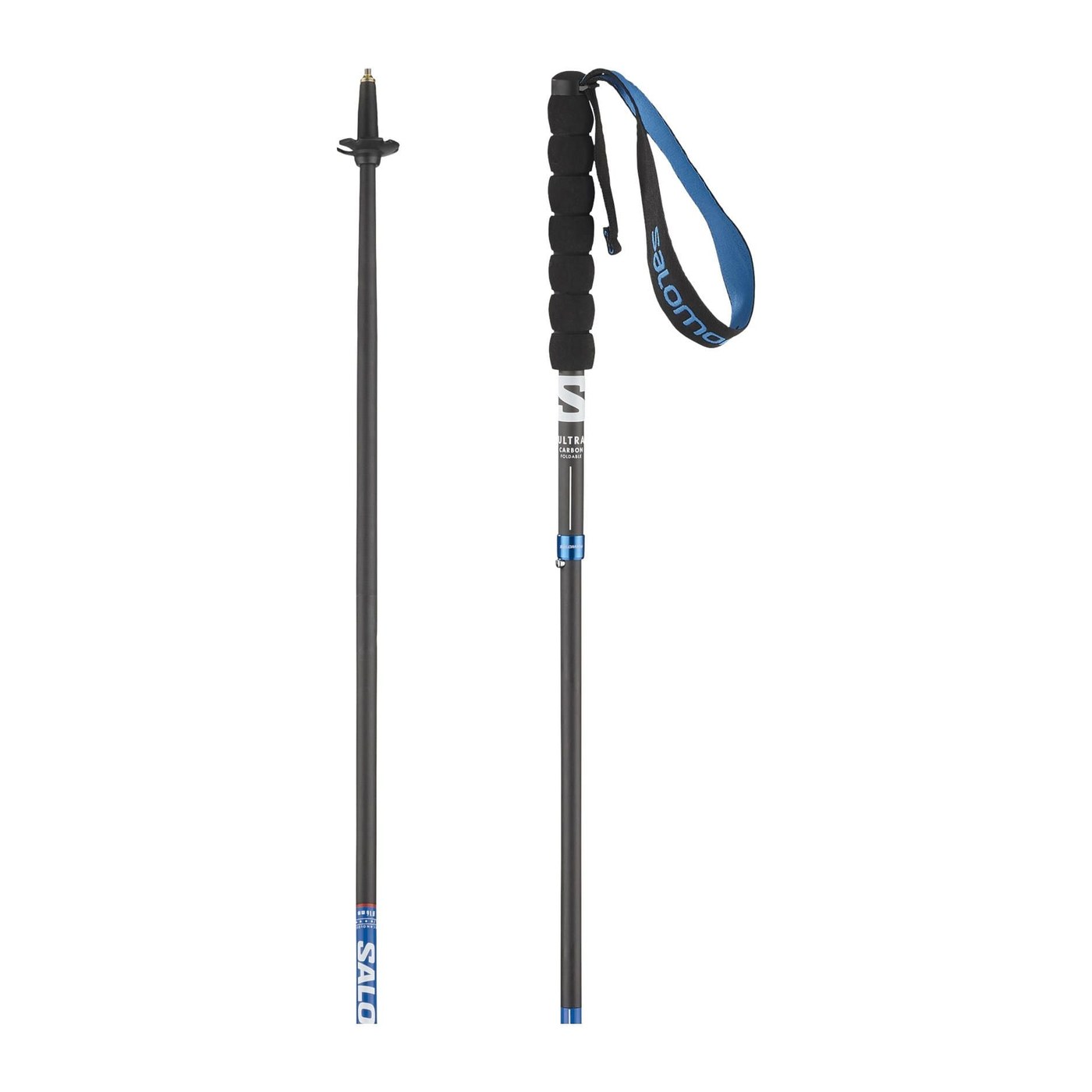
The name sums up the ambition: a 3-section fold that, according to Salomon, takes a split second. In practice, it's a tensioned internal cable system, the same principle used by most premium folding poles on the market (Leki FX.One, Black Diamond Distance Carbon Z). Here it's tuned for a 100% carbon shaft with a 14 mm diameter, which is stiffer than hybrid carbon/aluminum shafts.
The carbon/widia tip is the second technical selling point. Unlike a standard carbide tip, the widia alloy (sintered tungsten carbide and cobalt) is billed by Salomon as more wear-resistant on rock, while still holding reliably on hard snow and ice, terrain where many pure carbon tips skate.
© Salomon, official photo used for editorial purposes
Field test: stiffness confirmed, suitability depends on terrain
RunMorph tip: lock the Split Second system firmly every time you unfold it. A section that isn't fully engaged loses stiffness, and you'll feel it on the very first push uphill.
One 50 km test reports that the shafts kept their original stiffness from start to finish, including on repeated rocky and rooty sections, with no play or unwanted flex felt in the hand. The same report highlights how tough the tip is on rock and roots, in line with the marketing promise of the carbon/widia tip.
User reviews collected on the official product page (4.6/5 from 28 reviews) point to the same overall impression: a reliable, sturdy pole with no major flaw reported. Independent measurements from heavier hiking use temper that praise, though. The light shaft, an obvious asset in trail running, becomes a limitation when hiking with a heavy load or slogging through long stretches of mud, since the pole isn't built to take the weight of an expedition pack. This isn't a contradiction, just a question of use. For pure trail running, the Ultra Carbon Foldable delivers. For heavy-load hiking, it's out of its element.
Ultra Carbon Foldable vs Leki Ultratrail FX.One Superlite: head to head
| Criterion | Salomon Ultra Carbon Foldable | Leki Ultratrail FX.One Superlite |
|---|
| Weight | 160 g | 137 g |
| Price | €160 | ~€190 |
| Shaft material | 100% carbon, 14 mm | 4-section HRC carbon |
| Folding | Split Second Carbon, 3 sections | Folding, 4 sections |
| Tip | Carbon/widia | Tungsten carbide |
| Ecosystem | Salomon Custom Quiver | Dedicated Leki system |
The Leki is still 23 g lighter per pole, a gap you'll notice over a long ultra. But the Ultra Carbon Foldable costs 30 euros less and, above all, works natively with the Custom Quiver if you already wear a Salomon pack. The decision comes down to the ecosystem more than the raw spec sheet.
Our take from the trail: who is it for?
The Ultra Carbon Foldable is aimed first and foremost at runners already invested in the Salomon ecosystem: those who own a Custom Quiver compatible pack and want a consistent lineup rather than a weight record. If you're buying your first poles with no brand loyalty, it's well worth comparing it with the Kiprun Bâtons Trail Carbone or the Guidetti Platinium Néo, depending on your budget.
To get stronger on the climbs that call for poles in the first place, your training needs structure well before race day. RunMorph's trail-focused training plans include strength and hill sessions that get you ready to use poles in a race.
The RunMorph Coach's verdict
For a first pole, Salomon delivers a solid product with no major flaw showing up on the trail, but it doesn't reinvent anything. The Leki Superlite is still lighter, and several French poles under €180 offer comparable build quality. What really tips the scales is Custom Quiver integration if you already own a recent Salomon pack: a genuine advantage, not a marketing gimmick.
8/10. A reliable, well-built pole, but the price only fully makes sense if you're already in the Salomon ecosystem. Otherwise, the Leki Ultratrail FX.One Superlite or the Kiprun Bâtons Trail Carbone offer better performance for the money, depending on your priority.