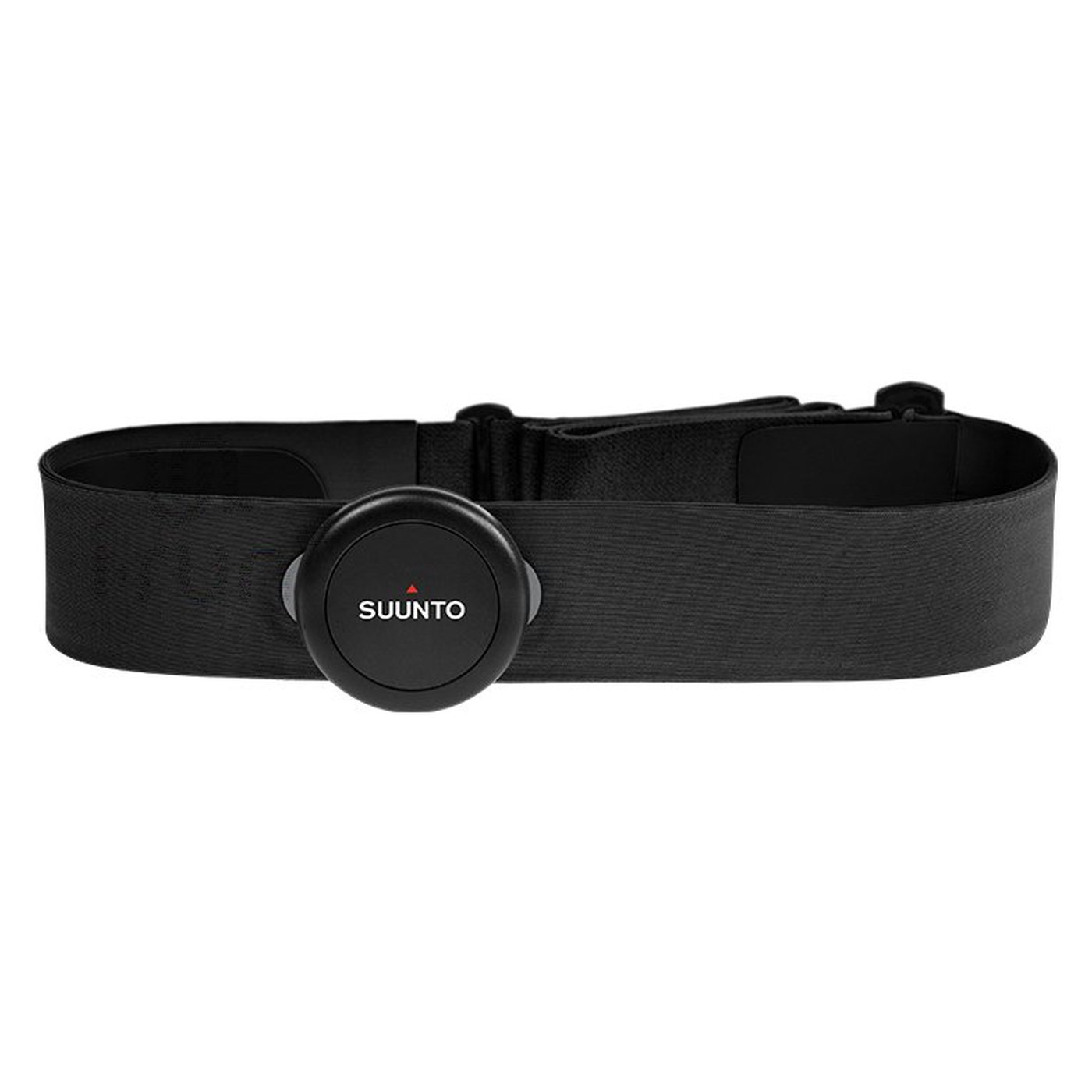
Suunto has sold its ECG chest strap for nearly a decade with barely a design change, yet the product is still surprisingly relevant in 2026: accuracy close to the best in the market, record battery life and one of the lowest prices in its category. Sold as the Smart Sensor (or Smart Sensor HR, depending on the retailer), this single-channel ECG strap notably feeds the ZoneSense algorithm on recent Suunto watches.
© Suunto, official photo used for editorial purposes
Suunto Smart Sensor: the veteran chest strap is still in the race
The Smart Sensor has been paired with Suunto watches since the days of the Ambit 3: nearly ten years on the market with almost no design changes. In that time, optical wrist-based heart rate has gone mainstream, but a chest strap is still a must if you want reliable accuracy during intervals or zone-based training. On recent Suunto watches like the Suunto Race 2, the heart rate variability captured by the strap feeds straight into the ZoneSense algorithm, which adjusts your training zones in real time. That's a strong reason to stick with this accessory rather than the optical sensor on your wrist.
The RunMorph catalog already includes several benchmark chest straps and armbands, but no Suunto product: a surprising gap for a brand so well established in outdoor and trail watches. The Smart Sensor fills it with a clear positioning as the most affordable ECG chest strap from a major brand.
Suunto Smart Sensor specs
| Brand | Suunto |
| Model | Smart Sensor (also sold as Smart Sensor HR) |
| Product code | SS050579000 (size M) |
| Sensor type | Single-channel ECG, chest strap |
| Weight | 40.6 g (fabric strap + module) |
| Battery | CR2025, claimed battery life 500 h |
| Connectivity | Bluetooth Smart (BLE) only, 1 channel, no ANT+ |
| Water resistance | 30 m, swim-compatible |
| Internal memory | 3.5 h of data at 120 bpm with no watch nearby |
| Strap sizes | S (56-82 cm), M (70-110 cm), L (96-160 cm) |
| Compatibility | Any Bluetooth Smart/BLE device, Movesense apparel |
| Official price | €80, typical street price around €59 |
On the i-Run store, the strap holds a 4.7/5 rating from 77 verified reviews, with 94% of customers satisfied: a solid score for a product that has been on sale for several years.
Single-channel ECG and swim memory: what Suunto kept and what it left out
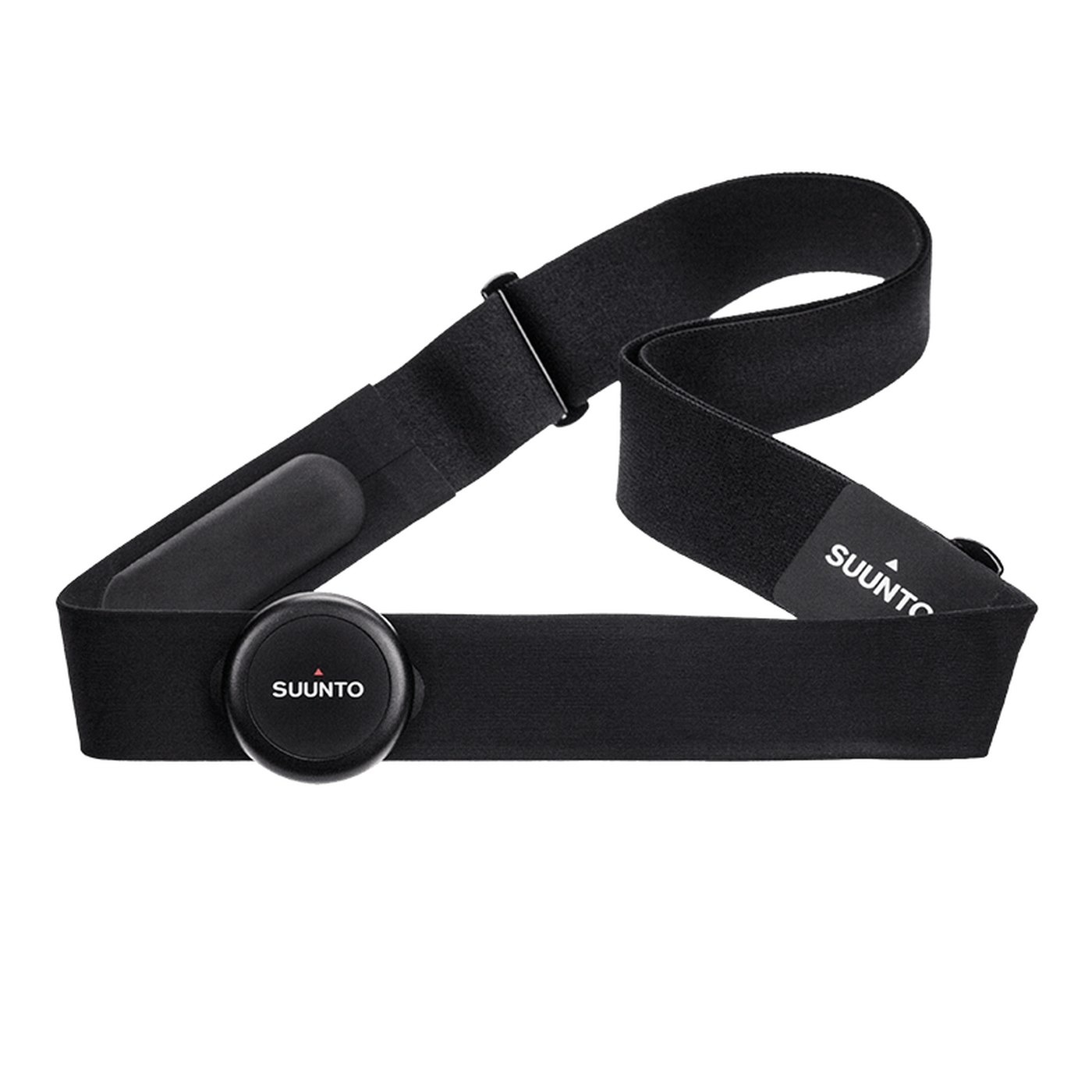
The Smart Sensor relies on a single-lead ECG sensor, a proven technology that in theory beats optical sensors on accuracy, especially during hard efforts when peripheral blood flow drops. The module detaches from the fabric strap so you can wash it, and the two screws that hold it in place double as electrical connectors, a design that limits the contact points prone to oxidation.
The product's big strength is its internal memory: up to 3.5 hours of heart rate data stored directly in the module, with no watch connected. That lets you swim with just the strap, then sync the data afterward with a compatible Suunto watch, a real plus for triathletes. The trade-off: connectivity is limited to Bluetooth Smart, with no ANT+ and no multiple simultaneous connections. You can't send your heart rate to a watch and a bike computer at the same time, a limitation that hurts more and more as competitors roll out multi-channel support across the board.
© Suunto, official photo used for editorial purposes
Field test: accuracy confirmed, comfort and durability less clear-cut
RunMorph tip: always rinse the fabric strap with clean water after every session. The electrode area tends to curl up on itself if you don't lay it back flat, which reduces contact and can skew the readings.
Independent measurements over several sessions, compared head-to-head with a Polar H10 used as the reference, show an average gap of just 0.11 bpm on short high-intensity intervals and 0.10 bpm on an extended tempo run: near-perfect accuracy, with a consistency score above 96% in both cases. On a cycling route, the average gap stays under 0.5 bpm despite the usual electrostatic artifacts of that activity, with a final score above 97%. The heart rate variability curves, essential for algorithms like ZoneSense, overlap almost perfectly with those of the reference strap.
Comfort draws more mixed reviews: the electrodes feel stiffer than those from Polar or Wahoo, which improves electrical contact but can create pressure points after several hours of effort. One point deserves to be flagged without smoothing it over: several long-term user reports describe readings degrading after a few months of heavy use, especially with heavy sweating and insufficient washing. This review can't settle that issue definitively, since a brand-new unit doesn't provide enough hindsight. Keep in mind that only a limited number of recent independent test sources could be found for this exact model. The feedback above combines one full data-driven test with verified customer reviews aggregated by a retailer; no third independent field test is available to date.
Suunto Smart Sensor vs Polar H10: head-to-head
| Criterion | Suunto Smart Sensor | Polar H10 |
|---|
| Street price | ~€59 | ~€79-99 |
| Sensor type | Single-channel ECG | Single-channel ECG |
| Connectivity | Bluetooth Smart only | Bluetooth + ANT+, multiple connections |
| Battery life | 500 h (CR2025 battery) | 400 h (CR2025 battery) |
| Weight | 40.6 g | ~48 g |
| Swim memory | 3.5 h at 120 bpm | Yes, larger capacity |
The Polar H10 keeps the edge on broader connectivity and overall electrode comfort, two areas where it remains the industry benchmark. The Suunto Smart Sensor fires back with a price 20 to 40 euros lower and slightly longer battery life, for measurement accuracy that, based on the available data-driven tests, gives almost nothing away to the H10.
Our field verdict: who is it for?
The Smart Sensor is aimed first at runners who want reliable ECG readings without paying a premium, and especially at Suunto watch owners who want to get the most out of the ZoneSense algorithm. If you need ANT+ or several simultaneous connections, look instead at the Polar H10 or the Garmin HRM 600, both more versatile but also more expensive.
An accurate chest strap is only worth something if the training zones it feeds are well built in the first place. RunMorph training plans rely on personalized heart rate zones so you can improve without burning yourself out in training.
RunMorph Coach verdict
The Suunto Smart Sensor proves that a product that has barely changed in ten years can stay competitive: its measurement accuracy matches the market benchmarks, and its price remains one of the lowest in its category. Still, single-channel connectivity and mixed feedback on long-term durability keep it from being a universal first choice.
7.5/10. A reliable, affordable chest strap, ideal if you already own a Suunto watch or want accurate ECG readings without breaking the bank. If you need ANT+ or several simultaneous connections, the Polar H10 remains the more versatile benchmark.