Amazfit launched the Active Max in late December 2025 at €169.90, with a 3000-nit AMOLED screen, full offline maps and a claimed battery life of up to 25 days. Three independent French reviews confirm value for money that is rare at this price point, but they also agree on the same gap: real-world battery life in daily use with the always-on display falls well short of the marketing figures, and the lack of a dual-band GPS chip caps accuracy against premium watches.
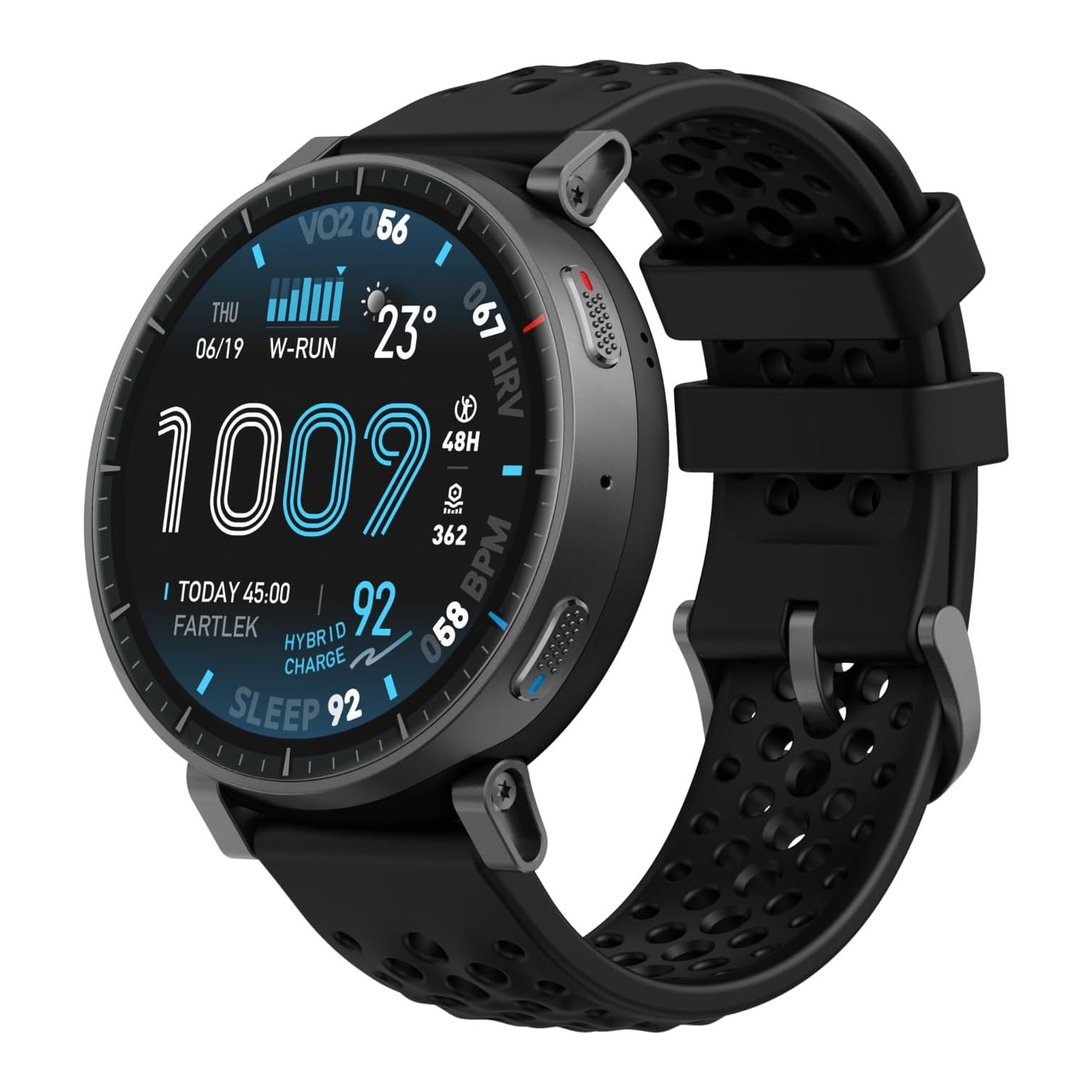
© Amazfit, official photo used for editorial purposes
Amazfit Active Max: a rock-bottom price on a premium spec sheet
Amazfit has built its reputation on the same principle for several generations: GPS watches with a feature set close to the high end, at a fraction of what the competition charges. The Active Max sticks to the formula. It replaces the Active 2 in the lineup and sits just below the Balance 2, which costs roughly twice as much for an identical screen. Below it, the Bip 6 covers the entry level.
The case grows from 44 mm on the Active 2 to 48.5 mm on the Active Max, with a larger 38 mm screen (up from 30.5 mm) and brightness climbing to 3000 nits, versus 2000 on the previous generation. Internal storage doubles to 4 GB and the claimed battery life doubles too. In return, the price goes up slightly but stays far below the rest of the market.
RunMorph's advice: for almost twice the budget, the Amazfit Balance 2 adds a dual-band GNSS chip and more sport profiles. If budget is your absolute priority and you can live without maps, the Coros Pace 3 is still an alternative worth comparing.
Amazfit Active Max: what's claimed versus what holds up over time
On battery life, Amazfit quotes several figures depending on usage: up to 25 days with factory settings (heart rate measured every 5 minutes), 13 days under so-called heavy use (measurement every minute, voice assistant on), and just 10 days with the always-on display enabled. In continuous GPS mode, the watch claims 64 hours, a figure confirmed on paper by the most detailed review available in French.
The problem shows up in real use. The reviewer at Montre Cardio GPS, who routinely tests several GPS watches side by side, points out that with the always-on display and the map shown on screen, GPS battery life quickly drops to around 20 hours, a long way from the theoretical 64. On daily battery life, Presse-citron reports never managing a full 3 weeks without charging, with the watch asking for its dock after 15 to 20 days. Begeek, for its part, measured 32% battery left after 15 days of use without detailing every active setting, which still fits the upper end of that range.
| Metric | Claimed (Amazfit) | Measured (French field tests) |
|---|
| Typical-use battery life | Up to 25 days | 15 to 20 days in real use without always-on |
| Always-on display battery life | 10 days | Consistent with field feedback |
| Continuous GPS battery life | 64 hours | ~20 hours with always-on and the map displayed |
All three sources reach the same conclusion: Amazfit's battery figures are accurate under the exact conditions stated, but those conditions (factory settings, infrequent heart rate sampling, screen that switches off) don't match how a regular exerciser actually uses the watch day to day.
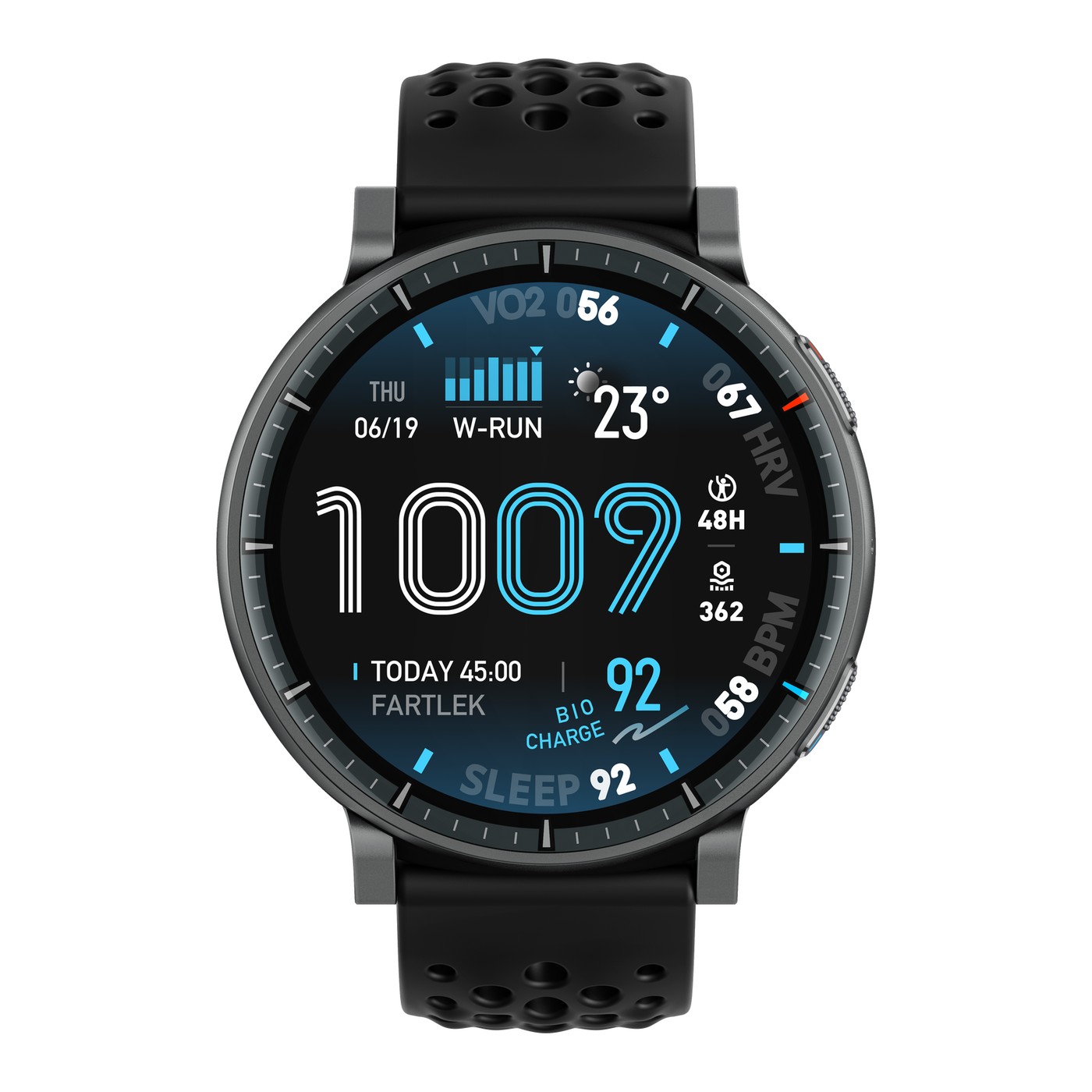
© Amazfit, official photo used for editorial purposes
Comfort and handling: a big case you still forget you're wearing
At 48.5 mm across, the Active Max is a generously sized watch, but at just 39.5 g it's surprisingly light compared with the competition. For reference, the Apple Watch Ultra 3 measures 49 mm and weighs 61 g, while the 46 mm aluminium Series 11 weighs 37.8 g. The aluminium case is ringed by a thin metal band with no protruding bezel, and the screen takes up most of the front.
The 22 mm silicone strap attaches via double-hinged metal lugs rather than being fixed directly to the case. That choice improves the fit on both slim and thick wrists, but according to the Montre Cardio GPS reviewer it slightly undermines the premium feel. The two physical buttons are small but functional, backed up by a responsive touchscreen that works even with thin gloves.
Field test: a single-band GPS that shows its limits in tricky environments
According to the most detailed review available, the BioTracker 6.0 optical heart rate sensor works "pretty well, without being extraordinary". That verdict fits the watch's positioning: good enough for daily tracking and endurance sessions, with no pretence of matching the most advanced sensors on the market during hard efforts.
On GPS, the lack of a dual-band chip shows up as visible track smoothing on tight bends, roundabouts and S-curves, typical Amazfit behaviour according to the reviewer, who has compared several generations. In dense forest cover, the Active Max does better than a Garmin Venu 4 set to GPS only, which loses the signal completely under the trees. But against a Garmin Fenix 8 Pro switched to dual-band GNSS mode, the Garmin clearly takes the lead again in dense urban areas.
Another point raised by Presse-citron: the Zepp app, which centralises all the watch's data, lacks fluidity and has an interface that feels uninspiring. It's not a flaw of the watch itself, but worth knowing before you buy if you expect the software experience to be as polished as the hardware.
Where it works, and where it falls short
Getting back into exercise and regular easy runs: the Active Max's home turf. Auto-start, adjusted heart rate zones, overexertion alerts: the automation built for beginners does the job without any fuss.
Hiking and long outings with maps: very comfortable thanks to turn-by-turn navigation and contour lines, as long as you accept real GPS battery life closer to 20 hours than the claimed 64.
HYROX and strength training: well-designed dedicated profiles, with automatic rep counting and a muscle heat map after the session.
Running in dense cities: this is where GPS smoothing without dual-band is most visible, especially around big intersections and between tall buildings.
Hard interval sessions with the always-on display: this is where battery drains fastest, down to the claimed 10 days, and less in real use.
Flaw #1: real battery life well behind the marketing figures
The 25 days and 64 GPS hours Amazfit claims can be verified, but only under specific test conditions (factory settings, screen that turns off automatically). As soon as the always-on display or maps come into play, one reviewer measured real GPS battery life closer to 20 hours than 64, and none of the sources consulted managed more than 20 days of real daily use. It's not a poor result in absolute terms, but it's a clear gap with the marketing promise that you need to factor in before buying.
Flaw #2: no dual-band GPS, which caps accuracy in tricky environments
The Active Max uses a multi-constellation GNSS chip but without dual-band mode, the technology that does the most to improve accuracy in cities or under dense cover. Smoothing on bends and roundabouts remains visible on GPS tracks. On roads and open trails, you'll almost never notice this limit; if you regularly run in dense urban areas, it can mean slightly off distance and pace on some segments.
Amazfit Active Max vs Amazfit Balance 2, one step up the range
The Balance 2 shares the same 480 x 480 pixel AMOLED screen as the Active Max, which makes a direct comparison revealing about what the extra money really buys: a dual-band GNSS chip, more sport profiles (170 versus 160), diving and golf modes, and a case with side reinforcements. For a road runner or hiker who isn't after ultimate GPS accuracy, the price gap, roughly double for the Balance 2, isn't necessarily justified. If you run a lot in the city or want the best accuracy possible, the extra cost makes clear sense.
Amazfit Active Max vs its direct rivals
Against the Coros Pace 3, which sits in a similar price bracket, the Active Max wins on full maps and screen brightness, while the Pace 3 stays lighter and more focused on pure running performance, with a cleaner interface. Neither offers dual-band GPS at this level of the range.
Against the Garmin Forerunner 165, about €80 more expensive, the difference is mostly about the ecosystem: Garmin Connect offers more mature training analysis and a longer track record of reliability, while the Active Max makes up for it with full maps and music storage, two features missing or limited on the Forerunner 165 at this level.
Strengths
- 3000-nit AMOLED screen, readable in bright sunlight and at night
- Full maps with voice navigation, rare at this price
- Light (39.5 g) despite a 48.5 mm case
- Automation designed for beginners (heart rate zones, activity detection, alerts)
- Outstanding value at €169.90
Weaknesses
- Real battery life far below the claimed figures once the screen stays on
- No dual-band GPS, visible smoothing in dense urban areas
- Zepp app feels sluggish and uninspiring
- Decent heart rate sensor, but not cutting-edge during hard efforts
Find the training plan that suits your watch on RunMorph →
RunMorph verdict: 7.6 / 10
The Amazfit Active Max delivers on a simple promise that's rare at this price: a premium AMOLED screen, full maps and in-depth health tracking for under €170. The three French reviews consulted agree on the same limits: real battery life well below the marketing figures once the screen stays on, and GPS accuracy capped by the lack of dual-band. If you're getting back into regular exercise or want a complete watch without breaking the bank, the equation is clearly in your favour. If you're an urban runner who demands accuracy or you live with the always-on display, think the trade-off through before buying.
Key takeaways
The Amazfit Active Max is a €169.90 GPS watch with a 1.5-inch 3000-nit AMOLED screen, a 48.5 mm aluminium case weighing 39.5 g, 5 ATM water resistance, full maps and more than 160 sport profiles. Its claimed battery life of up to 25 days (typical use) drops to 15-20 days in real use without always-on, and its 64-hour GPS battery life falls to around 20 hours with the always-on display and maps active. Without dual-band GPS, it shows track smoothing in dense urban areas.
Amazfit Active Max FAQ
What is the real battery life of the Amazfit Active Max?
Amazfit claims up to 25 days in typical use and 13 days in heavy use. French field tests measure more like 15 to 20 days in real use without the always-on display, and around 20 hours of continuous GPS with the map displayed, versus a theoretical 64 hours.
Does the Amazfit Active Max have dual-band GPS?
No. It has a multi-GNSS chip (GPS, Galileo, GLONASS, Beidou) but no dual-band mode, which results in visible track smoothing on bends and in dense urban areas.
How much does the Amazfit Active Max cost?
€169.90 at launch in late December 2025, a price well below GPS watches with maps and a comparable AMOLED screen.
Is the Zepp app reliable for tracking your training?
It pulls all the data together well (sleep, BioCharge, training load), but one reviewer notes a lack of fluidity and an interface that feels uninspiring compared with the quality of the hardware.
What's the difference between the Amazfit Active Max and the Amazfit Balance 2?
The Balance 2 adds dual-band GPS, more sport profiles and a reinforced case, for roughly twice the price of the Active Max.