The Garmin Forerunner 165 arrived in 2024 with a clear pitch: the full Garmin ecosystem (Training Status, HRV Status, Body Battery, music) for under €250, with an AMOLED display that makes €130 watches look obsolete at first glance. For thousands of runners in France, it is their first real Garmin GPS watch: the one that replaces the smartphone as a training tool.
Garmin Forerunner 165 Review: AMOLED and Full Coaching for €249
8.5/10
The essentials in 3 sentences
The Garmin Forerunner 165 is Garmin's premium entry-level running GPS watch, with a 1.2-inch AMOLED display, 19 hours of GPS battery life and access to the full Garmin Connect coaching features (Training Status, HRV Status, Body Battery, Daily Suggested Workouts). It adds music storage (500 songs) and NFC payments (Garmin Pay) at €249, which makes it the most affordable Garmin watch with this feature set. For a runner who trains 3 to 5 times a week and wants to structure their training, it offers the best features-to-price ratio in the Garmin lineup.
8.5
/ 10 · RunMorph overall score
Who it is forRunners doing 3 to 5 sessions a week who want full Garmin coaching without spending €400
Who it is not forMountain trail runners (no maps), ultra trail runners (limited battery life), anyone who wants multi-band GPS
Garmin Forerunner 165: the Garmin ecosystem goes mainstream at €249
Before the Forerunner 165, getting Training Status, HRV Status and Garmin music storage cost at least €350 (Forerunner 255 Music). The FR165 changed the game in 2024 by bringing that trio under €250, plus an AMOLED display that makes the LCD Forerunner 55 and 255 look dated. It's one of the few GPS watches that reads equally well in direct sunlight and in night mode, with no compromise.
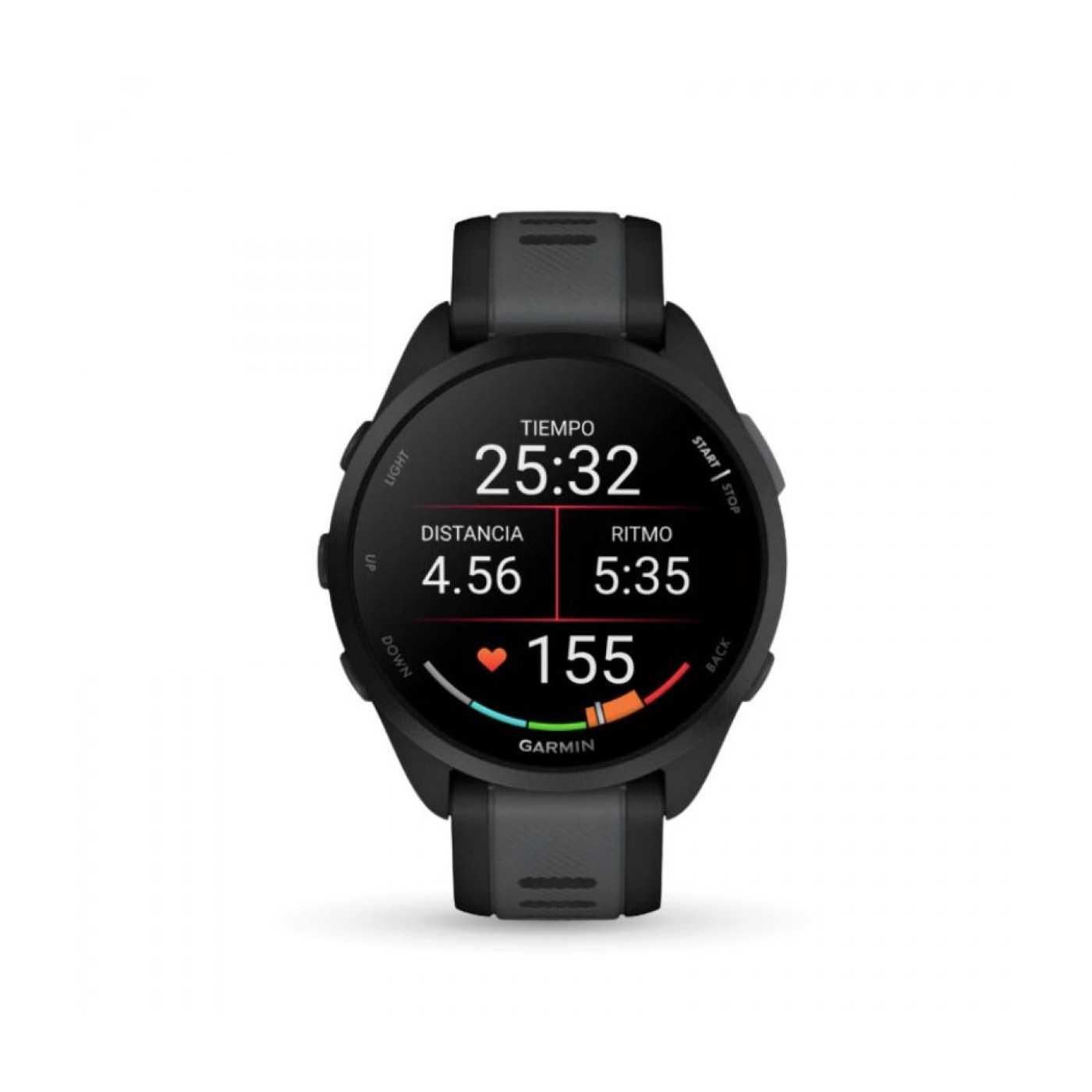
© Garmin, official photo used for editorial purposes
RunMorph tip: if your budget goes above €290, go for the Garmin Forerunner 170, which adds multi-band GPS (accuracy in cities and under tree cover), map guidance and slightly better battery life. Under €250, the FR165 is the Garmin benchmark, with no serious rival in its own ecosystem. For demanding trail running or ultras, the Forerunner 265 or the Fenix 8 are a better fit.
Technical specs
| Spec | Value |
|---|---|
| Brand | Garmin |
| Model | Forerunner 165 |
| Release | 2024 |
| Display | 1.2-inch AMOLED (390 × 390 px) |
| GPS | GPS / GLONASS / Galileo (single-band) |
| GPS battery life | 19 h (standard) / 6 h (streaming music) |
| Smartwatch battery life | 11 days |
| Weight | 39 g (with strap) |
| Strap | 20 mm QuickFit silicone |
| Water rating | 5 ATM (swimming) |
| Music | Yes, 500 songs + streaming (Spotify, Deezer) |
| Payments | Garmin Pay (NFC) |
| Coaching features | Training Status, HRV, Body Battery, Morning Report |
| Retail price | €249.99 (at launch) / ~€209 (2026) |
Who is the Garmin Forerunner 165 for?
The regular runner who wants structured training
If you run 3 to 5 times a week and want more than a simple stopwatch, the FR165 is your way into Garmin coaching. Training Status tells you whether you're overtraining (Unproductive), improving (Productive) or resting enough (Recovery). HRV Status measures your heart rate variability every morning to tell you whether your nervous system is ready for a hard session. It's a digital personal coach, for €249.
The beginner who wants a GPS watch that lasts 5 years
The classic beginner mistake is buying an €80 GPS watch that's obsolete within 18 months (no Garmin Connect, no advanced metrics, a display you can't read in the sun). The FR165 avoids that trap: the AMOLED display ages well, the Garmin Connect ecosystem is complete, and software updates extend the watch's lifespan. It's a smarter investment than buying two budget watches.
The runner who trains to music without a smartphone
The FR165 stores up to 500 songs locally and syncs from Spotify, Deezer or Amazon Music over WiFi. Paired with Bluetooth headphones, it frees you from your smartphone entirely on solo runs. On RunMorph plans with programmed intervals, the watch announces pace changes by vibration and voice prompts, so you don't need to check the screen at every transition.

© Garmin, official photo used for editorial purposes
Key features in real-world use
Training Status and Training Load: the watch analyzes your last 4 weeks of training to assess whether you're improving or at risk of overtraining. On the RunMorph half marathon plans (12 weeks), Training Status typically moves to Productive during load weeks and to Recovery during lighter weeks, confirming that the planned load is being absorbed.
HRV Status: measured every night while you sleep, HRV Status gives you a window into your recovery. A week with "balanced" or "high" HRV is the green light for a long or hard session. With "low" or "unbalanced" HRV, the FR165 suggests an easy run, which usually matches the fatigue you feel. Accuracy doesn't match a dedicated chest strap like the Garmin HRM 600, but it's more than enough for day-to-day decisions.
GPS accuracy: in single-band mode (GPS/GLONASS/Galileo), the FR165 is very accurate in open terrain and slightly off under dense tree cover or among tall city buildings. On an urban 10 km, it can read 200 to 300 m over or under the real distance in tight streets lined with buildings. On non-technical trails or open roads, accuracy is flawless.
Garmin Forerunner 165 vs the rest of the Garmin lineup
| Criterion | FR165 | FR70 | FR170 | FR265 |
|---|---|---|---|---|
| Price | €249 | €249 | €299 | €449 |
| Display | AMOLED 1.2" | AMOLED 1.1" | AMOLED 1.2" | AMOLED 1.3" |
| GPS | Single-band | Single-band | Multi-band | Multi-band |
| GPS battery life | 19 h | 10 h | 17 h | 24 h |
| Music | Yes | No | Yes | Yes |
| HRV Status | Yes | Yes | Yes | Yes |
| Training Status | Yes | Yes | Yes | Yes |
| Maps | No | No | No | No |
| RunMorph score | 8.5 / 10 | 7.5 / 10 | 8.5 / 10 | 9 / 10 |
The comparison with the Forerunner 170 (released in 2025) is the most telling: for €50 more, the FR170 adds multi-band GPS and map guidance, but gives up GPS battery life (17h vs 19h). If you run only on roads, or on trails where you don't need maps, the FR165 remains the better deal. The Forerunner 70 costs less but has no music and only 10 hours of GPS battery life.
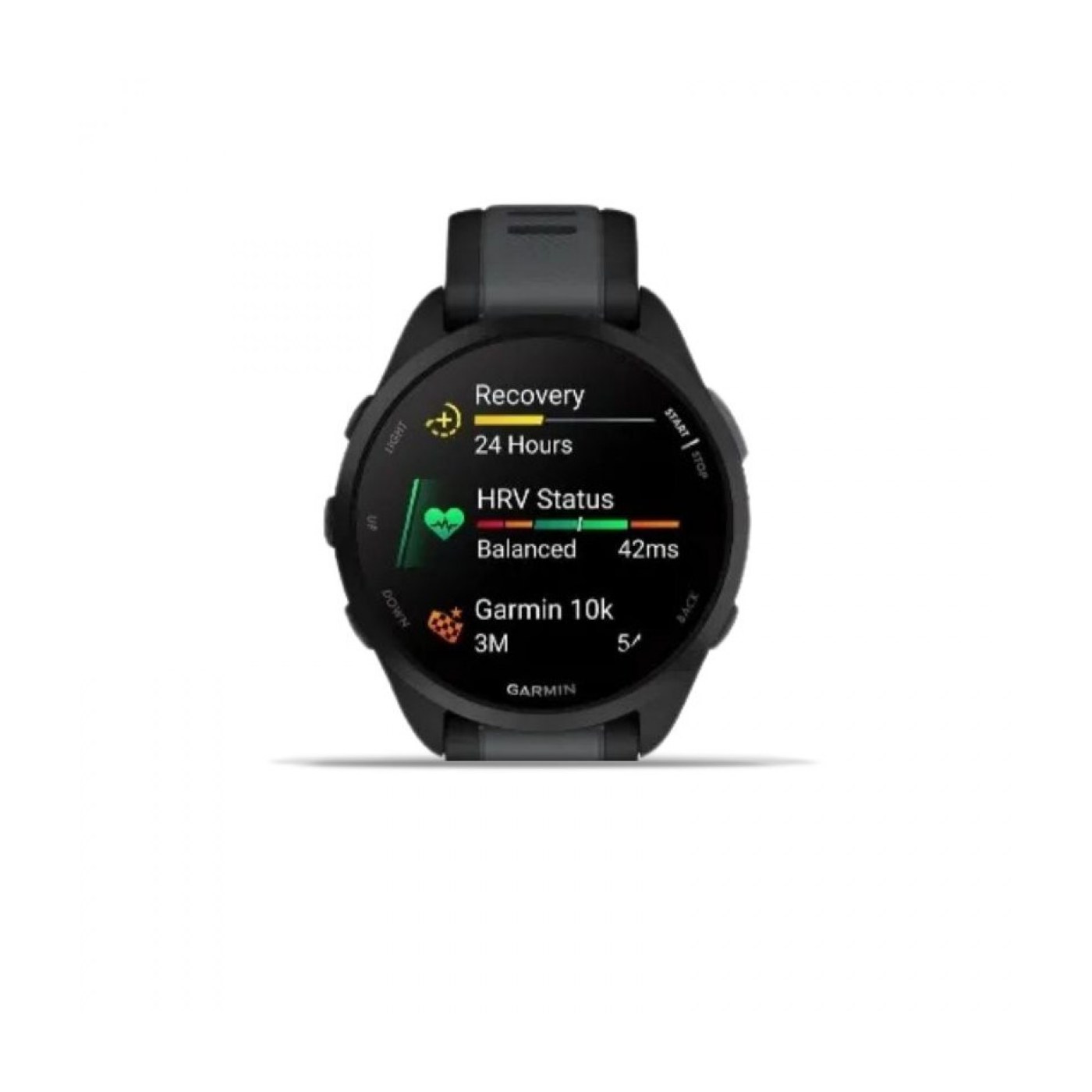
© Garmin, official photo used for editorial purposes
Garmin Forerunner 165 pros and cons
Pros
- 1.2-inch AMOLED display: outstanding readability in all conditions
- Training Status + HRV + Body Battery: full Garmin coaching
- Onboard music (500 songs) and Spotify/Deezer streaming
- Garmin Pay (NFC): pay mid-run without a card or phone
- 19h of GPS battery life: enough for half marathon and marathon runners
- 39 g: unobtrusive on the wrist all day long
- ~€209 in 2026: unbeatable value for money
Cons
- Single-band GPS: inaccurate in dense cities or under forest cover
- No maps: map navigation is impossible
- 6h with GPS + streaming music: not enough for a marathon with music
- No temperature sensor, limited barometric altimeter
- 20 mm strap: fewer options than the 22 mm of higher-end models
How to use the Garmin Forerunner 165 with a RunMorph plan
The Forerunner 165 is built to work with Garmin Connect, which offers guided training plans. To get the most out of it with a RunMorph plan, just turn on Daily Suggested Workouts in the settings: the watch automatically suggests the right type of session for how you feel that day (load, recovery, quality), based on your HRV, your training load and your goal.
In a typical 10 km training week (intermediate level), the FR165 announces your intervals by vibration, shows your target pace on screen and calculates your recovery status after each session. The next morning, the Morning Report gives you your sleep score, your overnight HRV and a suggestion for the day.
For multisport RunMorph plans (running + cycling + swimming), the FR165 supports cycling, pool swimming and transitions, which makes it an entry-level watch for sprint and L-distance triathlons. For long distances and outdoor adventures, check out the RunMorph plans and their gear recommendations by level.
© Garmin, official photo used for editorial purposes
RunMorph Coach verdict
The Garmin Forerunner 165 is the watch that opened up the Garmin ecosystem to the masses. At €249 at launch, and now often under €220, it delivers an excellent AMOLED display, full Garmin Connect coaching and 19 hours of GPS battery life, enough for 99% of runners. Its only real weakness is single-band GPS, which loses accuracy in tough environments. If you run on open routes and want to learn structured training, it's the best way into the Garmin lineup. RunMorph score: 8.5/10.
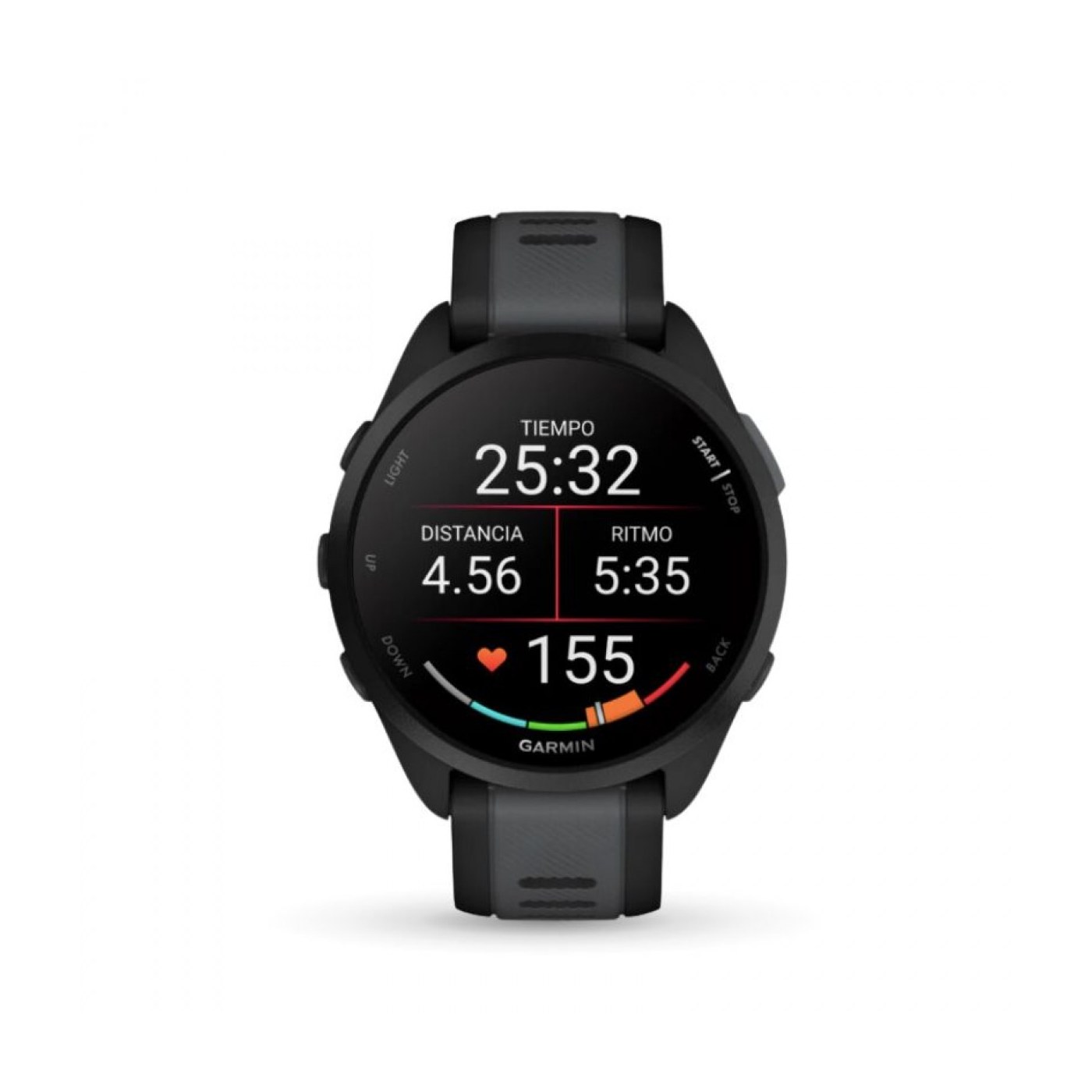
© Garmin, official photo used for editorial purposes
Key takeaways for your training
- 1.2-inch AMOLED: the readability gap with an LCD display is obvious right away, especially in direct sunlight. At this price, no other Garmin watch offers this level of display.
- Training Status + HRV Status: together, these two metrics let you fine-tune your weekly load with a precision few human coaches can match at this price.
- 19h GPS without music, 6h with streaming: for a marathon, use local (stored) music instead of streaming to save battery. 500 songs is more than 30h of offline music.
- Single-band GPS: plan your routes: on open roads and open trails, accuracy is excellent. If you often run in dense city centers, the Forerunner 170 and its multi-band GPS are worth the €50 difference.
- ~€209 in 2026: with the FR170 and FR265 now on the market, the FR165 is often on sale. It's the smart buy for full Garmin coaching without paying full price.