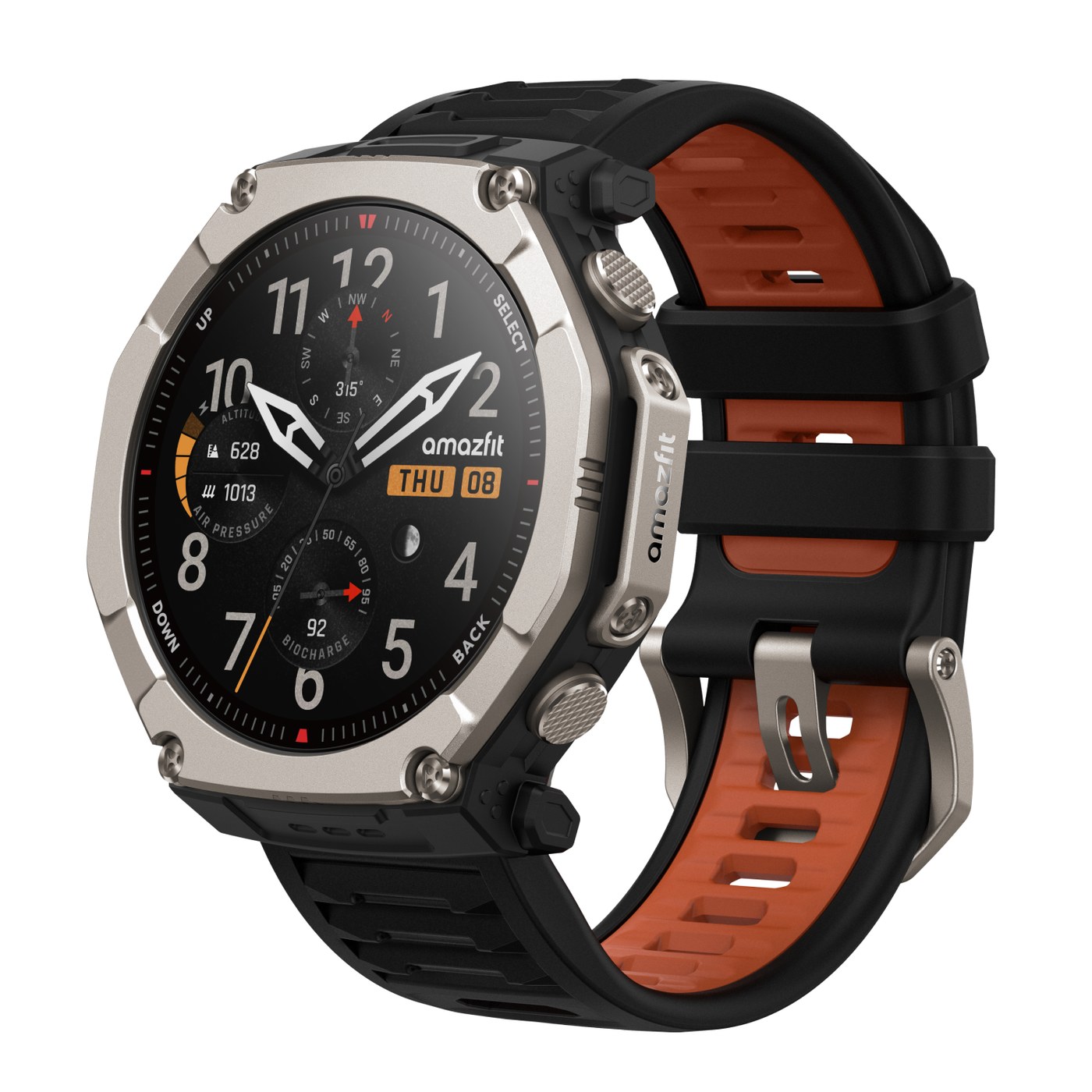
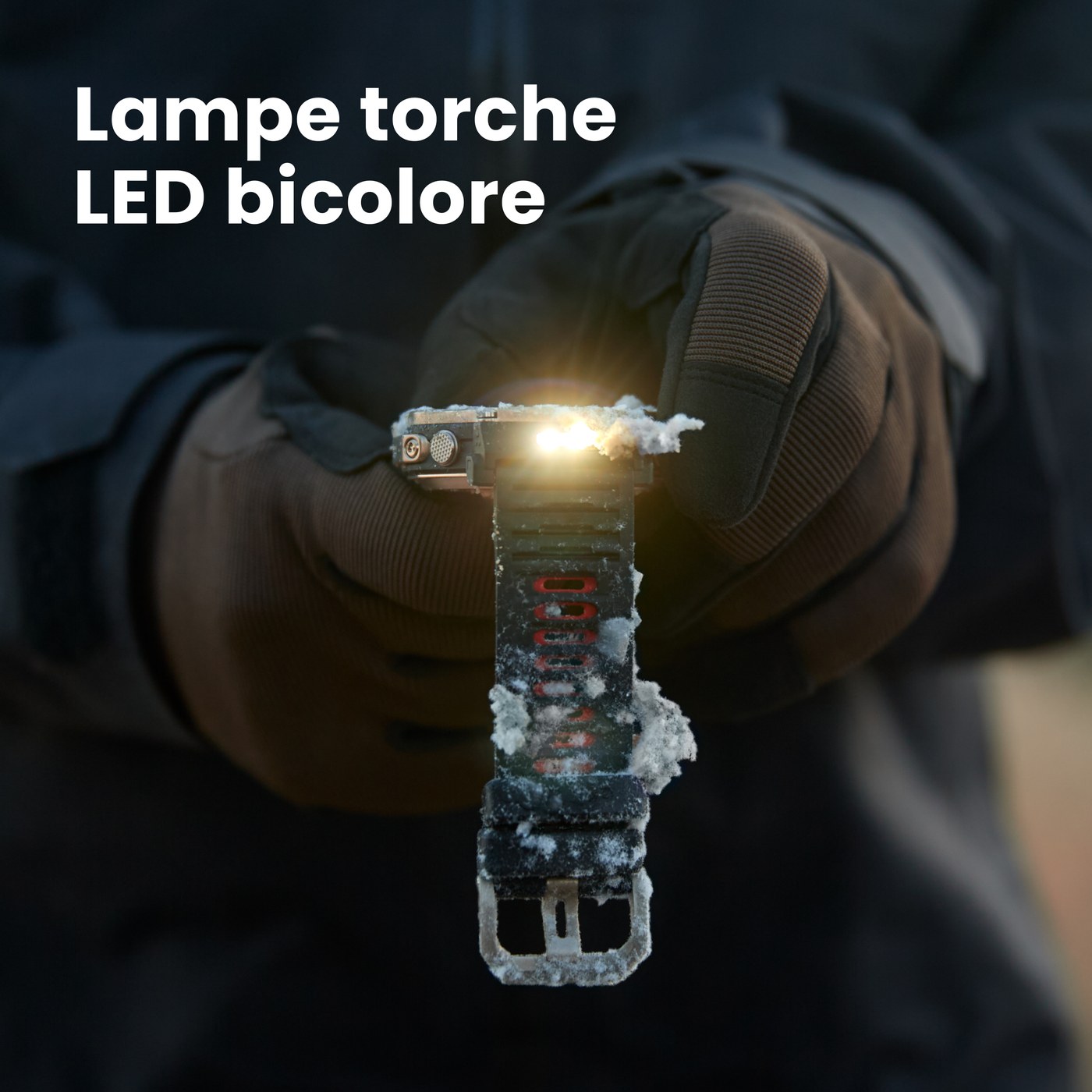
Launched in February 2026, the Amazfit T-Rex Ultra 2 is Amazfit's answer to premium outdoor watches: a grade 5 titanium case, a 3,000-nit AMOLED display, a built-in flashlight, offline color mapping and 177 hours of GPS in max battery mode. On paper, it gives Garmin cold sweats. In practice, the ZeppOS ecosystem remains its biggest drawback for runners who want a digital coach on their wrist.
Amazfit T-Rex Ultra 2 Review: RunMorph's Complete Verdict
7.5/10
The essentials in 3 sentences
The T-Rex Ultra 2 delivers exceptional outdoor hardware: titanium, sapphire, a 3,000-nit AMOLED and 64 GB of storage for €549.90. Its 6-constellation GPS and full offline mapping make it a formidable ally on mountain trails and long expeditions. ZeppOS still isn't mature enough for detailed running training analysis, which puts it behind Garmin and COROS on that specific point.
7.5
/ 10 · RunMorph overall score
Who is it for?Trail runners and mountaineers who want an unbreakable case, 177 h of GPS battery life and subscription-free offline maps, at €350 less than the fenix 8.
Who should skip it?Road runners and half marathoners who want advanced training guidance, a sharp Training Status or a feature-rich app: ZeppOS can't match Garmin Connect yet.
T-Rex Ultra 2: Amazfit moves upmarket
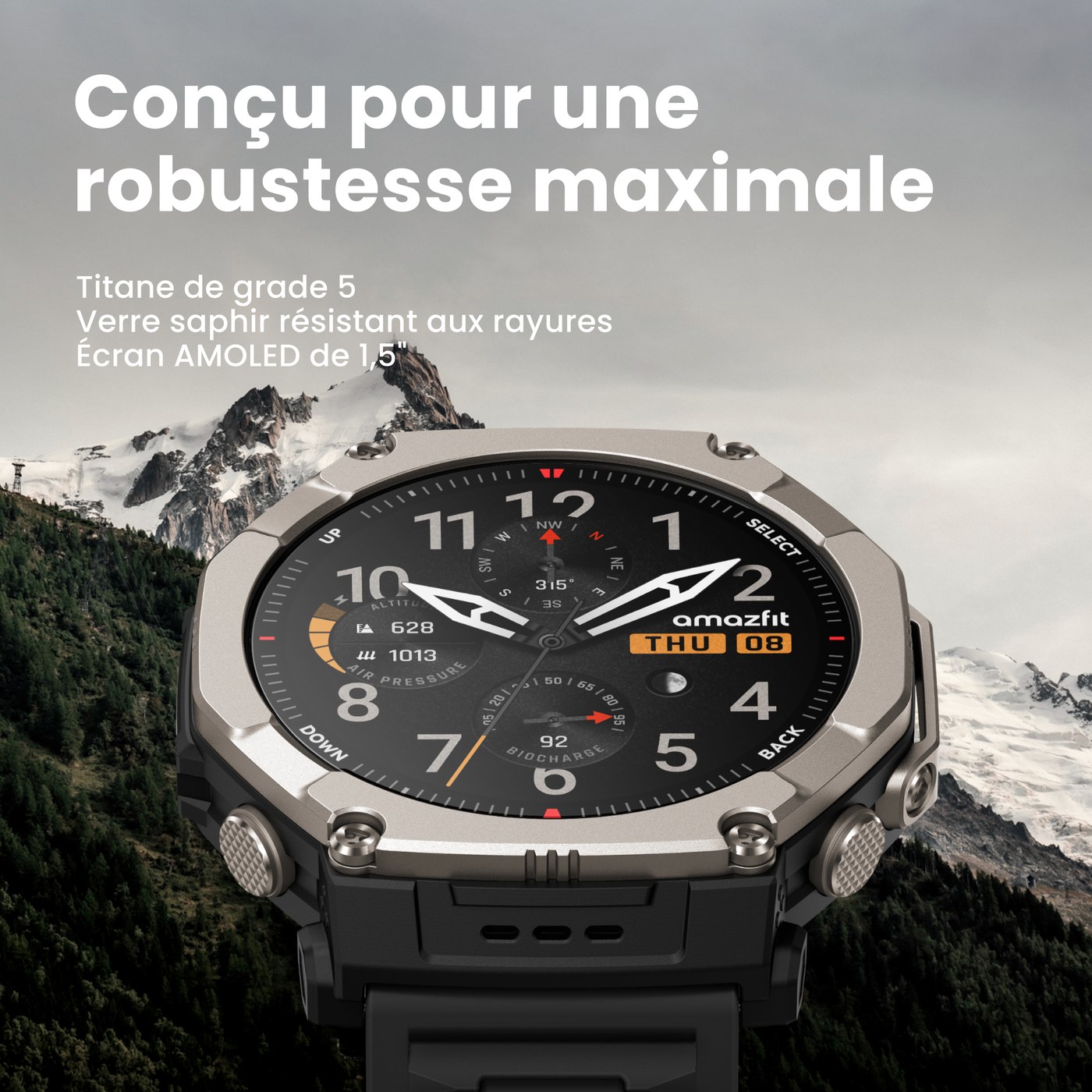
Until now, the T-Rex was known for its startling toughness-to-price ratio. With the Ultra 2, Amazfit takes a decisive step: reinforced plastic gives way to a full grade 5 titanium case, bezel, caseback and buttons included. You feel the difference the moment you pick it up. The watch weighs 86 grams with its 26 mm strap, yet it has the kind of solidity you'd expect from a Garmin fenix 8 or a COROS Vertix 2S, not from a watch under €600.
The 1.5-inch AMOLED display peaks at 3,000 nits, the same brightness as the Apple Watch Ultra 3. In harsh high-altitude sun, it stays perfectly readable. Sapphire glass completes the package: scratch resistance is guaranteed even on the most abrasive terrain. At €549.90, Amazfit is clearly going on the offensive.
RunMorph's advice
If you already own an Amazfit Cheetah 2 Ultra, the T-Rex Ultra 2 isn't for you: both watches share the same GPS and comparable battery life, but the T-Rex Ultra 2 bets on extreme ruggedness and a built-in flashlight rather than low weight. If you're looking for a trail watch that doubles as a GPS unit for high-mountain expeditions, it's the right pick in the Amazfit lineup.
Technical specs
| Feature | T-Rex Ultra 2 |
|---|---|
| Brand | Amazfit |
| Model | T-Rex Ultra 2 |
| Official release | February 2026 |
| Case | 52 x 52 x 14.4 mm, grade 5 titanium |
| Weight | 86 g (26 mm strap included) |
| Display | 1.5-inch AMOLED, 480 x 480 px, 3,000 nits, sapphire glass |
| Multi-band GPS battery life | 50 h (high accuracy), 90 h (power saving) |
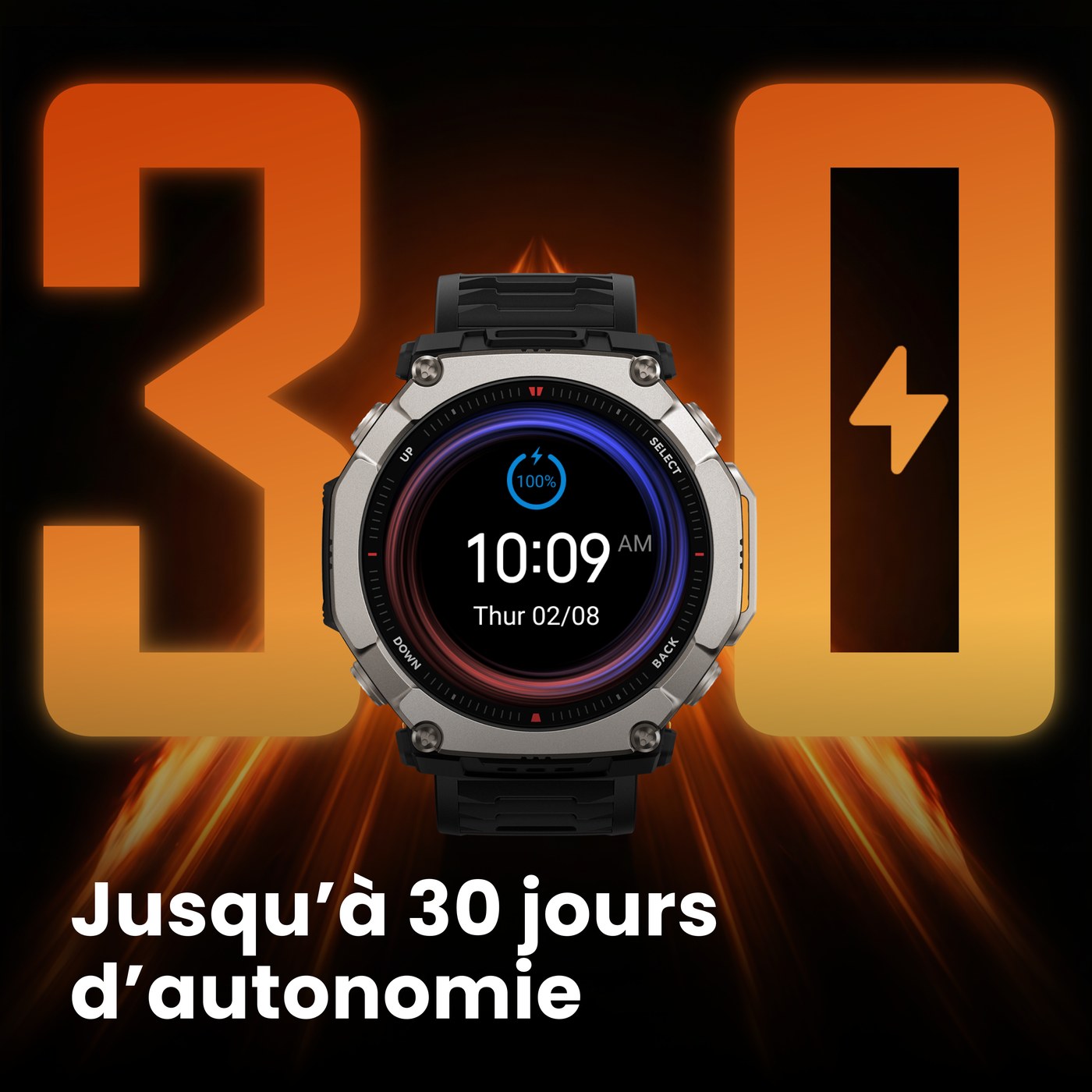
| Maximum battery life | 177 h (reduced GPS) · 30 days in smartwatch mode |
| GNSS | GPS, GLONASS, Galileo, BeiDou, QZSS, NavIC (6 systems) |
| Mapping | Yes, preloaded worldwide color maps, topo maps included, offline |
| Sensors | Optical heart rate, SpO2, barometer, thermometer, gyroscope |
| Sport profiles | 170+ modes including trail, ultra-trail, skiing, diving, triathlon |
| Internal storage | 64 GB (maps, music, activities) |
| Contactless payments | Yes, NFC (EU version) |
| Flashlight | Two-color LED (white + green), SOS mode |
| Water resistance | 10 ATM, operates down to -30°C, dual dive certification |
| Smartphone connectivity | Bluetooth, Wi-Fi, NFC |
| App | Zepp (iOS/Android), works with Strava, Komoot, TrainingPeaks, Stryd |
| Suggested retail price | €549.90 |
Who is the T-Rex Ultra 2 for?
Trail runners who want an unbreakable watch
Grade 5 titanium, sapphire glass, cold resistance down to -30°C and 10 ATM: the T-Rex Ultra 2 is built for environments where an ordinary watch gives up. If you run in the mountains in winter, haul a heavy pack with your wrist constantly brushing rock, or plan multi-day raids with few chances to recharge, this is the watch designed for you.
Long-distance adventurers
177 hours of GPS battery life in max mode, 64 GB for maps and music, automatic rerouting and offline route planning up to 100 km: the T-Rex Ultra 2 is a full-fledged expedition watch. For ultrarunners, mountaineers and hikers who want standalone navigation without relying on their phone, the concept fully delivers.
Runners moving to trails and mountains
If you mostly run on roads and are thinking about hitting the trails, the T-Rex Ultra 2 gives you offline mapping and trail metrics (grade-adjusted pace, climb segmentation, elevation gain per segment) that you won't get on a pure running watch. Be aware, though: the bulky 52 mm case and its 86 grams will make themselves felt on long city runs.
GPS accuracy and heart rate sensor
The T-Rex Ultra 2 supports six satellite systems: GPS, GLONASS, Galileo, BeiDou, QZSS and NavIC. In high-accuracy mode on open terrain, distance and track readings are faithful, within the usual margins of dual-frequency GPS. On technical routes through dense forest or under rock faces, a few dropouts appear, as with every watch in this category.
The optical heart rate sensor delivers consistent data during moderate aerobic efforts and long distances. On short, intense efforts (short intervals, explosive climbs), independent measurements show a slight response lag compared with a reference chest strap. This is a known weakness of optical sensors housed in 52 mm cases: wrist contact is harder to maintain during fast movement. For quality sessions, pairing it with the Helio Strap or an external chest strap is still the way to go.
Grade-Adjusted Pace is on board and works well, a real asset for runs with lots of elevation gain. Automatic climb segmentation, similar to Garmin's ClimbPro, alerts you in real time to the elevation remaining in each segment.
Offline mapping and navigation
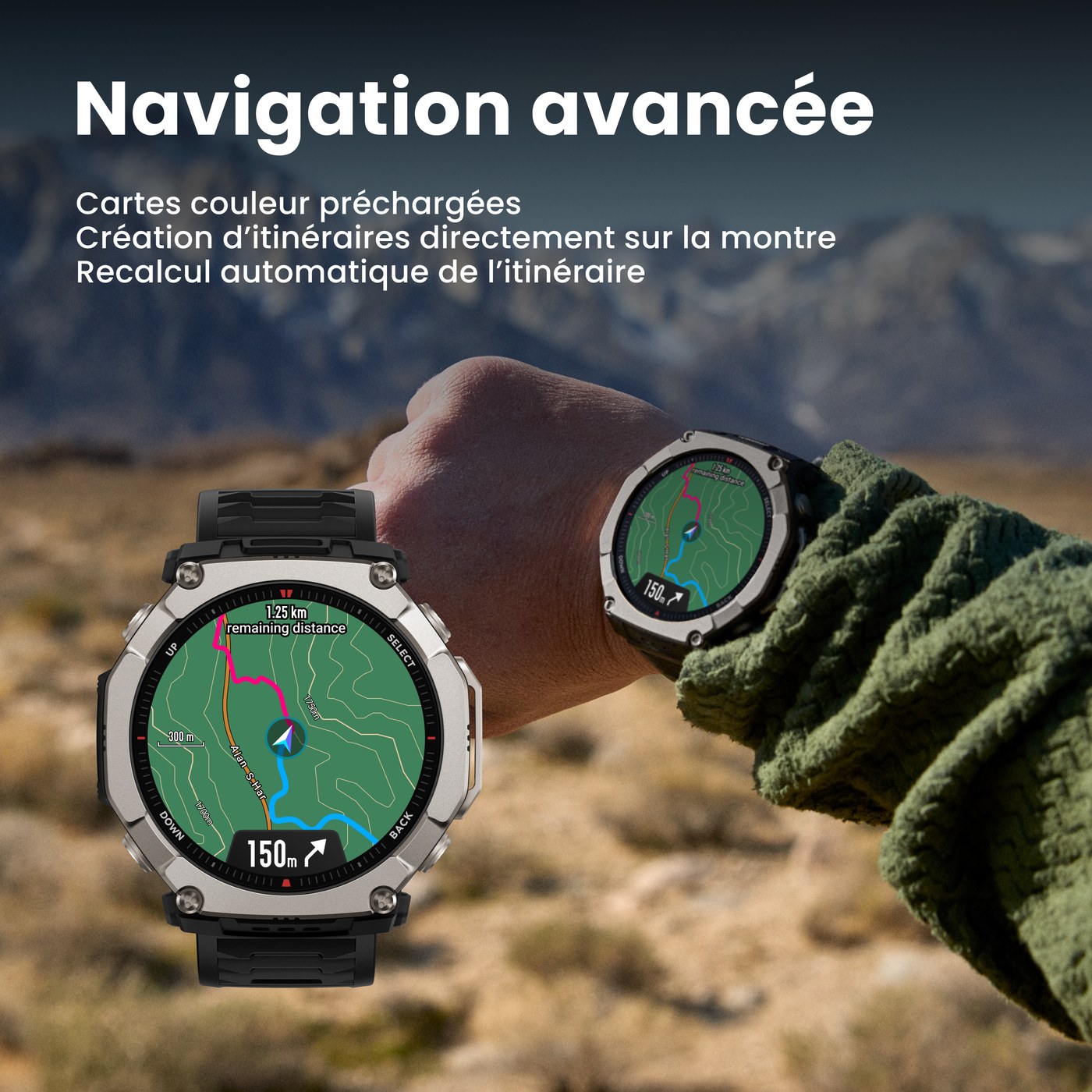
This is probably the T-Rex Ultra 2's most distinctive strength. Worldwide color maps come preinstalled from the factory: in the Zepp app, you simply select the regions you want to activate. Topographic maps (standard contour lines) are included. Detailed contour maps and ski resort maps are downloaded separately, at no extra cost.
Offline route planning is available up to 100 km, with automatic rerouting if you go off course. Points of interest (huts, summits, water sources) are accessible straight from the watch face with no phone connection. That's a level of functionality you usually find on €800-900 watches like the Garmin fenix 8.
The 64 GB of internal storage lets you load several map regions at once, plus a music library so you can run without your phone. On expeditions with no connectivity, that's a decisive advantage.
Training and recovery metrics
The T-Rex Ultra 2 covers the fundamentals: estimated VO2max, current form (BioCharge in the Amazfit ecosystem), weekly and monthly training load, and estimated lactate threshold. The data is clearly presented on the AMOLED display and in the Zepp app.
Where ZeppOS shows its limits against Garmin Connect or COROS Training Hub is depth of analysis. Garmin's Training Readiness, COROS's Volume and Load management, and Polar's recovery cycles are more mature and more actionable when you're planning a training week. ZeppOS provides useful indicators, but its recommendation algorithm remains basic.
On the plus side, the T-Rex Ultra 2 works with Stryd (running power meters), Komoot for route import and TrainingPeaks for plan tracking. If you manage your training through an outside coach or a dedicated app like RunMorph, this openness partly makes up for ZeppOS's shortcomings.
Real-world battery life: the numbers that change everything
Battery life is the T-Rex Ultra 2's knockout argument. In practice, the four main modes break down like this:
- Smartwatch mode: up to 30 days, with Bluetooth notifications on.
- High-accuracy GPS (multi-band): about 50 hours. This is the mode to use for technical trail races and mountaineering.
- Power-saving GPS: up to 90 hours, enough for multi-day traverses where you don't check the map constantly.
- Max battery mode: 177 hours, with a reduced GPS sampling rate. Ideal for multi-day expeditions where you just want to record your route.
There's also a dedicated low-temperature mode (operational down to -20°C) that delivers about 40 hours of battery life. The watch can be charged at temperatures as low as -10°C, which is rare in this category.
By comparison, the COROS Vertix 2S claims 140 h in UltraMax mode, and the fenix 8 Solar tops out at 86 h in power-saving GPS. The T-Rex Ultra 2 clearly wins this round.
T-Rex Ultra 2 vs the competition: head-to-head
| Watch | Price | Case | Multi-band GPS | High-accuracy GPS battery | Mapping | Weight |
|---|---|---|---|---|---|---|
| T-Rex Ultra 2 | €549.90 | Grade 5 titanium | Yes (6 systems) | 50 h | Offline color maps included | 86 g |
| Garmin fenix 8 | €899 | Titanium or steel | Yes | 57 h | TopoActive included | 73 g (47 mm) |
| COROS Vertix 2S | €699 | Titanium | Yes | 90 h | Offline color maps included | 73 g |
| Amazfit Cheetah 2 Ultra | €599 | Grade 5 titanium | Yes | 80 h | Offline maps included | 54 g |
The T-Rex Ultra 2 is the most affordable option in the premium outdoor segment with mapping. It outclasses the competition on extreme-temperature resistance and with its built-in flashlight. The Vertix 2S keeps the edge on weight and real-world GPS battery life. The fenix 8 remains unbeatable for ecosystem depth and training metrics. For runners who mainly want a rugged navigation watch without paying the Garmin premium, the T-Rex Ultra 2 is the best choice at this price.
How to fit it into your RunMorph training plan
The T-Rex Ultra 2 is first and foremost a watch for the outdoors. It fits best into a RunMorph plan during trail- and mountain-specific blocks: it gives you the elevation, grade-adjusted pace and GPS distance data you need to calibrate your efforts on long runs.
For quality sessions (intervals, threshold work), sync it with an external sensor (Stryd or a heart rate strap) to make your data more reliable. Exporting to TrainingPeaks or Strava lets you feed your training dashboard and stay in the RunMorph loop, even if you don't use the Zepp app as your main interface.
If you want a structured training plan that adapts to your level and your trail goals, check out the RunMorph training plans: they factor in the demands of elevation gain and can be calibrated with the data exported from your T-Rex Ultra 2.
RunMorph Coach verdict
The Amazfit T-Rex Ultra 2 is a hardware success. Amazfit has built a genuinely premium outdoor watch, with grade 5 titanium, a 3,000-nit AMOLED display, record battery life and offline mapping that stands up to €700-900 rivals. At €549.90, it's a serious, honest offer.
What holds it back from a higher score is the ZeppOS ecosystem. If you want to fine-tune your training from the watch, the coaching in Garmin Connect or COROS Training Hub offers a far deeper level of analysis. ZeppOS is improving, but the gap remains significant in 2026.
If you're a trail runner, mountaineer or ultra hiker, or if you regularly run in tough conditions, the T-Rex Ultra 2 deserves a serious look. If you're mainly a road runner looking for detailed training metrics, wait for the next ZeppOS version or take a look at the Garmin Forerunner 570.
RunMorph score: 7.5 / 10
Key takeaways for your training
- Exceptional outdoor hardware: grade 5 titanium, sapphire, 3,000-nit AMOLED, -30°C and 10 ATM for under €550.
- Benchmark battery life: 50 h in high-accuracy GPS, 177 h in max mode, 30 days as a smartwatch. The best in its segment at this price.
- Full offline mapping: worldwide color maps included, 64 GB of storage, offline route planning up to 100 km, automatic rerouting.
- ZeppOS needs work: training metrics (coaching, Training Status, recovery) are less advanced than on Garmin and COROS. Make up for it with TrainingPeaks and Stryd.
- Niche format: at 86 g and 52 mm, it's imposing. Ideal for long mountain adventures, less suited to everyday city running.