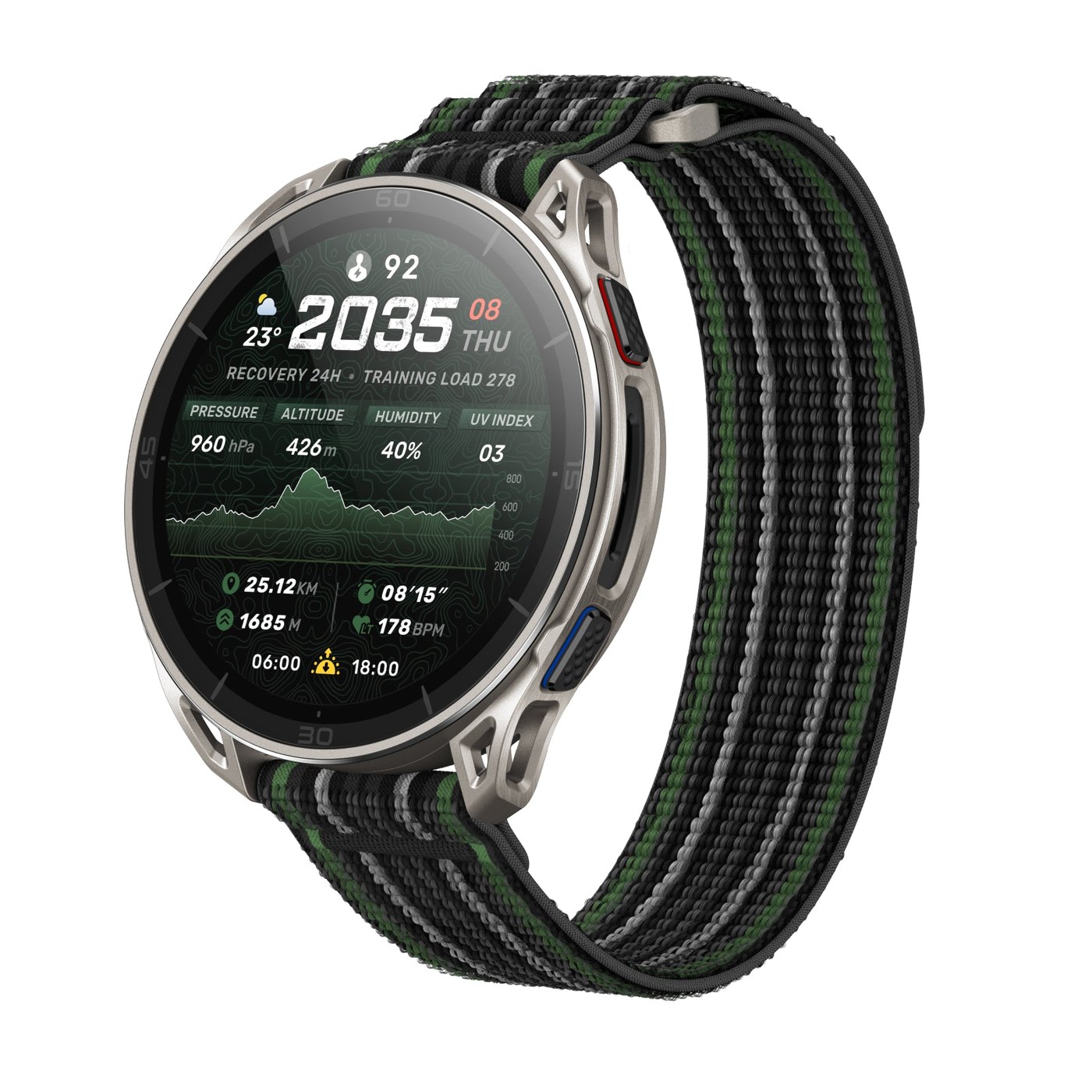
Amazfit unveiled the Cheetah 2 Ultra on May 13, 2026, and it reshuffles the high-end trail watch market. A 47 mm Grade 5 titanium case, sapphire glass, a 1.5-inch AMOLED at 3,000 nits, six-constellation multiband GPS, 60 hours of GPS battery life, 80 hours in endurance mode and worldwide offline topographic mapping, all for €599. At that price, you expect a copy of the Garmin Forerunner 970 or the Suunto Vertical 2. In reality, it beats expectations on battery life and falls a little short on pure accuracy. Full verdict below.
Amazfit Cheetah 2 Ultra Review: 80 h, Titanium and Maps for €599
8.5/10
Amazfit Cheetah 2 Ultra, the trail watch out to shake up the €600 segment
Amazfit has long been filed under "value-for-money Garmin killer". The Cheetah 2 Ultra changes the angle. This time, the brand goes openly premium: aerospace-grade titanium, sapphire, microphone and speaker, a two-color LED flashlight, worldwide offline mapping and L1+L5 multiband GNSS. On paper, you get the spec sheet of an €800 or €900 watch sold at €599. The May 13, 2026 retail launch (Amazfit France) lines up perfectly with the summer break for runners preparing for UTMB, CCC, the Trail des Templiers or the Diagonale des Fous.
RunMorph's read on its positioning is clear. The Cheetah 2 Ultra slots in between the Suunto Vertical 2 (€599, AMOLED expedition trail segment) and the COROS APEX 4 (€499.99, transflective trail segment). It squarely targets the runner who dreams of a Garmin Enduro but won't spend €1,200, and the triathlete and trail runner who wants one watch for the spring marathon and the summer 100 km.
RunMorph's tip. The Cheetah 2 Ultra is for you if you want a real 50 to 70 hours of battery life for your first or second ultra and refuse to give up mapping. If you mostly run on the road, marathon and half marathon, look instead at the COROS Pace Pro at €349 or the Garmin Forerunner 170 at €299.99. And if pure GPS accuracy is your number one criterion, the Garmin Forerunner 970 keeps the crown.
© Amazfit, official photo used for editorial purposes
Objective technical data
| Spec | Value |
|---|---|
| Brand | Amazfit |
| Model | Cheetah 2 Ultra |
| Official release | May 13, 2026 |
| Colorway tested | Titanium Grade 5 (green striped nylon strap + black silicone strap included) |
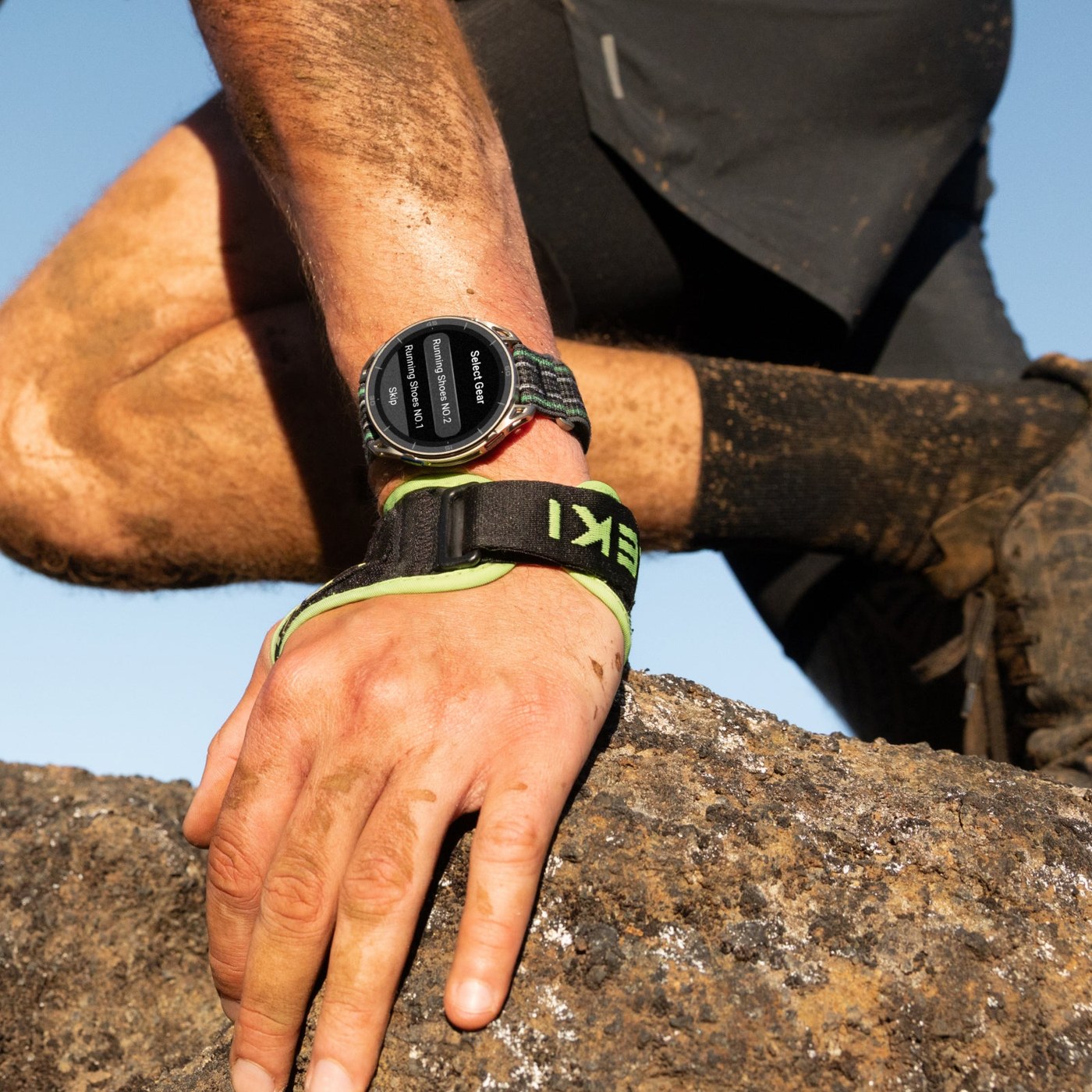
| Case | 47.4 mm, Grade 5 titanium (bezel, frame, caseback), titanium buttons |
| Thickness | 13.3 mm without heart rate sensor, 15.6 mm including sensor |
| Weight | 52 g without strap |
| Display | 1.5-inch AMOLED touchscreen, 480x480 px, up to 3,000 nits, scratch-resistant sapphire glass (44.8 mm active area) |
| Battery life (smartwatch) | Up to 30 days with typical daily use |
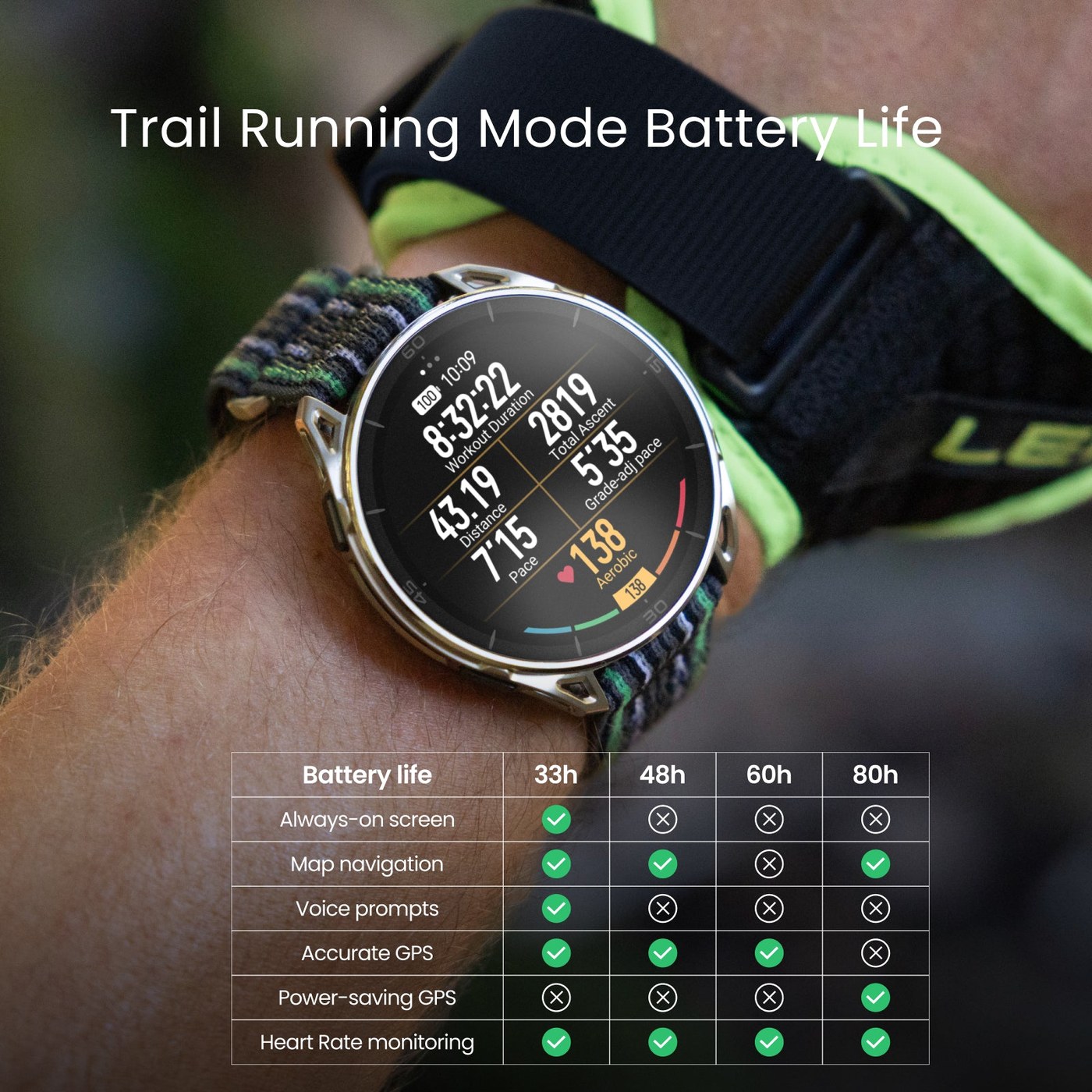
| GPS battery life | 60 h dual-band L1+L5 GPS / 33 h Trail Running mode with always-on display and mapping / 48 h standard GPS / 80 h ultra-trail endurance mode |
| GNSS | Dual-frequency multiband L1+L5, six systems (GPS, GLONASS, Galileo, BeiDou, QZSS, IRNSS), circularly polarized GPS antenna |
| Sensors | Next-generation BioTracker (optical heart rate, SpO2, stress, breathing), skin temperature, barometric altimeter, accelerometer, gyroscope, compass |
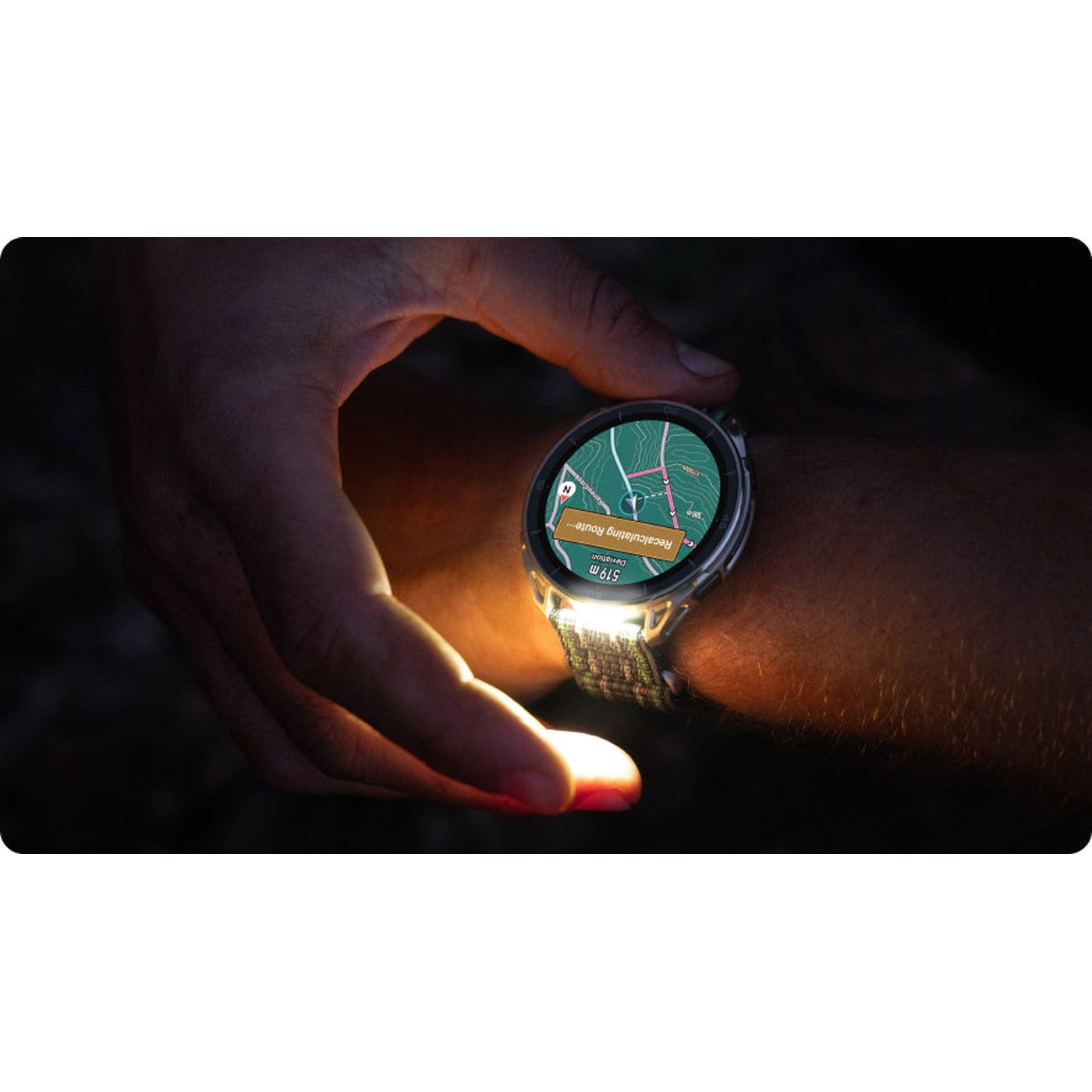
| Mapping | Worldwide offline color topographic maps, automatic rerouting, points of interest search, turn-by-turn navigation, loop planner, real-time slope assistant |
| Sport profiles | 180+ modes (dedicated Trail Running with load factor, HYROX, strength training, swimming, cycling, skiing, etc.) |
| Music storage | 64 GB (maps + local MP3, no Spotify or Deezer) |
| Contactless payment | Zepp Pay |
| LED flashlight | Two-color (white and red), Boost and SOS modes |
| Water resistance | 5 ATM (50 m static pressure) |
| Smartphone connectivity | Bluetooth 5.x, 2.4 GHz Wi-Fi, microphone and speaker, Bluetooth calls, Zepp Flow voice AI (iOS and Android) |
| Third-party Bluetooth sensors | Cycling power meters, chest straps, cadence sensors, air quality sensors |
| Official price in France | €599 (Amazfit France and partner retailers) |
Who is the Cheetah 2 Ultra for?
The ultra-distance trail runner preparing for a first 100 km or a first UTMB
This is its core target. The Cheetah 2 Ultra gives you 80 hours of battery life in endurance mode, more than enough to finish a Diagonale des Fous (165 km) or a UTMB (171 km) without touching the charger, while keeping decent GPS accuracy. Turn on the dedicated Trail Running mode and the watch calculates a load factor that accounts for gradient, terrain resistance and elevation gain, so the effort on screen finally reflects what your body goes through, not just your horizontal kilometers. The real-time slope assistant, comparable to ClimbPro, shows the current gradient, the remaining length of the climb and the profile ahead. No more digging the roadbook out of your pack.
The all-around road and trail runner who wants one watch
With 180+ sport profiles, including marathon, half marathon, 10K, cycling, pool swimming, HYROX and strength training with automatic recognition, the Cheetah 2 Ultra covers every session in your week. Worldwide offline mapping (64 GB of storage) lets you head off to a training camp in Font-Romeu, Tignes or the Canary Islands with zero prep. Download the area over Wi-Fi at home, and you can navigate even in a valley with no signal. For triathlon, dual-band accuracy follows you on the bike and in the pool, and you can pair a Bluetooth power meter for specific rides.
The runner fed up with Garmin and Apple prices
This is where Amazfit hurts. At €599, the Cheetah 2 Ultra offers a Grade 5 titanium case, sapphire glass, multiband GPS, worldwide offline mapping and 60 hours of continuous GPS. The Garmin Forerunner 970 asks €749 for better GPS accuracy (92% vs 85% in the independent 10-mile test). The Garmin Enduro 3 climbs to €1,199 to beat it on battery life. The Apple Watch Ultra 3 at €899 offers the iOS ecosystem and 5G, but tops out at 16 or 20 hours of continuous GPS, three to four times less. If you won't spend more than €600 but refuse to drop down a tier, the Cheetah 2 Ultra ticks the boxes.
© Amazfit, official photo used for editorial purposes
GPS accuracy and heart rate sensor
The trickiest topic. For GPS accuracy, the benchmark independent test (a standardized 10-mile test) puts the Cheetah 2 Ultra at 85%. That beats the Cheetah 2 Pro (73%) and ties the Amazfit T-Rex 3 and the Balance 2, but it trails the COROS APEX 4 at 88% and clearly trails the Garmin Forerunner 970 at 92%. Bottom line: on a flat marathon course or a long run in dense forest, you will spot small deviations in the track. On a high-mountain pass loop, the circularly polarized antenna and L1+L5 dual-band limit the damage, but Amazfit has not yet closed the gap with Garmin on this criterion. The honest verdict: the accuracy is good, but not the best in its segment.
The optical heart rate sensor, on the other hand, is a surprise. In the road bike sprint test (a high-variability effort, where every wrist sensor struggles), the Cheetah 2 Ultra stays within ±3 bpm limits of agreement. That's twice as good as the Fitbit Air (±6 bpm) on the same protocol. Against chest strap references (Garmin HRM 600, Polar H10) and armbands (Whoop MG, Polar Verity Sense), bias is close to zero. Same verdict in a HYROX simulation (variable intensity, pumping arms). For daily training, long runs and threshold work, you no longer need a chest strap. For very short intervals (200 m, 30/30) with fast arm changes, a chest strap is still recommended, as with any watch.
Mapping and navigation
The big one. Amazfit has caught up with and overtaken Suunto here, and now sits right behind Garmin. Maps are color topographic, offline and worldwide, and download directly to the watch over 2.4 GHz Wi-Fi. Pick your areas (Alps, Pyrenees, Cévennes, Massif Central, Corsica, Réunion) and store them on the 64 GB of onboard storage. Navigation offers automatic rerouting if you go off course, points of interest search (mountain huts, water fountains, parking lots) right on the watch through the offline maps, and real-time turn-by-turn guidance with vibrations and voice prompts.
The new feature that changes everything for runners: the loop planner. Choose a target distance (20 km, for example) and a starting direction, and the watch generates an optimized loop. Ideal when you show up at a training camp and want to explore without planning your run on Komoot. The slope assistant adds a real-time display of gradient, climb length and the profile ahead, which changes how you manage pace in the mountains. Overall, the Cheetah 2 Ultra moves Amazfit into the premium trail watch league for mapping. And that is its number one argument against the Suunto Vertical 2 at the same price.
Training and recovery metrics
BioCharge is the backbone of everyday Amazfit use, the equivalent of Garmin Body Battery or Polar Cardio Load. The score combines overnight HRV, sleep quality, SpO2 and breathing rate into a single readiness indicator, updated every morning. Paired with Training Load and Training Stress Balance, it shows you at a glance whether the day's hard session makes sense or whether you need to back off. Runners coming from Garmin will find their bearings in under a week.
On the running side, Amazfit has nailed the advanced metrics: VO₂ max with a multi-week trend, lactate threshold estimated from HRV and pace, wrist-based running power, vertical oscillation, stride length, cadence, and short- and long-term fatigue. Finish time predictions show up during your run (5K, 10K, half marathon, marathon). For trail, gradient-adjusted pace is the pivotal metric: it tells you your equivalent effort on flat ground, so you can manage your energy output without checking your heart rate every thirty seconds on a climb.
For recovery, RestoreIQ breaks down sleep stages, overnight HRV, breathing and even naps. One-Tap Measuring captures heart rate, stress, SpO2 and breathing simultaneously in 45 seconds. If you like to connect your data: automatic Strava sync, Komoot for routes, TrainingPeaks and Intervals.icu for plans, Runna for adaptive coaching. Zepp Coach, the in-house adaptive plan, covers 5K, 10K, half marathon and marathon, with weekly adjustments based on your actual load.
Real-world battery life
This is where Amazfit easily wins the €600 segment battle. Four GPS modes, ranked by the trade-off between accuracy and duration:
- Trail Running mode (33 h): always-on display, active mapping, multiband GPS and voice prompts, the mode for races where you look at your watch every minute. It is the killer mode for UTMB, the Trail des Templiers or the Diagonale des Fous.
- Dual-frequency multiband GPS (60 h): maximum Amazfit accuracy, always-on display off, maps available on demand. The everyday mode for most runners.
- Standard GPS (48 h): single-band, good enough in open terrain.
- Ultra endurance mode (80 h): spaced-out GPS fixes, maximum power saving. For multi-day events and expeditions.
In daily use (notifications, 24-hour heart rate, sleep, workouts 4 times a week), you get 18 to 22 real days depending on whether you turn on the always-on display, versus 30 claimed. That is still two to three times more than a Garmin Forerunner 970 and six to eight times more than an Apple Watch Ultra 3. The most rigorous independent test projected 55 hours of continuous multiband GPS (dual-band mode at full accuracy), which puts the Cheetah 2 Ultra ahead of the Garmin Forerunner 970 on this specific criterion. Charging uses a magnetic USB-C base (shipped without a cable, which you supply yourself, as part of a waste-reduction approach) and a full cycle takes under 90 minutes.
How it stacks up against the competition
Three direct rivals to pin down its positioning.
Against the Suunto Vertical 2 (€599, same price), the Cheetah 2 Ultra offers higher GPS battery life (60 h vs 65 h in Performance multiband, a close call) but above all 80 h in endurance mode (vs 110 h in Suunto Ultra mode, an edge for Suunto on multi-day events), comparable mapping, an LED flashlight that is also two-color, and a more accurate heart rate sensor. Suunto keeps the edge with its ecosystem of 300+ partners (Strava, Komoot, TrainingPeaks), ZoneSense, which no one else in the world offers, and its rotating crown. A draw on ergonomics, and an edge for Amazfit on premium features for the price.
Against the COROS APEX 4 (€499.99), the Cheetah 2 Ultra wins on the display (3000-nit AMOLED vs transflective MIP on the COROS), on mapping (color topographic vs COROS landscape maps) and on smart features (Zepp Pay, calls, voice AI). COROS wins on multiband battery life (65 h All Systems vs 60 h for the Amazfit), weight (52 g vs 52 g, a tie) and the daily EvoLab recap for running. The €100 price gap is justified on the Amazfit side if you value the AMOLED and full mapping.
Against the Garmin Forerunner 970 (€749), the Cheetah 2 Ultra loses on GPS accuracy (85% vs 92% in the independent 10-mile test), on the Connect ecosystem and on the depth of physiological analysis (Training Readiness, HRV Status, Garmin Coach). It wins on multiband GPS battery life (60 h vs 21 h for the FR970, a huge gap), on the two-color flashlight (red + white vs white only on the Garmin) and on price (€150 saved). Your choice depends on your top priority: accuracy and ecosystem with Garmin, battery life and value for money with Amazfit.
How to fit it into your RunMorph training plan
The Cheetah 2 Ultra fits naturally into RunMorph trail and ultra plans. Three points to set up.
First, gradient-adjusted pace. It is your new effort benchmark on climbs. When your RunMorph plan calls for a long run at marathon pace, go by adjusted pace, not raw pace. Hold 5:00/km adjusted rather than 6:30/km raw on a climb, and your real effort stays steady. You improve without blowing up the session on the first climb.
Next, Training Stress Balance and BioCharge. The RunMorph plan adjusts weekly load to how you are actually responding. The Cheetah 2 Ultra gives you two complementary signals: the balance between acute and chronic load (over 6 weeks), and the day's readiness (BioCharge). If BioCharge drops below 50/100 two days in a row after a big week, switch to an easy run and push the quality session back 48 hours.
Finally, Trail Running mode. Turn it on for every trail run from the first climb. The load calculation, which factors in gradient and terrain, lets you compare a 15 km session in the Vosges (1,200 m of elevation gain) with a 25 km flat session. RunMorph helps you calibrate your weekly volume based on this real load, not just the clock.
© Amazfit, official photo used for editorial purposes
RunMorph Coach verdict
The Cheetah 2 Ultra is the first Amazfit watch that truly earns the premium label and passes the RunMorph test for serious trail and ultra use. At €599, you get a Grade 5 titanium case, a 3000-nit sapphire AMOLED, worldwide offline mapping, 60 hours of multiband GPS, 80 hours in endurance mode, a two-color LED flashlight, a heart rate sensor accurate to ±3 bpm and a mature software ecosystem (Zepp Coach, Strava, TrainingPeaks, Runna, Komoot). It offers the best features-to-price ratio in the €500 to €800 segment as of June 2026.
The two honest caveats: pure GPS accuracy tops out at 85%, behind COROS and well behind Garmin in independent tests. And you have to accept leaving the Garmin or Apple ecosystem if that is what you are used to. If you want maximum battery life, full mapping and a sensible price, it is the smart buy right now.
RunMorph score: 8.5/10
Key takeaways for your training
- Turn on Trail Running mode from the first climb of every trail run: you get gradient-adjusted pace and the real-time slope assistant, both essential for managing your effort on long races.
- Download your maps over Wi-Fi before every training camp (Alps, Pyrenees, Massif Central, Corsica, Canary Islands, Madeira): with 64 GB onboard, you can load 5 to 10 areas without a problem.
- Manage your weekly load with BioCharge and Training Stress Balance: below 50/100 two days in a row, switch to easy runs and move your quality sessions.
- Turn off the always-on display on long races: you gain 27 hours of battery life (from 33 h to 60 h), enough for most ultras apart from UTMB and the Diagonale.
- Keep a chest strap for very short intervals (30/30, 200 m): the optical sensor is excellent but still imperfect on ultra-fast transitions, like any watch.