Garmin Forerunner 570 Review: Multiband AMOLED, but No Maps
7.5/10
✓Bright, sharp 1.4-inch AMOLED display, a real visual leap
✓Highly reliable dual-frequency multiband GPS, even in tough environments
✓Solid Elevate Gen 5 sensor for endurance work
✗No maps at all, a handicap as soon as you leave the road
Two years ago, choosing a Garmin running watch meant settling for a dull MIP display or breaking the bank for a fenix. The Forerunner 570 sweeps that compromise away: it brings a bright AMOLED display, multiband GPS and the latest-generation heart rate sensor in under the 600 euro mark. One question remains, and Garmin would rather nobody asked it too loudly: at 549 euros, with no maps and no ECG, does this mid-range watch really belong where it sits, squeezed between a little sister at 299 euros and a big sister at 749 euros?
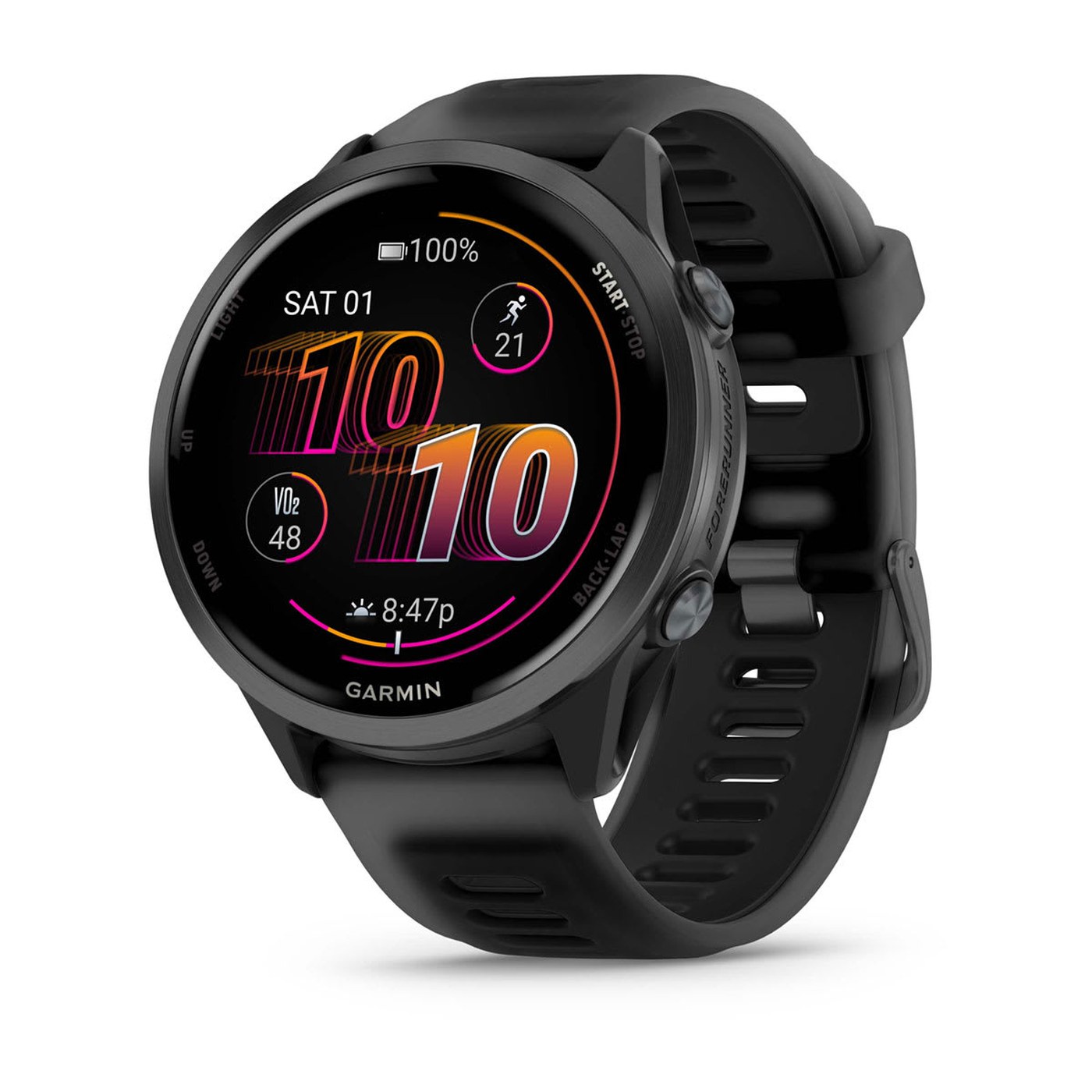
The Forerunner 570 is Garmin's mid-range AMOLED running and triathlon watch: bright display, SatIQ multiband GPS, Elevate Gen 5 sensor and an almost complete training suite. It targets regular runners and amateur triathletes who want serious metrics without moving up to a fenix or the Forerunner 970. The promise of an affordable premium AMOLED is kept, but the lack of maps and ECG at this price leaves it feeling unfinished.
7.5 / 10· RunMorph overall score
GPS accuracy8.5
Battery life7
Maps3
Metrics9
Value for money6
Who it is forRegular runners and amateur triathletes who want a bright AMOLED, reliable multiband GPS and real coaching without going up to 749 euros.
Who it is not forTrail runners who need topographic maps, or runners on a tight budget for whom the Forerunner 165 or the COROS Pace 4 is more than enough.
Garmin Forerunner 570: a tighter lineup strategy
To understand the 570, look at the 2025 overhaul of the Forerunner lineup. Garmin dropped the old 55 / 255 / 955 logic and replaced it with a clearer ladder: the Forerunner 70 and the Forerunner 170 as entry-level AMOLED models, the 570 in the middle, and the Forerunner 970 at the top. At RunMorph, we see one constant: each new Garmin generation pushes technologies once reserved for premium models down a notch. The 570 is the perfect example, since it inherits the Elevate Gen 5 sensor, multiband GPS and the microphone-plus-speaker combo that used to be exclusive to models above 700 euros. It directly replaces the Forerunner 265, the mid-range AMOLED benchmark of 2023.
The problem is that Garmin has also learned to segment with a scalpel. The 570 gets almost everything, except the two features that would push buyers toward the 970: color maps and ECG. That's no oversight, it's a deliberate commercial boundary. The 570 name suggests a complete watch, but its real positioning is that of a runner's AMOLED that deliberately leaves two boxes unticked to protect the high end. That is the whole question of this review: is what it offers enough to justify 549 euros?
Forerunner 570 specs: multiband AMOLED without the maps
The version we put through the RunMorph test bench is the 47 mm in Slate Gray with a black silicone band. It also comes in 42 mm for slim wrists, with a slightly smaller display and slightly shorter battery life.
Spec
Garmin Forerunner 570 (47 mm)
Release
May 2025 (on sale in France)
Case
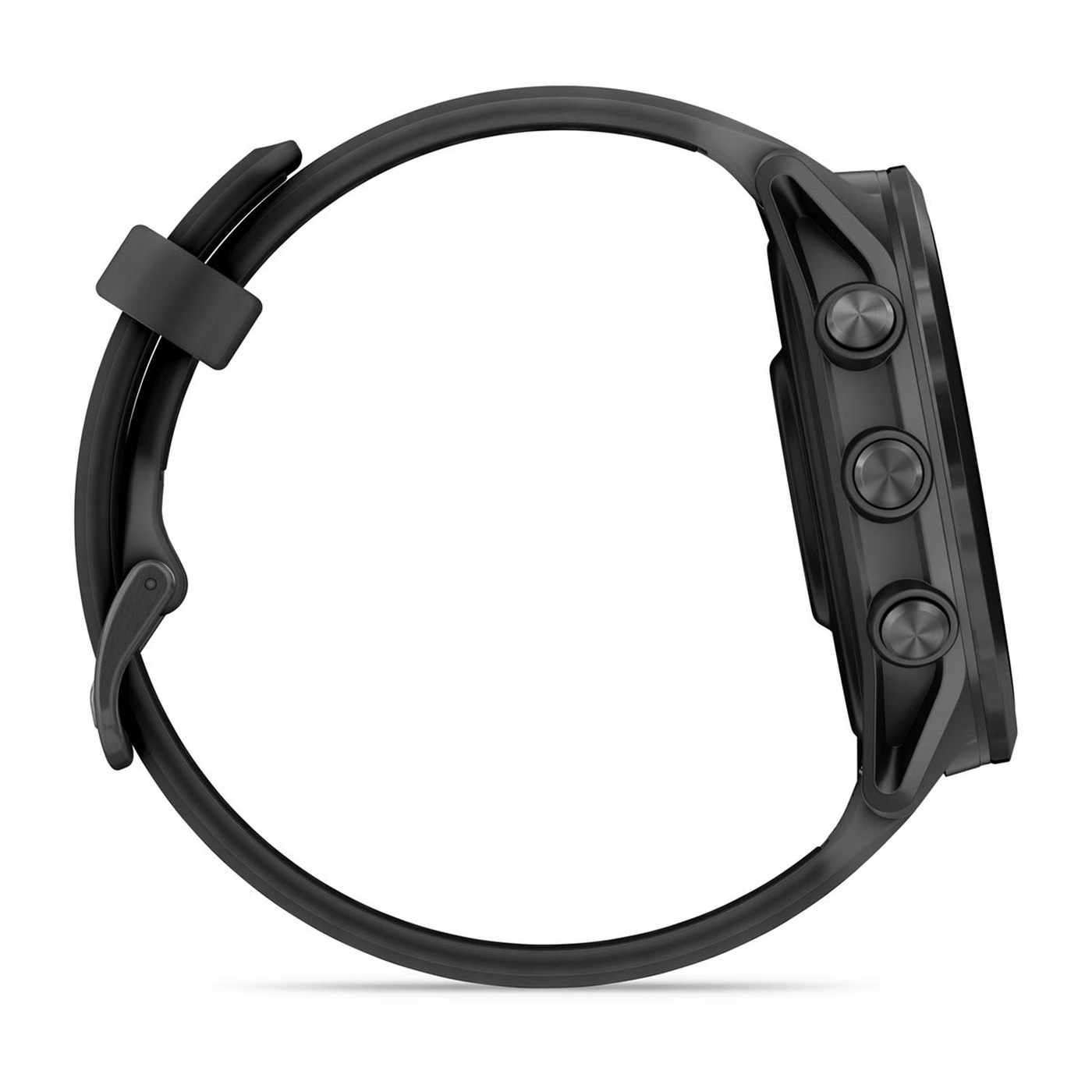
47 x 47 x 12.9 mm, aluminum bezel, reinforced polymer
Weight
50 g (47 mm) / 42 g (42 mm), band included
Display
1.4-inch AMOLED touchscreen, 454 x 454 px, Gorilla Glass 3 (1.2-inch 390 x 390 on the 42 mm)
GPS accuracy and heart rate sensor: how good are the tracks?
This is where the 570 performs best. The dual-frequency L1 plus L5 multiband GPS is the same hardware as on the 970, and SatIQ technology adjusts the satellite systems in use in real time to balance accuracy and battery life. In independent measurements and in our own use, the track stays clean in dense forest and along tall buildings, exactly where single-frequency watches start to zigzag. For a runner who lives by pace per kilometer, this is what matters most, and it holds up.
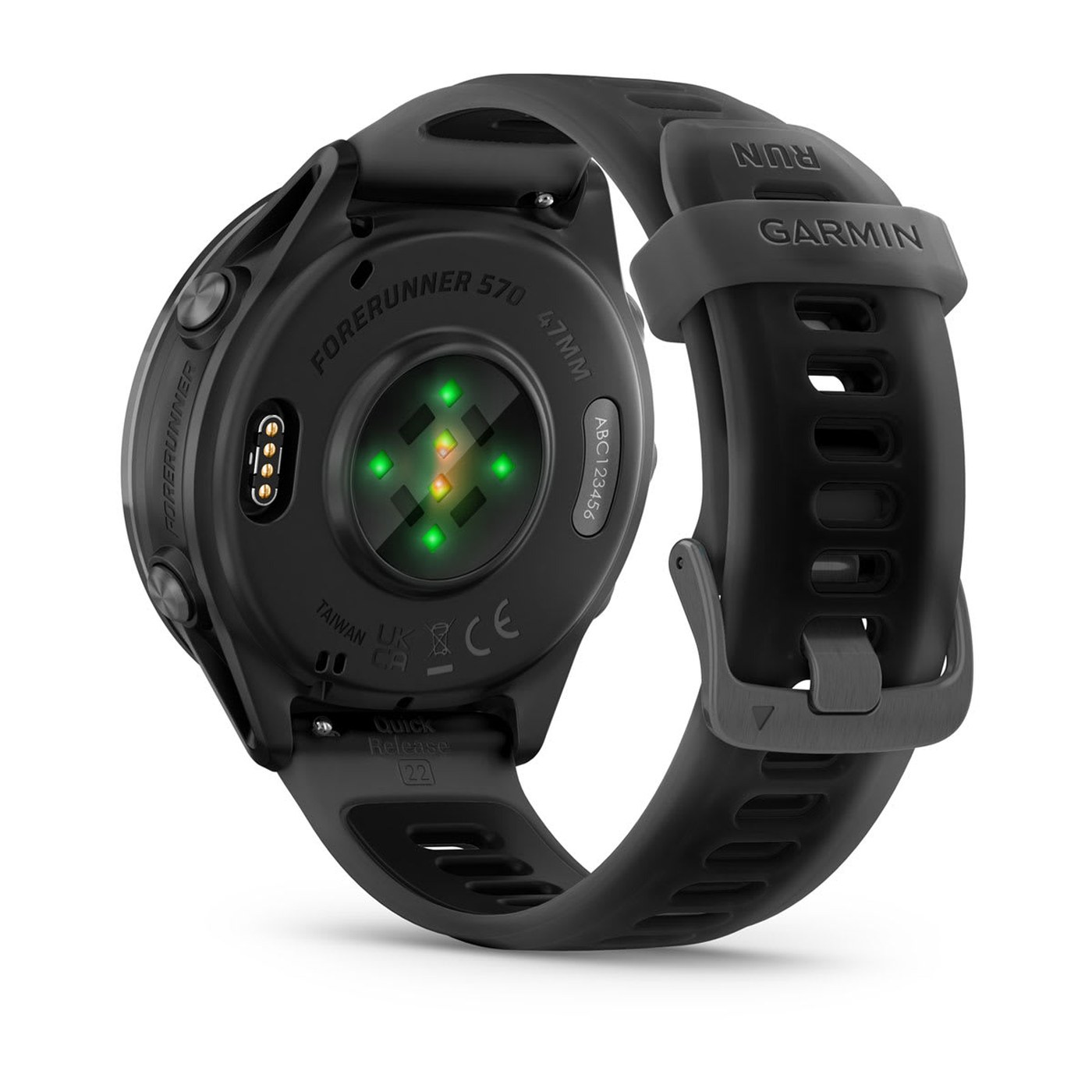
On heart rate, the Elevate Gen 5 is a real step up from previous generations. On endurance work and steady-pace runs, it tracks a chest strap to within a few beats. As always with a wrist sensor, short intervals and sharp changes of pace remain its weak spot: for precise MAS (maximal aerobic speed) or threshold work, a chest strap is still the right call. At RunMorph, we recommend pairing the 570 with an external sensor such as the Garmin HRM 600 or the COROS HR Monitor for sessions where every beat counts. One regret specific to the 570: unlike the 970, it has no ECG, so no on-demand heart rhythm reading.
No maps: the real issue with the Forerunner 570
Here is the paragraph Garmin would like you to skip. The 570 has no maps at all. No topographic map, no color base map, no turn-by-turn navigation on a map. It makes do with a breadcrumb trail (your route displayed as a line) and imported GPX routes, with a back-to-start function. For road and track running, that's no big deal: you rarely run a tempo session with a map in front of your eyes.
But as soon as you set foot on a trail, the lack of maps becomes a real handicap. Finding your way at a singletrack junction, deciding on the fly to extend a loop, checking you haven't missed a turn: all of that takes a map, and the 570 doesn't have one. At 549 euros, that's hard to accept when a COROS Pace Pro at 349 euros comes with free worldwide offline maps. It's the watch's most glaring limitation, and it alone explains why our maps score drops to 3 out of 10.
If maps are the weak point, the software suite is the strong point, and it's top-notch. The 570 packs almost the entire Garmin training ecosystem: Training Readiness (a score from 1 to 100 every morning to tell you whether your body is ready), HRV Status, Body Battery, sleep tracking with stages, VO2max, training load and status, daily suggested workouts, PacePro for pacing, and race time predictions. Running dynamics (cadence, stride length, ground contact time, vertical oscillation, wrist-based power) are measured directly, with no accessory.
A new feature that matters for triathletes: Garmin Triathlon Coach, a free adaptive plan that adjusts your swim, bike and run sessions based on your form and recovery. Add multisport mode with transitions, and the 570 becomes a true amateur triathlon watch, whereas the Forerunner 170 is limited to single-sport use. On this front, the 570 fully earns its 9 out of 10 for metrics.
RunMorph's advice. If you're torn between the 570 and the Forerunner 170 at 299 euros, ask yourself one question: do you do triathlon or multisport? If yes, the 570 earns its price with its transitions mode and Triathlon Coach. If you're a pure runner, the 170 gives you 90 percent of the metrics for 250 euros less. And if you can't do without maps, look instead at the COROS Pace Pro or the Forerunner 970.
Field test: from 4'00 to 6'00 per kilometer, on road and track
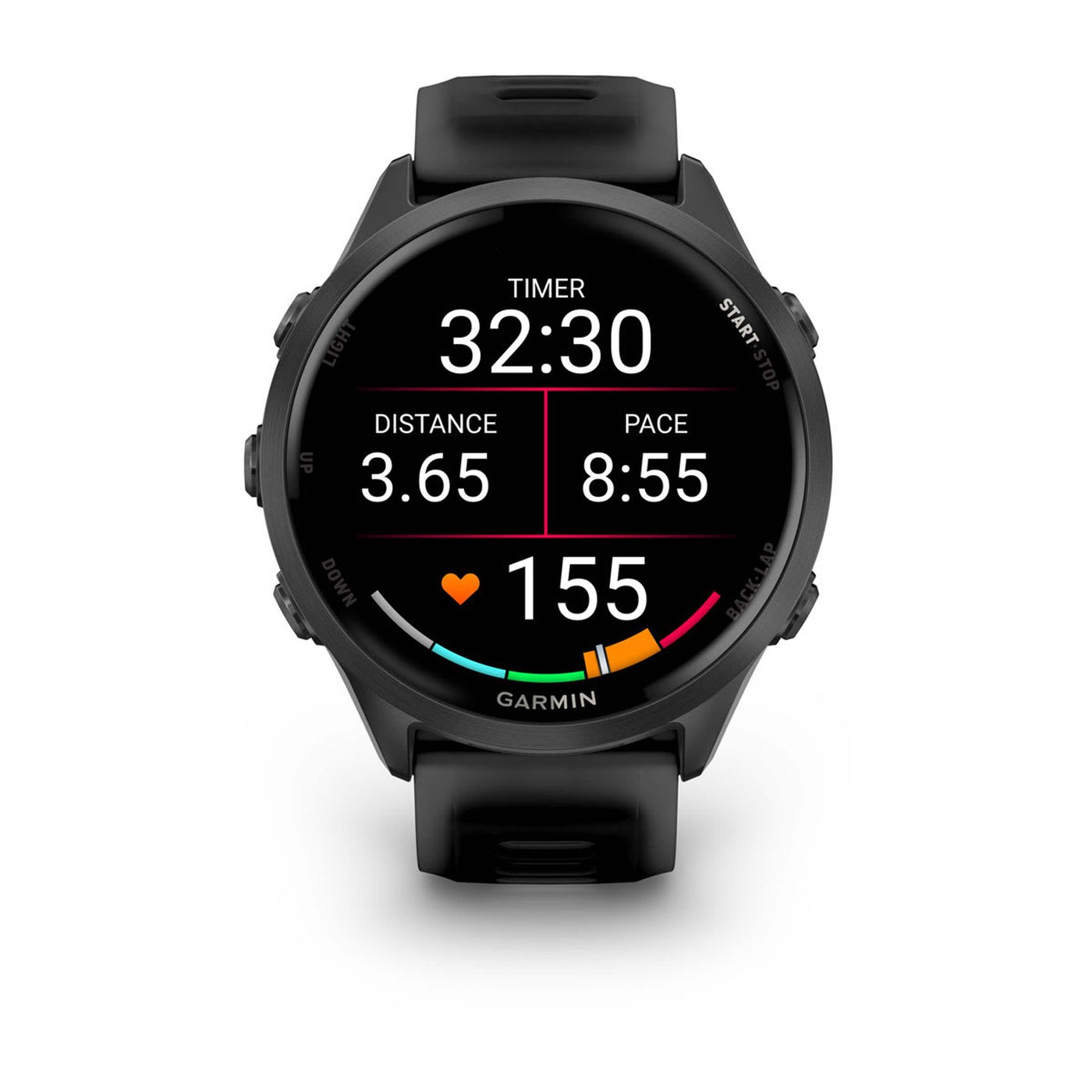
We ran the 570 through a training block mixing long runs at 5'30, tempo runs at 4'20 and track sessions at 4'00 per kilometer, plus a few bike and swim sessions to put multisport mode to the test. First takeaway: the 1.4-inch AMOLED display is a real pleasure. Bright in full sun, sharp, with an always-on mode that stays readable, it buries the era of dull MIP displays in this price range for good. At 50 g, the watch disappears on your wrist, even on runs of more than two hours.
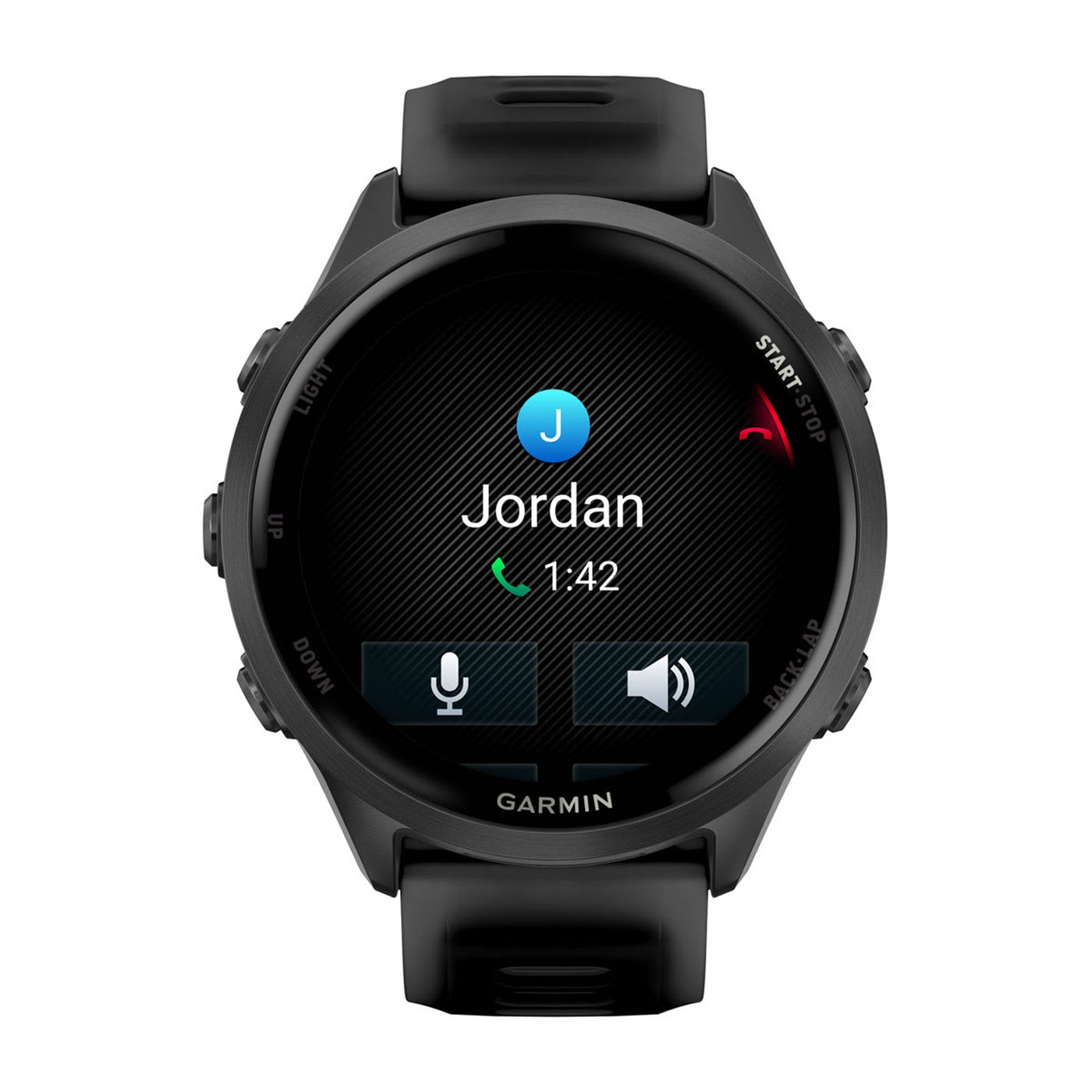
On the run, satellite acquisition is fast and the track is faithful. Track sessions are split cleanly and instant pace is stable. The microphone and speaker let you take a call relayed from your phone, a nice extra during recoveries. As for battery life, the 14 hours in multiband all-systems mode are decent without being exceptional: enough to cover a marathon or a long-distance triathlon, but ultra-trail runners will need to look elsewhere. In smartwatch use with one or two GPS sessions a week, you get through a full week without stress, around 8 to 10 days in practice.
What we liked less, beyond the missing maps: the price. At 549 euros, the 570 sits very close to the 599 euros of a Suunto Race 2, which does offer offline maps and longer battery life. The 570 is excellent, but its price puts it up against better-equipped rivals.
Forerunner 570 vs 170 vs 970 vs COROS Pace Pro: the comparison
To place the 570 fairly, you have to put it between its two Garmin sisters and against the rival that challenges it most on value.
Criterion
Forerunner 570
Forerunner 170
Forerunner 970
COROS Pace Pro
Price
549 euros
299 euros
749 euros
349 euros
Display
AMOLED 1.4"
AMOLED 1.2"
AMOLED 1.4" sapphire
AMOLED 1.3"
Multiband GPS
Yes
No (single frequency)
Yes
Yes
Maps
No
No
Yes (color)
Yes (free offline)
ECG
No
No
Yes
No
Triathlon / multisport
Yes
No
Yes
Yes
Multiband GPS battery life
~14 h
~19 h single freq.
~21 h
~31 h
The takeaway is clear. Over the 170, the 570 adds multiband GPS and multisport, which justifies the gap for a triathlete. Against the 970, it gives up maps, ECG and sapphire glass for 200 euros less. But it's the COROS Pace Pro that poses the most awkward problem: at 349 euros, it offers offline maps and better battery life than the 570 at 549 euros. Here, Garmin is selling the reliability of its ecosystem and its training suite, but a rational buyer will have to weigh that 200 euro gap carefully.
Bright, sharp 1.4-inch AMOLED display, a real visual leap
Highly reliable dual-frequency multiband GPS, even in tough environments
Solid Elevate Gen 5 sensor for endurance work
Almost complete training suite: Training Readiness, HRV, PacePro, Triathlon Coach
Multisport mode with transitions, a true amateur triathlon watch
Microphone, speaker, Garmin Pay and offline music
What we liked less
No maps at all, a handicap as soon as you leave the road
No ECG, unlike the 970
Average multiband GPS battery life (14 h)
A 549 euro price too close to better-equipped rivals
Gorilla Glass 3 rather than sapphire
Our verdict from the field: which runners is it for?
Regular road and track runners
This is the ideal target. If you log 30 to 60 km a week on road and track, you're aiming for a half marathon or a marathon and you never miss a map, the 570 gives you a superb display, reliable GPS and first-rate coaching. You get everything Garmin is known for without paying for the 970.
Amateur triathletes
Here the 570 makes a lot of sense. Multisport mode with transitions, pool and open-water swimming, cycling, free Garmin Triathlon Coach: enough to prepare seriously for a sprint, an Olympic or even a half-Ironman without moving up the range. This is the profile where it best justifies its price over the 170.
Occasional trail runners (with reservations)
The 570 handles runnable trails thanks to its multiband GPS, but the lack of maps rules it out as soon as the terrain gets complicated. If you mostly run trails, go for a watch with maps such as the Suunto Race 2 or the Forerunner 970.
Your watch measures, your plan makes you progress.
A Forerunner 570 on your wrist gives you the data (Training Readiness, paces, load). A RunMorph plan gives it meaning: sessions calibrated to how you feel on the day, progression toward your half marathon, your marathon or your first triathlon. Discover RunMorph training plans and turn your metrics into race times.
The Garmin Forerunner 570 is an excellent watch held back by its positioning. Technically, it does almost everything very well: the AMOLED is superb, the multiband GPS is reliable, the training suite is among the best on the market and triathlon mode makes it a genuine multisport watch. But Garmin deliberately removed maps and ECG to protect the 970, and left the price at 549 euros, very close to rivals that do offer maps. The result is a watch we recommend without hesitation to road runners and amateur triathletes who don't care about maps, and advise against as soon as the trail calls. A very good product, but a price point that keeps it from being an obvious choice. RunMorph score: 7.5/10.
Key takeaways for your training
1.4-inch AMOLED display and reliable multiband GPS: the 570 handles road, track and triathlon perfectly.
A top-flight training suite (Training Readiness, HRV, PacePro, Triathlon Coach) to steer your progress.
No maps: avoid it if you mostly run technical trails.
For precise interval work, pair it with a chest strap, since the wrist sensor shows its limits on short efforts.
At 549 euros, compare it with the Forerunner 170 (cheaper) and the COROS Pace Pro (maps included) before deciding.