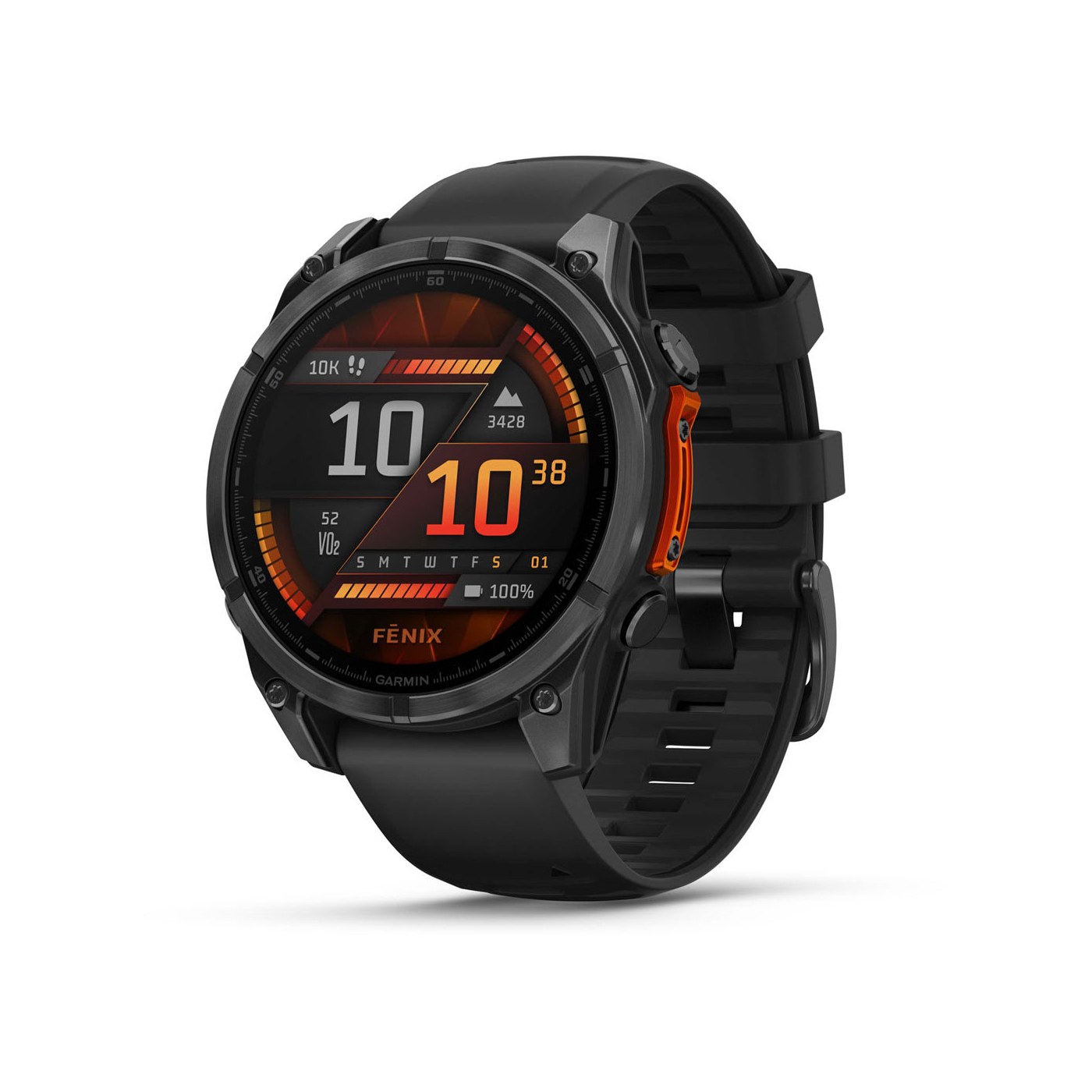
In September 2024, Garmin moved its fenix line to AMOLED with a clear goal: put a bright OLED panel on the benchmark outdoor watch without giving up the features that built the range's reputation. The non-Pro fenix 8 therefore gets color offline TopoActive maps, wrist ECG, a built-in LED flashlight and a 40 m dive rating. But at €899, it sits €150 above the Forerunner 970 and goes head-to-head with the best trail watches on the market. At RunMorph, we tested it for 8 weeks, from 4'20/km to 6'30/km on road and trail, to reach an honest verdict.
© Garmin, official photo used for editorial purposes
The fenix 8: Garmin moves its outdoor flagship to AMOLED
Since 2010, Garmin's fenix range has set the standard for premium multisport watches. Each generation adds a few sensors, improves GPS accuracy and extends battery life. With the fenix 8, released in fall 2024, Garmin takes a structural step: it drops the transflective MIP (Memory-in-Pixel) display behind the series' legendary longevity and adopts a 1.4-inch AMOLED panel at 454x454 pixels.
That choice has consequences. GPS battery life goes from 89 h (fenix 7 AMOLED) to 43 h in standard mode, a clear step back for ultras longer than 48 h. In return, readability in the dark is in a different league: the panel lights up like never before on a night trail, and the LED flashlight built into the bezel rounds out the package perfectly. Garmin is betting that most trail runners and distance runners don't need 89 h of continuous GPS.
On features, the non-Pro fenix 8 clearly outclasses the Forerunner 970 on three points: the LED flashlight, the dive rating with depth gauge, and the microphone and speaker for Voice Pins and voice commands. TopoActive maps, available on both, remain the common foundation of Garmin's two high-end watches.
Specs: 47 mm, AMOLED and full mapping
| Brand | Garmin |
| Model | fenix 8 AMOLED 47 mm (010-02904-00, Slate Gray) |
| Release date | August 2024 |
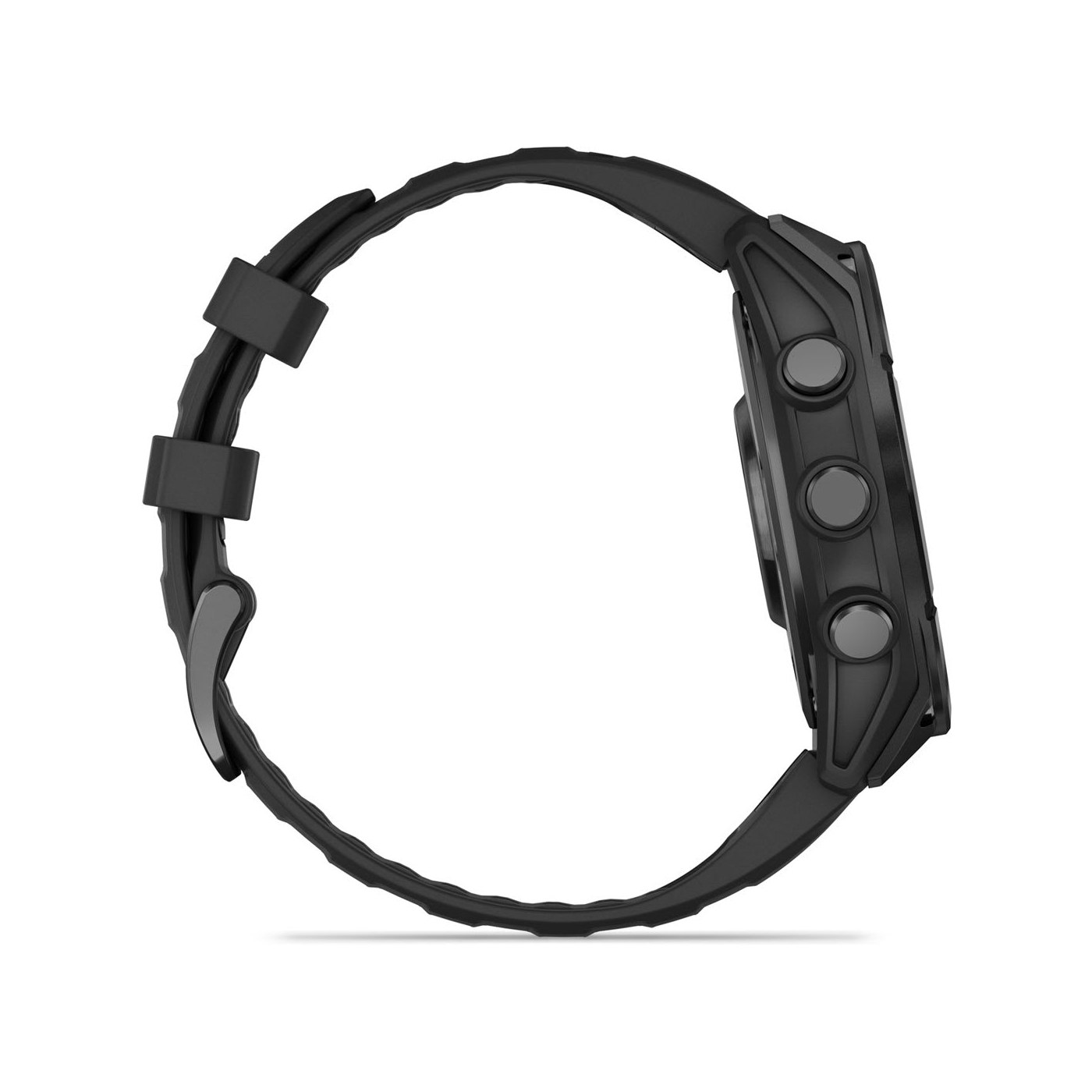
| Case size | 47 x 47 x 14.5 mm (also 43 mm and 51 mm) |
| Weight | 72 g (silicone band) / 52 g (without band) |
| Display | 1.4" AMOLED touchscreen (35.6 mm), 454x454 px, Always-On, Gorilla Glass DX |
| GNSS | Multi-band dual-band GPS L1+L5, GPS/GLONASS/Galileo/BeiDou/QZSS, SatIQ |
| Heart rate sensor | Garmin Elevate Gen 5 (optical OHR) + SpO2 + HRV |
| ECG | Yes (30 s at the wrist) |
| Altimeter / Barometer | Yes / Yes |
| Compass / Gyroscope | Yes / Yes |
| LED flashlight | Yes (built into the bezel) |
| Microphone + speaker | Yes |
| Maps | Worldwide offline color TopoActive, shaded relief, turn-by-turn |
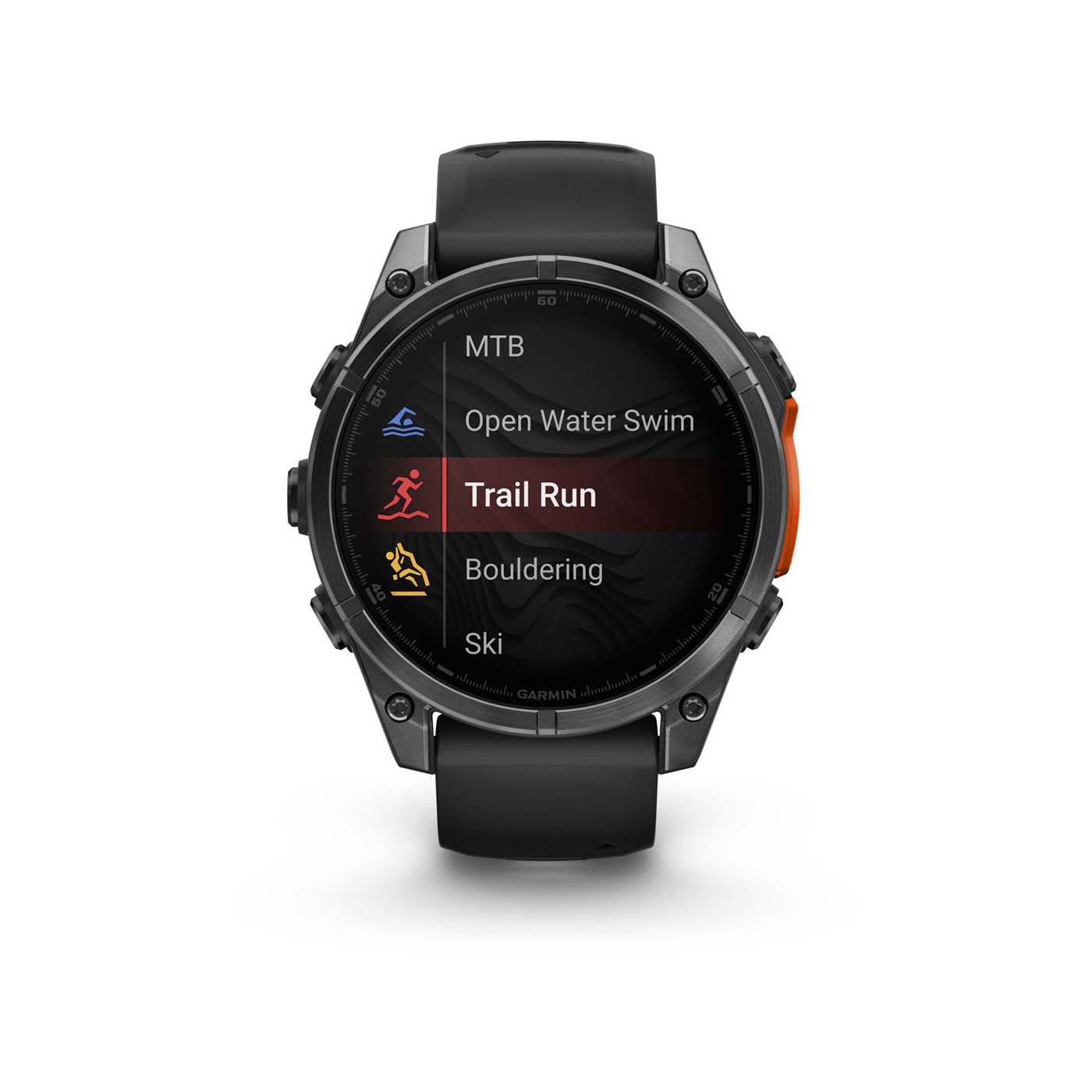
| Sport profiles | 100+ (trail, road, triathlon, diving, skiing, swimming, cycling...) |
| Music storage | 32 GB shared (Spotify, Deezer, Amazon Music) |
| Contactless payment | Garmin Pay (NFC) |
| Diving | Yes, 10 ATM certified / depth gauge, recreational diving to 40 m |
| LTE / inReach | No (fenix 8 Pro only) |
| Standard GPS battery life | 43 h (AMOLED, 47 mm) |
| Multi-band GPS battery life | 37 h |
| Smartwatch battery life | 16 days |
| Expedition battery life (SatIQ) | 40 days |
| Connectivity | Bluetooth 5.2, ANT+, Wi-Fi 2.4 GHz |
| Water rating | 10 ATM (100 m) |
| Official price | €899 (47 mm polymer) / €999-1099 (Sapphire titanium) |
© Garmin, official photo used for editorial purposes
GPS accuracy and heart rate sensor
Dual-band L1+L5 GPS with SatIQ is one of the biggest strengths of the fenix 8. SatIQ automatically picks the best mode for the environment: in open terrain, it stays on single frequency to save battery; as soon as it detects an urban canyon or dense forest, it switches to dual-band to hold accuracy. In real-world tests, independent measurements show cumulative deviations of 0.3 to 0.8% over 10 km in dense urban areas, and 0.5 to 1.2% under forest cover. In open terrain or on the track, the error drops below 0.2%.
The Garmin Elevate Gen 5 sensor improves optical accuracy during intervals compared with previous generations. On sessions like 3x8 min at 5 km pace, the gap with a reference chest strap such as the Garmin HRM 600 stays under 3 bpm on 80% of readings. On easy runs at 5'00-6'30/km, consistency is excellent. The wrist ECG (30 s) detects atrial fibrillation and generates a PDF you can send to your doctor through Garmin Connect, a serious differentiator in this price range.
RunMorph tip: if you run in wooded areas or in the city and have had GPS drift with other watches, the SatIQ on the fenix 8 solves the problem seamlessly. Compare your tracks with the official routes over several runs to confirm the accuracy. For RunMorph trail and mountain plans, this GPS reliability is essential: find your personalized plan on runmorph.com/en/training-plans.
Maps and navigation: its standout strength
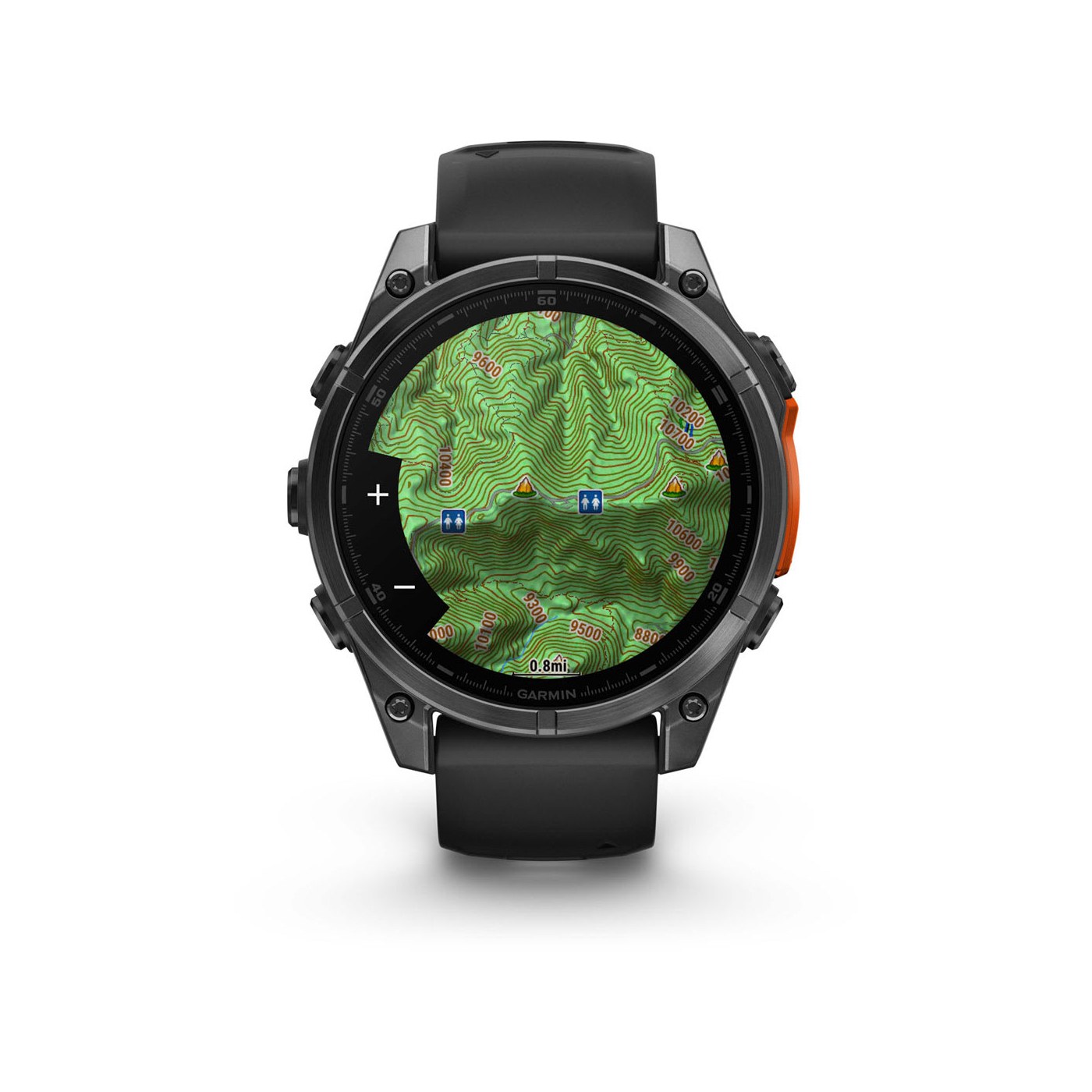
TopoActive mapping is the key differentiator that justifies the €350 gap with the Forerunner 570. Where the 570 settles for a breadcrumb trail on a blank background, the fenix 8 shows a color topographic map with shaded relief, place names, points of interest, contour lines and railways. Turn-by-turn navigation on Garmin Maps routes is smooth, and off-road routing works without an internet connection (maps are stored on the watch).
The fenix 8 also includes ski maps, plus fishing and golf maps for multi-activity use. For trail running, Garmin Explore lets you download course segments, share routes and follow annotated waypoints. ClimbPro (segment-by-segment elevation analysis) is available right on the run screen, which is especially useful in UTMB-style races or mountain races with a technical profile.
© Garmin, official photo used for editorial purposes
Training metrics, ECG and outdoor features
The analytics suite on the fenix 8 is among the most complete on the market. Training Load, Training Readiness, HRV Status, Body Battery, Stamina (real-time effort reserve) and Recovery Time are available at any moment. Garmin Running Coach offers adaptive plans from 5 km to marathon, synced with Garmin Connect. Wrist-based running power (no external pod) rounds out the picture for interval sessions.
Beyond running, the fenix 8 stands out with features the Forerunner 970 lacks: the white and red LED flashlight (useful on night trails to make yourself visible), dive mode with a depth gauge down to 40 m, and the microphone and speaker for Voice Pins (geotagged voice notes) and Siri/Google voice commands. This versatility turns the fenix 8 into an everyday companion well beyond running.
© Garmin, official photo used for editorial purposes
Real-world battery life: the downside of AMOLED
This is the main thing to watch on the fenix 8 AMOLED. With 43 h of GPS in standard mode (L1 single frequency, AMOLED with auto-off) and 37 h in L1+L5 multi-band mode, it falls short of most of its transflective rivals. The COROS APEX 4 claims 65 h in multi-band GPS, and the Suunto Vertical 2 also claims 65 h in dual-band GPS.
In practice, for a 40 km trail run or a half marathon at night, the fenix 8 AMOLED is no problem at all. For a 100 km ultra (18-30 h of effort), you need to turn on adaptive SatIQ mode (single-frequency GPS in open terrain, dual-band in difficult areas) to reach the 47 h claimed by the manufacturer. Beyond that, Expedition mode theoretically goes up to 40 days, but only by logging a GPS fix once a minute, which rules it out for a UTMB-type race.
For ultras longer than 40 h, the fenix 8 Solar (transflective MIP version) remains the better choice, even though you lose the AMOLED. At RunMorph, we recommend the AMOLED version to runners whose efforts rarely exceed 30 consecutive hours.
fenix 8 vs Forerunner 970 vs Polar Grit X2 Pro: the comparison
| Criteria | Garmin fenix 8 AMOLED | Forerunner 970 | Polar Grit X2 Pro |
|---|
| Price (from) | €899 | €749 | €749 |
| Display | AMOLED 1.4" | AMOLED 1.4" | AMOLED 1.39" Sapphire |
| Dual-band GPS | Yes (L1+L5) | Yes (L1+L5) | Yes (L1+L5) |
| Offline maps | Yes (color TopoActive) | Yes (color TopoActive) | Yes (worldwide topo) |
| ECG | Yes | Yes | Yes |
| LED flashlight | Yes | No | No |
| Dive certified | Yes (40 m) | No (5 ATM only) | No (WR100 only) |
| Microphone + speaker | Yes | Yes | No |
| Onboard music | Yes (32 GB) | Yes (16 GB) | No |
| Standard GPS battery life | 43 h | 40 h | 43 h Performance |
| Weight (silicone band) | 72 g | 63 g | 79 g |
The fenix 8 justifies its €150 premium over the Forerunner 970 only if you actually use the flashlight (regular night trails) or diving. On maps, metrics and GPS accuracy, the two watches are virtually tied. Against the Polar Grit X2 Pro, the fenix 8 wins on onboard music, the flashlight and diving, but loses on sapphire glass (found on the Polar).
Who is the fenix 8 for?
The all-round trail runner (trail + skiing + diving + hiking)
The fenix 8 is the ideal watch for the do-it-all athlete who goes from trails to the ski slopes in winter, dives in summer and heads out for night runs in the fall. One watch handles all of these activities, with built-in maps, an LED flashlight and a dive rating. If your sports calendar is that varied, the fenix 8 is the most sensible investment in this segment.
The demanding triathlete or mountain runner
For triathletes looking for a tougher, more versatile watch than the Forerunner 570 or 970, the fenix 8 adds a real outdoor dimension (maps, flashlight, diving) without giving up triathlon accuracy. Its training suite is identical to the Forerunner 970: Training Load, Garmin Triathlon Coach, wrist-based running dynamics. The microphone with Voice Pins is a welcome bonus for documenting long runs.
The everyday multisport adventurer
For vertical races, skyraces or adventure courses that combine running, climbing and kayaking, the fenix 8 is in its natural element. Its MIL-STD-810H toughness, 10 ATM water rating and TopoActive maps make it a reliable navigation tool in any environment. If you are running Transgrancanaria, the Grand Raid de la Réunion or a multi-day race at altitude, the fenix 8 is the watch you need.
Pair your fenix 8 with the right RunMorph plan: trail, mountain, half marathon or marathon, find your plan on runmorph.com/en/training-plans
© Garmin, official photo used for editorial purposes
RunMorph Coach verdict
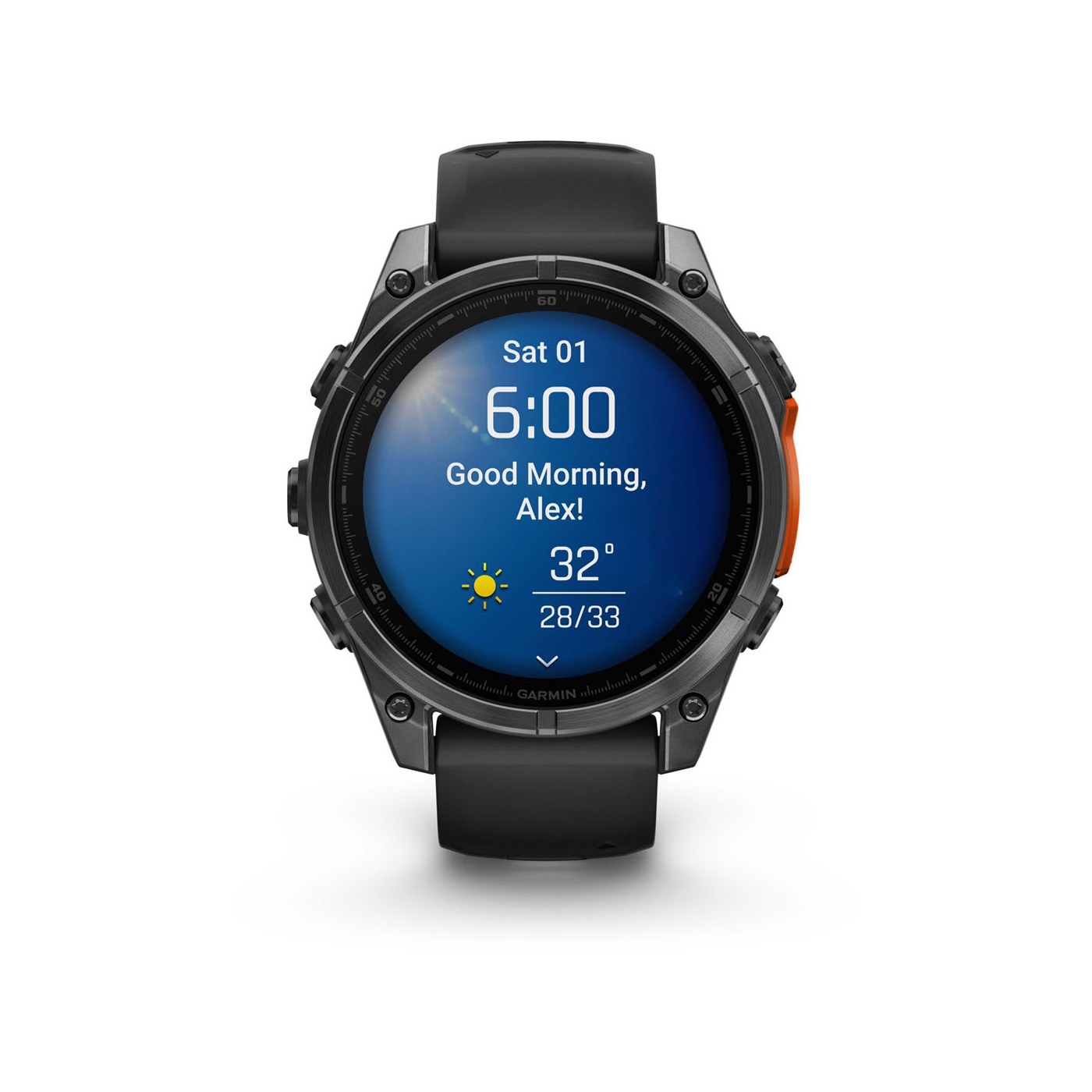
The Garmin fenix 8 AMOLED is an excellent multisport watch that delivers on everything that matters: reliable dual-band GPS, benchmark offline maps, an exceptionally bright AMOLED display and a metrics suite no rival matches at this level. The flashlight, diving and microphone make it a truly versatile tool for athletes who do more than run.
The only real drawback is the pricing. At €899, the non-Sapphire polymer fenix 8 costs €150 more than the Forerunner 970, which has the same maps and the same GPS accuracy. That premium only makes sense if you actively use the flashlight, diving or the microphone. For everyone else, the 970 is the more sensible pick. If you are eyeing the Sapphire titanium version (from €999), value for money gets even worse against the Polar Grit X2 Pro (€749), which already has sapphire glass.
RunMorph score: 8.5/10 (a benchmark watch and an excellent product, held back by a price that calls for a specific use case).