Garmin puts the hands back at the center of the dial. The Instinct Crossover AMOLED pairs a real analog movement with an always-on color screen, a built-in flashlight and multi-band GPS, in a case built to MIL-STD-810 military standards. At RunMorph, the test settles one point fast: there is not a single map in sight, for 599.99 euros.
Garmin Instinct Crossover AMOLED: mechanical hands and an AMOLED screen at 599 euros, but no mapping
7.2/10
- AMOLED screen readable at dawn, dusk, in the rain and in bright sun
- Mechanical hands that actually work and double as an animated compass
- Precise multi-band GPS, judged superior to a fenix 8 on some difficult sections
- No mapping at all
The essentials in 3 sentences
The Instinct Crossover AMOLED pairs mechanical hands with an AMOLED screen that stays readable in any condition, a built-in flashlight and precise multi-band GPS. At RunMorph, the field test found real-world GPS battery life well below the advertised figures and no mapping at all, which puts it in the short hike and marked trail category rather than long-range navigation. At 599.99 euros, it brushes against the price of some entry-level fenix watches, which do carry maps.
7,2
/ 10 · RunMorph overall score
Who is it for?Hybrid-watch fans who want real hands AND a color screen, for short hikes, marked trail runs and rugged everyday outdoor use.
Who should skip it?Trail runners who navigate by map on long, self-sufficient outings, and tight budgets: the Instinct 2 costs less for comparable GPS features.
Garmin Instinct Crossover AMOLED: the Instinct line finally leaves black and white behind
Since 2022, the Crossover has been Garmin's most unusual bet in its outdoor lineup: a ring of mechanical hands sitting on top of a digital screen, showing the time like a classic watch while keeping the functions of a connected one. The 2022 version was limited to a monochrome MIP screen. Three years on, Garmin moves the concept to AMOLED, 390 x 390 pixels, protected by sapphire glass. The change is not just cosmetic: it repositions the Crossover against pricier hybrids (Garmin charges 599.99 euros, 699.99 euros for the Tactical Edition) while cutting into the battery life that built its reputation.
At RunMorph, the field-test angle is easy to state: Garmin is selling a rugged hiking and outdoor watch here, not a long-range navigation watch. The hands are appealing, so is the AMOLED screen, but the mapping box stays empty, and real-world GPS battery life falls well short of the segment's expedition standards.
RunMorph's advice: if you want a hybrid watch for running and hiking without ever needing complex navigation, the Crossover AMOLED gets the job done. If you want full maps for self-sufficient trips, look instead at the Garmin fenix 8 or the Enduro 3.
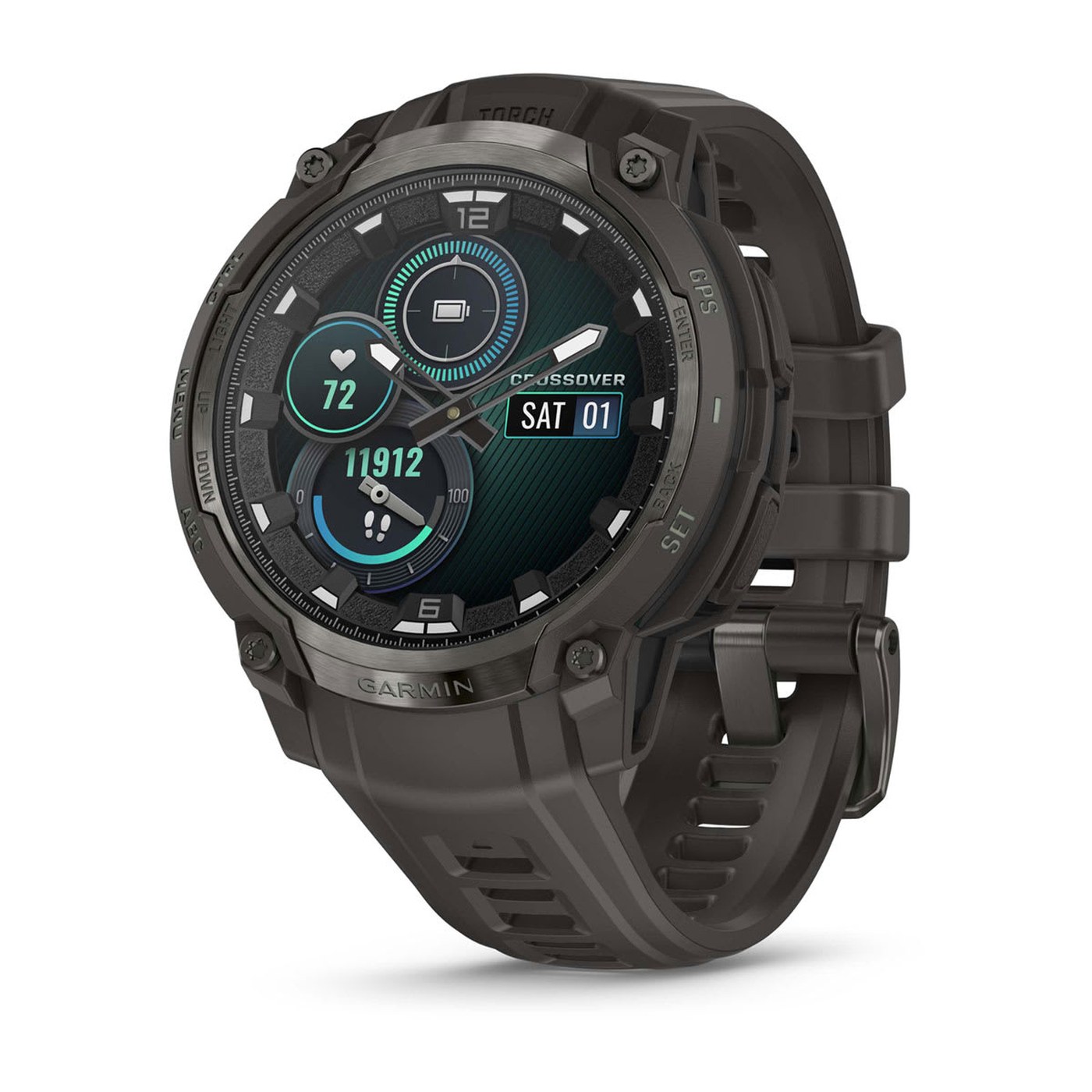
© Garmin, official photo used for editorial purposes
Objective technical data
| Specification | Garmin Instinct Crossover AMOLED |
|---|---|
| Release | September 17, 2025 (France) |
| Case | 46.6 x 46.6 x 15.1 mm, fiber-reinforced polymer, double-layer stainless steel bezel |
| Weight | 67 g |
| Screen | Always-on AMOLED, 1.2 inch (30 mm), 390 x 390 px, sapphire glass, Super-LumiNova hands |
| Hand mechanism | RevoDrive, self-calibrating after impact |
| Battery life (smartwatch mode) | 14 days standard / 5 days always-on display / 18 days battery saver |
| GPS battery life | 29 h single-frequency / 18 h all systems / 15 h multi-band / 53 h max battery GPS / 12 days expedition (UltraTrac) |
| GNSS | GPS, GLONASS, Galileo, dual-frequency multi-band with SatIQ |
| Sensors | Elevate optical heart rate (4th generation), SpO2, barometric altimeter, 3-axis compass, gyroscope, thermometer, ambient light sensor |
| Mapping | None, navigation limited to TracBack and the compass |
| Sport profiles | 80 plus, including Rucking |
| Music storage | None, 4 GB of internal memory reserved for activity data |
| Contactless payment | Garmin Pay |
| Water rating | 10 ATM |
| Connectivity | Bluetooth, ANT+, no Wi-Fi |
| Light | Built-in LED flashlight, red night mode |
| Price | 599.99 € (gray or bronze), 699.99 € for the Tactical Edition (black) |
Who is the Instinct Crossover AMOLED for?
The occasional hiker and trail runner
The hand-driven compass, the barometric altimeter and the flashlight cover most of a day-long outing on a marked trail. With no mapping, it suits someone who already knows the route or is following marked signage, not someone improvising in unfamiliar terrain.
The road runner who wants a hybrid piece for everyday wear
The multi-band GPS and the Elevate sensor are enough to follow a standard training plan, from easy runs to intervals. A runner who also wants a watch that looks good off the track gets a trade-off that purely sport-focused watches do not offer.
The rugged outdoor enthusiast
Hunting, fishing, mountain trips, outdoor job sites: the MIL-STD-810 rating, 10 ATM water resistance and built-in flashlight target a use case broader than running, in keeping with the historic Instinct line.
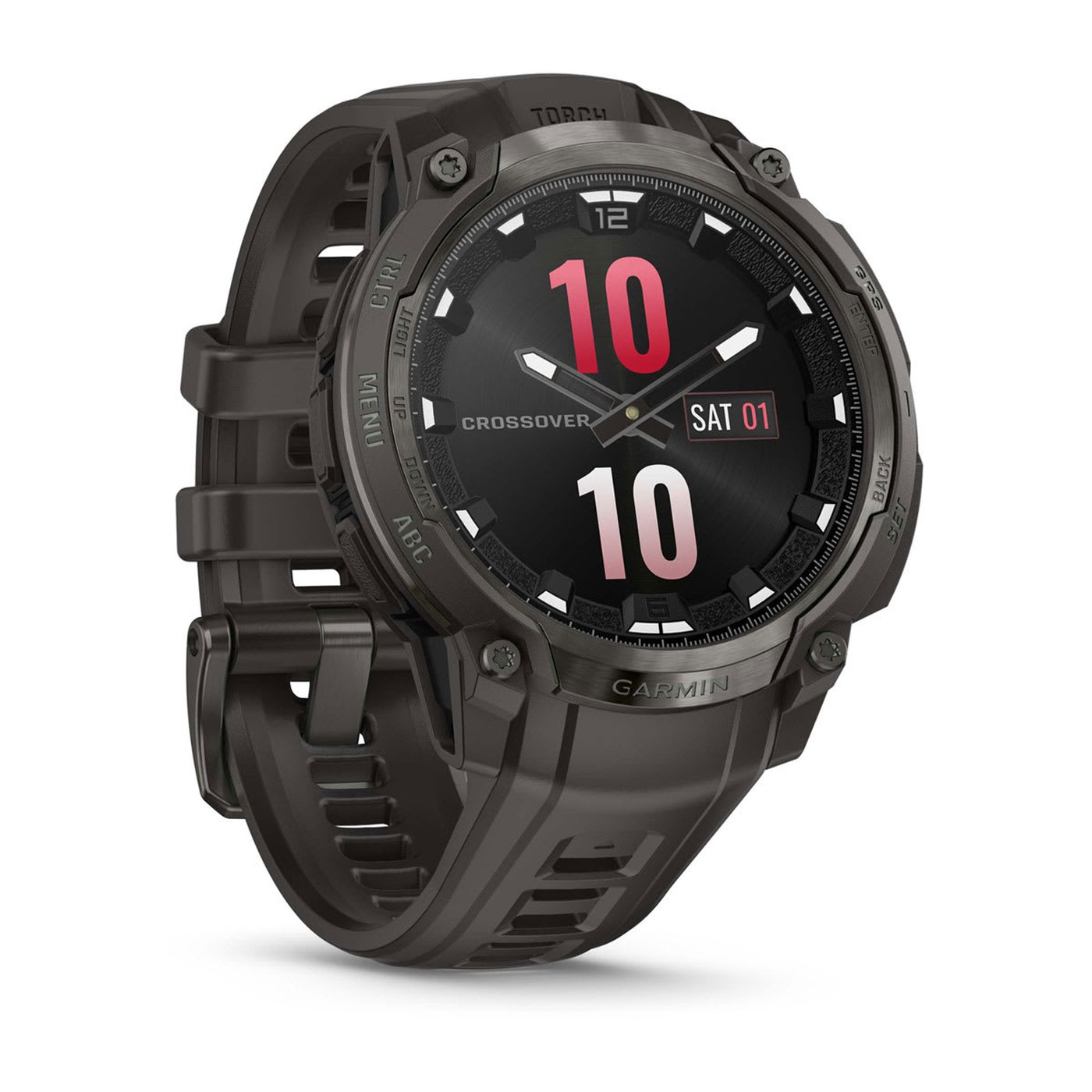
© Garmin, official photo used for editorial purposes
GPS accuracy and heart rate sensor
The multi-band GNSS with SatIQ is the best-scoring point of the test. On a multi-day comparative trial in difficult terrain (a low-tide crossing, 30 km days in remote areas), the Crossover AMOLED's GPS track stayed tight, comparing favorably with a fenix 8 and a Suunto Vertical 2 on the same sections. Satellite lock was fast, including under heavy tree cover.
On the heart rate side, the onboard Elevate sensor is still the 4th generation Garmin sensor, not the 5th generation fitted to the fenix 8. Checked against a chest strap during interval sessions, tracking stayed in sync beat for beat, with a one to three second lag when heart rate dropped after an effort, typical behavior for an optical sensor. No significant dropouts were recorded.
Mapping and navigation: the gap that matters
Unlike the fenix 8 or the Enduro, the Instinct Crossover AMOLED carries no preloaded maps. Navigation is limited to TracBack, the electronic compass and the barometric altimeter. On a multi-day route through remote terrain, the tester had to rely on another watch for fine-grained orientation. For a runner sticking to known loops or official signage, the limit does not show. For anyone wanting to read a full route on their wrist, it is a dealbreaker, and no software update fixes this: it is a product positioning choice, not a bug.
Training and recovery metrics
The Crossover AMOLED inherits the Instinct 3 software suite: training status, training load, Body Battery, Sleep Coach and nap detection. Sleep tracking was judged consistent with how the tester actually felt over a multi-night trial, and the Body Battery score matched the fatigue felt after the longest days. These metrics are identical to those on the rest of the Instinct 3 lineup, the AMOLED screen and the hands change nothing in this software base.
Real battery life: the gap between the claim and the field
This is the most critical point of the test. Garmin claims 14 days in standard smartwatch mode and up to 12 days in GPS expedition mode (low-frequency UltraTrac). On a five-day field test with multi-band GPS active (a 70-mile hike), the battery dropped from 100% to 53% after the first day of roughly seven hours of walking, then to 11% after a second day of eight hours. Overnight loss, outside activity, came to about 4% per night, and each active day used between 4 and 5% per hour of active GPS. In total, the watch logged 31 hours of GPS tracking over five days, with two partial recharges in between.
For direct comparison on the same route, a Suunto Vertical 2 needed no recharge at all over the five days and still had about 50% battery left at the end. The gap comes down to the always-on AMOLED screen, far more power-hungry than the Vertical 2's transflective display, and to the drop from 28 days of standard battery life on the original Crossover to 14 days on this AMOLED version. For a day hike or a weekend trip, the battery life is plenty. For a multi-day expedition with no recharge, UltraTrac mode becomes mandatory, at the cost of much less precise GPS tracking.
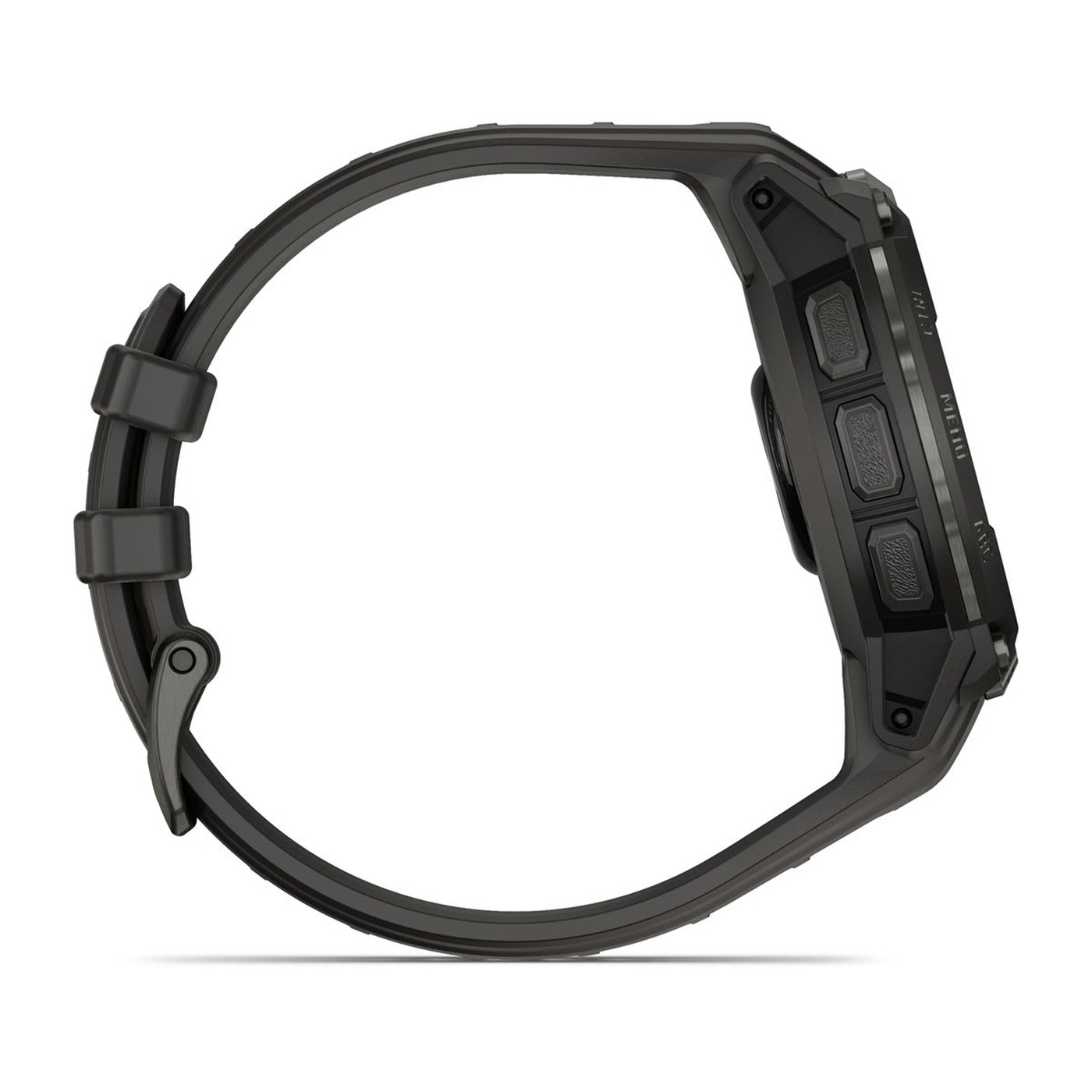
© Garmin, official photo used for editorial purposes
Garmin Instinct Crossover AMOLED vs Garmin Instinct 2 vs Garmin fenix 8: the comparison
| Criterion | Instinct Crossover AMOLED | Instinct 2 | fenix 8 |
|---|---|---|---|
| Screen | AMOLED + hands | Monochrome MIP | AMOLED |
| Mapping | None | None | Full TopoActive |
| Smartwatch battery life | 14 days | 28 days | Up to 29 days (AMOLED) |
| Heart rate sensor | Elevate Gen 4 | Elevate Gen 4 | Elevate Gen 5 |
| Price | 599.99 € | About 300 € | From 899 € |
The simple reading: anyone who just wants a tough, affordable Instinct and does not care about hands stays with the Instinct 2, cheaper for comparable GPS features. Anyone who needs full maps and a newer heart rate sensor should upgrade to the fenix 8, even if it costs 300 euros more. The Crossover AMOLED sits in a niche between the two: it charges a premium for the hands and the AMOLED screen without the mapping that would really justify the price gap with the fenix 8.
Pros and cons
Pros
- AMOLED screen readable at dawn, dusk, in the rain and in bright sun
- Mechanical hands that actually work and double as an animated compass
- Precise multi-band GPS, judged superior to a fenix 8 on some difficult sections
- Built-in LED flashlight, good enough as backup to a headlamp on a night trail run
- Reliable heart rate sensor, in sync with a chest strap
Cons
- No mapping at all
- Real GPS battery life of about 31 hours cumulated over five days of hiking, far from the segment's expedition standards
- Time hidden during an activity, as the hands move to 9 and 3 o'clock to clear the screen
- Five flat buttons with no real tactile feedback, hard to identify in the dark
- No music storage
How to fit it into your RunMorph training plan
On a RunMorph trail plan, the Crossover AMOLED works well for long runs on marked or already-familiar routes, where the multi-band GPS and altimeter are enough to track pace and elevation. For a training block that includes scouting unfamiliar terrain with map navigation, plan for a backup (paper map, smartphone app) or switch to a watch with built-in mapping. Check out a RunMorph trail plan suited to this kind of outing.
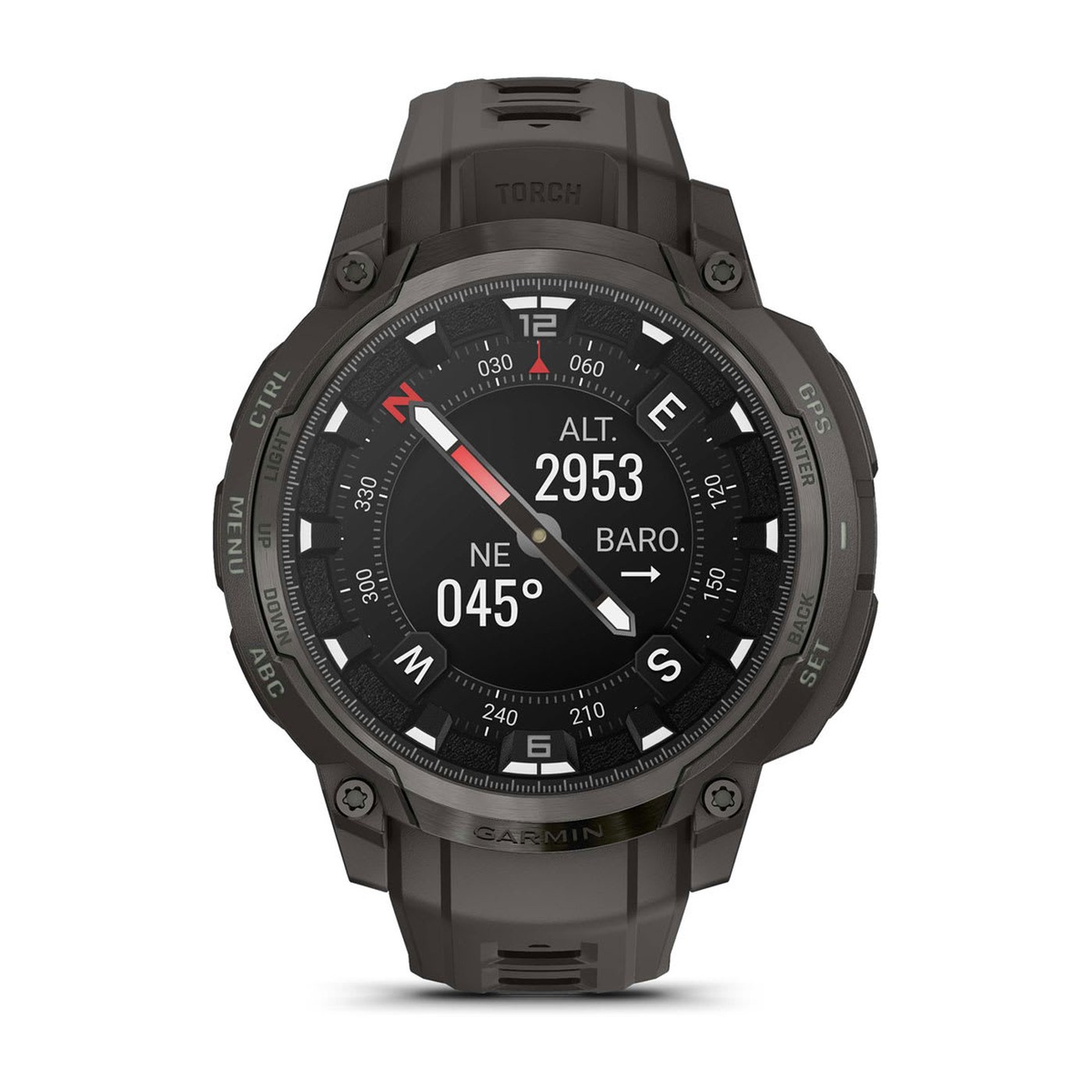
© Garmin, official photo used for editorial purposes
RunMorph Coach's verdict
The Instinct Crossover AMOLED pulls off its technical bet: a color screen readable in any condition, hands that actually work, precise multi-band GPS. At RunMorph, the overall score of 7.2/10 reflects a product that is consistent in what it does, penalized for what it does not do. The lack of mapping and real GPS battery life under 35 hours cumulated over five days of demanding terrain put it in the marked-trail and hiking watch category, not the expedition one. At 599.99 euros, it costs almost as much as an entry-level fenix 8 without offering its maps.
What to remember for your training
- Precise multi-band GPS, confirmed in a multi-day comparative test against a fenix 8 and a Suunto Vertical 2
- Real GPS battery life of about 31 hours cumulated over five days of active hiking, worth planning around before a long outing with no recharge
- No mapping at all: plan for a backup for any navigation in unfamiliar terrain
- Reliable Elevate Gen 4 heart rate sensor for intervals and zone tracking
- Price of 599.99 euros worth comparing to an entry-level fenix 8 before buying